

on August 05, 2026

For most women, the best collagen supplement is a hydrolyzed collagen peptide powder delivering 5–10 g per serving daily. Here are the top picks by goal:
- Best overall / skin elasticity: From Within — Collagen Peptides Glow Booster — patented Wellnex® peptides, full ingredient transparency, targeted delivery
- Best widely available powder: Vital Proteins Collagen Peptides — unflavored, mixes cleanly, a higher dose per serving
- Best for joints: Ancient Nutrition Multi Collagen Protein — multi-type formula covering types I, II, III, and more
- Best gummy format: Nature Made Collagen Gummies — accessible, third-party tested, lower dose
- Best marine option: Correxiko Marine Collagen Powder — type I marine collagen, clean ingredient list
- Best budget pick: NeoCell Super Collagen Peptides — low cost per serving, types I and III
Collagen is a structural protein, not an instant fix. Clinical research shows that measurable skin improvements typically appear after 8–12 weeks of consistent daily use. Set that expectation now, and the rest of this guide will make a lot more sense.
| Product | Best for | Type | Form | Dose/serving | Price/serving (approx.) |
|---|---|---|---|---|---|
| From Within — Collagen Peptides Glow Booster | Skin elasticity, perimenopause | I (Wellnex®) | Powder | 5–10 g | $$ |
| Vital Proteins Collagen Peptides | Overall daily use | I, III (bovine) | Powder | 20 g | $ |
| Ancient Nutrition Multi Collagen Protein | Joints, multi-tissue | I, II, III, V, X | Powder | 10 g | $$ |
| Thorne Collagen Plus | Skin + joint combo | I, III | Powder | 10 g | $$$ |
| Sports Research Biotin-Infused Collagen Peptides Complex with Hyaluronic Acid | Skin + hair + nails | I, III (bovine) | Powder | — | $$ |
| Nature Made Collagen Gummies | Convenience, beginners | I, III | Gummy | — | $ |
| Correxiko Marine Collagen Powder | Marine preference | I (marine) | Powder | 10 g | $$$ |
| NeoCell Super Collagen Peptides | Budget | I, III (bovine) | Powder | 6 g | $ |
| Orgain Collagen Peptides | Protein + collagen combo | I, III | Powder | 20 g | $ |
| Nature’s Truth Beauty Collagen Types 1 + 3 | Capsule preference | I, III | Capsule | 3 g | $ |
| Absolute Collagen Marine Collagen Supplement Drink | On-the-go liquid | I (marine) | Liquid sachet | 8 g | $$$ |
TL;DR:
- For most women: From Within — Collagen Peptides Glow Booster (patented peptides, 5–10 g daily, transparent formula)
- For women in perimenopause or menopause: prioritize a clinically studied peptide formula at the higher end of the 5–10 g range, since estrogen decline accelerates collagen loss
Table of Contents
- What are the best collagen supplements for women right now?
- How do you choose the right collagen for your goals?
- What do collagen types and sources actually mean for your skin and joints?
- How much collagen should you take, and when will you see results?
- Are there side effects or interactions you should know about?
- How do you know if a collagen product is actually good quality?
- How we selected these picks
- What’s the final verdict by reader profile?
- Key Takeaways
- Why targeted peptides matter more than most brands admit
- Fromwithin’s Collagen Peptides Glow Booster is worth a closer look
- Useful sources
What are the best collagen supplements for women right now?
The products below cover the range of goals, budgets, and form preferences most women are shopping for. Each entry highlights what makes it worth considering and where it fits best.
From Within — Collagen Peptides Glow Booster uses Wellnex® patented peptides, a bioactive peptide technology designed for targeted delivery to skin tissue. The formula is transparent about every ingredient, which matters when you’re comparing products that often hide behind vague “collagen blend” labels. It’s the pick for women who want a clinically minded formula focused on skin elasticity and structural support, including those navigating perimenopause.
Vital Proteins Collagen Peptides is the most widely recognized collagen powder in the US market. It delivers 20 g of bovine-sourced types I and III per serving, mixes into coffee or smoothies without clumping, and costs well under $1.50 per serving at most retailers. No frills, no patented peptide complex, but a solid daily driver for women who want a clean, unflavored option at scale.

Thorne Collagen Plus and Sports Research Biotin-Infused Collagen Peptides Complex with Hyaluronic Acid both take a combination approach. Thorne pairs types I and III collagen with additional nutrients for a skin-and-joint formula. Sports Research adds biotin and hyaluronic acid to its bovine peptide base, which makes it a practical choice for women focused on hair, nails, and skin together. Vitamin C and hyaluronic acid commonly appear alongside collagen because they support endogenous collagen synthesis and may amplify peptide effectiveness.
Ancient Nutrition Multi Collagen Protein covers types I, II, III, V, and X from multiple sources (bovine, chicken, fish, eggshell membrane). If joint support is your primary goal, the inclusion of type II collagen from chicken cartilage is a meaningful differentiator. It’s one of the few widely available powders that genuinely addresses cartilage-specific needs alongside skin.
NeoCell Super Collagen Peptides delivers types I and III at a low cost per serving, making it the go-to budget recommendation. The dose per serving is lower than clinical trial benchmarks, so you may need to adjust serving size to hit 5–10 g daily.
Orgain Collagen Peptides blends collagen with organic plant protein, which suits women who want a higher overall protein intake alongside their collagen dose. At 20 g per serving, it’s one of the higher-dose options at its price point.
Nature Made Collagen Gummies are third-party tested and widely available at drugstores. The dose per serving is lower than powders, so they work best for women who want a simple daily habit rather than a clinical-dose protocol.
Nature’s Truth Beauty Collagen Types 1 + 3 comes in capsule form, which suits women who dislike powders or travel frequently. The per-serving dose is modest, so it’s better suited to maintenance than to addressing an acute deficiency.
Absolute Collagen Marine Collagen Supplement Drink delivers 8 g of marine type I collagen per liquid sachet, making it one of the more convenient high-dose marine options. Editorial testing consistently favors powders and high-strength liquid sachets for delivering clinical doses without requiring multiple capsules or gummies.
Correxiko Marine Collagen Powder is a clean marine type I option for women who prefer fish-sourced collagen or have a sensitivity to bovine products. The ingredient list is short and the dose per serving is competitive.
Innermost The Glow (unflavored sachets), Shreddy Superglow Collagen Powder, Hunter & Gather Rise & Glow collagen daily beauty tonic, Ancient and Brave cacao and collagen, JSHealth Vitality X + Collagen Nourish + Glow, ESN Collagen Peptides, More Nutrition More Skin Glow, VitaBright Bovine Collagen Powder, Doctor Seaweed Collagen+, NaturePlus Collagen Peptides, and Vital Proteins cocoa flavoured bovine collagen round out the market. These are primarily UK and European products. If you’re shopping in the US, availability varies; check current import listings before purchasing. Several of these, particularly Innermost The Glow and Ancient and Brave, have strong followings for their flavor profiles and clean formulas.
Statistic callout: Clinical trials supporting collagen supplementation for skin outcomes typically use daily doses of 5–10 g of hydrolyzed peptides, with measurable improvements in skin hydration and elasticity appearing at 8–12 weeks of consistent use.
How do you choose the right collagen for your goals?
The right collagen for you depends on what you’re trying to support, your life stage, and a few practical factors. Here’s a step-by-step checklist.
-
Start with your primary goal. Skin elasticity and hydration call for type I hydrolyzed peptides. Joint and cartilage support benefits from type II (often from chicken). Bone health and overall connective tissue support lean on types I and III together. If you want to cover multiple areas, a multi-collagen formula makes sense.
-
Check that it’s hydrolyzed. Look for “hydrolyzed collagen,” “collagen peptides,” or “collagen hydrolysate” on the label. Hydrolysis breaks collagen into smaller molecules that absorb more efficiently into the bloodstream, which is why this form is the practical standard for supplements.
-
Verify the dose per serving. The evidence-backed range is 5–10 g per day. Many capsule and gummy formats fall short of this. If a product delivers 2–3 g per serving, you’d need multiple servings to reach a meaningful dose.
-
Look for patented bioactive peptides. Branded complexes like VERISOL®, FORTIBONE®, FORTIGEL®, and Wellnex® have published clinical studies linking them to specific tissue outcomes. A generic “collagen peptide” label without a named peptide complex offers no such assurance.
-
Check for third-party testing. NSF Certified for Sport, USP Verified, or an independent certificate of analysis (COA) tells you the product contains what the label claims and has been screened for contaminants. This matters especially for women who are pregnant, breastfeeding, or taking medications.
-
Flag your allergens. Marine collagen contains fish. Some bovine formulas are processed in facilities that handle dairy or soy. Gluten cross-contact is possible in shared manufacturing environments. Always read the allergen declaration, not just the ingredient list.
-
Pick a form you’ll actually use every day. Consistency is the single biggest driver of results. A powder you enjoy mixing into your morning coffee beats a capsule you forget to take.
Red flags to avoid: any product that lists “collagen complex” without specifying the type or dose; undeclared animal source; promises of results in days or weeks; proprietary blends that hide individual ingredient amounts.
Pro Tip: If you’re over 40, prioritize a formula with a named, clinically studied peptide complex and aim for the higher end of the 5–10 g daily range. Estrogen decline during perimenopause and menopause accelerates collagen degradation, so your structural needs are genuinely higher than they were in your 30s.
For women who are pregnant or breastfeeding: collagen supplements are generally considered low-risk, but the supplement industry is not FDA-regulated for efficacy, and some formulas include herbs or additives that haven’t been studied in pregnancy. Check with your OB or midwife before starting any new supplement.
What do collagen types and sources actually mean for your skin and joints?
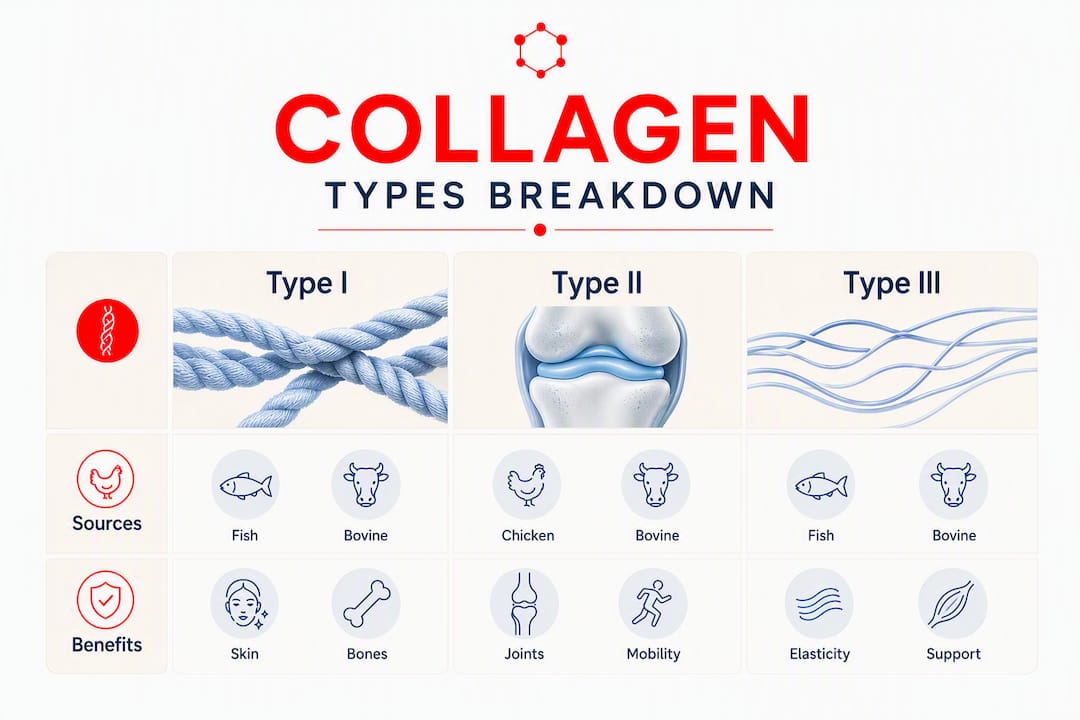
Collagen isn’t one thing. Your body makes at least 28 types, but three dominate in supplements.

Type I is the most abundant collagen in the human body and the primary structural protein in skin, tendons, and bones. It’s the type most directly linked to skin firmness and elasticity, and it’s what most beauty-focused collagen products deliver. Marine collagen is almost exclusively type I. Bovine hide is also predominantly type I and III.
Type II is the main collagen in cartilage. It’s sourced primarily from chicken sternum or cartilage and is the relevant type for joint support. Most skin-focused powders don’t include it, which is why a multi-collagen formula or a dedicated joint product is worth considering if cartilage health is your goal.
Type III works alongside type I in skin and blood vessels. It’s often found together with type I in bovine-sourced products, and the pairing is common in general-purpose collagen powders.
Why hydrolyzed peptides matter more than the source
The processing method determines how well your body can use the collagen. Whole collagen protein molecules are too large to absorb intact. Hydrolysis breaks them into shorter peptide chains, and research confirms these smaller molecules reach the bloodstream more efficiently and can signal fibroblasts to support collagen production in skin tissue. The animal source matters less than whether the product is properly hydrolyzed.
Patented bioactive peptide complexes like VERISOL® (skin), FORTIBONE® (bone), and FORTIGEL® (joints) take this further by engineering specific peptide sequences shown in clinical studies to signal target tissues. Fromwithin’s Wellnex® peptides follow the same principle of targeted peptide delivery.
What about vegan collagen?
No plant contains collagen. “Vegan collagen” products are actually collagen boosters: they supply vitamin C, zinc, copper, and amino acids that your body uses to synthesize its own collagen. They can support collagen production, but they’re not delivering collagen peptides directly. If you’re vegan and want to support skin health, these formulas are worth considering, but they work through a different mechanism than hydrolyzed peptide supplements.
How much collagen should you take, and when will you see results?
The evidence-backed daily dose for hydrolyzed collagen peptides is 5–10 g per day for most skin and joint outcomes. Some clinical trials for bone health have used higher doses, but for the majority of women, 5–10 g is the practical target.
Timing is flexible. Collagen peptides don’t require a specific window the way some amino acids do. Morning coffee, a smoothie, or a glass of water all work. What matters is daily consistency, not the clock.
Statistic callout: In clinical trials, skin hydration and elasticity improvements are generally measurable after several weeks of daily supplementation. Joint comfort may show earlier subjective improvement, but structural changes in cartilage and bone take longer and depend on sustained use alongside adequate vitamin C and, for bone, calcium and vitamin D.
Collagen is a building block, not a cosmetic shortcut. Experts note that it supports structural rebuilding over time, and managing that expectation is what keeps people consistent long enough to see real results. If you start a collagen routine and quit at week four because you haven’t noticed a difference, you’ve stopped just before the window where most people begin to see changes.
A practical approach: mix your powder into something you already drink every morning. That habit stacking is the simplest way to maintain your daily intake without it feeling like another item on your to-do list.
Are there side effects or interactions you should know about?
Collagen supplements are well-tolerated for most women. The most common complaints are mild digestive discomfort (bloating, a feeling of fullness) and, with some marine products, a fishy aftertaste. Both tend to resolve within a week or two of starting, or by switching to a bovine or multi-source formula.
Allergen watch:
- Marine collagen contains fish and shellfish derivatives. If you have a seafood allergy, avoid it entirely.
- Some bovine formulas are processed alongside dairy or soy. Check the allergen statement.
- Gluten cross-contact is possible in shared facilities. Look for a certified gluten-free seal if you have celiac disease.
When to check with your clinician before starting:
- You’re pregnant or breastfeeding
- You take blood thinners (some collagen formulas include vitamin K or other nutrients that interact with anticoagulants)
- You have an autoimmune condition affecting connective tissue
- You’re managing a complex medication regimen
Pro Tip: If you have a known fish or shellfish allergy, stick to bovine or chicken-sourced collagen and confirm the product is manufactured in a dedicated allergen-free facility. Don’t rely on the ingredient list alone — cross-contact can happen even when fish isn’t a listed ingredient.
This article is general information, not medical advice. Confirm current guidance with your healthcare provider, especially during pregnancy, lactation, or if you’re managing a chronic condition.
How do you know if a collagen product is actually good quality?
The supplement industry in the US is regulated by the FDA under dietary supplement rules, but products don’t require pre-market approval for efficacy. That means quality varies widely, and the label alone isn’t enough.
Here’s what to check:
| Quality marker | What to look for | Red flag |
|---|---|---|
| Third-party testing | NSF Certified for Sport, USP Verified, or independent COA | No testing seal, no COA available on request |
| Collagen type declared | Type I, II, III (or named peptide complex) | “Collagen complex” with no type specified |
| Dose per serving | 5–10 g hydrolyzed peptides | Under 2 g per serving without multiple-serving guidance |
| Ingredient transparency | Full ingredient list, no proprietary blends hiding dose | “Proprietary blend” with no individual amounts |
| Allergen declaration | Clearly states fish, dairy, soy, gluten status | No allergen statement |
| Source declared | Bovine, marine, chicken, porcine | Undeclared animal source |
| Vitamin C / HA inclusion | Listed with dose if included | “Contains vitamin C” with no amount |
| Country of manufacture | Stated on label | No manufacturing information |
The FDA’s Current Good Manufacturing Practice (cGMP) regulations set baseline standards for supplement manufacturing, but cGMP compliance alone doesn’t verify the potency or purity of a specific product. Third-party testing fills that gap.
Be skeptical of “clinically proven” claims without a citation. A product that references “clinical studies” without naming the study, the peptide complex tested, or the dose used is borrowing credibility it hasn’t earned. Named peptide complexes like VERISOL®, FORTIBONE®, FORTIGEL®, and Wellnex® have published research you can actually look up.
How we selected these picks
Every product in this guide was evaluated against the same criteria: clinical evidence for the peptide type or formula, dose per serving relative to the 5–10 g evidence-backed range, presence of named bioactive peptide complexes, third-party testing or certification, ingredient transparency, allergen declarations, form and mixability, and price per serving.
Sources used include peer-reviewed clinical trials (PubMed/PMC), expert consensus from registered dietitians and sports medicine practitioners, editorial testing and buyer guidance from established health publications, and brand documentation for proprietary peptide technologies. Competitor product pages were excluded as citation sources.
Price per serving was calculated from publicly listed retail prices divided by the number of servings per container. “Best for” designations were assigned based on the primary collagen type, dose, and any named bioactive peptide complex in the formula.
Disclosure: Fromwithin is the publisher of this article and manufactures the Collagen Peptides Glow Booster featured in this guide. The Fromwithin product was evaluated against the same criteria as all other entries. Its inclusion as the top overall pick reflects its use of patented Wellnex® peptides, full ingredient transparency, and formulation designed for skin elasticity. Readers are encouraged to compare all options using the criteria above.
What’s the final verdict by reader profile?
For most women, the single best choice is a hydrolyzed collagen peptide powder delivering 5–10 g per day, used consistently for at least 8–12 weeks.
- Most women (skin + overall health): From Within — Collagen Peptides Glow Booster. Patented Wellnex® peptides, transparent formula, designed specifically for skin elasticity and structural support.
- Women over 40 / perimenopause or menopause: Same pick, at the higher end of the dose range. Estrogen decline speeds up collagen loss, so a clinically studied peptide formula matters more, not less, as you get older.
- Budget-conscious: NeoCell Super Collagen Peptides or Vital Proteins Collagen Peptides. Both deliver types I and III at a low cost per serving; adjust serving size to reach 5–10 g daily.
- Marine preference: Correxiko Marine Collagen Powder or Absolute Collagen Marine Collagen Supplement Drink for a convenient liquid format.
- Capsule or gummy preference: Nature’s Truth Beauty Collagen Types 1 + 3 (capsules) or Nature Made Collagen Gummies. Expect a lower dose per serving and plan accordingly.
Whatever you choose, the dose and the consistency matter more than the brand name on the label.
Key Takeaways
Hydrolyzed collagen peptides at recommended daily doses, taken consistently over a clinically relevant timeframe, are the evidence-backed foundation for skin elasticity and structural support in women.
| Point | Details |
|---|---|
| Dose and form matter most | Aim for clinically supported doses of hydrolyzed collagen peptides daily; powders and liquid sachets often deliver these most reliably. |
| Timeline is 8–12 weeks | Measurable skin improvements typically appear after several weeks of consistent daily use, not days. |
| Women over 40 need more | Estrogen decline accelerates collagen loss; prioritize a clinically studied peptide formula at the higher end of the dose range. |
| Check quality markers | Look for NSF, USP, or independent COA; confirm collagen type, dose, and allergen declarations on the label. |
| Fromwithin’s top pick | From Within — Collagen Peptides Glow Booster uses patented Wellnex® peptides for targeted skin elasticity support. |
Why targeted peptides matter more than most brands admit
Here’s an opinion you won’t find on most collagen brand pages: the majority of collagen powders on the market are essentially protein supplements with good marketing. They deliver amino acids, your body uses those amino acids for whatever it needs most (muscle repair, enzyme production, immune function), and your skin may or may not benefit depending on your overall nutritional status. That’s not a scandal. It’s just how protein metabolism works.
The meaningful distinction is between generic hydrolyzed collagen and products that use specific, clinically studied bioactive peptide sequences designed to signal fibroblasts in skin tissue. VERISOL®, FORTIBONE®, FORTIGEL®, and Wellnex® are examples of this. They’re not magic, but they represent a more targeted approach than a generic bovine powder, and they have published research you can actually read.
What I’d push back on is the industry habit of treating all collagen peptides as equivalent. A 20 g serving of generic bovine collagen is not the same as 5 g of a targeted bioactive peptide complex, even though the first sounds more impressive on a label. Dose and peptide specificity together are what the evidence actually supports.
For women navigating perimenopause or menopause, this distinction is especially worth understanding. Your collagen production is declining faster than it did in your 30s, and the window for structural support is real. A formula built around targeted peptides and a clinically meaningful dose gives you a better shot at meaningful results than a large scoop of generic powder.
The other thing worth saying plainly: no supplement replaces sleep, sun protection, and adequate protein from food. Collagen works best as part of a routine that already covers the basics, not as a substitute for them.
Fromwithin’s Collagen Peptides Glow Booster is worth a closer look
If you’ve read this far, you know what separates a credible collagen supplement from a generic powder. Fromwithin built the Collagen Peptides Glow Booster around exactly those differentiators: patented Wellnex® peptides for targeted skin delivery, a fully transparent ingredient list, and a formula designed for the dose range the clinical evidence actually supports.

Unlike many powders that rely on high gram counts to look impressive, the Glow Booster focuses on peptide quality and bioavailability. Every ingredient is listed with its purpose. There are no proprietary blends hiding the dose. For women who want to know exactly what they’re putting in their body and why, that transparency is the point.
You can explore the full collagen range, including product details and ingredient breakdowns, on the Fromwithin collagen page. If you’re ready to start a consistent daily routine backed by targeted peptide science, the Glow Booster is where we’d point you first.
Useful sources
The claims and selection criteria in this article draw on the following peer-reviewed research and authoritative references:
- Estrogen, aging, and collagen degradation — Research linking estrogen decline during perimenopause and menopause to accelerated collagen loss; supports guidance for women over 40.
- Bioavailability and absorption of hydrolyzed collagen peptides — Evidence that hydrolyzed peptide forms show higher bioavailability; supports the recommendation to prioritize hydrolyzed collagen over whole protein.
- Clinical research on collagen supplementation — Systematic findings on skin hydration, elasticity, and joint outcomes; source for the 8–12 week timeline.
- How much collagen per day? (Healthline) — Expert consensus on the 5–10 g/day dose range for hydrolyzed peptides.
- ScienceDaily: collagen expectations and timelines — Coverage of expert guidance on setting realistic expectations for structural support vs. cosmetic effects.
- Gelita: Fortibone and branded collagen peptides — Source for VERISOL®, FORTIBONE®, and FORTIGEL® clinical research and tissue-specific peptide signaling.
- Vogue: best collagen supplements and ingredient synergies — Context for vitamin C and hyaluronic acid as companion ingredients supporting collagen synthesis.
- FDA cGMP regulations for dietary supplements — Baseline manufacturing standards; context for why third-party testing matters beyond regulatory compliance.
