

on August 20, 2026

Here’s the short answer: yes, you can meaningfully support your skin and joints after 40, but the right expectation is improvement, not reversal. Collagen loss is real and accelerates around menopause, yet consistent daily habits plus a trial-matched supplement routine can visibly improve hydration and elasticity within weeks.
Start here, today:
- Apply broad-spectrum SPF 30+ every single morning, rain or shine.
- Introduce a topical retinoid a few nights a week to nudge collagen production.
- If you try oral collagen, match the dose to what clinical trials actually use: 2.5 to 10 grams daily.
- Quit smoking if you haven’t. It’s one of the fastest ways to speed up collagen breakdown.
- Talk to your doctor before considering hormone therapy if menopause symptoms are part of the picture.
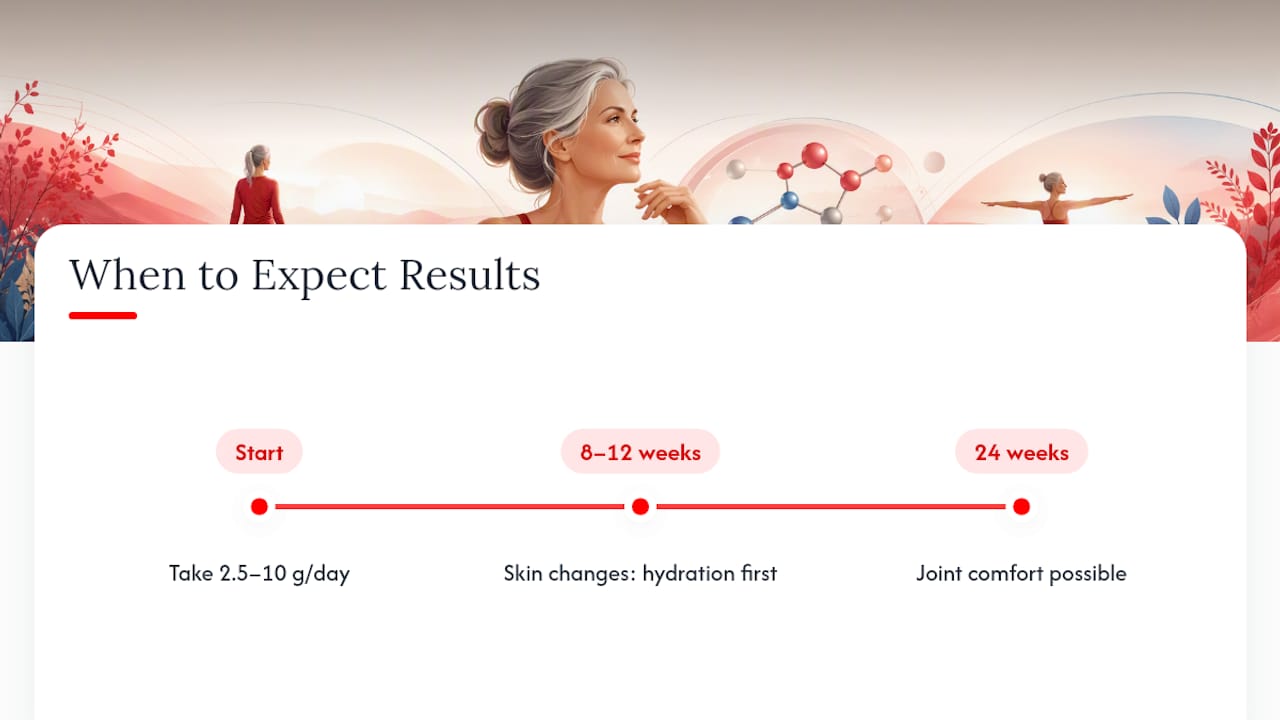
Give any new routine 8 to 12 weeks before judging results. Hydration tends to improve first, elasticity and fine lines follow.
Key Takeaways
Consistent sun protection, a trial-matched collagen dose, and 8 to 12 weeks of patience produce the most reliable improvements in skin hydration and elasticity after 40.
| Point | Details |
|---|---|
| Menopause accelerates loss | Estrogen decline can drop skin collagen by roughly 30% in the first five years post-menopause. |
| Match the dose to trials | Look for 2.5 to 10 grams of hydrolyzed collagen peptides daily, the range used in most research. |
| Give it 8 to 12 weeks | Hydration improves first, elasticity and wrinkle depth follow, joint benefits may take up to 24 weeks. |
| Layer topicals with supplements | Daily SPF 30+, a retinoid, and vitamin C protect collagen while supplements help rebuild it. |
| Choose transparent formulations | Fromwithin’s Collagen Peptides Glow Booster uses trial-matched dosing and clear ingredient sourcing. |
Table of Contents
- Why Collagen Declines After 40, and Why Menopause Makes It Worse
- What the Research Actually Shows About Oral Collagen Peptides
- Building a Topical Routine That Protects Existing Collagen
- Clinic Treatments That Trigger New Collagen Growth
- The Daily Habits That Slow Collagen Breakdown
- Choosing a Collagen Supplement That Actually Matches the Science
- What the Strongest Studies Show, and Where They Fall Short
- A Collagen Option Built Around the Research, Not the Hype
- Frequently Asked Questions
- Sources
Why Collagen Declines After 40, and Why Menopause Makes It Worse
Your skin’s collagen comes from cells called fibroblasts, and their output slows with age largely because estrogen helps keep them active. As estrogen signaling weakens, enzymes called MMPs (matrix metalloproteinases) start breaking down collagen faster than fibroblasts can replace it. Think of it as a factory losing workers while demolition crews keep working overtime.
Menopause turns a gradual slope into something closer to a drop-off. Estrogen decline can trigger what researchers call a “collagen cliff,” with some studies estimating skin collagen falls by roughly a substantial portion in the first years after menopause (https://theconversation.com/does-menopause-cause-a-collagen-cliff-what-you-need-to-know-278127), stacked on top of the steady 1 to 1.5% yearly decline that starts in your 20s and 30s.
You’ll likely notice it as:
- Skin that feels thinner or more fragile
- Slower healing from cuts or blemishes
- Persistent dryness that lotion doesn’t fully fix
- Wrinkles becoming more visible, especially around the eyes and mouth
- Volume loss in the cheeks and jawline
What the Research Actually Shows About Oral Collagen Peptides
The evidence here is genuinely encouraging, with a caveat: the gains are real but modest. Randomized controlled trials consistently show that hydrolyzed collagen peptides taken at 2.5 to 10 grams daily improve skin hydration, elasticity, and wrinkle depth in adult women, usually measured over 8 to 12 weeks. Joint-related benefits sometimes take longer to show up, with some trials running as long as 24 weeks.
Here’s the order things typically improve in:
- Hydration shifts first, often within a few weeks.
- Elasticity and skin firmness follow around the 8 to 12 week mark.
- Visible changes in wrinkle depth and joint comfort come last, if at all, and vary by person.
Systematic reviews back this up but add a fair warning: formulations vary widely across brands, and many trials use small sample sizes, so treat “improvement” as a real but bounded outcome rather than a dramatic transformation.
Pro Tip: Take a “before” photo in the same lighting and angle before you start, then repeat it at week 8 and week 12. Your eyes adjust to gradual change faster than a camera does.
Tolerability tends to be good, though collagen peptides are usually sourced from bovine, fish, or poultry, so check the label if you have relevant allergies. If you’re on regular medications, mention any new supplement to your prescriber, just as a courtesy check.
Building a Topical Routine That Protects Existing Collagen
Supplements work from the inside. Your skincare routine works from the outside, and dermatology guidance is pretty consistent on what matters most: daily broad-spectrum sunscreen, a topical retinoid to stimulate new collagen, and antioxidants like vitamin C to fight the oxidative stress that breaks it down.
A simple order of operations:
- Morning: vitamin C serum, moisturizer, then SPF 30 or higher.
- Evening: cleanse, then a pea-sized amount of retinoid two to three nights a week to start.
- Layer in a peptide serum on non-retinoid nights if your skin tolerates it.
If your skin is drier than it used to be, thanks to menopause, ease into retinoids slowly. Start twice weekly, use a moisturizer underneath as a buffer, and pause retinoid use for a few days before or after any in-office procedure.
Pro Tip: If your skin stings or flakes when you start a retinoid, that’s your skin telling you to slow down, not stop entirely. Cut back to once a week and build up gradually.

Clinic Treatments That Trigger New Collagen Growth
If topicals and supplements feel too slow, professional treatments can accelerate things, though they come with more cost and downtime. Procedural studies show measurable increases in dermal collagen after these options:
- Microneedling creates controlled micro-injuries that trigger a healing and collagen response, usually done in a series with minimal downtime.
- Radiofrequency microneedling combines needling with heat for deeper collagen stimulation, often used on lax skin.
- Fractional lasers resurface skin in a grid pattern, improving texture and stimulating collagen over several sessions.
- Biostimulatory injectables (like poly-L-lactic acid) gradually rebuild volume over months rather than instantly.
These work faster than anything you apply or swallow, but they need a board-certified dermatologist and realistic expectations. A single session rarely does it. Most protocols involve a series spaced weeks apart.
The Daily Habits That Slow Collagen Breakdown
Supplements and procedures get attention, but daily habits are the quiet workhorses behind healthy collagen. Sun protection remains the single biggest lever, since UV exposure accelerates collagen degradation faster than almost anything else. Smoking runs a close second. It measurably reduces collagen production, and the damage compounds over years.
Beyond that, a few things matter more than people expect:
- Prioritize consistent sleep. Skin repair happens overnight.
- Eat enough protein and vitamin C, both required for your body to actually build collagen.
- Try resistance training two to three times a week. It supports connective tissue health, not just muscle.
- Consider collagen-rich foods like bone broth as a complementary habit, though the evidence here is much thinner than for hydrolyzed supplements.
Pro Tip: Alcohol dehydrates skin and disrupts the deep sleep your body needs for repair. Cutting back even a couple of nights a week can show up in your skin faster than you’d think.
Choosing a Collagen Supplement That Actually Matches the Science
Not all collagen products are created equal, and the label tells you more than the marketing does. Look for:
- Hydrolyzed collagen peptides specifically, since this is the form used in nearly every trial showing benefit.
- A stated dose per serving that falls in the 2.5 to 10 gram range used in skin-focused research.
- Transparent sourcing (bovine, marine, or poultry-based) so you can check for allergens.
- A format you’ll actually stick with, whether that’s a powder, a ready-to-drink format, or capsules.
Matching your product to the trial protocols you’re trying to replicate is the whole game here. If a product doesn’t disclose its dose, you can’t know if it’ll do anything.
If you take medications like citalopram or other prescriptions, mention any new collagen supplement to your prescriber. Current evidence doesn’t point to a known drug interaction with collagen peptides, but it’s a five-second conversation that removes any guesswork. Avoid marine-based collagen if you have shellfish or fish allergies, and skip supplementation altogether without medical guidance if you have kidney disease.
Pro Tip: Count servings, not scoops. A “2 scoop” serving might only add up to 3 grams of actual peptides, well under the trial-tested amount, so check the nutrition panel, not just the front label.
What the Strongest Studies Show, and Where They Fall Short
The clearest data point comes from randomized trials showing that women taking 2.5 to 10 grams of collagen peptides daily for 8 to 12 weeks see measurable gains in hydration, elasticity, and wrinkle depth. Joint-focused studies often extend that window to 24 weeks before measuring outcomes.
That said, the research isn’t flawless. Reviewers point to real limitations:
- Formulations vary a lot between brands and studies, making direct comparisons tricky.
- Many trials involve smaller sample sizes than you’d want for airtight conclusions.
- Some studies are industry funded, which doesn’t invalidate the results but does warrant a critical eye.
- Long-term data (beyond a year) is still limited.
None of that erases the signal. It just means “modest but real” is the honest way to describe it.
A Realistic Note From Fromwithin
We know how tempting it is to want a dramatic before-and-after. What the evidence actually supports is steadier: consistent habits and trial-matched supplementation that add up over months. That’s still worth doing. If menopause symptoms are part of your picture, loop in your clinician, especially for hormone therapy decisions.
A Collagen Option Built Around the Research, Not the Hype
If you’re ready to try oral collagen but don’t want to guess at dosing, Fromwithin’s Collagen Peptides Glow Booster is formulated around the same dose ranges used in clinical research, with full ingredient transparency so you know exactly what you’re taking and why.

The patented Wellnex® peptides are designed for direct bloodstream absorption, which matters when you’re trying to hit a dose that actually mirrors what the studies used. No proprietary blends hiding the real numbers, no mystery sourcing. Browse the full collagen lineup to compare formats and find the serving size that fits your routine, and check the label against your own allergies before you order. This is general guidance, not medical advice. If you’re navigating menopause symptoms, drug interactions, or hormone therapy questions, talk to your clinician first.
Frequently Asked Questions
Does collagen actually work after 40, or is it mostly marketing? The evidence for oral hydrolyzed collagen peptides is real, though modest. Randomized trials show improved hydration, elasticity, and wrinkle measures at doses of 2.5 to 10 grams daily over 8 to 12 weeks, not an overnight transformation.
How much collagen should a woman over 40 take daily? Most trials showing skin benefits use 2.5 to 10 grams of hydrolyzed collagen peptides per day. Joint-focused studies sometimes use higher amounts over longer periods.
Can collagen supplements interact with citalopram or other medications? There’s no well-established interaction between collagen peptides and citalopram in current research. Still, mention any new supplement to your prescriber, particularly if you’re managing multiple medications.
How long before I see results from collagen supplements? Give it a minimum of 8 to 12 weeks for visible skin changes. Hydration tends to improve first, with elasticity and wrinkle depth following. Joint comfort, if it improves at all, may take up to 24 weeks.
Is topical retinoid or oral collagen better for aging skin? They target different things. Retinoids stimulate new collagen production directly in the skin, while oral peptides support hydration and elasticity from within. Dermatology guidance typically recommends using both together for the strongest effect.
This article is general information, not a substitute for advice from a qualified doctor. Consult a qualified healthcare professional about your own circumstances before acting on anything here.
Sources
- Collagen supplementation: clinical evidence and mechanisms (PMC12661388)
- Does menopause cause a ‘collagen cliff’? What you need to know
- Skin care during menopause (American Academy of Dermatology patient guidance)
- Collagen for older adults: FAQ and evidence (Healthline)
