

on August 21, 2026

Here’s the honest, evidence-backed answer: expect skin hydration to shift around 4 to 6 weeks, visible elasticity and softer wrinkles by 8 to 12 weeks, joint comfort improving in about 3 to 6 months, nails growing out stronger over several months, and bone density benefits only showing up after a full year. Hair? The evidence is thin, so keep expectations modest there.
If you’re starting collagen for the first time, commit to daily use for at least 8 to 12 weeks before you judge skin results, and 3 to 6 months if joints are your goal. Give it 12 months if bone health is what you’re really after.
- Skin hydration: ~4-6 weeks
- Skin elasticity/wrinkles: ~8-12 weeks
- Joint comfort: ~12-24+ weeks
- Nail strength/growth: ~16-24 weeks
- Bone density: ~12 months
This is general guidance based on published research, not personalized medical advice. Your own timeline can vary depending on dose, consistency, and your starting point.
If you want a straightforward place to start that trial clock, Collagen Peptides gives you a documented dose to work from instead of guessing.
Key Takeaways
Collagen results follow a predictable, tissue-specific timeline, and the biggest reason people quit too early is judging results before the relevant checkpoint arrives.
| Point | Details |
|---|---|
| Skin changes fastest | Hydration often shifts by 4-6 weeks; elasticity and wrinkle depth are measurable by 8-12 weeks. |
| Joints and nails take longer | Joint comfort and nail strength typically need 3-6 months of consistent daily use. |
| Bone results need a year | The one long-term trial measuring bone density ran a full 12 months at 5 g/day. |
| Dose and type must match your goal | Skin uses gram-scale peptides; joints use milligram-scale UC-II, a different mechanism entirely. |
| Track with photos, not memory | Same lighting, angle, and distance every 4 weeks gives you an honest before-and-after. |
| Fromwithin offers a documented starting point | Collagen Peptides Glow Booster uses a studied dose so an 8-12 week skin trial is measured, not guesswork. |
Table of Contents
- What Happens Week by Week After You Start Taking Collagen
- What Do Collagen Results Actually Look Like By Goal?
- What Clinical Research Says About Collagen Timelines
- Which Collagen Type and Dose Matches Your Goal?
- How to Speed Up and Track Your Collagen Results
- Is Collagen Safe? Side Effects and When to See a Doctor
- Frequently Asked Questions About Collagen Results Timelines
- Sources
What Happens Week by Week After You Start Taking Collagen
Your body doesn’t work on marketing schedules, it works on biology. Here’s what’s actually happening under the surface during those first three months and beyond.
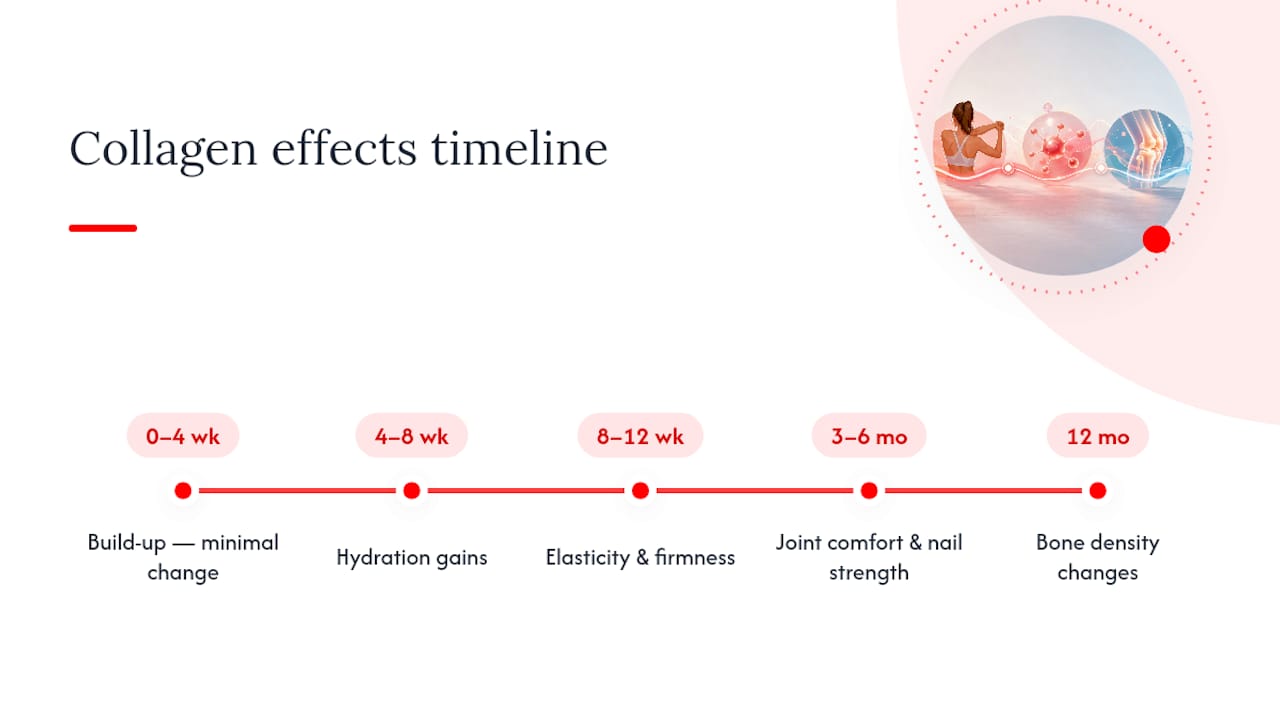
Weeks 0 to 4: This is the quiet build-up phase. Collagen peptides break down into amino acids your body uses as raw material, but you’re mostly building a reserve here, not seeing results yet. Some people notice slightly softer, less tight-feeling skin toward the end of this window as hydration markers begin to shift.
Weeks 4 to 8: Hydration improvements tend to show up clearly now, and some double-blind trials record measurable elasticity gains by week 8 compared to placebo. This is when your skin might start to feel like it’s holding moisture better instead of drinking in every drop of lotion you apply.
Weeks 8 to 12: This is the checkpoint most skin trials use to measure real change: elasticity, wrinkle depth, and skin firmness. If you’re going to see a difference in photos, this is usually when it shows.
3 to 6 months: Joint comfort and nail strength typically live in this window. Nails grow slowly, roughly 3mm a month, so a visibly stronger, less brittle nail takes a few full growth cycles to appear.
12 months: Bone density changes, if they’re your goal, only appear in trials run this long.
Pro Tip: Take a photo every 4 weeks in the same spot, same lighting, same time of day, and same distance from your face or hands. Your eyes adjust to gradual change faster than a camera does, so the photo will catch what you might miss.
Set your first real checkpoint at week 8, not week 2. That’s the earliest point the science actually supports judging whether something is working.
What Do Collagen Results Actually Look Like By Goal?
“Results” means something different depending on what you’re chasing. Here’s how to know what to actually watch for.
Skin. Hydration shows up first, your skin feels less tight, less flaky, more plump to the touch. Elasticity is next: try the pinch test on your cheek or forearm and see how quickly skin bounces back. Wrinkle depth is the slowest-moving marker and the one photos capture best.
- Check: cheek hydration by feel at week 4-6
- Check: pinch-and-bounce elasticity test at week 8
- Check: side-by-side photos under consistent lighting at week 12
Joints. Look for less soreness after activity, easier movement first thing in the morning, and reduced stiffness climbing stairs. It’s worth knowing that joint studies mostly use undenatured type II collagen (UC-II) at a much smaller dose than skin-focused peptides, and those trials run 90 to 180 days before measuring pain and function.
Nails. Watch for fewer splits and peels, and nails that need trimming more often, a sign of faster growth. Sixteen to 24 weeks lines up with how long it takes a nail to fully regrow from the cuticle.

Hair. Be realistic here. The evidence for hair is far weaker than for skin, and any changes people report often overlap with better diet, less stress, or other supplements taken at the same time.
What Clinical Research Says About Collagen Timelines
The skin timeline isn’t a guess, it’s built on repeated trial data. Multiple randomized studies using 2.5 to 10 grams a day of hydrolyzed collagen peptides show hydration improvements as early as 4 weeks, with elasticity and wrinkle changes more consistently measured at 8 to 12 weeks.
Joint research tells a different story with a different molecule. Trials using roughly 40 mg a day of UC-II, a much smaller dose because it works through a different mechanism, measured pain and mobility outcomes at 90 to 180 days. One notable trial combined collagen peptides with resistance training and found measurable body composition changes at 12 weeks, which tells you consistency plus a physical stimulus can shorten some timelines.
The honest limitation: hair and nail studies tend to have smaller sample sizes and less consistent methodology than skin research, and Harvard’s own review of the evidence flags real variability in product claims and formulations across the market. Not every “collagen” product on a shelf was tested the way the trials behind these timelines were built.
- Skin peptides: 2.5-10 g/day, measured at 8-12 weeks
- UC-II for joints: ~40 mg/day, measured at 90-180 days
- Bone-specific peptides: 5 g/day, measured at 12 months
- Muscle/tendon peptides: higher doses paired with resistance training, measured at 12 weeks
Which Collagen Type and Dose Matches Your Goal?
Not all collagen is interchangeable, and this is where a lot of people waste money on the wrong product for their goal.
Type I and III hydrolyzed peptides, measured in grams, are what skin trials use. If smoother, more hydrated skin is your target, look for a product delivering somewhere in that 2.5 to 10 gram range daily.
Undenatured type II collagen (UC-II), measured in milligrams, is the joint-focused form, and it works on a completely different mechanism than peptide-based collagen. The dose is tiny by comparison, around 40 mg, because it’s not acting as a raw material the way peptides do.
Bone health research used a specific 5 gram peptide formula sustained for 12 full months, and muscle and tendon studies leaned on higher peptide doses stacked with actual resistance training, not the supplement alone.
Pro Tip: Flip the label before you buy. Check whether the peptide type matches your goal, confirm it’s measured in grams (skin) or milligrams (joints), and look for third-party testing. A buyer’s guide focused on choosing the right type and dose can save you from picking a blend that doesn’t match what you’re actually trying to fix.
How to Speed Up and Track Your Collagen Results
Consistency beats everything else here. The studied dose taken daily is the single strongest predictor of whether you’ll see the results the trials found.
- Take your collagen at the studied dose for your goal, every day, at roughly the same time so it becomes automatic.
- Pair it with vitamin C, which your body needs as a cofactor to actually synthesize new collagen, not just absorb the peptides.
- Keep your overall protein intake adequate, collagen supplements support but don’t replace your total daily protein.
- If muscle or tendon strength is your goal, add resistance training, since the trials that found the strongest body composition changes combined both.
- Photograph the same skin area every 4 weeks (weeks 4, 8, and 12) with the same lighting, background, and distance, and label the files by date.
Pro Tip: To dodge placebo bias, ask a friend to look at your unlabeled, randomized before-and-after photos and guess which came first. If they can’t tell, be honest with yourself about what “results” really means for you.
Is Collagen Safe? Side Effects and When to See a Doctor
Collagen supplements are generally well tolerated, but a few things are worth knowing before you start.
- Mild stomach upset or a heavy, full feeling is the most commonly reported side effect.
- Allergic reactions are uncommon but possible if you’re sensitive to the source, shellfish and egg-derived collagens carry that risk specifically.
- Labeling accuracy varies across the market, and some products don’t deliver what the label claims, so third-party testing matters more than marketing copy.
- Talk to a doctor before starting if you’re pregnant, managing an autoimmune condition, dealing with new joint pain that hasn’t been diagnosed, or already taking multiple supplements or medications.
This is general information, not a replacement for advice tailored to your own health history.
Why We Built Our Trial Recommendation Around the Evidence, Not Hype
At Fromwithin, we built our collagen peptides around what the clinical research actually supports, not around what sounds impressive on a label. Our formulation uses documented peptide types and doses, backed by proprietary research and third-party testing, because transparency is the whole point. If you’re going to run an 8 to 12 week trial, you deserve to know exactly what you’re testing.

Ready to Start Your 8 to 12 Week Trial?
If you’ve read this far, you already know the real answer isn’t “collagen doesn’t work,” it’s usually “I didn’t give it enough time or a real dose.” That’s the gap Collagen Peptides Glow Booster is built to close: a documented peptide dose in the range the skin trials actually used, so you’re not guessing whether you’re taking enough.

Pair it daily for at least 8 to 12 weeks, since that’s the checkpoint the research points to for visible skin change, and snap your first comparison photo today so you have a real baseline instead of a fuzzy memory of “before.” For a hydration boost from the outside while your internal levels build, hyaluronic acid eye patches make a nice companion step for the under-eye area specifically. Browse the full collagen lineup and pick the option that matches your goal, then mark your calendar for week 8. That’s your first honest checkpoint.
Frequently Asked Questions About Collagen Results Timelines
How long does it take for collagen to work on skin? Most people notice hydration changes by 4 to 6 weeks, with visible elasticity and wrinkle improvements showing up in clinical measurements by 8 to 12 weeks.
How long for collagen results in joints? Joint comfort trials using UC-II typically measure change at 90 to 180 days, so plan on a 3 to 6 month trial before drawing conclusions.
Is a collagen peptides results timeline the same for everyone? No. Your starting skin condition, dose consistency, and product quality all shift your personal timeline, which is why the trial windows given here are ranges, not guarantees.
What’s a realistic trial period before I decide collagen isn’t working for me? Give skin goals 8 to 12 weeks minimum, joints 3 to 6 months, and bone health a full 12 months, matching the actual trial durations behind each outcome.
Why does hair take longer to show collagen benefits, if it shows any at all? The evidence base for hair is thinner and less consistent than for skin, and any changes people notice often overlap with other diet or supplement changes happening at the same time.
This article is general information, not a substitute for advice from a qualified doctor. Consult a qualified healthcare professional about your own circumstances before acting on anything here.
