

on August 31, 2026

Short answer: collagen counts as protein on a nutrition label and it counts toward your daily calories, but it doesn’t count the same way whey or eggs do when your goal is building muscle. Collagen is missing a key amino acid called tryptophan and runs low on leucine, so your body can’t use it to build new muscle tissue the way it uses complete proteins. Where collagen earns its keep is skin, joints, and connective tissue support, and that’s genuinely worth something.
TL;DR:
- Collagen is a low-quality protein source for muscle building because it lacks tryptophan and has minimal leucine, reducing its effectiveness for muscle synthesis.
- Nutrition labels measure nitrogen content, so collagen’s grams count as protein but do not reflect its limited amino acid profile relevant to muscle growth.
- Collagen supports skin, joint, and connective tissue health through glycine, proline, and hydroxyproline, but does not stimulate muscle protein synthesis like whey or eggs.
- To maximize benefits, pair collagen with complete proteins like dairy, eggs, or legumes, and log it separately if tracking protein intake for muscle goals.
- Consistent use for 8 to 12 weeks is needed to observe skin or joint improvements, with higher doses generally needed for joint comfort and collagen synthesis support.
Table of Contents
- Does Collagen Count as Protein? What Protein Quality Scores Actually Show
- What Collagen’s Amino Acids Actually Do for Your Body
- Do Clinical Trials Back Collagen for Muscle or Just Skin and Joints?
- How to Fit Collagen Into a Complete-Protein Day
- How Much Collagen Do You Actually Need, and How Long Until You See Results?
- How to Read a Collagen Label Without Getting Misled
- What the Research Actually Adds Up To
- What to Do With This Information Starting Today
- A Note on Why We Formulate the Way We Do
- Where Fromwithin Fits Your Skin and Joint Goals
- Sources
Does Collagen Count as Protein? What Protein Quality Scores Actually Show
Grams on a label don’t tell the whole story. Two scoring systems, PDCAAS (Protein Digestibility Corrected Amino Acid Score) and DIAAS (Digestible Indispensable Amino Acid Score), exist specifically because not all protein behaves the same way once it’s in your body.
Both scores ask the same basic question: does this protein contain enough of every essential amino acid, in the right proportions, for your body to actually use it? Whey and eggs score close to the top of the scale. Collagen doesn’t, and the reason is specific. It has zero tryptophan, one of the nine amino acids your body can’t make on its own and must get from food. Miss even one essential amino acid entirely, and the scoring math treats the whole protein as unusable for building body tissue, which is why hydrolyzed collagen protein is considered a very low-quality protein source by that strict standard, with a PDCAAS near zero.
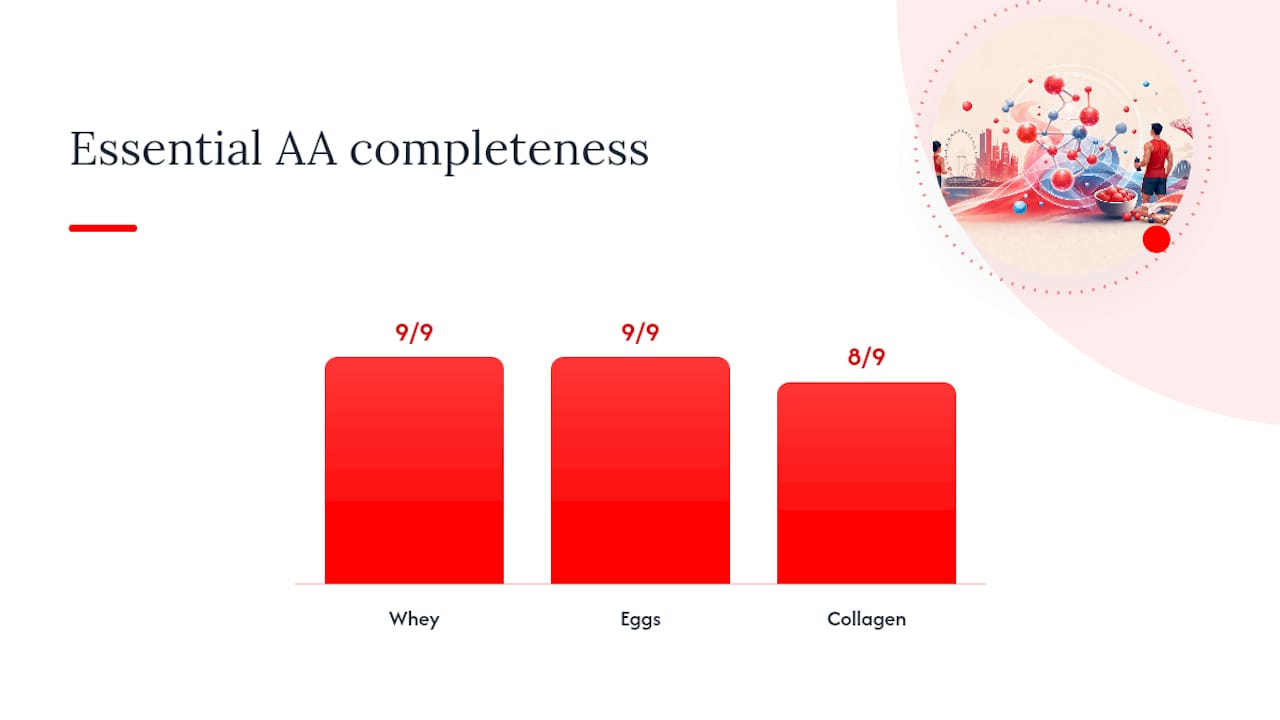
Here’s where it gets confusing for a lot of you. Nutrition labels don’t use PDCAAS or DIAAS. They use a nitrogen-based test that simply measures protein content, not quality. A supplement can legally say “20 g protein” on the front of the label even when that protein is nutritionally incomplete, because the label is answering “how much nitrogen is here,” not “can your body build muscle with this.”
That gap between what a label says and what your body can actually do with it matters for anyone tracking macros closely:
- Food-tracking apps count collagen grams as protein grams, no exceptions, no asterisk.
- Regulators evaluate protein content by nitrogen, not by amino acid completeness.
- Your muscles, meanwhile, evaluate protein by amino acid completeness, not by what’s printed on the box.
So if you’re hitting your protein target on paper but leaning heavily on collagen to get there, your muscles may be seeing a very different number than your tracking app.
What Collagen’s Amino Acids Actually Do for Your Body
Collagen is built overwhelmingly from three amino acids: glycine, proline, and hydroxyproline. Together they make up roughly half of collagen’s total amino acid content, and they’re the literal building blocks of your skin’s extracellular matrix, the scaffolding that keeps skin looking plump and joints moving smoothly.

Glycine supports collagen synthesis directly. Proline and hydroxyproline stabilize the triple-helix structure that gives collagen fibers their strength and elasticity. This is the amino acid profile that shows up in the research on skin hydration and joint comfort, and it’s the reason collagen has a real, specific job in your body.
Pro Tip: Think of collagen’s amino acids as raw material for repair, not fuel for growth. Glycine and proline rebuild the scaffolding; they don’t add horsepower to your muscles.
That’s a fundamentally different job from what leucine does. Leucine is the amino acid that flips the switch on muscle protein synthesis, the process your body uses to repair and build muscle fiber after training. Whey is loaded with it. Collagen contains barely a trace.
A few things follow from that profile:
- Collagen’s glycine, proline, and hydroxyproline concentration supports connective tissue remodeling, not muscle fiber growth.
- Leucine and the other branched-chain amino acids (BCAAs), which collagen barely supplies, are what trigger the anabolic signal muscles need.
- Collagen functions best as a targeted, goal-specific supplement, not a stand-in for your main protein source.
If your goal is visibly firmer skin or steadier joints, collagen’s amino acid lineup is doing exactly the work you want. If your goal is adding muscle, it’s the wrong tool for that particular job.
Do Clinical Trials Back Collagen for Muscle or Just Skin and Joints?
The clinical picture is consistent once you separate the two goals: collagen for connective tissue holds up in trials, collagen for muscle building doesn’t.
An 8-week randomized trial in overweight women compared isocaloric whey protein against hydrolyzed collagen. The whey group saw more favorable body composition changes and higher intake of leucine and BCAAs, while the collagen group actually saw a slight BMI increase and no comparable metabolic benefit. Even when researchers matched total protein grams, whey outperformed collagen on every muscle-relevant marker.
That result lines up with what a broader narrative review of collagen and connective tissue found: collagen peptides consistently show up as useful for skin and joint outcomes, but not for stimulating the kind of protein synthesis that builds muscle.
Collagen peptide supplementation supports musculoskeletal connective tissue remodeling and is associated with reported improvements in skin and joint outcomes across multiple trials, but it does not reliably drive the muscle protein synthesis response seen with complete, leucine-rich proteins.
The populations where collagen looks strongest are worth noting specifically:
- Adults tracking skin elasticity and hydration over 8 to 12 weeks report the most consistent improvements.
- People using collagen alongside resistance training for joint comfort, rather than as their main protein source, tend to see the clearest combined benefit.
- Older adults and people managing joint discomfort show some of the more encouraging connective tissue results in the literature, though this remains an area of ongoing research rather than settled fact.
None of this makes collagen useless. It makes it specific. The evidence simply doesn’t support asking one supplement to do two very different jobs at once.
How to Fit Collagen Into a Complete-Protein Day
Here’s the practical rule: don’t count collagen toward your protein target on training days, or any day you’re chasing a specific gram-per-kilogram goal for muscle. Count it separately, as a bonus for skin and joints, on top of a complete protein base.
That doesn’t mean skipping collagen. It means pairing it. Collagen combined with foods that supply the amino acids it lacks, especially tryptophan and leucine, rounds out the amino acid profile so your overall day still supports muscle maintenance. Research modeling this kind of substitution found that collagen peptides can be incorporated into a mixed diet at fairly high proportions, up to roughly a third of total protein in some scenarios, without creating an essential amino acid shortfall, as long as the rest of your diet fills the gaps.
Good pairing options:
- Collagen plus dairy. Stir a scoop into milk or Greek yogurt; dairy is rich in tryptophan and leucine, the two things collagen skips.
- Collagen plus eggs. A collagen drink alongside breakfast eggs covers what the collagen alone can’t.
- Collagen plus soy or legumes. For anyone eating plant-forward, tofu, edamame, or lentils alongside collagen fills the same gap.
- Collagen as a separate ritual, not a meal replacement. Many people take it between meals specifically so it doesn’t quietly displace a more complete protein source.
A realistic sample day: eggs and Greek yogurt at breakfast, a chicken or tofu-based lunch, a collagen drink mid-afternoon (5 to 15 g), and a whey or plant-protein shake or a protein-forward dinner after training. Your muscle-protein needs get met by the complete sources; your skin and joints get the collagen dose the research actually studied.
Pro Tip: If you’re tracking daily protein in grams per kilogram of body weight for a muscle goal, log your collagen separately from your “usable” protein tally. It keeps your numbers honest.
How Much Collagen Do You Actually Need, and How Long Until You See Results?
Most trials showing measurable skin or joint benefits used doses within a commonly studied range of collagen intake, taken daily. Exact dosing depends on the specific goal, with some evidence suggesting lower doses for skin and higher doses for joint comfort.
Patience matters more than dose here. Skin hydration and elasticity improvements in trials typically emerge over 8 to 12 weeks of consistent daily use, not days. That timeline lines up with how long it takes skin cells to actually turn over and remodel, so a week of use won’t tell you much either way.
A few formulation details change how well collagen performs within that window:
- Hydrolyzation matters. Hydrolyzed collagen peptides are broken down into smaller chains that absorb more readily than unprocessed collagen or gelatin.
- Vitamin C co-administration is common in trials. Vitamin C is a cofactor your body needs for collagen synthesis, so many effective study formulations pair the two.
- Population differences are real. Age, baseline skin condition, and joint health status all affect how quickly and how strongly someone responds.
None of this changes the muscle-building verdict. Even at the top end of the effective dose range for skin and joints, collagen still isn’t supplying the leucine your muscles need after a workout.
How to Read a Collagen Label Without Getting Misled
The single most important thing to check on any collagen label isn’t the protein gram count. It’s whether the brand tells you anything about the amino acid profile behind that number.
Remember that protein labeling is based on nitrogen content, not amino acid completeness, which is exactly why a collagen product can legally say “20 g protein” while still lacking tryptophan entirely. That’s not a loophole any one brand is exploiting; it’s just how the labeling math works across the whole category.
What’s actually worth checking before you buy:
- Amino acid profile disclosure. A brand willing to publish its amino acid breakdown, not just total grams, is giving you the information PDCAAS and DIAAS actually depend on.
- Leucine content, if muscle support is claimed. If a collagen product markets itself for “muscle support,” ask what leucine content backs that claim. Often, there isn’t much.
- Vitamin C inclusion. Since vitamin C supports your body’s own collagen synthesis, its presence (or absence) tells you something about formulation intent.
- Peptide sourcing and third-party testing. Traceable sourcing and independent testing are reasonable proxies for a brand that takes formulation seriously.
The biggest red flag is a broad “builds muscle” or “boosts strength” claim with no amino acid data anywhere near it. That’s marketing borrowing credibility from whey’s reputation, not evidence about what that specific product does in your body.
What the Research Actually Adds Up To
Pulled together, the strongest evidence points in one consistent direction: collagen peptides support connective tissue remodeling and show up reliably in skin and joint outcome trials, while randomized comparisons against whey show collagen falling short on muscle protein synthesis and body composition markers, largely because of its leucine and tryptophan gap.
Registered dietitians tend to frame this the same way: collagen works best as a complementary, goal-specific supplement, not an interchangeable protein source you swap in for whey or soy.
Collagen peptides are a specialized tool. They do a specific job, connective tissue support, extremely well, and a different job, muscle building, quite poorly. Treating them as interchangeable with complete proteins misreads what the amino acid science actually shows.
Fromwithin’s collagen formulations are built around Wellnex® peptides, developed to be absorbed efficiently, so the glycine, proline, and hydroxyproline your skin and joints need actually reach circulation. Internal formulation and stability data support that absorption approach, and Fromwithin continues to track outcomes as its clinical research program develops further. None of that changes the muscle-building verdict above; it’s exactly why the brand markets its collagen for skin elasticity and joint comfort rather than as a muscle-building protein.
What to Do With This Information Starting Today
Keep this simple: collagen counts for calories and for skin, joint, and connective tissue goals. It doesn’t count toward your muscle-building protein target, because it’s missing tryptophan and runs low on leucine.
- Log collagen separately from your “usable” muscle-protein tally if you’re tracking grams per kilogram of body weight.
- Pair collagen with a complete protein source (dairy, eggs, soy, legumes) somewhere in your day so your amino acid bases stay covered.
- Give it 8 to 12 weeks of consistent daily use before judging whether it’s working for skin or joints.
- Talk to a dietitian or clinician before relying heavily on collagen if you’re an older adult, following a restrictive diet, or recovering from an injury where protein needs run higher.
| Your goal | Count collagen toward it? | What to pair it with |
|---|---|---|
| Muscle building or preservation | No | Whey, eggs, soy, legumes |
| Skin elasticity and hydration | Yes | Vitamin C, consistent daily timing |
| Joint comfort | Yes | Resistance training, consistent daily timing |
| General daily calorie/macro tracking | Yes, but log separately from “usable” protein | Any complete protein source |
A Note on Why We Formulate the Way We Do
We built Fromwithin’s collagen line around Wellnex® peptides because well-characterized, absorbable peptides are what the skin and joint research actually calls for, not because we wanted another protein claim to print on a label. We’d rather tell you plainly what collagen does and doesn’t do than let a big gram number do the talking. Our formulation notes and ongoing research are documented on our product pages, and we’ll keep updating them as our own trial work matures. If you’re chasing visible skin results, we think the evidence supports starting there.
— From
Where Fromwithin Fits Your Skin and Joint Goals
If everything above left you thinking “okay, so which collagen do I actually take,” that’s exactly the question Fromwithin’s collagen line was built to answer. Instead of chasing a big protein number, our formulations lean on Wellnex® peptides, engineered for efficient absorption so the glycine and proline your skin and joints actually use get where they need to go, at doses that match the ranges shown to work in skin and joint research.

For skin elasticity specifically, the Collagen Peptides Glow Booster is formulated at a daily dose consistent with the 2.5 to 15 gram range covered earlier, and it’s meant to be taken daily for at least 8 weeks before you judge results, exactly the timeline the research supports. If joint comfort or overall connective tissue support is more your focus, our broader skin-support collection covers formulations built around the same peptide science. Pair it with a complete protein at meals, give it two to three months, and see how your skin actually responds. Start with a single bottle and judge it on your own timeline.
Sources
- Effects of whey versus collagen supplementation on body composition and biochemical markers in overweight women (randomized trial)
- Significant Amounts of Functional Collagen Peptides Can Be Incorporated in the Diet While Maintaining Indispensable Amino Acid Balance – Nutrients (2019)
- Does Collagen Protein Count Towards Your Daily Protein Intake? – PEScience
This article is general information, not a substitute for advice from a qualified doctor. Consult a qualified healthcare professional about your own circumstances before acting on anything here.
