

on September 04, 2026

Halal collagen absolutely exists, and you have real options: marine collagen and halal-certified bovine collagen from properly slaughtered animals. Porcine collagen, on the other hand, is haram across every major school of thought, no exceptions. Your job as a shopper is simple: check the package for a named halal certifier and a clearly declared source before you buy.
TL;DR:
- Consumers should prioritize collagen products certified by reputable bodies like JAKIM or IFANCA, and verify the certifier’s name and standards before trusting the label.
- Porcine collagen remains forbidden across all Islamic schools, regardless of processing, while bovine collagen is permissible with traceable halal slaughter and supply chain, and marine collagen is broadly allowed.
- Authentic certification and transparent supply chain information, including sourcing, slaughter method, and third-party testing results, are critical for assuring halal integrity.
- Laboratory testing methods like qPCR, ELISA, and LC–MS/MS are essential for verifying species in heavily hydrolyzed collagen, especially due to the significant portion of porcine collagen in global supply.
- When shopping online, look for detailed product descriptions, clear source declarations, and third-party test results, avoiding vague claims or unverified halal logos.
Table of Contents
- What Does “Halal” Actually Mean for Collagen?
- How Do You Verify Halal Collagen Certification and Traceability?
- What’s the Step-by-Step Checklist for Buying Halal Collagen?
- Does Halal Collagen Actually Work, and How Much Should You Take?
- Why Ingredient Transparency Matters More Than Marketing Claims
- Why Certification Beats Guesswork Every Time
- Where to Find Halal-Minded Collagen From Fromwithin
- Where to Learn More About Halal Collagen Standards
- Sources
What Does “Halal” Actually Mean for Collagen?
Here’s the thing about collagen: it’s almost never made from just one clean, obvious ingredient. It’s extracted from animal connective tissue, skin, or bone, which means the animal it came from, and how that animal was processed, decides everything about whether the final product is permissible for you to take.
Three religious concepts do most of the heavy lifting here, and once you understand them, the rest of this topic gets a lot less confusing.
Zabiha refers to the Islamic method of slaughter. An animal has to be killed according to specific religious rites for its byproducts, including collagen, to be considered halal from the start. Najis describes something ritually impure, and pork products fall into this category regardless of how they’re processed afterward. Istihalah is the more debated concept: it’s the idea that a substance can undergo such complete chemical transformation that its original, impure source no longer matters religiously.
That istihalah argument does not extend to pork. No amount of processing changes the ruling on porcine collagen, and Halalmed’s overview of collagen in medicines confirms this is treated as prohibited across all major Islamic schools.
Fish is where things get simpler. A systematic PRISMA review of collagen and Islamic religious prescriptions found marine collagen broadly classified as permissible, with far less scholarly disagreement than you see around bovine sources. Islamic Q&A guidance goes a step further, noting that consumers taking marine collagen supplements aren’t obligated to investigate which exact fish species was used. If the label clearly states a marine source, that’s generally sufficient.
So where does this leave you? Here’s the breakdown that matters most for everyday shopping:
- Porcine collagen: prohibited in all major schools, no transformation exception applies.
- Bovine collagen: permissible when the source animal was slaughtered via zabiha and the supply chain is traceable; contested when it isn’t.
- Marine collagen: broadly permissible, with species identification generally unnecessary.
- Recombinant or plant-derived alternatives: no animal slaughter involved, which removes most religious ambiguity.
Certification exists precisely because most of us don’t have the time or technical background to trace a bovine supply chain back to a specific slaughterhouse. A trusted certifier has already done that verification for you. As one analysis of collagen permissibility from Utrujj points out, scholars increasingly recommend relying on certification and documented traceability rather than parsing fiqh arguments product by product. That’s not a shortcut. It’s the practical, sensible path most jurists actually endorse.
How Do You Verify Halal Collagen Certification and Traceability?
A halal logo on the box is a good start, but it’s not the whole story. The certifier’s name behind that logo matters just as much as the logo itself, because certification standards genuinely vary from one organization to another.
JAKIM (Malaysia’s Department of Islamic Development) and IFANCA (the Islamic Food and Nutrition Council of America) are two of the more widely recognized certifying bodies internationally, and products carrying their marks have generally passed a documented audit process covering sourcing, slaughter method, and manufacturing hygiene. Local certification bodies exist in many countries too, and their rigor can differ. Malaysia’s MS 2424:2019 standard for halal pharmaceuticals is a notable example of a detailed national framework, but as the PRISMA systematic review on collagen and Islamic prescriptions points out, international harmonization across certifiers remains fragmented. That means a certification logo you don’t recognize deserves a quick search before you trust it blindly.
Traceability statements are your next checkpoint. A manufacturer confident in its supply chain will usually tell you, without you having to dig: the raw material’s country and animal source, the slaughter method used, and whether halal ingredients run on segregated production lines separate from non-halal products. If a brand’s website or packaging is silent on all three, that silence is itself useful information.
Pro Tip: Email the manufacturer directly and ask for a Certificate of Analysis (COA) or a supplier traceability statement before you buy. Reputable halal-focused brands respond to this request quickly; vague or evasive answers are a signal to walk away.
For products where the collagen has been so heavily hydrolyzed that visual or even standard chemical inspection can’t identify the source species, laboratory testing becomes the gold standard. Three methods come up repeatedly in scientific literature on this topic:
- qPCR (quantitative polymerase chain reaction) detects species-specific DNA fragments, useful when some genetic material survives processing.
- ELISA (enzyme-linked immunosorbent assay) identifies species-specific proteins, working well on less-processed materials.
- LC–MS/MS (liquid chromatography with tandem mass spectrometry) detects peptide signatures even in extensively hydrolyzed products where DNA and intact proteins are gone.
The PRISMA review’s authentication findings recommend using these methods in combination, called an orthogonal testing strategy, rather than relying on just one. qPCR and ELISA work best on native or lightly processed matrices, while LC–MS/MS becomes necessary once a product is so hydrolyzed that genetic and protein markers have broken down.
Why this matters more than you’d think: the same review estimates that porcine-sourced material accounts for roughly 41% of global collagen production. That’s not a niche concern. It’s nearly half the global supply, which is exactly why label transparency and third-party testing aren’t optional extras for Muslim consumers. They’re the baseline.
Watch for these red flags on any label before you commit to a purchase:
- The word “collagen” alone with no species or source named anywhere.
- Gelatin capsules with no indication of whether the gelatin is halal-certified.
- Manufacturing claims like “processed in a certified facility” without naming which certifier.
- A halal logo you can’t identify or verify through a quick search.
What’s the Step-by-Step Checklist for Buying Halal Collagen?
Shopping for supplements online means you often can’t ask a shopkeeper a quick question, so the label and product page have to do all the talking. Breaking your evaluation into tiers, must-haves, should-haves, and nice-to-haves, keeps you from getting overwhelmed by a page full of marketing claims.
- Certified halal by a named certifier. This is non-negotiable. Look for JAKIM, IFANCA, or a recognized local certification body listed explicitly, not just a generic “halal-friendly” claim with no logo attached.
- Declared collagen source. The product should state plainly whether it’s marine, bovine, or another source. If this information is missing or vague, that’s a dealbreaker, not a minor oversight.
- Halal capsule or delivery format. If the collagen comes in capsule form, confirm the shell is plant-based or made from halal-certified gelatin, not standard bovine or porcine gelatin.
- Traceability statement. Should-have territory: does the brand disclose where the raw material comes from and how it was processed? Brands with nothing to hide usually say so.
- Certificate of Analysis or third-party lab testing. Also a should-have. A brand willing to share a COA on request is signaling real confidence in its supply chain.
- Transparent full ingredient list. Check for hidden additives, flavorings, or preservatives that might carry their own sourcing questions.
- Clear dosing information. You want to know exactly how many grams of collagen peptides you’re getting per serving, not a vague “collagen blend” listed in milligrams that obscures the real dose.
- Sustainably sourced marine collagen, recombinant labeling, or linked clinical studies. These fall into nice-to-have territory: genuinely valuable, but not deal-breakers if everything else checks out.
When you’re actually looking at a product page, this plays out fast. A page that says “Marine Collagen Peptides, JAKIM-certified, sourced from wild-caught fish, third-party tested” gives you almost everything you need in one sentence. A page that just says “Premium Collagen Blend” with a stock photo of glowing skin tells you almost nothing, and that gap is exactly what you’re screening for. Our own guide on finding the right collagen supplement walks through more of these label-reading habits if you want a deeper dive.
Does Halal Collagen Actually Work, and How Much Should You Take?
Collagen research has moved well beyond wishful thinking, but it’s worth being precise about what the evidence actually shows before you set your expectations. Randomized controlled trials on hydrolyzed collagen peptides consistently report improvements in skin elasticity and hydration, generally emerging after eight to twelve weeks of consistent daily use. This isn’t an overnight fix. It’s a cumulative one.
Dosing matters more than most shoppers realize. Most clinical studies on skin benefits use somewhere between 2.5 and 10 grams of hydrolyzed collagen peptides daily. That range is wide enough to trip people up when comparing products, so do the label math yourself: check the grams of collagen per serving, not just the total product weight, since fillers and flavorings can pad out a serving size without adding meaningful collagen content.
Here’s where source matters again, and it circles back to the halal question directly. Whether your collagen is marine or halal-certified bovine, hydrolyzed peptides from either source are absorbed and used by your body in essentially the same way. The halal or non-halal status of the source animal has no bearing on bioavailability or effectiveness. That’s a genuinely reassuring point: choosing certified halal collagen doesn’t mean sacrificing efficacy. You’re not trading religious compliance for weaker results.
A few safety notes worth taking seriously:
- Allergens: fish-derived collagen isn’t appropriate for anyone with a shellfish or fish allergy, even though it’s often marketed under the broader “marine collagen” label.
- Pregnancy and chronic conditions: collagen supplements are generally well tolerated, but anyone pregnant, nursing, or managing a chronic condition should check with a clinician before adding a new supplement to their routine.
- Medication interactions: collagen peptides rarely interact with medications, but it’s still worth a quick conversation with a doctor or pharmacist if you’re on multiple prescriptions.
Global collagen supply skews heavily toward porcine sourcing, with estimates putting porcine material at around 41% of production worldwide. That statistic alone explains why safety and sourcing questions deserve equal attention on every label you check.
So what should you actually expect if a halal-certified collagen product is working for you? Most people notice subtler skin bounce and improved hydration first, typically somewhere in that eight to twelve week window. Nail strength and reduced brittleness tend to follow a similar timeline. Joint comfort improvements, if that’s your goal, often take longer to show up and depend heavily on consistency. Skipping days here and there slows everything down. You can read more about the underlying mechanisms in our breakdown of how collagen supplements support skin at a cellular level.
Why Ingredient Transparency Matters More Than Marketing Claims
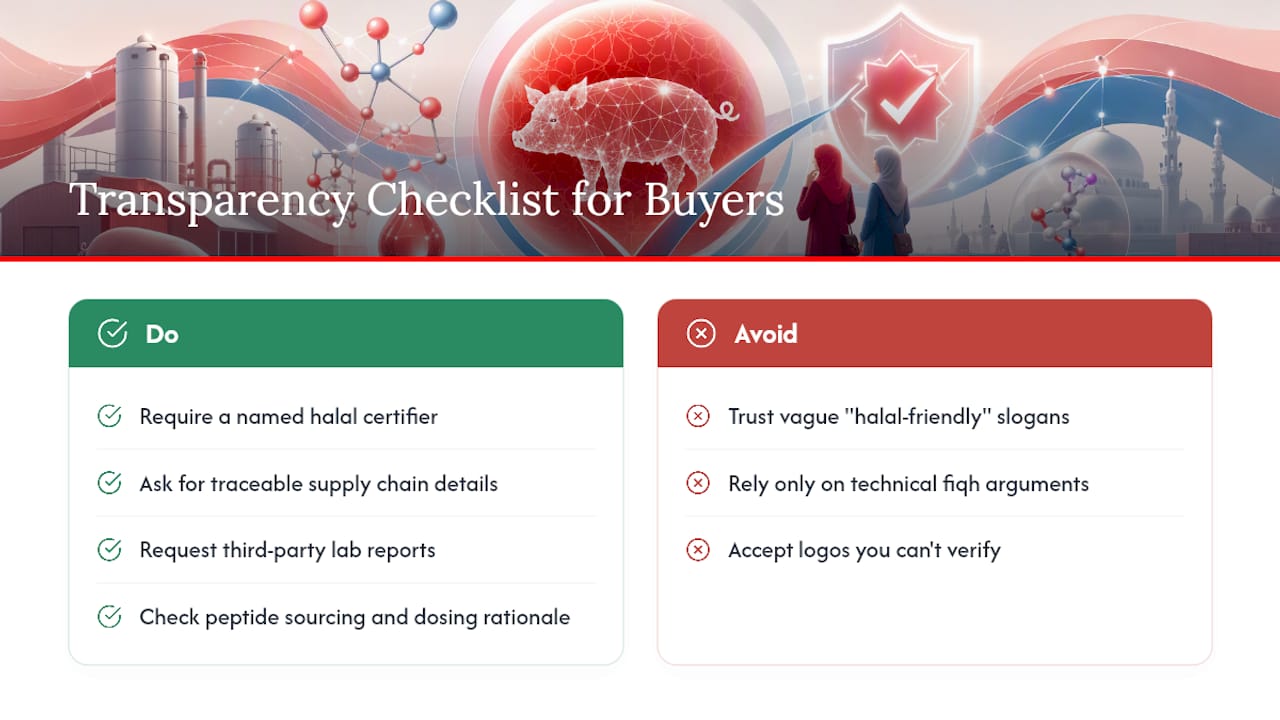
Trust in this category gets built through documentation, not slogans. Any brand can print “halal-friendly” on a label. Far fewer can show you a named certifier, a traceable supply chain, and a willingness to share testing data on request. That gap is exactly where health-conscious Muslim consumers should be spending their scrutiny.
Clinically researched formulations matter here for a reason beyond marketing appeal: when a brand discloses its peptide sourcing, dosing rationale, and manufacturing standards clearly, it removes a lot of the guesswork that usually falls on the consumer. Collagen peptide drinks built around this kind of transparency use patented peptides designed for direct bloodstream absorption, with ingredient sourcing and dosing disclosed rather than buried in vague blend terminology. That disclosure standard is what should form the operating baseline for any halal-conscious buyer.
“Practically, scholars recommend choosing products with clear halal certification and traceability rather than relying on technical fiqh arguments alone. Certification reduces dispute and gives peace of mind to consumers.” This guidance, drawn from Halalmed’s analysis of collagen in medicines, applies just as directly to supplements as it does to pharmaceuticals.
Formulators’ credentials, third-party lab reports, and specific certification documentation are the kind of detail that separates a brand worth trusting from one that simply says the right words. When a brand can point to that level of documentation on request, and not just as a marketing footnote, that’s the signal worth prioritizing over a logo you can’t independently verify. Look at how a brand talks about its own sourcing on its product-focused pages before you decide whether their transparency claims hold up under a closer look.
Why Certification Beats Guesswork Every Time
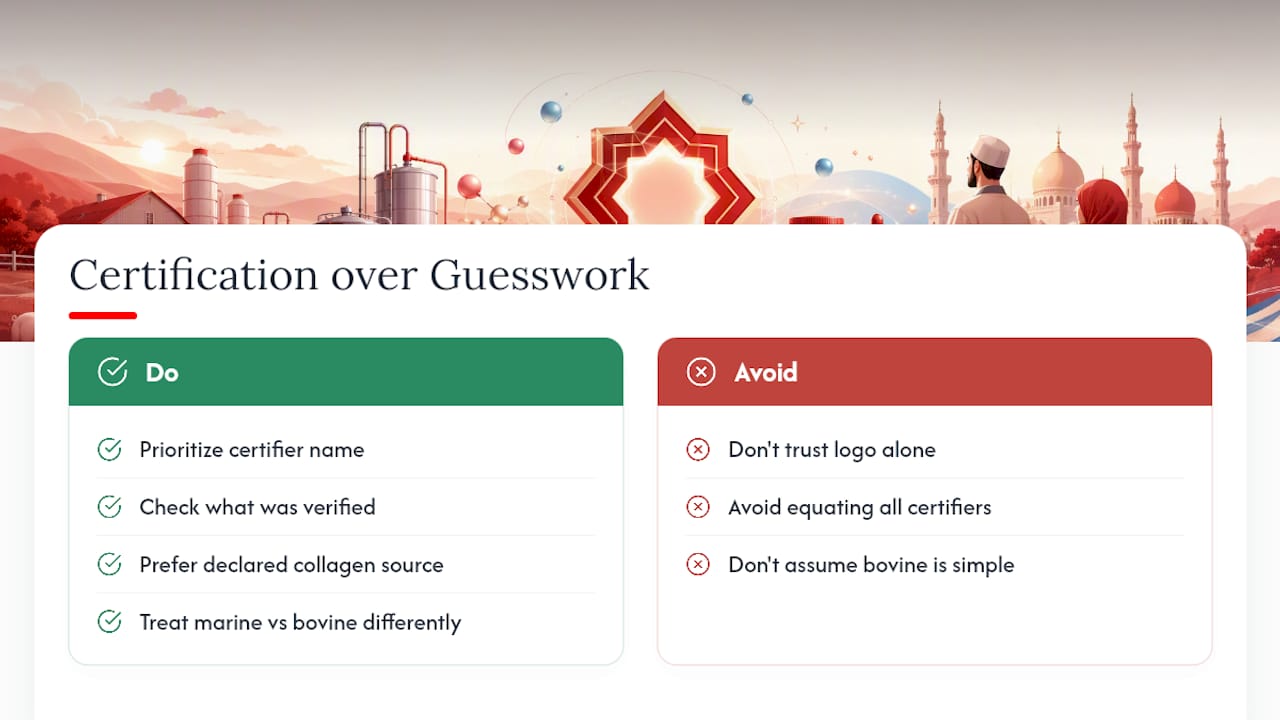
The conventional advice on this topic tends to stop at “check for a halal logo,” and honestly, that’s not enough anymore. What the research actually supports is a two-layer approach: religious certification from a named, credible body, paired with an understanding of what that certification did and didn’t verify. A JAKIM mark and a small local certifier’s mark aren’t interchangeable in rigor, even though they look similar on a package.
Where most guidance falls short is treating marine and bovine collagen as equally straightforward. They’re not. Marine collagen carries a much lighter burden of proof; bovine carries real, ongoing scholarly disagreement that certification exists specifically to resolve. If you take one thing from this article, prioritize the certifier’s name and the declared source over every other claim on the label. Dosing and bioavailability matter for effectiveness, but they’re secondary once you’ve confirmed a product actually clears the religious bar you’re shopping for in the first place.
*— From
Where to Find Halal-Minded Collagen From Fromwithin
If you’ve made it this far, you already know that finding a collagen product with real sourcing transparency, not just a vague “clean beauty” label, is half the battle. That’s exactly the gap Fromwithin was built to close: clinically researched collagen peptide drinks with ingredient sourcing and dosing disclosed plainly, no blend names hiding what’s actually in the bottle.
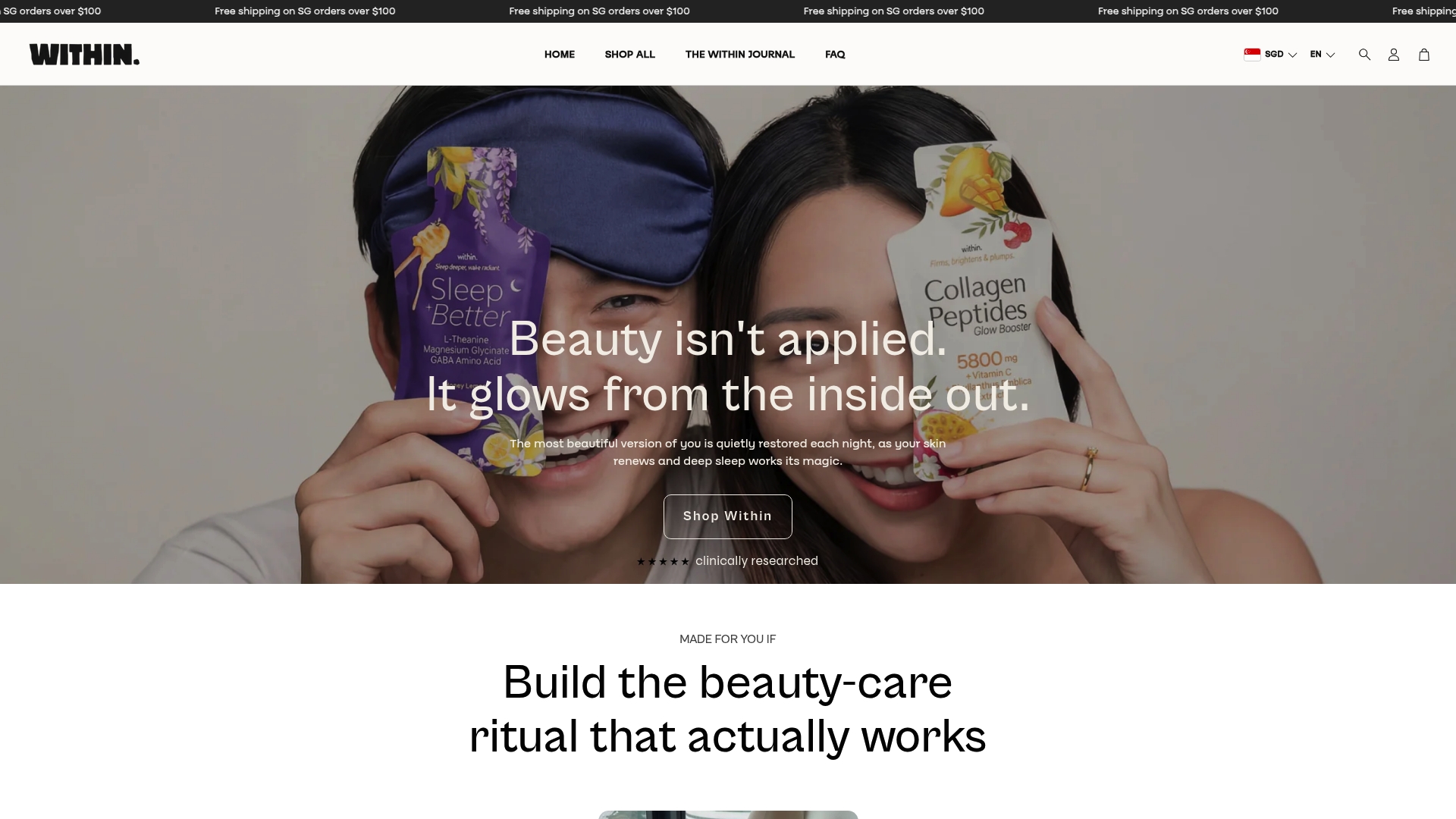
Our Collagen Peptides Glow Booster uses patented Wellnex® peptides formulated for direct bloodstream absorption, paired with the kind of ingredient transparency this whole article has been arguing for. You won’t find ambiguous “collagen blend” language on our packaging, and you can review full sourcing details before you buy, not after. Browse the full collagen line to compare formats and start your order today.
Where to Learn More About Halal Collagen Standards
A few sources are worth bookmarking if you want to dig deeper into this topic yourself:
- Halalmed’s guide to collagen in medicines breaks down the religious reasoning behind porcine and bovine rulings in plain language.
- The PRISMA systematic review on collagen and Islamic prescriptions is the most rigorous scientific summary available, covering both jurisprudence and laboratory authentication methods.
- Islamic Q&A guidance on marine collagen offers practical, everyday answers for consumers weighing fish-derived supplements.
- The Halalification knowledge base explains manufacturing and contamination risks in accessible terms.
This article is general information, not a substitute for advice from a qualified doctor. Consult a qualified healthcare professional about your own circumstances before acting on anything here.
Sources
Not all collagen is created, or extracted, the same way, and the manufacturing method matters almost as much as the source animal. Most commercial collagen shows up in one of two forms: hydrolyzed peptides, where the protein has been broken into small, easily absorbed fragments, or gelatin, which is a less-processed, larger-molecule version often used in capsules and gummies. Knowing which form you’re looking at helps you understand what questions to ask.
Bovine collagen can be entirely halal, but it depends on two things holding true at once. First, the cattle need to have been slaughtered according to zabiha. Second, the manufacturing facility needs to avoid cross-contamination with non-halal animal byproducts somewhere along the line. Look for label language like “sourced from halal-certified cattle” or a named certifying body printed directly on the packaging. Vague phrases like “beef-derived collagen” with no certification mark should raise a flag, not reassure you.
Marine collagen is generally the least controversial option on the shelf, and it’s become the default recommendation for a lot of Muslim consumers who want to skip the bovine debate entirely. It’s typically derived from fish skin and scales, byproducts of the seafood industry that would otherwise go to waste. The main risk isn’t the fish itself. It’s cross-contamination in shared manufacturing facilities that also process non-halal ingredients. A halal ingredient knowledge base on marine-sourced collagen notes that certification checks specifically look at whether processing lines and final products meet halal cleanliness standards, not just the raw fish source.
Porcine collagen is haram, full stop, and it’s also the sneakiest one to spot. Pig-derived collagen and gelatin show up in places you wouldn’t expect: some gummy vitamins, certain capsule shells, and low-cost supplement lines that don’t disclose sourcing clearly on the front label. If a product simply says “collagen” with no species named anywhere, porcine origin is a real possibility, especially with cheaper imports.
Recombinant and plant-based alternatives are the newest entries in this space, and they sidestep the whole question of animal slaughter. Recombinant collagen is produced using genetically engineered yeast or bacteria that manufacture human-identical collagen proteins without any animal tissue involved. Plant-based “collagen boosters” typically don’t contain actual collagen at all. Instead, they supply the amino acids and cofactors (like vitamin C and proline) your body needs to produce its own collagen. Commercial availability for true recombinant collagen is still limited compared to bovine and marine options, but it’s worth watching as the category matures.
Here’s a quick reference for the four main categories:
- Collagen in medicines: additional Islamic information — Halalmed
- Animal-derived collagen and Islamic religious prescriptions: a systematic review (PRISMA) — Springer
- I am taking marine collagen supplements for health reasons — islamic Q&A
- Is collagen from marine sources halal? — Halalification knowledge base
