

on July 03, 2026

Stopping overthinking at bedtime means training your mind to release the day’s mental load before sleep, rather than replaying it on a loop. If you’ve ever stared at the ceiling with your thoughts racing through tomorrow’s to-do list, you already know how much this disrupts real rest. The good news is that you don’t need a complicated ritual. A scheduled worry window of just 15–20 minutes earlier in the day, paired with simple techniques like the 4-7-8 breathing method and physical journaling, gives your brain a clear off-ramp. These stop overthinking bedtime relaxation steps work because they interrupt the anxiety cycle before it takes hold.
Why does overthinking happen at night?

Your brain doesn’t automatically switch off when you lie down. During the day, tasks and distractions keep anxious thoughts at bay. At night, with no competing input, the brain fills the silence with unresolved worries. This is sometimes called the “default mode network” activating, and it’s a normal neurological pattern, not a personal flaw.
Several triggers make nighttime overthinking worse:
- Blue light exposure from phones and laptops suppresses melatonin, the hormone that signals your body it’s time to sleep. Less melatonin means your nervous system stays in an alert state longer.
- Racing thoughts often spike when the sympathetic nervous system (your fight-or-flight response) hasn’t fully wound down from the day’s stress.
- Unresolved decisions left open in the evening keep the prefrontal cortex active, making it harder to shift into the relaxed state needed for sleep onset.
- Irregular routines remove the predictable cues your brain uses to recognize that sleep is coming.
Structured relaxation steps work by activating the parasympathetic nervous system, the body’s “rest and digest” mode. Breathing exercises, dim lighting, and consistent pre-sleep cues all send the same message to your brain: the day is done. Over time, your nervous system learns to respond to those cues automatically.
How to set up your bedroom to calm your mind
Your environment does a lot of the work before you even close your eyes. A bedroom that signals safety and calm makes it much easier to quiet racing thoughts.
-
Dim your lights 1.5–2 hours before bed. Dimming lights early supports natural melatonin production and begins shifting your nervous system toward rest. Bright overhead lights tell your brain it’s still daytime.
-
Put screens away 30–60 minutes before sleep. Blue light from phones and laptops delays melatonin release and keeps your mind alert. Swap scrolling for a physical book, light stretching, or quiet conversation.
-
Keep your bedroom between 60–67°F. Optimal sleep temperature sits in this range because your core body temperature needs to drop slightly for deep sleep to begin. A room that’s too warm fights that process.
-
Avoid vigorous exercise close to bedtime. High-intensity workouts near bedtime raise core temperature and alertness, which works against your body’s natural wind-down. A gentle walk or yoga is fine; a hard run is not.
Here’s a quick reference for the key environmental targets:
| Factor | Target |
|---|---|
| Light dimming | 1.5–2 hours before bed |
| Screen-free window | 30–60 minutes before bed |
| Bedroom temperature | 60–67°F (15–19°C) |
| Exercise cutoff | Avoid vigorous activity within 2–3 hours of sleep |
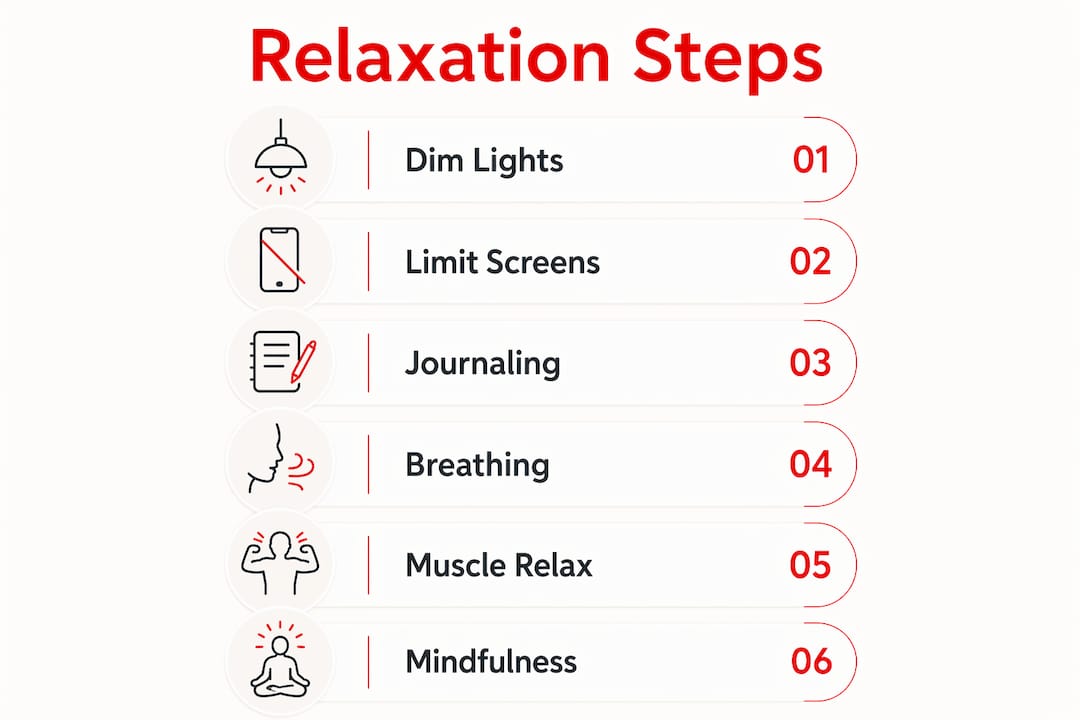
The goal is not a perfect setup every night. Pick one or two of these as your consistent anchors. Consistent cues work better than a long checklist because your brain learns to associate them with sleep, not stress.
Step-by-step relaxation techniques to quiet racing thoughts
These techniques are the core of any effective bedtime routine for people managing anxiety. You don’t need all of them. Start with one and build from there.
The 4-7-8 breathing technique
The 4-7-8 breathing method activates the parasympathetic nervous system and is one of the most well-documented ways to reduce physical tension quickly. Inhale through your nose for 4 counts, hold your breath for 7 counts, then exhale slowly through your mouth for 8 counts. Repeat this cycle 3–4 times. The extended exhale is what does the work. It slows your heart rate and signals your body that there is no threat.
Physical journaling to offload worries
Writing down your worries on paper before bed helps your brain release them rather than recycle them. Using paper and pen is deliberate here. A phone or laptop risks pulling you into notifications, news, or social media, all of which re-stimulate the nervous system. Keep a dedicated notebook on your nightstand. Write down what’s bothering you, then close the book. That physical act of closing it is a small but real psychological signal that the thought has been set aside.
Pro Tip: Don’t try to solve the problems you write down. Just list them. The goal is to move them from your head to the page, not to fix them at 10:30 PM.
Mindfulness and sensory anchoring
Mindfulness before bed doesn’t require a meditation app or a 30-minute session. It simply means redirecting your attention to what’s happening right now in your body. Notice the weight of the blanket, the temperature of the air, the sound of the room. When a worry thought appears, acknowledge it without engaging: “There’s that thought again.” Then return to your senses. This practice teaches your brain that thoughts are events to observe, not problems to solve immediately.
Progressive muscle relaxation
Start at your feet and work upward. Tense each muscle group for 5 seconds, then release. Move through your calves, thighs, stomach, hands, arms, shoulders, and face. The contrast between tension and release trains your body to recognize what relaxed actually feels like. Many people fall asleep before they finish.
Limit evening decisions
Every decision you make in the evening keeps your prefrontal cortex active. Lay out tomorrow’s clothes, prep your bag, and choose what you’ll have for breakfast before 8:00 PM. Removing small decisions from the late evening reduces the mental load your brain carries into bed.
How does a scheduled worry window reduce nighttime anxiety?
A worry window is a dedicated 15–20 minute block earlier in the day, set aside specifically for thinking through concerns. Scheduling worry time works because it gives your brain a legitimate outlet for anxious thoughts, so they don’t have to compete for attention at midnight.
Here’s how to use it effectively:
- Set a consistent time. Mid-afternoon works well for most people, far enough from bedtime that the anxiety doesn’t carry directly into sleep.
- Write down every worry during that window. Don’t judge or filter. Let the thoughts flow onto paper.
- When worries appear at night, redirect them. Tell yourself, “I’ve noted that. I’ll think about it at my worry time tomorrow.” This isn’t avoidance. It’s postponement with intention.
- Use cognitive shuffling if thoughts persist. This technique involves imagining a random sequence of unrelated images, a cat, a red door, a mountain, a spoon. The randomness disrupts the logical chain of anxious thinking and helps the brain drift toward sleep.
Pro Tip: If you’re unsure which relaxation technique to try first, just pick one and commit. Flip a coin if you have to. The act of choosing and sticking with it is more effective than endlessly searching for the perfect method, which is itself a form of overthinking.
The deeper principle here is that effective bedtime routines don’t aim to eliminate thoughts. They teach you to change your response to them. That shift in relationship with your own mind is what creates lasting calm.
Key Takeaways
Calming bedtime overthinking requires a consistent environment, a few targeted techniques, and the willingness to commit to one approach rather than searching for the perfect routine.
| Point | Details |
|---|---|
| Schedule a worry window | Set aside 15–20 minutes daily to process worries before evening arrives. |
| Prepare your environment | Dim lights 1.5–2 hours before bed and keep the room between 60–67°F. |
| Use the 4-7-8 breath | Inhale 4, hold 7, exhale 8 counts, repeated 3–4 times, to activate rest mode. |
| Journal on paper | Write worries in a physical notebook and close it to signal mental release. |
| Commit to one technique | Choosing and sticking with one method beats endlessly searching for the ideal one. |
What I’ve learned from years of watching people struggle with sleep
Here’s the honest truth I’ve come to after spending a lot of time thinking about sleep and stress: most people don’t have a relaxation technique problem. They have a permission problem. They feel like they haven’t earned rest yet, like there’s still something they should be doing, fixing, or planning. That guilt keeps the nervous system switched on long after the lights go out.
The techniques in this article work. But they work best when you pair them with a genuine decision to stop for the night. Not because everything is handled, but because rest is not a reward. It’s a requirement.
I’ve also noticed that people tend to overcomplicate their wind-down routines. They read about 12-step sleep rituals and feel defeated before they start. The research backs up what I’ve seen firsthand: simple emotional connection before bed, whether that’s a quiet conversation, a hug, or even a few minutes of gentle physical comfort, calms the nervous system more reliably than any elaborate protocol. Don’t underestimate that.
My honest advice is this: pick your two anchors, dim the lights and write in your notebook, and do them every night for two weeks. Don’t grade yourself. Don’t track your sleep score. Just show up for the routine. Consistency is the technique.
— From
Fromwithin’s sleep support for your wind-down routine
If you’ve built a solid bedtime routine and still find yourself lying awake, your body may need a little extra support from the inside.

Fromwithin’s sleep aid is formulated to support your body’s natural melatonin production without creating dependence on prescription sleep medications. It fits naturally into the kind of simple, consistent routine described here. You take it as part of your wind-down, alongside your breathing practice or journaling, and let it work with your body’s own signals rather than overriding them. If you’re curious whether a supplement might be the missing piece, the guide on signs you need a sleep supplement is a good place to start. Rest is worth investing in.
FAQ
What is the fastest way to stop racing thoughts at night?
The 4-7-8 breathing technique is one of the fastest ways to interrupt racing thoughts. Inhale for 4 counts, hold for 7, and exhale for 8, repeated 3–4 times, to activate the parasympathetic nervous system within minutes.
How long does a bedtime relaxation routine need to be?
A consistent routine of 15–20 minutes is enough for most people. Research shows that one or two reliable anchor habits, like dimming lights and a brief breathing exercise, outperform lengthy multi-step checklists.
Does journaling before bed actually help with anxiety?
Writing worries on paper before bed helps the brain offload unresolved thoughts rather than recycle them. Using a physical notebook instead of a phone avoids the screen stimulation that keeps the nervous system alert.
What bedroom temperature is best for sleep?
The Cleveland Clinic recommends keeping your bedroom between 60–67°F (15–19°C). Your core body temperature needs to drop slightly for deep sleep to begin, and a cooler room supports that process.
What is a worry window and how does it work?
A worry window is a scheduled 15–20 minute daily block for processing anxious thoughts, set earlier in the day. When worries appear at night, you redirect them to that future time, which reduces bedtime rumination without suppressing the thoughts entirely.
