

on July 07, 2026

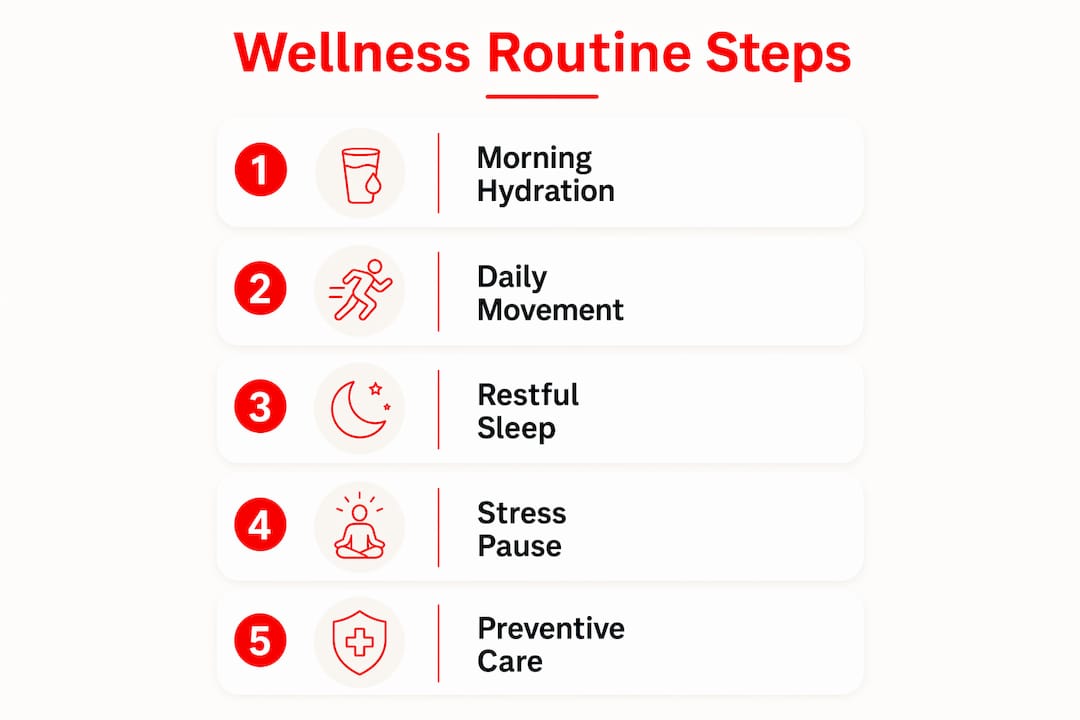
A wellness routine is defined as a structured, intentional set of daily habits that support your physical, mental, and emotional health. Think of it as your personal operating system for feeling good, not just avoiding illness. Research from Harvard Health shows that five healthy lifestyle habits can extend life expectancy by more than a decade after age 50. That single finding reframes what a wellness routine actually is: not a luxury, but a long-term investment in how well and how long you live. The four foundational pillars recognized by the NIH and Harvard are regular exercise, quality sleep, stress management, and preventive health care.
What is a wellness routine made of?
A wellness routine is built from repeatable daily behaviors that, taken together, create a stable foundation for health. No single habit does all the work. The power comes from combining several practices that reinforce each other.
Movement: the non-negotiable pillar
The physical activity target most supported by research is 150 minutes of moderate exercise per week. That breaks down to about 30 minutes on five days, which is genuinely manageable. Moderate-intensity movement includes brisk walking, cycling, swimming, or dancing. You do not need a gym membership or an hour-long class to hit this target.

Sleep: your body’s repair window
Adults need 7–9 hours of sleep per night to support cognitive function, immune health, and emotional regulation. Consistency in sleep and wake times is the most critical factor in maintaining your circadian rhythm. Irregular sleep schedules disrupt that rhythm and raise cortisol levels, which compounds stress over time.
Stress management: the overlooked daily practice
Brief stress pauses built into your day make a measurable difference. These do not need to be elaborate. A few minutes of quiet breathing, a short walk, or writing three sentences in a journal all count. Small daily pauses practiced consistently build resilience and reduce cumulative stress over weeks and months.
Preventive care and nutrition
Routine health screenings and vaccinations belong in your wellness plan, even when you feel fine. They catch problems early, which is far less disruptive than treating advanced conditions. Nutrition and hydration support every other pillar. Staying well-hydrated and eating mostly whole foods gives your body the raw materials it needs to recover, focus, and perform.
Pro Tip: Start a wellness routine by picking just one pillar to improve this week. Trying to fix sleep, exercise, and diet simultaneously is the fastest way to quit all three.
| Pillar | Recommended practice | Why it matters |
|---|---|---|
| Exercise | 150 minutes moderate movement weekly | Reduces chronic disease risk and boosts mood |
| Sleep | 7–9 hours with consistent timing | Supports circadian rhythm and emotional regulation |
| Stress management | Daily 5-minute pause (breathing, walking, journaling) | Lowers cortisol and builds long-term resilience |
| Preventive care | Annual screenings and vaccinations | Catches health issues before they become serious |
| Nutrition | Whole foods plus adequate hydration | Fuels recovery, focus, and physical performance |
How does a wellness routine support mental health?
A structured daily routine does something specific for your brain: it reduces the number of decisions you have to make. Daily routines reduce decision fatigue and create predictable rhythms that support emotional wellness. When your brain is not constantly choosing what to do next, it has more capacity to regulate mood and manage stress.
The research on movement and mental health is direct. Just 10–15 minutes of daily walking lowers stress levels by 18%. That is a meaningful reduction from a habit most people can fit into a lunch break or morning commute.
Mindfulness practice works on a neurological level. Fifteen minutes of daily mindfulness reduces stress-related amygdala activity over eight weeks. The amygdala is the brain’s alarm system. Calming it through consistent practice means you react less intensely to everyday stressors, which directly improves emotional stability.
“Mindful integration of everyday tasks, like brushing your teeth attentively or washing dishes with full attention, transforms mundane chores into mental health hygiene practices. This approach reduces stress and improves emotional stability without requiring any additional time in your day.” — Stanford Medicine
Screen time also shapes mental health in ways most people underestimate. Screen time exceeding two hours daily doubles anxiety risk among adolescents and quadruples behavioral difficulties. Scheduled digital breaks are not optional extras in a wellness routine. They are protective habits.
- Take a 10-minute screen-free break every 90 minutes of work
- Avoid screens for the final 30 minutes before bed
- Replace one daily scroll session with a short walk or breathing exercise
- Practice single-tasking: one screen, one task, one window at a time
Pro Tip: Set your phone to grayscale mode in the evening. Color is one of the primary design cues that keeps you scrolling. Removing it makes the screen noticeably less appealing.
What are the biggest misconceptions about building a routine?
The most damaging myth about wellness routines is that they must be rigid and perfect to work. They do not. Effective wellness routines must be flexible, adapting to your energy levels and daily priorities rather than locking you into a fixed schedule. Honoring your internal peaks and troughs reduces burnout and keeps you engaged long-term.
A second misconception is that habits and routines are the same thing. They are not. Habits are automatic responses triggered by cues. Routines are intentional sequences of behaviors you choose to repeat. Distinguishing between habits and routines helps you avoid decision fatigue, because a routine removes the need to decide whether to do something. You have already decided.
Here is how to build a sustainable routine without overwhelming yourself:
- Start with one anchor habit. Pick one existing behavior, like making coffee or sitting at your desk, and attach a new wellness behavior to it. This is called habit stacking. Anchoring new behaviors to existing daily anchors improves adoption rates significantly.
- Design a minimum viable routine. On low-motivation days, your routine should shrink, not disappear. A 5–10 minute base routine prevents the “all-or-nothing” thinking that leads to quitting entirely.
- Avoid the complete overhaul. Adding five new habits at once almost always fails. Add one habit, practice it for two weeks, then add the next.
- Experiment deliberately. Treat your routine like a personal experiment. If morning workouts leave you exhausted, try evenings. If journaling feels forced, try voice memos. The goal is a routine you will actually keep.
- Adjust without guilt. Missing a day is data, not failure. Ask what made the habit hard to do, then adjust the design.
Pro Tip: Write your minimum viable routine on a sticky note and put it somewhere visible. On hard days, that note is your permission slip to do the short version and still call it a win.
How can you create a wellness routine that fits your life?
Building a personal wellness routine starts with one honest question: what area of your health needs the most attention right now? Sleep, stress, movement, and nutrition all matter, but you cannot fix everything at once. Pick the pillar that would make the biggest difference and start there.
- Identify your top priority. Is it getting to sleep before midnight? Moving your body three times a week? Eating a real breakfast? Name it specifically.
- Set a small, measurable goal. “Exercise more” is not a goal. “Walk for 20 minutes on Monday, Wednesday, and Friday” is.
- Build in a backup plan. Life disrupts routines. Decide in advance what you will do when it does. If you miss your morning walk, will you take a 10-minute walk at lunch instead?
- Plan weekly, not daily. A weekly view gives you flexibility. If Tuesday is chaotic, you can shift your planned workout to Thursday without feeling like you failed.
- Track simply. A paper habit tracker, a notes app, or a simple calendar check mark all work. The goal is to see your streak and protect it.
| Approach | Best for | Limitation |
|---|---|---|
| Daily rigid schedule | People with predictable routines | Breaks down under life disruptions |
| Weekly flexible planning | Busy professionals and parents | Requires weekly review habit |
| Habit stacking only | Beginners adding one new behavior | Hard to scale beyond 2–3 habits |
| Minimum viable routine | Low-energy or high-stress periods | May feel too small to be motivating |
Social support accelerates consistency. Telling a friend about your routine, joining a walking group, or sharing progress with a partner creates accountability. Wellness activities also work better when they feel enjoyable, not punishing. If you hate running, you will not run. Find movement you genuinely like and build from there.
Pro Tip: Schedule your wellness activities the same way you schedule meetings. Put them in your calendar with a specific time. Vague intentions do not survive a busy week.
Key takeaways
A wellness routine is most effective when it is consistent, flexible, and built around your actual life rather than an idealized version of it.
| Point | Details |
|---|---|
| Definition matters | A wellness routine is a structured set of daily habits covering exercise, sleep, stress, and preventive care. |
| Science backs the basics | Five healthy lifestyle habits can extend life expectancy by more than a decade after age 50. |
| Mental health benefits are direct | Ten to fifteen minutes of daily walking lowers stress by 18%, making movement a mental health tool. |
| Flexibility prevents quitting | A minimum viable routine of 5–10 minutes keeps you engaged on low-motivation days. |
| Start small and stack | Anchoring new habits to existing daily behaviors is the most reliable way to build consistency. |
Why I think “perfect routine” culture is holding you back
Here is something I have seen repeatedly: people spend more time designing their ideal wellness routine than actually doing it. They research the perfect morning schedule, buy the right journal, and plan a six-habit sequence. Then one hard week hits, and the whole thing collapses because it was built for a frictionless life that does not exist.
Wellness is an ongoing relationship with your daily habits, not a destination you reach. The goal is not to execute a flawless routine. The goal is to stay in the game long enough for the habits to compound. An imperfect routine you do consistently beats a perfect one you abandon after three weeks.
I have also noticed that the people who sustain wellness habits long-term treat setbacks as information, not failure. They ask “what made this hard?” and adjust. They do not restart from zero. They pick up where they left off.
The most underrated wellness practice is also the simplest: paying attention to what you are already doing. Brushing your teeth mindfully, walking to your car with your phone in your pocket, drinking your morning water before checking email. These micro-moments of presence add up. They do not require extra time. They just require intention.
Build what works for you, not what looks good on someone else’s social media. Your routine is a tool, not a performance.
— From
How Fromwithin supports your wellness routine

A wellness routine covers a lot of ground, and supplements can fill the gaps that diet and habits alone sometimes miss. Fromwithin specializes in clinically researched products designed to support two of the most important wellness pillars: sleep and skin health from the inside out.
The Fromwithin sleep aid is formulated to promote natural relaxation without dependence on prescription medications, making it a practical addition to any evening wind-down routine. For skin and joint support, Fromwithin’s collagen products use patented Wellnex® peptides that absorb directly into the bloodstream for real, visible results. You can also explore the full range of wellness supplements to find what fits your personal routine.
FAQ
What is a wellness routine in simple terms?
A wellness routine is a set of daily habits you practice consistently to support your physical, mental, and emotional health. It typically includes movement, sleep, stress management, and preventive care.
How long does it take to build a wellness routine?
Research on habit formation suggests new behaviors become automatic after several weeks of consistent practice. Starting with one small habit and building gradually produces more lasting results than overhauling your entire schedule at once.
What are the best wellness activities for beginners?
A 15–20 minute daily walk, a consistent sleep schedule, and one brief stress pause per day are the most accessible starting points. These three practices address movement, circadian health, and stress management without requiring equipment or major time commitments.
How does sleep fit into a wellness routine?
Sleep is one of the four foundational wellness pillars. Adults need 7–9 hours per night, and consistent sleep timing matters as much as total duration. Poor sleep disrupts every other wellness habit, including mood, appetite, and motivation to exercise.
Can a wellness routine improve mental health?
Yes. Structured daily routines reduce decision fatigue and support emotional stability. Even brief practices like 10–15 minutes of walking or mindfulness lower measurable stress markers, making mental health support one of the clearest benefits of a consistent wellness routine.
