

on August 17, 2026

The best time to take collagen is whenever you’ll actually take it every single day. Not 7 AM sharp. Not “right before bed, no exceptions.” Just a moment you can realistically repeat, day after day, for at least two months.
That’s the honest answer, and I know it’s not as satisfying as a precise clock time. But here’s what the research actually supports: consistency is the variable tied to results, not the hour on your phone. Clinical trials on skin typically use daily doses of 5 to 10 grams, with visible improvement showing up after a minimum of about 8 weeks of steady use. Joint and recovery goals often call for 2.5 to 15 grams daily, depending on what you’re chasing.
If you want a starting point today, pick one of these:
- Morning routine: Stir it into coffee or a smoothie right after you wake up. Good for skin, hair, and nails, and easiest to remember.
- Pre or post-workout: Take it 30 to 60 minutes before or after resistance training if your goal is joint or connective tissue support.
- Bedtime routine: Take 15 grams about an hour before sleep. A small crossover trial found this dose reduced overnight awakenings and supported next-day cognitive performance in physically active men.
Pro Tip: Set a recurring phone reminder for the exact moment you’re most likely to follow through, whether that’s when you brew coffee or when you brush your teeth at night. The habit trigger matters more than the hour.
Key Takeaways
Collagen works best when a consistent daily dose matched to your specific goal is paired with realistic patience through at least an 8 to 12 week window.
| Point | Details |
|---|---|
| Pick a repeatable time | Choose morning, pre/post-workout, or bedtime based on your goal, and stick to it daily. |
| Match dose to goal | Use 2.5–5 g for maintenance, 5–10 g for skin, and 10–15 g for joints or the sleep protocol. |
| Pair with vitamin C | Vitamin C supports your body’s own collagen synthesis and is easy to add to any dose. |
| Track for 8–12 weeks | Use photos, a stiffness scale, or a sleep log rather than judging results too early. |
| Ask a clinician when needed | Pregnancy, kidney or liver disease, and current medications all warrant a quick check-in first. |
| Try Fromwithin’s Glow Booster | Its single-serve format and Wellnex® peptide delivery fit either a morning or bedtime routine described above. |
Table of Contents
- How Collagen Absorption Actually Works (and Why the Clock Matters Less Than You Think)
- When to Take Collagen for Skin, Joints, Muscle Recovery, Hair, and Sleep
- Collagen on an Empty Stomach, With Food, or in Coffee?
- How Much Collagen to Take and When You’ll Actually See Results
- Collagen Side Effects, Medication Interactions, and Who Should Ask a Doctor First
- Fitting Collagen Into Fasting, Travel, and a Protein-Heavy Routine
- What the Clinical Trials Actually Show (and Where They Fall Short)
- Why I Think Most Collagen Advice Gets the Timing Question Backward
- How Fromwithin’s Collagen Fits the Routine You Just Read About
- Sources
How Collagen Absorption Actually Works (and Why the Clock Matters Less Than You Think)
Collagen doesn’t work like a painkiller, hitting your system and fading within hours. Hydrolyzed collagen peptides break down into small amino acid chains during digestion, and those amino acids circulate in your bloodstream for hours after you drink them, feeding tissue repair well past whatever moment you swallowed the dose.

That’s a meaningful difference from whole, undenatured collagen or gelatin, which digest more slowly and less completely. Hydrolyzed collagen is generally the more absorbable form, which is one reason most supplement peptides on the market, including ours, use the hydrolyzed version.
Skin remodeling, joint repair, and connective tissue adaptation are cumulative processes. Your body doesn’t rebuild collagen fibers in a single afternoon. It happens gradually, across weeks, as amino acids get recruited into new tissue over and over. Protein digestion research backs this up: peptides stay bioavailable in circulation long enough that hitting an exact hour is far less important than showing up daily.
The amino acids from a single serving of collagen remain available to your tissues for hours, not minutes. Daily repetition, not precise timing, is what drives the cumulative rebuilding that shows up as visible improvement.
There are exceptions where timing does shift outcomes a little:
- Taking collagen close to a workout appears to support connective tissue and muscle adaptation in trials that paired collagen with resistance training.
- Taking it an hour before bed is the specific protocol behind the sleep-quality findings mentioned above, not a random guess.
So does it matter if you take collagen on an empty stomach or right after lunch? A little, for comfort and tolerance, but not for whether it “works.” That question deserves its own section, coming up shortly.
When to Take Collagen for Skin, Joints, Muscle Recovery, Hair, and Sleep
Your goal should decide your dose and your window a lot more than any universal “best hour” ever will. Here’s how to match the two.
-
Skin. Take 5 to 10 grams daily, any time, but at the same time. RCTs on skin elasticity and hydration don’t show a clear morning-versus-evening advantage. What they consistently show is that people who take it every day for at least 8 weeks see visible change, while inconsistent users don’t. Pro Tip: Pair your skin dose with a vitamin C source in the same meal. Vitamin C is a cofactor your body needs to actually synthesize new collagen, so skipping it can blunt what you’re paying for.
-
Joints and tendons. Aim toward the higher end, 10 to 15 grams, and time it around activity. Practitioner guidance frequently recommends taking collagen 30 to 60 minutes before or shortly after resistance exercise to support the connective tissue that takes the load during training. Pro Tip: If your joint pain flares after specific activities like running or climbing stairs, take your dose before those sessions rather than a generic morning slot.
-
Muscle recovery. The exercise window matters here more than in almost any other use case. Studies pairing collagen with structured resistance training programs report strength and body composition improvements when the supplement is taken around training sessions, though results vary by population. Pro Tip: Don’t assume collagen replaces your post-workout whey shake. Think of it as a supporting player for tendons and ligaments, not your primary recovery protein.
-
Hair and nails. Lower doses, often in the 2.5 to 5 gram range, tend to be sufficient. Because there’s no exercise or sleep mechanism at play here, a simple morning habit, stirred into breakfast or coffee, works fine. Pro Tip: Hair growth cycles are slow. Give this at least 12 weeks before judging whether it’s doing anything, since new growth takes time to become visible at the surface.
-
Sleep. Take 15 grams about one hour before bed. This is the one goal where a specific window is actually backed by a controlled trial: a small crossover study in physically active men found this exact protocol reduced nighttime awakenings and improved next-day cognitive performance. The theorized mechanism involves glycine, an amino acid abundant in collagen that has calming, sleep-supportive properties. Pro Tip: Treat this as a promising option worth trying, not a guarantee. The sample was small and specific to active men, so if it doesn’t move your sleep quality, that doesn’t mean something’s wrong with you.
Collagen on an Empty Stomach, With Food, or in Coffee?
You don’t need to overthink this one. Collagen peptides are already broken down small enough that they don’t require special digestive conditions to absorb.
Some people take collagen on an empty stomach because amino acids may show up in the bloodstream slightly faster without other food competing for digestion. If you tend to have a sensitive stomach, though, taking collagen with a meal is often better tolerated than knocking it back first thing before you’ve eaten anything.
Here’s a simple way to decide:
- Empty stomach: Choose this if you want a marginally quicker rise in circulating amino acids and your gut handles it fine.
- With a meal: Choose this if you notice any bloating or discomfort on an empty stomach, or if mixing it into oatmeal or a smoothie is just easier to remember.
- In coffee or tea: Both work. Heat doesn’t meaningfully degrade hydrolyzed collagen peptides, so your morning latte is a legitimate delivery vehicle.
- Caffeine at bedtime: If you’re using the 15 gram before-bed protocol, skip caffeinated tea. It defeats the purpose of a wind-down ritual.
Pro Tip: Pair your dose with a vitamin C source, whether that’s orange juice, a supplement, or citrus in a salad. Vitamin C is a required cofactor for your body’s own collagen production, so combining the two is one of the easiest upgrades you can make to a basic routine.
How Much Collagen to Take and When You’ll Actually See Results
Dose depends entirely on why you’re taking it, and expecting results too early is the most common reason people quit before collagen has a chance to work.
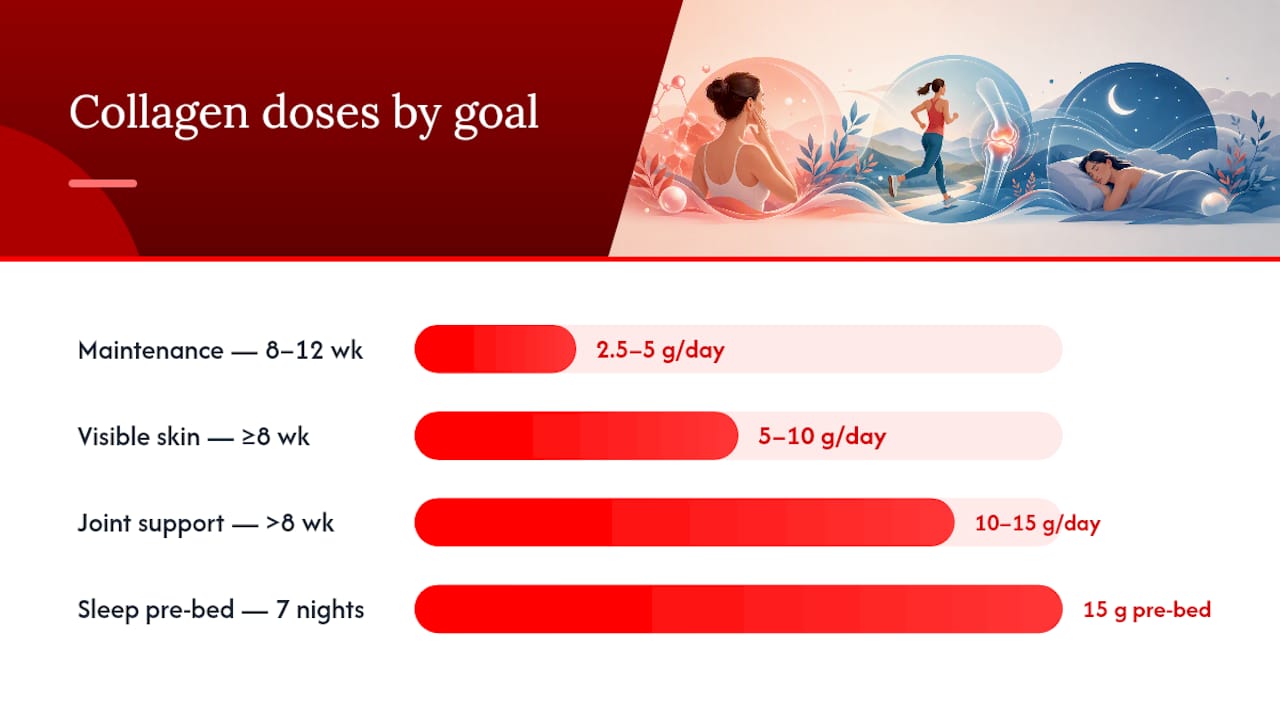
For general skin maintenance, 2.5 to 5 grams daily is a reasonable baseline. For more visible skin, hair, or nail changes, most RCTs land in the 5 to 10 gram range. Joint support and the sleep protocol both climb toward the 10 to 15 gram end of the spectrum.
Should you split your dose or take it all at once? Single dosing is simpler and works for most people. Splitting, say half in the morning and half in the evening, can help if you’re targeting the higher end of the range and want to ease digestive tolerance, or if you’re combining a skin dose with a separate bedtime sleep dose.
| Dose | Common Goal | Typical Timeframe to Notice Results |
|---|---|---|
| 2.5–5 g/day | General maintenance, hair, and nails | 8–12 weeks |
| 5–10 g/day | Visible skin elasticity and hydration | At least 8 weeks |
| 10–15 g/day | Joint support and recovery | Often longer than 8 weeks, varies by individual |
| 15 g, 1 hour before bed | Sleep quality (small trial population) | Effects observed within 7 nights in the study |
Track progress with something more objective than a mirror glance. Take a monthly photo in the same lighting, note joint stiffness on a simple 1 to 10 scale, or log how many times you wake up overnight if sleep is your target. Two months of tracking will tell you far more than two weeks of guessing.
Collagen Side Effects, Medication Interactions, and Who Should Ask a Doctor First
Collagen is generally well tolerated. Mild digestive symptoms like bloating or a heavy feeling are the most commonly reported side effects, and switching to a smaller dose or taking it with food usually resolves them.
A few groups should check with a clinician before starting:
- Pregnant or breastfeeding individuals should get personalized guidance rather than relying on general dosing advice.
- Anyone with kidney or liver disease needs medical input, since protein metabolism places extra load on these organs.
- People using high-calcium collagen formulations should be cautious if they already have elevated calcium levels or a related condition.
- People with fish, shellfish, or egg allergies need to check the collagen source. Most peptide supplements come from bovine, marine, or poultry sources, and marine collagen in particular can trigger shellfish or fish allergies in sensitive individuals.
One question that comes up often: does collagen interact with SSRIs or other medications? The evidence here is genuinely limited. There’s no strong signal that collagen peptides interfere with common antidepressants, but that absence of data isn’t the same as a clean bill of health. If you’re on any prescription medication, run your supplement plan by the prescriber rather than assuming it’s automatically fine.
Worth noting separately: plant-based “collagen boosters” (usually vitamin C, biotin, and amino acid blends) aren’t actual collagen. They may support your body’s own production, but they don’t supply the same peptides that hydrolyzed animal-derived collagen does.
Fitting Collagen Into Fasting, Travel, and a Protein-Heavy Routine
Intermittent fasting throws a wrench into a lot of supplement routines, and collagen is no exception. If you’re doing a strict fast for metabolic reasons like autophagy research protocols, a 5 to 15 gram dose does contain calories and amino acids, technically breaking a zero-calorie fast. If your fasting goal is more about meal timing than strict metabolic purity, a small collagen dose inside your eating window is simpler and won’t meaningfully derail your goals.

Travel disrupts routines fast, especially across time zones. The fix isn’t complicated: anchor your collagen dose to your local morning or local bedtime, whichever slot matches your usual habit, and let your body clock adjust around it rather than trying to preserve your home time zone’s schedule.
Collagen is an incomplete protein, missing tryptophan, so it shouldn’t replace your primary protein source. If you already drink a whey or plant protein shake after workouts, collagen works better as a separate, smaller addition earlier or later in the day rather than crowding the same serving.
Two simple templates to copy:
- Morning routine: Wake up, make coffee, stir in 5 to 10 grams of collagen peptides plus a splash of orange juice for vitamin C. Done before you’ve even checked your phone.
- Evening routine: About an hour before bed, mix 15 grams of collagen into warm water or a non-caffeinated tea, dim the lights, and treat it as a two-minute wind-down cue rather than just a supplement.
Pro Tip: If you’re stacking a bedtime collagen dose with a skin-focused morning dose, that’s fine. Just make sure your total daily intake stays within the ranges backed by the research for your specific goal, rather than doubling up out of impatience.
What the Clinical Trials Actually Show (and Where They Fall Short)
Here’s the honest state of the evidence, without oversell.
- A small crossover trial tested 15 grams of collagen peptides one hour before bed for seven nights in physically active men, finding reduced awakenings and better next-day cognitive performance.
- Trials examining collagen combined with resistance training report strength and body composition improvements, though protocols and populations vary considerably between studies.
- Skin-focused RCTs generally use doses around 10 grams daily and report visible improvements starting around the 8 week mark.
| Study Focus | Dose Used | Population | Main Finding |
|---|---|---|---|
| Sleep and cognition | 15 g, 1 hour before bed | Physically active males | Reduced overnight awakenings, improved next-day cognitive performance |
| Muscle and recovery | Varies by protocol | Adults in resistance training programs | Strength and body composition gains when combined with training |
| Skin elasticity | ~10 g daily | Adults, general population | Visible improvement after roughly 8+ weeks of daily use |
The honest limitation across this research: sample sizes tend to be small, trial durations are often short relative to how slowly tissue actually remodels, and the specific population studied (frequently athletic men) doesn’t automatically generalize to everyone. A 2019 review of collagen supplementation put it plainly.
The benefits of collagen supplementation for skin and joint health are biologically plausible and supported by early trials, but the field needs larger, longer, and more standardized studies before the evidence can be considered definitive.
That’s not a reason to dismiss collagen. It’s a reason to treat the guidance in this article as evidence-informed practical advice, not settled science, and to judge your own results with realistic patience.
Why I Think Most Collagen Advice Gets the Timing Question Backward
Most articles on this topic spend 2,000 words building suspense around whether morning or night is “better,” then quietly admit at the end that it doesn’t matter much. I’d rather just tell you that upfront and spend the real estate on what actually moves the needle: dose accuracy and habit design.
Here’s what I think gets underestimated. People treat the bedtime sleep protocol as if it’s the universal answer, because “collagen before bed” sounds soothing and complete. But that 15 gram, hour-before-bed routine comes from one small trial in physically active men. It’s a legitimately useful option if sleep is your specific goal, not a default everyone should copy regardless of what they’re actually trying to fix.
The bigger blind spot is dose creep. People start at 5 grams, feel nothing after two weeks, bump to 10, still feel nothing after three weeks, and quit right before the 8 week mark where skin studies actually start showing change. Impatience, not timing, is the real reason most people conclude collagen “doesn’t work” for them.
If I were building a routine from scratch, I’d pick the goal first, match the dose to that goal using the ranges above, then build the timing around whatever moment I could genuinely sustain for three months. That’s a duller answer than “take it at 7 PM for best results,” but it’s the one the trials actually support.

How Fromwithin’s Collagen Fits the Routine You Just Read About
Everything above points to the same conclusion: pick a dose that matches your goal, pick a time you’ll repeat daily, and give it real weeks before judging results. Our Collagen Peptides Glow Booster is built for exactly that kind of routine, single-serve and easy to mix into morning coffee or a bedtime warm drink, depending on which slot you’re more likely to keep.

What sets it apart from a generic tub of powder is the patented Wellnex® peptide delivery, formulated to absorb efficiently rather than sit heavy in your gut before your body can use it. If skin elasticity is your main target, our full collagen lineup lays out ingredient sourcing and dosing clearly on each product page, so you’re not guessing what’s actually in the bottle. And if your goal is the evening wind-down side of this article rather than skin, our non-melatonin sleep aid is designed for that exact routine without leaning on hormonal dependence.
Start by picking your goal, then check the relevant product page for the dose that matches it.
Sources
- PubMed: 37874350 (collagen peptides and sleep study)
- Verywell Health: Best time to take collagen
- PMC: Collagen supplementation review (2019)
- EatingWell: Best time to take collagen
- PubMed: 33742704 (collagen + resistance training trials)
These sources were chosen because they combine peer-reviewed trial data with clinical guidance from recognized medical institutions, giving you evidence you can actually verify rather than secondhand claims.
This article is general information, not a substitute for advice from a qualified doctor. Consult a qualified healthcare professional about your own circumstances before acting on anything here.
