

on August 19, 2026

Oral collagen peptides can support hair health for some people, but the evidence for reliable, dramatic regrowth is still thin. One small human trial found a 27.6% increase in hair density and a 31.9% jump in perceived hair appearance after 12 weeks of daily hydrolyzed collagen. Cleveland Clinic and Harvard Medical School both stop short of calling collagen a hair-growth treatment, and that gap between the marketing and the research matters.
If you’re dealing with brittle strands, age-related thinning, or a diet that’s light on protein, you’re the person most likely to notice a difference. If your hair loss follows a clear hereditary pattern, like classic androgenetic alopecia, collagen probably isn’t going to move the needle the way a medical treatment would.
Here’s the practical version: pick a hydrolyzed collagen peptide, ideally marine-sourced or a studied peptide like Verisol®, commit to at least 12 weeks, and track it. Take a baseline photo of your part line today, jot down how much hair collects in your brush each week, and check back in three months. That’s the whole experiment.
Key Takeaways
Collagen peptides may modestly support hair density and texture in some people over a 12-week trial, but they are not a proven substitute for medical hair-loss treatment.
| Point | Details |
|---|---|
| Evidence is real but limited | Small trials show density and appearance gains, but sample sizes and study designs fall short of drug-level proof. |
| Hydrolyzed form is essential | Only hydrolyzed collagen peptides absorb into the bloodstream well enough to reach tissues like hair and skin. |
| Run a 12-week minimum trial | Structural changes take time; most positive studies required 12 to 24 weeks of consistent daily use. |
| Rule out medical causes first | Sudden or patterned shedding warrants a clinician visit before assuming a supplement will fix it. |
| Choose studied peptide blends | Fromwithin’s Wellnex® peptides offer transparent, clinically oriented formulation for readers starting a collagen trial. |
Table of Contents
- What Does the Research Say About Collagen for Hair?
- How Might Collagen Support Hair Growth?
- What Do the Key Human Trials Actually Show?
- Which Type of Collagen Actually Matters for Hair?
- How Much Collagen Should You Take, and for How Long?
- What Should You Check Before Buying a Collagen Product?
- What Are the Risks and Who Should Talk to a Doctor First?
- When Should You Consider Medical Treatment Instead?
- How Do You Actually Start a Collagen Trial for Your Hair?
- Why We Focus on Clinically Studied Peptides
- Ready to Try a Clinically Studied Peptide?
- Frequently Asked Questions
- Sources
What Does the Research Say About Collagen for Hair?
The honest answer is: promising, but not proven at scale. Most of what we know comes from a handful of small trials, a few animal studies, and some reasonable biological theory, not the kind of large, multi-year trials that back drugs like minoxidil or finasteride.
Finasteride is FDA-indicated for men only. Women who are or may become pregnant must not handle crushed or broken finasteride tablets, due to the risk of harm to a male fetus. It can also cause sexual side effects (reduced libido, erectile dysfunction) in a minority of men, which usually resolve after stopping treatment. Discuss these risks with a physician before starting.
Here’s what the human evidence actually shows:
- A 12-week trial of oral hydrolyzed collagen peptides reported a 27.6% increase in hair density along with participants rating their hair’s appearance 31.9% better than at baseline.
- A randomized, assessor-blinded trial combining marine hydrolyzed collagen with amino acids and micronutrients found that 50% of people using the supplement alongside standard hair-loss drugs reached a Global Assessment Score of 2 or higher, compared with just 23% on drugs alone.
- A related nail study using 2.5 g/day of Verisol® for 24 weeks showed a 12% increase in nail growth rate and 42% fewer broken nails, with 80% of participants reporting visibly better nails.
That nail data isn’t about hair directly, but it matters here. Nails and hair are both keratin-based structures built from similar amino acid pools, so seeing collagen peptides measurably strengthen one gives some indirect support for the other.
Pro Tip: Don’t chase the biggest percentage in a study without checking the sample size. A 27.6% increase sounds huge, but small trials swing more dramatically than large ones, and that number needs to be replicated in bigger studies before it becomes a guarantee.
Now for the limitations, because they’re real. These trials tend to run on small groups, often a few dozen participants, over 12 to 24 weeks. Several rely on how people feel their hair looks (subjective, perceived improvement) rather than objective measurements like phototrichograms. A few were funded by the companies selling the peptide blend being tested, which doesn’t invalidate the results but does mean you should read them with a slightly more skeptical eye. Harvard Health has noted that there’s little direct human evidence tying oral collagen to hair growth, and Mayo Clinic researchers echo that caution, pointing back to a balanced, protein-rich diet as the more dependable foundation.
Compare that to minoxidil and finasteride, both of which carry decades of large, placebo-controlled trials and FDA approval behind them. Collagen isn’t in that league yet. Think of it less as a replacement for medical hair-loss treatment and more as a supportive layer, especially useful if your diet or age is working against your hair’s baseline health.
How Might Collagen Support Hair Growth?
Collagen doesn’t work on hair the way a drug does, by blocking a hormone or triggering a specific receptor. It works more like raw material delivery. Collagen breaks down into amino acids, mainly proline, glycine, and hydroxyproline, that your body can use to build keratin (the protein your hair is actually made of) and maintain the extracellular matrix that supports hair follicles.

That’s the indirect mechanism. But there’s also a more direct one showing up in preclinical work. Lab and mouse studies on fish-derived collagen peptides found they increased proliferation of dermal papilla cells (the cells at the base of each follicle that control hair growth cycles), upregulated the Wnt/β-catenin signaling pathway, and raised VEGF and IGF-1 levels while lowering TGF-β1. In plain terms: those pathway shifts are associated with pushing follicles into the active growth (anagen) phase and improving blood supply to the follicle. In that mouse study, one fish collagen peptide fraction even produced a hair-growth index comparable to finasteride.
That’s genuinely interesting science, but it’s mice and cell cultures, not confirmed human mechanism. And absorption matters more than most people realize. Whole collagen protein is too large to be absorbed intact, which is why hydrolyzed collagen (broken into smaller peptide chains) is the form that actually shows up in your bloodstream in usable amounts, according to research on collagen peptide absorption.
One honest caveat: your body doesn’t know you bought collagen for your hair. Amino acids get distributed wherever they’re needed most, skin, joints, gut lining, muscle repair. There’s no guarantee your hair follicles get first pick.
What Do the Key Human Trials Actually Show?
Reading past the headline percentages helps you judge whether a study’s results apply to your situation. Here’s how the major trials stack up side by side.
A few patterns are worth flagging:
- The strongest human result (27.6% density) comes from a single, small, mostly self-reported study, not a large replicated trial.
- The adjunct trial is arguably the most clinically useful one, since it tested collagen alongside drug therapy, which mirrors how most dermatologists would actually recommend using it.
- The Verisol® data is about nails, not scalp hair. It’s relevant because it demonstrates the peptide can meaningfully affect keratin-based tissue, but it isn’t direct proof of hair regrowth.
- None of these trials isolate collagen peptides against a true placebo over 24+ weeks with objective phototrichogram measurements in a large cohort. That’s the study that doesn’t exist yet.
Multi-ingredient formulas are common in this research, and that’s a real problem for attribution. When a supplement combines marine collagen with iron, selenium, and amino acids like methionine and cysteine, you can’t cleanly credit the collagen alone for the outcome. It’s entirely possible the iron correction (a known driver of hair shedding when deficient) did most of the work.
Which Type of Collagen Actually Matters for Hair?
Not all collagen is created equal, and the source you pick changes both how well your body absorbs it and what you need to watch out for.
Marine (fish) collagen tends to have a smaller molecular structure than mammalian sources, which several dermatology reviewers point to as a reason it’s often favored in beauty formulations for higher bioavailability. It also comes with a lower inflammatory profile in some comparisons and sidesteps religious or ethical restrictions tied to bovine or porcine sourcing. The tradeoff: if you have a fish or shellfish allergy, this is not your category.
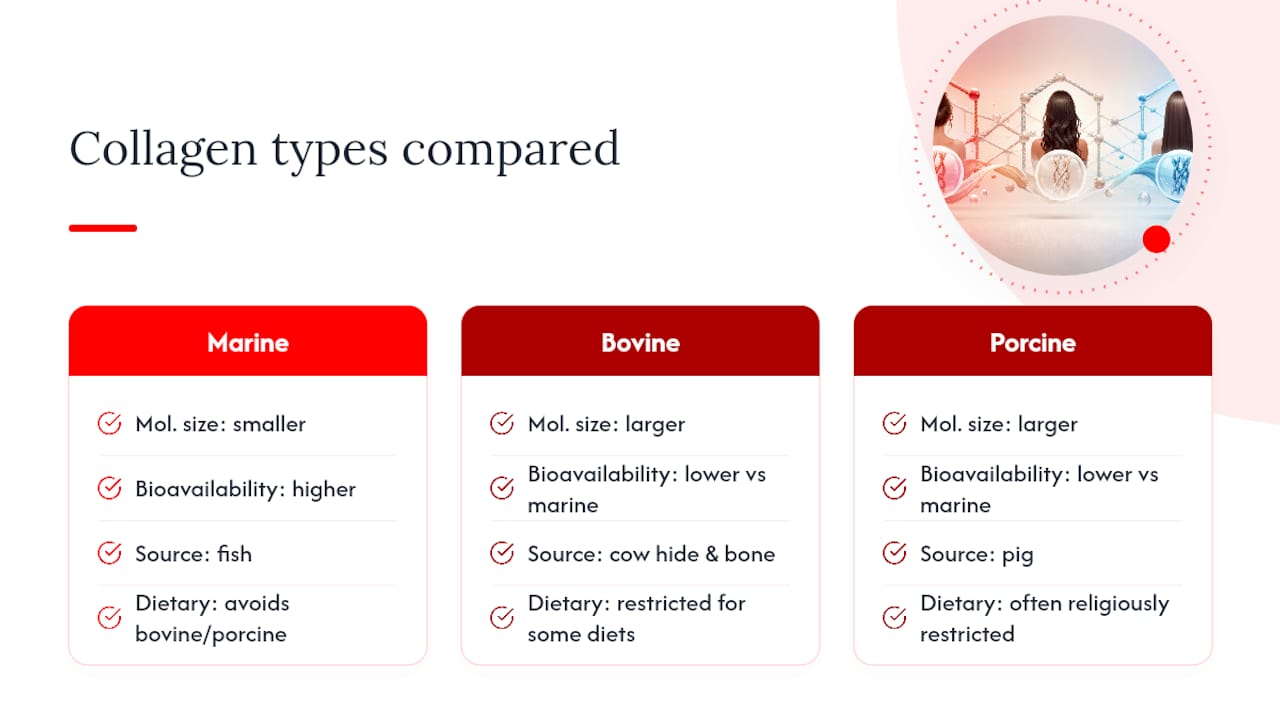
Bovine collagen is widely available and generally well tolerated, though it’s derived from cow hide and bone, so it’s off the table for strict vegetarians, and some religious dietary practices restrict it.
Porcine collagen shows up less often in hair-focused products but follows similar rules: check sourcing if religious dietary law matters to you.
Across all three sources, the form matters more than the animal it came from. Hydrolyzed collagen (also labeled “collagen peptides”) is the version your gut can actually absorb into the bloodstream, according to collagen absorption research. Whole, unhydrolyzed collagen protein is too large a molecule to cross the gut wall intact.
When you’re scanning a label, look for “hydrolyzed collagen peptides,” a stated peptide molecular weight, and ideally a named, clinically studied blend like Verisol®, which shows up repeatedly in the nail and skin literature. A Wiley-published dermatology review specifically recommends favoring transparent, patented peptide blends over generic “collagen powder” with no dosing data behind it. If you want a deeper look at how these peptides behave at the cellular level, this primer on collagen absorption breaks it down further.
How Much Collagen Should You Take, and for How Long?
Trial doses cluster in a fairly narrow range, which makes this easier to plan than most supplement categories.
- Pick your dose range. Verisol® studies used 2.5 g/day for nail benefits. Marine collagen peptide trials for hair and skin tend to run 2.5 to 10 g/day. There’s no evidence that more is dramatically better past this range, so there’s no reason to overshoot it.
- Commit to 12 weeks, minimum. Every trial that showed a measurable hair benefit ran at least 12 weeks. Collagen doesn’t work on a two-week timeline, supplement timing research makes clear that most people quit right before effects would show up.
- Consider 24 weeks if you’re also tracking nails or skin. That’s the duration used in the Verisol® nail study, and it gives structural proteins more time to show up in visibly different tissue.
- Track it like data, not vibes. Take a baseline photo of your scalp part and hairline under the same lighting each time. Keep a simple weekly note on shedding (a rough count from your brush or shower drain works fine) and breakage.
- Set a realistic bar. Less breakage, better texture, and modest density gains are realistic. A full reversal of pattern hair loss is not, at least not from collagen alone.
If you hit week 12 with zero change in shedding or texture, that’s useful information too. It’s a signal to look at other causes, or to bring your notes to a clinician instead of doubling the dose.
What Should You Check Before Buying a Collagen Product?
Ingredient labels vary wildly in this category, so a quick checklist saves you from paying for filler.
Look for hydrolyzed collagen or collagen peptides listed explicitly, not just “collagen,” and check whether the source is marine or bovine so you can flag allergen risk early. A stated peptide dose per serving matters more than a vague “collagen blend” claim. Single-ingredient peptide products make it easier to know what’s actually working; multi-ingredient formulas (collagen plus amino acids, iron, or vitamin C) can be more clinically effective, per the adjunct supplement trial, but make attribution harder if you’re trying to isolate collagen’s specific effect.
Cofactors are worth watching for too. Research on collagen utilization suggests that without vitamin C, zinc, or biotin on hand, your body may burn peptides for energy rather than tissue repair. A product that pairs collagen with vitamin C isn’t just marketing, it’s addressing a real metabolic step.

Third-party testing seals (USP, NSF, or ISO certification) tell you a batch has been independently verified for purity and contaminants, which matters especially for marine collagen given the risk of heavy metal accumulation in fish-derived ingredients. If you’re comparing specific formulations, this roundup of clinically tested beauty supplements walks through several vetted options and what their studies actually measured.
What Are the Risks and Who Should Talk to a Doctor First?
Collagen peptides are generally well tolerated, but “generally” isn’t “always.”
- Mild GI upset (bloating, an off taste, occasional heartburn) is the most commonly reported side effect.
- True allergic reactions are rare but possible, especially with marine collagen if you have a fish or shellfish allergy.
- Marine-sourced products carry a small risk of heavy metal contamination, which is exactly why third-party testing certificates matter more here than in most supplement categories.
If you’re pregnant, breastfeeding, on anticoagulant medication, or managing severe kidney disease, check with your doctor before adding collagen peptides to your routine. The same goes if you have a known fish or bovine allergy.
Stop and seek care if you notice a new rash, unusual GI symptoms, or a sudden escalation in hair shedding rather than a gradual change. Sudden shedding in particular deserves medical attention because it can point to something collagen won’t fix: thyroid disease, iron deficiency, or hormonally driven androgenetic alopecia. A supplement can’t correct a thyroid problem, and no amount of peptide dosing changes that.
When Should You Consider Medical Treatment Instead?
Collagen fits best as a support strategy, not a substitute for treatments with decades of trial data behind them. Minoxidil and finasteride both carry large, placebo-controlled trials and regulatory approval for pattern hair loss, evidence collagen simply doesn’t have yet. If your hair loss follows a hereditary, patterned course, that’s the category where a clinician-guided treatment, potentially including topical minoxidil or a procedure like platelet-rich plasma, deserves priority over a supplement aisle experiment.
Nutrition still does a lot of heavy lifting here. Adequate protein intake, vitamin C, iron, zinc, selenium, and the amino acids cysteine and methionine all play a role in keratin production. If your diet already covers these, an isolated deficiency is less likely to be your problem, and it’s worth asking your doctor to check ferritin and TSH levels before assuming collagen is the missing piece.
Beyond supplements, simple scalp habits amplify whatever internal support you’re providing. Cutting back on heat styling, chemical treatments, and tight hairstyles reduces mechanical breakage that no supplement can outpace. Managing sleep and stress matters too. Telogen effluvium, a stress-triggered shedding pattern, is common and often resolves once the underlying stressor eases, no collagen required.
Prioritize a medical evaluation over self-supplementing if you notice rapid, patchy, or patterned shedding, or any visible scalp changes like redness or scarring. Those are signs worth ruling out before you spend three months on a trial.
How Do You Actually Start a Collagen Trial for Your Hair?
If you’ve decided this is worth testing, here’s the concrete version.
- Choose a hydrolyzed collagen peptide product, ideally marine-sourced or built on a studied blend like Verisol®.
- Take a baseline photo of your part line and hairline under consistent lighting, and note your current shedding pattern.
- Set your dose (2.5 to 10 g/day, based on the trial ranges above) and put it on a calendar so you actually stay consistent.
- Add vitamin C if your product doesn’t already include it, since it supports how your body uses the peptides.
- Mark week 12 on your calendar as your first real checkpoint.
Along the way, track photos, perceived breakage, and a rough shedding count. If nothing’s changed by week 12 and you suspect something medical is going on, that’s the point to see a trichologist or dermatologist, and bring your notes with you. If you’re already on a prescribed hair-loss treatment, loop your doctor in before adding collagen, mainly so they know your full regimen, not because the two typically conflict.
Why We Focus on Clinically Studied Peptides
We built Fromwithin’s collagen approach around a simple frustration: most of the category sells vague “beauty blends” with no dosing transparency and no human data behind them. That gap between marketing claims and actual evidence is what pushed us toward Wellnex® peptides, formulated for direct bloodstream absorption rather than relying on generic collagen powder.
Patented, clinically studied blends like Verisol® matter because they give you reproducible dosing and actual human trial data, not just a marketing story. That’s the standard we hold our own formulations to.
Our honest recommendation: if you’re going to try collagen for your hair, pick a peptide with real study data behind it, run your own 12-week trial, and track it objectively. If you suspect something medical is driving your hair loss, see a clinician before you spend three months guessing. Collagen is a support tool, not a diagnosis.
Ready to Try a Clinically Studied Peptide?
Most collagen products on the shelf give you a vague “collagen blend” and no real dosing data to plan a trial around. Fromwithin’s approach is different: our peptides are built on the patented Wellnex® formulation, engineered for direct bloodstream absorption rather than relying on whatever your gut happens to break down.

If you’ve read this far, you already know what a real trial looks like: a studied peptide, a clear dose, and 12 weeks of consistent tracking. Our Collagen Peptides Glow Booster gives you a transparent, single-ingredient starting point for exactly that experiment, no guessing at hidden fillers or unclear peptide sizes. Browse the full collagen lineup to compare formats, and if better sleep is also part of your wellness routine, our non-melatonin sleep support is worth a look too. Start your 12-week trial this month and take your first baseline photo today.
Frequently Asked Questions
Does collagen help hair and nails at the same time? Yes, the evidence is stronger for nails so far. The Verisol® trial showed clear nail growth and strength improvements, and since hair and nails are both keratin-based, that data offers reasonable indirect support for hair benefits too.
What’s the best type of collagen for hair growth? Hydrolyzed marine collagen peptides tend to be favored for higher bioavailability, and clinically studied blends like Verisol® give you actual dosing and outcome data instead of a guess.
Should I take biotin or collagen for hair? They work differently. Biotin supports keratin production directly, while collagen supplies broader amino acid building blocks and shows some pathway-level effects on follicle activity in preclinical research. Many products, including well-formulated collagen supplements, pair the two rather than making you choose one.
What are the disadvantages of taking collagen for hair? The main downsides are mild GI discomfort in some people, allergy risk with marine or bovine sources, and the reality that evidence for dramatic hair regrowth is still limited. It’s a support strategy, not a guaranteed fix, and it won’t help conditions like hereditary pattern baldness on its own.
How long before I’d notice a difference? Give it a full 12 weeks before judging results. Every trial showing measurable hair benefits ran at least that long, and stopping early is the most common reason people conclude collagen “doesn’t work.”
Sources
Start with the 12-week hydrolyzed collagen trial and the marine collagen adjunct trial for the strongest human data available. The Verisol® nail study offers useful cross-tissue context, while the fish collagen mechanism study explains the biology in preclinical terms. For grounded, non-promotional context, Cleveland Clinic’s overview and Harvard Health’s commentary are worth reading in full. Weigh sample size and control design before trusting any single percentage, and treat animal studies as mechanism clues, not proof of human results.
- PubMed: (study reporting hair density and appearance improvements after 12 weeks)
- Efficacy and tolerability of an oral supplement containing amino acids, iron, selenium, and marine hydrolyzed collagen in subjects with hair loss (PMC)
- Oral supplementation with specific bioactive collagen peptides improves nail growth and reduces symptoms of brittle nails (PubMed)
