

on August 13, 2026

Oral collagen supplements can meaningfully improve skin hydration for most healthy adults, and clinical trials typically show measurable changes within 4–12 weeks of daily use. A practical starting point is a daily dose in the 1–4 g range of hydrolyzed collagen peptides, paired with a vitamin C source to support synthesis. If you’re pregnant, breastfeeding, or managing kidney disease, check with your clinician before starting.
That’s the short answer. Here’s everything you need to make a confident, informed choice.
Key Takeaways
Oral collagen peptides can significantly improve skin hydration, with the most consistent results appearing at 8–12 weeks of daily use in the 1–4 g/day dose range.
| Point | Details |
|---|---|
| Evidence is moderately strong | A meta-analysis found a pooled SMD of ~1.25 for hydration across multiple RCTs using hydrolyzed collagen peptides. |
| Results take 4–12 weeks | Some trials saw hydration improvements at 4 weeks; most consistent outcomes appear at 8–12 weeks of daily use. |
| Dose range in trials: 1–4 g/day | Effective doses ranged from 1,000 mg to 3,500–4,000 mg/day; pair with vitamin C to support collagen synthesis. |
| Choose hydrolyzed, single-ingredient products | Low-molecular-weight peptides with declared Gly-Pro/Pro-Hyp content produce more consistent results than complex blends. |
| Fromwithin’s Wellnex® peptides align with trial parameters | Fromwithin’s liquid collagen shots use patented low-molecular-weight peptides designed for direct bloodstream absorption. |
Table of Contents
- How collagen for hydration actually works in your skin
- The biology behind skin hydration improvements
- What randomized controlled trials show about collagen and skin hydration
- Which collagen type and form should you look for?
- How to use collagen supplements effectively for hydration
- Safety, side effects, and when to check with a clinician
- Can food alone give you the same hydration benefit?
- How Fromwithin’s collagen aligns with the clinical evidence
- What I’d tell a friend who’s thinking about starting collagen
- Fromwithin’s collagen collection for skin hydration
- Sources
How collagen for hydration actually works in your skin
Collagen is the most abundant protein in the human body, and it’s the primary structural scaffold of your skin. Type I collagen makes up the vast majority of dermal collagen, giving skin its tensile strength and plumpness. Type III collagen works alongside it, contributing to the skin’s elasticity and resilience. Together, they form the dense fibrous network that keeps skin looking firm and feeling supple.
The problem is that your body’s natural collagen production declines with age, and that loss shows up as dryness, fine lines, and reduced bounce. Collagen supplements aim to address this from the inside out.
Not all collagen forms are equal for this purpose. Intact collagen molecules are too large to be absorbed meaningfully through the gut. Hydrolyzed collagen, also called collagen peptides, is collagen that has been broken down into smaller fragments through enzymatic hydrolysis. These fragments, particularly low-molecular-weight di- and tripeptides, are small enough to pass through the intestinal wall and enter the bloodstream.
The peptide features that matter most in trials:
- Low molecular weight (typically under 5 kDa): smaller fragments absorb more efficiently
- Specific dipeptides like Gly-Pro and Pro-Hyp: these appear in plasma within 1–2 hours of ingestion and act as biological signals, not just raw building blocks
- Declared peptide sequences: products that disclose their peptide composition give you more confidence you’re getting the active fractions
The biology behind skin hydration improvements
Here’s the part that surprises most people: collagen peptides don’t just replenish collagen directly. They work as signaling molecules.
When bioactive peptides like Gly-Pro and Pro-Hyp reach the dermis, they interact with dermal fibroblasts, the cells responsible for producing collagen and hyaluronic acid (HA). These peptides appear to up-regulate hyaluronic acid synthase (HAS2), an enzyme that drives HA production in dermal cells. HA is a hygroscopic molecule, meaning it draws and holds water. More HA in the dermis means better water retention, and that’s what registers as improved skin hydration in clinical measurements.

So the pathway looks like this: you ingest hydrolyzed peptides → they absorb into the bloodstream → they reach fibroblasts → fibroblasts produce more HA and collagen → skin holds more moisture. It’s a cascade, not an overnight switch, which is why the timeline runs weeks rather than days.
Your body also needs specific cofactors to complete this process. Cleveland Clinic guidance notes that collagen supplements show promise in trials but are most effective when dietary cofactors, especially vitamin C, zinc, and copper, are available. Vitamin C is particularly critical: it’s required for the hydroxylation of proline and lysine, two steps that are non-negotiable in collagen synthesis.
Key cofactors to keep in mind:
- Vitamin C: aim for foods like bell peppers, citrus, kiwi, or a daily supplement
- Zinc: found in pumpkin seeds, beef, and legumes; supports collagen cross-linking
- Copper: trace amounts from nuts, seeds, and shellfish support lysine oxidase activity
- Adequate protein intake: your body needs sufficient amino acids overall to prioritize collagen synthesis
Pro Tip: Pairing your collagen supplement with a vitamin C–rich food or drink at the same time, like a small glass of orange juice or a kiwi, is one of the simplest ways to support the synthesis pathway. You don’t need a separate vitamin C supplement if your diet is already varied, but consistency matters more than the exact source.
What randomized controlled trials show about collagen and skin hydration
The clinical evidence is moderately strong and growing. Multiple randomized controlled trials (RCTs) and at least one systematic review and meta-analysis have found that oral collagen supplements significantly increase skin hydration, with a pooled standardized mean difference (SMD) of approximately 1.25. Trial doses in that meta-analysis clustered around 3.5–4 g/day, though effective doses ranged from roughly 1 g to 10 g/day across studies.
Here’s a snapshot of key trials:
| Study / Product | Daily Dose | Duration | Primary Hydration Outcome |
|---|---|---|---|
| Low-molecular-weight collagen peptide RCT | 1,000 mg | 12 weeks | Significantly higher facial hydration vs. placebo at 6 and 12 weeks |
| Collagen peptide NS (CPNS) RCT | 1,650 mg | 12 weeks | Significant hydration improvement from week 4, maintained through week 12 |
| Pure Gold Collagen consumer trial | Daily drink | 60 days | Measurable reductions in skin dryness and wrinkle depth |
| Meta-analysis pooled estimate | ~3.5–4 g (most common) | 4–12 weeks | SMD ~1.25 for hydration across included trials |
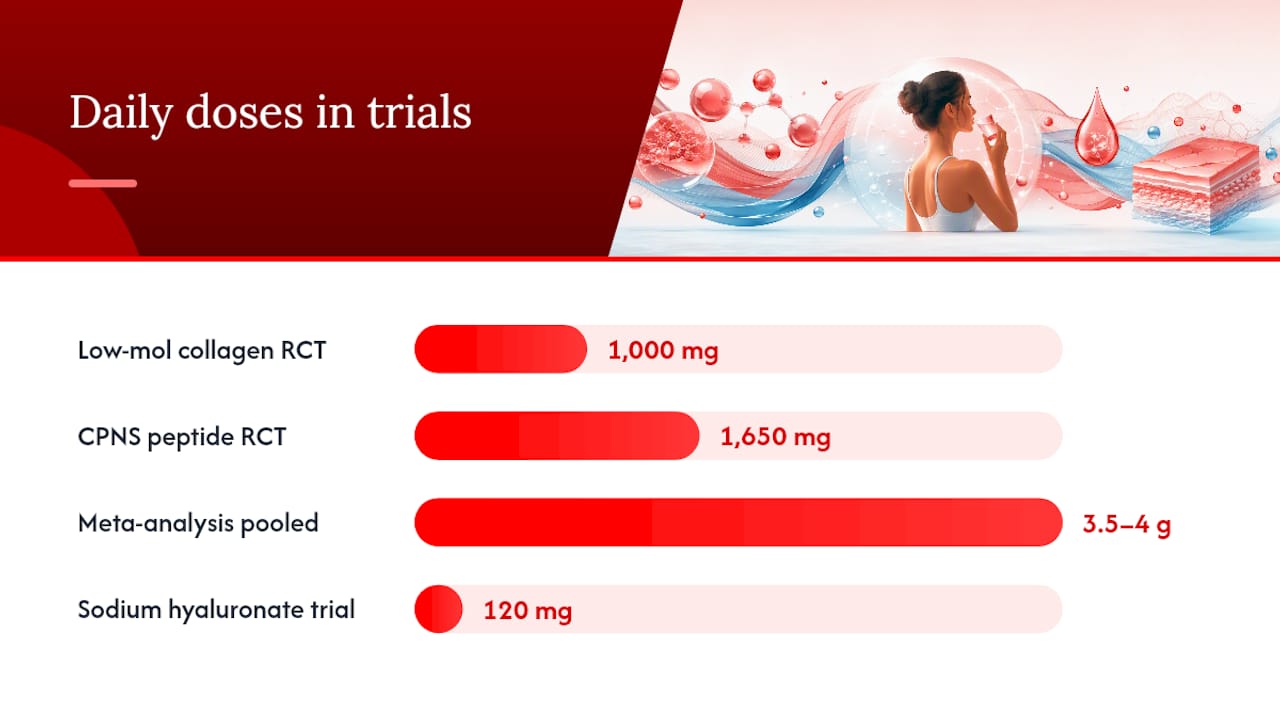
For context, a 12-week trial of oral sodium hyaluronate at 120 mg/day also showed dose-dependent facial hydration improvements and reduced transepidermal water loss (TEWL), which illustrates that hygroscopic ingredients taken orally can influence skin moisture through different but complementary pathways.
Limitations worth knowing:
- Many trials enrolled predominantly female or Asian cohorts, so results may not generalize equally across all demographics
- Sample sizes in individual studies are often small (under 100 participants)
- Some trial reports note that placebo groups can show late improvements (around week 12), possibly due to vehicle or cosmetic effects in topical-adjacent protocols
- Variability in peptide composition across products makes direct dose comparisons imprecise
- Single-ingredient collagen preparations tend to produce more consistent results than complex multi-ingredient blends, suggesting peptide quality and dose are the primary drivers
What this means practically: the signal is real and consistent enough to justify a personal trial, but individual responses vary. Tracking your own skin over 8–12 weeks gives you more useful information than any single study average.
Which collagen type and form should you look for?
When your goal is skin hydration, the form matters more than the source animal. Here’s a quick orientation:
Hydrolyzed collagen peptides (from bovine or marine sources) are the form used in virtually all the RCTs above. The key is low molecular weight and declared bioactive peptide content.
Marine (fish) collagen is predominantly type I, which is the dominant type in skin. Some research suggests marine collagen may have slightly higher bioavailability due to its smaller average peptide size, though the practical difference in well-formulated products is modest.
Bovine collagen provides both type I and type III, which mirrors the collagen composition of human skin more closely. It’s the most widely studied source in long-term trials.
Proprietary or patented peptide blends (like Wellnex® peptides) are engineered for specific molecular weight ranges and peptide sequences. When the manufacturer discloses the peptide profile, these can offer more predictable absorption than generic hydrolysates.
A practical buying guide can help you navigate label claims, but here’s a checklist to use at the shelf or on a product page:
- Peptide type declared? Look for “hydrolyzed collagen peptides” or specific dipeptide content (Gly-Pro, Pro-Hyp)
- Dose per serving clearly stated? You want to know exactly how many grams of collagen peptides you’re getting, not just total protein
- Molecular weight disclosed? Lower is generally better for absorption (under 5 kDa is a meaningful signal)
- Third-party testing or certification? NSF, Informed Sport, or USP marks indicate independent quality verification
- Allergen information? Marine collagen is a fish allergen; bovine collagen is not suitable for some dietary preferences; egg-derived collagen exists but is less common
- Dietary compatibility? Bovine collagen is not halal or kosher unless certified; marine collagen may suit pescatarian diets but not vegan ones
How to use collagen supplements effectively for hydration
Knowing the dose and timing makes a real difference in whether you see results.
Practical usage tips:
- Timing is flexible. Collagen peptides can be taken with or without food. Some people prefer morning (easy to build into a routine); others take it at night when skin repair processes are active. Consistency matters far more than the exact time.
- Mix it right. Powder forms dissolve well in warm water, smoothies, or coffee. Liquid collagen shots are pre-dissolved and convenient for busy mornings.
- Daily use beats intermittent. All the trials above used daily supplementation. There’s no evidence that skipping days and doubling up produces the same effect.
- Pair with vitamin C at the same meal or snack for cofactor support.
- Give it time. Some people notice a difference in skin feel around week 4. More consistent, visible changes typically appear at 8–12 weeks. Continued daily use appears necessary to maintain the effect once it’s established.
Starting a personal trial:
- Pick a single-ingredient hydrolyzed collagen peptide product with a declared dose
- Take it daily at a consistent time
- Note your skin’s hydration and texture at baseline, week 4, week 8, and week 12
- Stop and consult a clinician if you experience any adverse reactions
Safety, side effects, and when to check with a clinician
Collagen supplements have a reassuring safety profile in the trials conducted to date. Most reported side effects are mild and transient.
Common mild side effects:
- Digestive discomfort (bloating, a feeling of fullness, occasional loose stools), especially at higher doses
- Taste or texture complaints with certain powder or liquid formulations
- Rare allergic reactions, most commonly in people with known fish or shellfish allergies taking marine collagen
Specific populations who should consult a clinician first:
- Pregnancy and lactation: safety data in these populations is limited; check with your OB or midwife before starting
- Kidney disease: high-protein supplementation can place additional load on compromised kidneys; a nephrologist’s guidance is appropriate
- Anticoagulant medications: some collagen products include vitamin C or other additives that may interact; review the full ingredient list with your prescriber
- Known food allergies: fish, egg, or bovine protein allergies require careful source verification before use
A note on quality: The FDA does not pre-approve dietary supplements before they go to market. Third-party testing (NSF, USP, Informed Sport) is the most practical way to verify that a product contains what it claims and is free from contaminants.
If you have a chronic condition, take multiple supplements or prescription medications, or are in any of the populations above, a brief conversation with your doctor or a registered dietitian is worth the time.
Can food alone give you the same hydration benefit?
Honestly, food-based collagen sources are valuable, but they don’t replicate what a concentrated peptide supplement delivers. When you eat collagen-rich foods like bone broth, gelatin, or skin-on poultry, your digestive system breaks the protein down into amino acids. Those amino acids join the general amino acid pool and get allocated wherever your body needs them most, which may or may not be your skin.
The key difference with hydrolyzed collagen supplements is that the enzymatic pre-digestion produces specific bioactive dipeptides (Gly-Pro, Pro-Hyp) that appear to reach the dermis intact and signal fibroblasts directly. Food-based collagen doesn’t deliver those peptides in concentrated, pre-formed doses. You’d need to consume very large quantities of collagen-rich foods to approach the gram-level doses used in RCTs, and even then the peptide profile would be less predictable.
That said, collagen-supporting foods absolutely belong in a skin-health routine:
- Bone broth and gelatin: provide glycine, proline, and hydroxyproline as raw materials
- Vitamin C–rich fruits and vegetables: bell peppers, strawberries, citrus, broccoli
- Zinc-rich foods: pumpkin seeds, beef, lentils, chickpeas
- Fatty fish: supports skin barrier function alongside collagen pathways
- Eggs: provide proline and glycine, plus biotin for skin structure
The most practical approach is to use food as your cofactor foundation and a quality hydrolyzed peptide supplement when you want the concentrated, trial-level dose. They work together, not against each other.
How Fromwithin’s collagen aligns with the clinical evidence
Fromwithin’s collagen products are built around Wellnex® patented collagen peptides, a proprietary hydrolysate engineered for low molecular weight and direct bloodstream absorption. That formulation approach maps directly to what the RCT evidence identifies as the active fraction: small, bioavailable peptides that reach dermal fibroblasts and stimulate HA and collagen synthesis.
What to know about the product lineup:
- Peptide form: Wellnex® hydrolyzed collagen peptides, absorbed directly into the bloodstream
- Formulation: liquid collagen shots designed for convenience and consistent daily use, with no chalky aftertaste
- Ingredient transparency: the brand discloses its peptide source and clinical research basis, which aligns with the single-ingredient, transparent-formulation standard that meta-analytic reviews associate with more consistent trial results
- Dosing: check the product label for the per-serving peptide dose and align it with the 1–4 g/day trial range discussed above; daily use for 8–12 weeks is the evidence-supported trial period
Pro Tip: If you’re starting with Fromwithin’s collagen, treat the first 4 weeks as your baseline observation period. Take a photo of your skin in consistent lighting at the start, then again at week 4 and week 8. Hydration changes can be subtle early on, and having a visual reference makes it much easier to notice the gradual improvement.
What I’d tell a friend who’s thinking about starting collagen
Supplements help, but they’re not a shortcut. Here’s my honest perspective: the clinical evidence for collagen and skin hydration is more solid than most beauty supplement categories, and that’s genuinely encouraging. But the readers who see the best results are the ones who treat a collagen supplement as one piece of a broader skin-health routine, not the whole thing.
Sunscreen is still your single most effective anti-aging tool. Sleep is when your skin does most of its repair work. A diet with enough protein, colorful produce, and healthy fats creates the environment where collagen synthesis can actually happen. A supplement fills a specific gap in that picture, and it fills it well when you choose a quality product and give it enough time.
Visible changes take weeks, not days. Consistent daily habits have the biggest long-term payoff. If you go in with realistic expectations and a 12-week commitment, you’re giving the evidence the best chance to work in your favor.
Fromwithin’s collagen collection for skin hydration
If you’re ready to put the evidence into practice, Fromwithin’s skin-targeted collagen collection gives you a direct path from the science to your daily routine.

The products are built on Wellnex® patented peptides, formulated as easy-to-take liquid shots with no chalky aftertaste and full ingredient transparency. That means you know exactly what you’re getting, at a dose that aligns with the trial parameters covered in this article. Pair it with a vitamin C source, commit to daily use for 8–12 weeks, and track your skin along the way.
Visit the Fromwithin collagen page to see the full product details, including serving size, peptide source, and any current satisfaction guarantee or shipping information. Your skin’s glow starts from within.
Sources
- Collagen
- Effects of collagen-based supplements on skin’s hydration and elasticity: A systematic review and meta-analysis
- Oral sodium hyaluronate improves skin hydration, barrier function and signs of aging: a randomized, double-blind, placebo-controlled trial in 150 healthy adults
This article is general information, not a substitute for advice from a qualified doctor. Consult a qualified healthcare professional about your own circumstances before acting on anything here.
