

on July 29, 2026

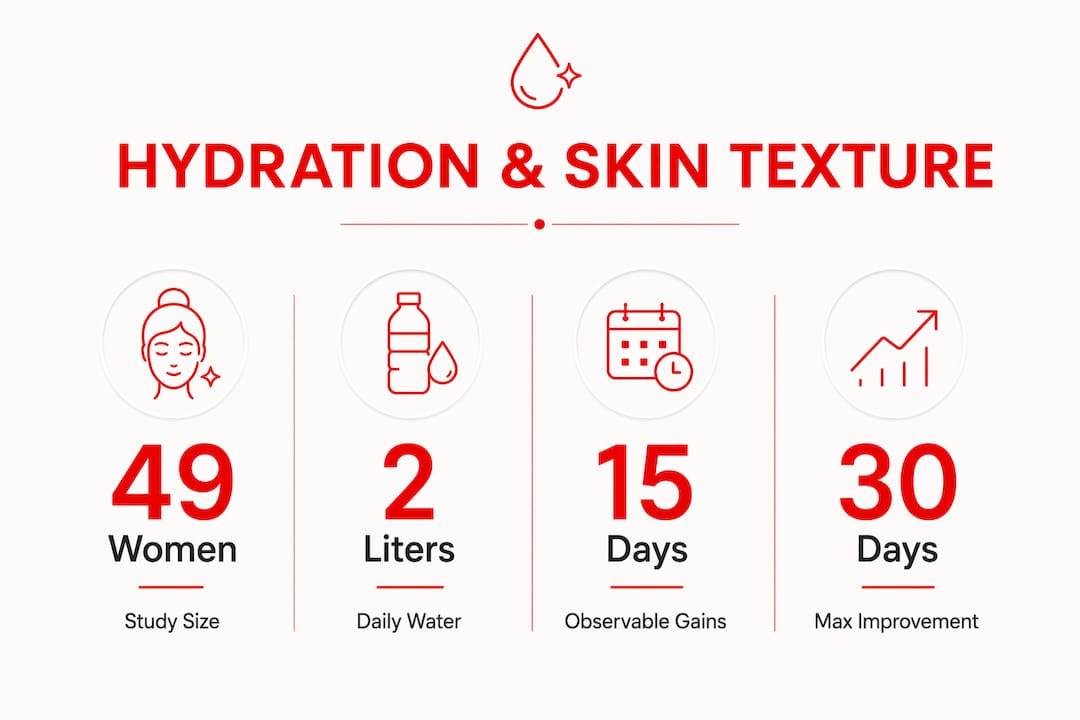
Hydration improves skin texture by restoring water balance in the stratum corneum and supporting the biomechanical properties that keep skin smooth, bouncy, and light-reflective. A 2015 clinical trial of 49 healthy women found that adding a substantial amount of water per day for about a month produced significant improvements in both superficial and deep skin hydration, with measurable changes appearing within a few weeks. That’s not a slow, invisible process — your skin responds to hydration faster than most people expect.
Here’s what that improvement actually looks like at the surface level:
- Plumper corneocytes. When the outermost skin cells absorb water, they swell slightly and lie flat, reflecting light more evenly and reducing the rough, uneven look of dehydrated skin.
- Fewer flakes. Barrier lipids (ceramides, cholesterol, fatty acids) need adequate moisture to stay intact. When they’re depleted, corneocytes curl at the edges and shed unevenly, creating that rough, patchy texture.
- Better biomechanical bounce. Hydration supports the elastic rebound and tensile strength of skin tissue, so skin “snaps back” rather than looking slack or creased.
Table of Contents
- Why hydration improves skin texture at the biological level
- What clinical research actually shows about drinking more water
- Systemic vs. topical hydration: how they work together
- How supplements and peptides support hydration-driven texture improvement
- A realistic daily routine to improve skin texture
- When you should see a dermatologist about skin texture
- Key Takeaways
- The evidence is clear, but the order matters
- Fromwithin’s collagen supplements fit here, not instead of hydration
- Useful sources
Why hydration improves skin texture at the biological level
The stratum corneum is your skin’s outermost layer, and it’s the main reason texture looks the way it does. Think of it as a brick wall: corneocytes are the bricks, and barrier lipids are the mortar. When water content in this layer drops, the bricks curl and the mortar cracks. Dehydrated corneocytes curl at their edges rather than lying flat, which scatters light unevenly and creates visible roughness.
Transepidermal water loss (TEWL) is the rate at which water evaporates through your skin. High TEWL means your barrier is compromised. When TEWL rises, enzymatic processes that regulate normal skin shedding (desquamation) break down, and you get the dry, flaky surface that feels rough to the touch. Barrier lipids — specifically ceramides, cholesterol, and free fatty acids — are what slow TEWL down. Keeping them intact is as important as drinking enough water.
Hyaluronic acid (HA) is your skin’s built-in water magnet. It’s a molecule that can hold many times its weight in water, and it exists in both the dermis and the epidermis. Multi-molecular-weight HA reaches different skin depths: larger molecules hydrate the surface, while smaller fragments penetrate more deeply. When HA levels are adequate, corneocytes stay plump and flat.
Hydration also supports collagen’s mechanical behavior. Collagen fibers need a well-hydrated matrix to maintain their elastic rebound and tensile strength. Dehydrated skin behaves like an accelerated-aging phenotype — barrier weakness makes lines look deeper and reduces the skin’s natural snap.
What clinical research actually shows about drinking more water
The clearest evidence comes from a randomized study of 49 healthy women (mean age 24.5) who added approximately 2 liters of water per day to their normal intake for 30 days. Participants had a baseline fluid intake below a certain moderate daily volume. Researchers measured both superficial and deep skin hydration along with biomechanical descriptors at day 0, day 15, and day 30.
| Metric | What it measures | Outcome at day 30 |
|---|---|---|
| Superficial hydration | Water content in the stratum corneum | Significant improvement |
| Deep hydration | Moisture in deeper skin layers | Significant improvement |
| Biomechanical descriptors | Elastic rebound, firmness, skin “snap” | Significant improvement |
The gains were measurable at day 15, not just at the end. That’s encouraging if you’re starting from a low baseline. The key caveat is that people who were already well-hydrated saw diminishing returns. The biggest improvements went to participants who were drinking the least to begin with. Sample size was small, and participants were young women, so results may not generalize to all ages and skin types.
Systemic vs. topical hydration: how they work together
Drinking water and applying a moisturizer do different things, and you genuinely need both.
Systemic hydration (drinking water) raises water availability across all skin layers. It’s most impactful when your baseline intake is low. Topical hydration works directly on the stratum corneum: humectants like hyaluronic acid draw water into the surface, while occlusives like ceramide-rich moisturizers seal it in and slow TEWL. Moisturizers with ceramides and niacinamide support barrier repair and help prevent moisture evaporation over time.
A quick way to check your systemic hydration: pale yellow urine means you’re on track; dark yellow or amber means drink more. For topical hydration, run your fingertips across your cheek an hour after cleansing. Tightness or visible flaking signals your barrier needs more support.
- Apply a humectant serum (multi-molecular-weight HA) to damp skin right after cleansing.
- Follow immediately with a ceramide-rich moisturizer to lock water in and protect the barrier.
- Add SPF in the morning — UV exposure accelerates TEWL and degrades barrier lipids.
- Drink water consistently through the day rather than in large amounts at once.
Pro Tip: Layer your humectant on slightly damp skin. HA draws moisture from its environment, and if the air is very dry, it can pull water from deeper skin layers instead. A ceramide moisturizer on top prevents that.
How supplements and peptides support hydration-driven texture improvement
Drinking water and applying a good moisturizer lay the foundation. Supplements and peptides build on that foundation by supplying the raw materials your skin uses for structural repair, as shown by topical copper peptide strategies like those at the Copper Peptide Anti-Aging Serum – Copper Peptides Store.
Oral collagen peptides and amino acids provide the building blocks for collagen and elastin synthesis. When your skin is well-hydrated, the cellular environment is more favorable for remodeling. Peptides absorbed into the bloodstream can signal fibroblasts to increase collagen production, but that process takes time. Structural collagen changes generally become visible between 4 and 12 weeks of consistent use. Early wins from hydration are faster but more surface-level; the deeper structural improvements come later.
Fromwithin’s formulas use patented Wellnex® peptides, which are designed for direct bloodstream absorption to maximize efficacy. Amino acids and vitamin C are important co-nutrients here: vitamin C is a required cofactor in collagen synthesis, and without adequate levels, even the best peptide formula can’t do its full job. Supplements work best when hydration and topical care are already optimized, not as shortcuts around them.
A safety note: always check ingredient lists if you have allergies or take medications, and consult a clinician before starting any new supplement regimen.
A realistic daily routine to improve skin texture
Morning
- Drink a glass of water before coffee or breakfast.
- Cleanse gently (no harsh sulfates that strip barrier lipids).
- Apply multi-molecular-weight HA serum to damp skin.
- Follow with a ceramide-rich moisturizer.
- Finish with SPF 30 or higher.
- Take your collagen or peptide supplement with breakfast (follow product guidance on timing).
Evening
- Cleanse to remove pollution and SPF residue.
- Apply HA serum, then moisturizer or a barrier-repair balm.
- If using a retinoid, apply it after moisturizer to reduce irritation, and always pair with extra hydration.
- Avoid over-exfoliating: limit chemical exfoliants to 2–3 times per week maximum.
What to avoid: low-humidity environments without barrier protection (use a humidifier in winter), harsh exfoliants without hydration support, and skipping SPF (UV exposure degrades barrier lipids and accelerates TEWL). A natural beauty routine doesn’t have to be complicated to be effective.
When you should see a dermatologist about skin texture
Hydration and OTC products handle most texture concerns, but some situations call for a clinician.
- Texture that worsens despite 4–6 weeks of consistent hydration and barrier repair.
- Painful cracking, bleeding, or open fissures in the skin.
- Rapidly spreading scaly or inflamed patches.
- Intense itching that disrupts sleep or daily life.
- Texture changes accompanied by systemic symptoms (fatigue, joint pain, digestive issues).
When you see a dermatologist, bring a clear timeline of when changes started, a list of products and supplements you’re using, and notes on any systemic symptoms. They may consider patch testing, prescription barrier-repair treatments, or screening for underlying dermatologic conditions that OTC approaches can’t address.
This article is general information, not medical advice. Consult a qualified clinician for guidance specific to your situation.
Key Takeaways
Hydration improves skin texture by restoring stratum corneum water balance, and the biggest gains go to people who start from a low baseline, with measurable changes appearing within 15 days and structural improvements taking 4–12 weeks.
| Point | Details |
|---|---|
| Who benefits most | People with low baseline water intake see the largest measurable gains in hydration and texture. |
| Expected timeline | Surface texture can improve within days; structural collagen changes take 4–12 weeks. |
| Dual approach works best | Combine systemic hydration (drinking water) with topical humectants and occlusives for lasting results. |
| Environmental factors matter | Low humidity, heating, AC, and UV exposure accelerate TEWL and worsen texture without barrier protection. |
| Fromwithin’s role | Wellnex® peptide supplements support collagen remodeling as a complement to hydration and topical care, not a replacement. |
The evidence is clear, but the order matters
Here’s something I think gets lost in the supplement conversation: peptides and collagen formulas are genuinely useful, but they’re not a workaround for poor hydration. The clinical evidence is pretty direct on this. The 2015 PMC trial showed measurable skin improvements from water intake alone, in just 30 days, without any topical or supplement intervention. That’s a strong signal that the foundation really does come first.
What I find underappreciated is the sequencing. Most people reach for a supplement before they’ve sorted out their barrier. If your stratum corneum is losing water faster than you’re replacing it, no peptide formula can fully compensate. Get the hydration right, layer your topicals correctly, and then supplements become genuinely additive rather than just hopeful. The collagen and elastin relationship is real, but it operates in a well-hydrated environment.
Fromwithin’s collagen supplements fit here, not instead of hydration
If you’ve built a solid hydration routine and you’re ready to support what’s happening deeper in the skin, Fromwithin’s collagen and peptide formulas are designed to complement exactly that. The Wellnex® peptides are absorbed directly into the bloodstream, giving your fibroblasts the signals and building blocks they need for collagen remodeling — the kind of structural change that shows up between weeks 4 and 12.
These formulas work alongside your water intake and topical routine, not instead of them. If you have existing medical conditions or take medications, check with your clinician before adding any supplement. When you’re ready to explore, the skin-focused collection is a good place to start.
Useful sources
- Effects of increased water intake on skin hydration (PMC, 2015) — Primary clinical trial: 49 participants, +2 L/day for 30 days, significant improvements in superficial and deep hydration and biomechanical markers at days 15 and 30.
- Why Hydration Is the Secret to Younger Looking Skin (LA Times) — Covers environmental factors (humidity, UV, pollution) and their effect on skin hydration and barrier function.
- The Vital Role of Hydration in Skin Health (Quinn Dermatology) — Clinician-oriented summary of hydration’s role in barrier function, texture, and protection against irritants.
- How to Improve Skin Texture: What the Science Actually Says (North Biomedical) — Explains corneocyte morphology, TEWL, and the timeline difference between surface hydration and structural collagen changes.
- How to Get Rid of Textured Skin (Vogue) — Dermatologist guidance on combining retinoids and exfoliants with hydration to avoid barrier compromise.
- How To Improve Skin Texture (SkinCeuticals) — Ingredient-level guidance on ceramides, niacinamide, and lipid-replenishing moisturizers for barrier repair.
For methodological detail on any study, consult the original publication directly. For personalized guidance on persistent texture concerns, speak with a board-certified dermatologist.
