

on August 14, 2026

Collagen peptides can genuinely improve mild-to-moderate, age-related skin laxity — but the results depend heavily on the type of peptide, the dose, and how long you stay consistent. If you’re noticing early jowling, a loss of bounce, or skin that just doesn’t spring back the way it used to, the evidence is encouraging. Randomized controlled trials have measured real improvements in dermal thickness, density, elasticity, and hydration after 8–16 weeks of daily supplementation. That said, collagen for sagging skin has clear limits: pronounced loose skin after major weight loss, or advanced structural laxity typically requires professional procedures rather than a supplement.
Here’s what you need to know upfront:
- Who benefits most: People with mild-to-moderate, age-related or photoaged skin laxity. Early laxity responds better than advanced sagging.
- Realistic timeline: Most trials show measurable changes by 8–12 weeks, with some effects continuing through 16 weeks of consistent daily intake.
- When to see a clinician: If your skin has significant loose folds, rapid changes in firmness, or you’ve recently lost a large amount of weight, a dermatologist or plastic surgeon is the right first call — not a supplement.
Singapore’s Health Sciences Authority (HSA) regulates supplement advertising and safety claims, so any product you buy locally should comply with those standards. Keep that in mind as you read through the guidance below.
Key Takeaways
Low-molecular-weight bioactive collagen peptides, taken consistently for 8–16 weeks, produce modest but measurable improvements in skin elasticity, hydration, and dermal thickness in people with mild-to-moderate age-related laxity — but they cannot replace professional procedures for advanced or structural sagging.
| Point | Details |
|---|---|
| Who benefits most | Mild-to-moderate, age-related laxity responds best; pronounced loose skin after major weight loss needs clinical assessment. |
| Realistic timeline | Hydration often improves by weeks 4–6; elasticity and dermal changes typically appear by weeks 8–12. |
| Dose and peptide quality | Trial-supported doses range from 1 g to 10 g/day; prioritize products with disclosed low-MW peptide profile and hydroxyproline content. |
| When to see a clinician | Significant loose folds, rapid firmness changes, or no improvement after 12 consistent weeks warrant a dermatologist visit. |
| Fromwithin Glow Booster | Uses patented Wellnex® low-MW peptides with vitamin C; matches the evidence-based label checklist for Singapore shoppers. |
Table of Contents
- How does collagen for sagging skin actually work?
- Oral versus topical collagen: which one actually reaches your dermis?
- What do the clinical trials actually show, and how long does it take?
- Who is likely to benefit, and when is a supplement not enough?
- How to choose a collagen supplement in Singapore
- How to combine collagen supplements with skincare and in-clinic treatments
- Is collagen supplementation safe, and how much should you take?
- What practitioners look for: peptide profiles, dose-response, and research signals
- The honest truth about collagen supplements and skin
- Fromwithin’s Collagen Peptides (Glow Booster) fits the checklist
- Sources
How does collagen for sagging skin actually work?
Your skin’s firmness comes from a dense network of collagen and elastin fibers sitting in the dermis, the deeper structural layer beneath the surface epidermis. From your mid-20s onward, fibroblasts (the cells that produce collagen) slow down, and the existing collagen network gradually degrades. The result is skin that loses its bounce, thins slightly, and starts to sag.
When you take oral collagen peptides, your digestive system breaks them down into di- and tripeptides, short amino acid chains that absorb directly into the bloodstream. These fragments, particularly the dipeptide Pro-Hyp (proline-hydroxyproline), travel to the dermis and do two things: they supply raw building blocks for new collagen, and they act as signaling molecules that tell fibroblasts to ramp up collagen and hyaluronic acid (HA) production. HA is what keeps skin plump and hydrated, so the benefit isn’t just structural.
Here’s a simplified picture of the pathway:
- Ingestion: You take a collagen peptide supplement.
- Digestion and absorption: Peptides break into di/tripeptides and enter the bloodstream.
- Dermal uptake: Pro-Hyp and hydroxyproline (Hyp) fragments accumulate in skin tissue.
- Fibroblast activation: These fragments stimulate fibroblasts to produce more collagen and HA.
- ECM remodeling: The extracellular matrix (ECM) gradually thickens and densifies over weeks.
What trials measure: A randomized, double-blind, placebo-controlled study found statistically significant increases in dermal thickness and dermal density by weeks 8–16 compared with placebo, with some effects sustained through a 4-week washout period. That’s a meaningful signal — though it’s worth noting that effect sizes vary by peptide profile and dose.
The mechanism is real, but it’s slow and cumulative. Think of it less like flipping a switch and more like consistently watering a plant. You won’t see overnight results, but the underlying biology is working.
Oral versus topical collagen: which one actually reaches your dermis?
For skin firmness, oral bioactive collagen peptides (BCP) with low molecular weight have stronger evidence for deep dermal effects than topical intact collagen. Here’s why that distinction matters.

Topical collagen creams and serums contain collagen molecules that are generally too large to penetrate past the outer epidermis. They can improve surface hydration and texture, which is genuinely useful, but they rarely reach the dermis where structural remodeling happens. Research comparing oral and topical approaches shows that oral hydrolyzed peptides more consistently affect dermal structure, while topical products overlap mainly on surface hydration benefits.
A quick comparison of delivery routes:
- Oral BCP (low molecular weight): Absorbed as di/tripeptides, reaches the dermis via bloodstream, stimulates fibroblasts, best evidence for elasticity and dermal thickness improvements.
- Topical collagen: Improves surface hydration and feel, minimal evidence for deep structural change due to molecular size.
- Injectable collagen/fillers: Directly volumizes tissue, fast visible results, but requires a clinician and carries procedural risks.
Key terms, simply explained:
- Bioactive collagen peptides (BCP): Hydrolyzed collagen fragments with specific amino acid sequences that signal fibroblasts.
- Low-molecular-weight peptides (<1 kDa): Smaller fragments that absorb more efficiently and accumulate in skin tissue.
- Pro-Hyp: A dipeptide (proline + hydroxyproline) that directly stimulates fibroblast activity and HA synthesis.
- Hydroxyproline (Hyp): An amino acid unique to collagen; its content in a supplement is a marker of collagen quality.
- Hydrolyzed collagen: Collagen broken down by enzymatic or acid hydrolysis into peptides — the form used in most supplements.
On source and allergens: most supplements use bovine (cow), porcine (pig), or marine (fish) collagen. Marine collagen tends to have a smaller average molecular weight and is popular in Singapore. If you have fish allergies, a bovine or porcine product is the safer choice. Always check the label for source disclosure and allergen warnings — this is especially relevant for halal-observant consumers, since porcine-derived collagen is not halal-certified.
Pro Tip: If you’re buying in Singapore, look for products that clearly state the collagen source on the label. “Hydrolyzed collagen” without a source disclosure is a red flag.
What do the clinical trials actually show, and how long does it take?
The evidence base for collagen peptides is more solid than many people expect, though it’s not without caveats. Here’s what the strongest studies report.
A meta-analysis of 19 randomized trials concluded that roughly 90 days of hydrolyzed collagen supplementation produces modest but consistent improvements in skin hydration, elasticity, and wrinkle measures. “Modest” is the honest word here — these are real, measurable changes, not dramatic before-and-after transformations.
Individual trials fill in the detail:
- 1,000 mg/day of low-molecular-weight collagen peptide for 12 weeks improved skin hydration by week 6 and elasticity and wrinkle measures by week 12 versus placebo in photoaged adults.
- 12 weeks of BCP supplementation produced significant improvements in dermal density, hydration, and dermal thickness, with some effects persisting through a 4-week washout.
- A 2026 randomized trial found dose-dependent improvements in wrinkles, elasticity, and hydration after 12 weeks of BCP supplementation, with larger effects at 10 g/day, alongside increases in systemic tissue-remodeling biomarkers TGF-β and Klotho.
A rough timeline of what to expect:
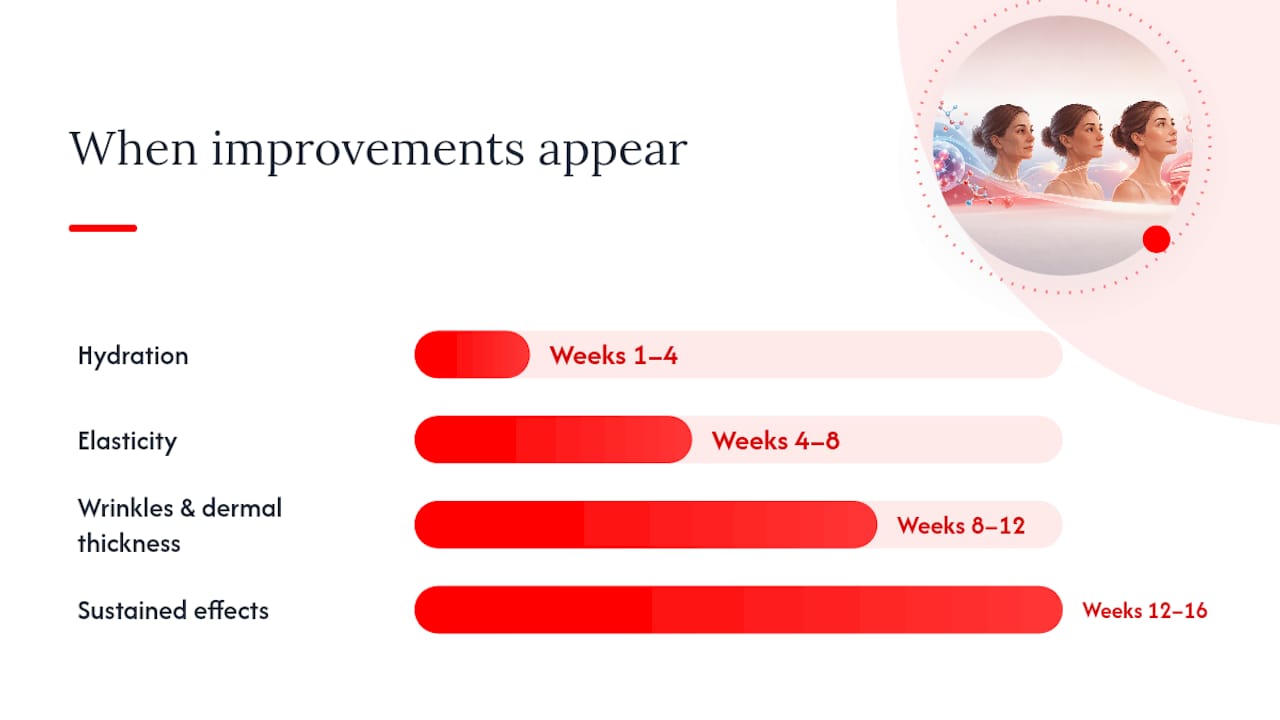
- Weeks 1–4: Hydration often improves first; skin may feel softer and more comfortable.
- Weeks 4–8: Early elasticity changes may begin; some people notice skin feels slightly firmer on touch.
- Weeks 8–12: Most trials report their primary endpoints here — measurable improvements in elasticity, hydration, and some structural measures.
- Weeks 12–16: Effects may deepen; the sustained-effects trial noted continued improvements and some persistence after stopping.
One honest limitation: study populations, peptide profiles, doses, and quality vary considerably. A trial using a specific proprietary peptide at 10 g/day doesn’t automatically mean any collagen product at any dose will deliver the same result. Peptide molecular weight and hydroxyproline content matter a lot, which is why the “how to choose” section below focuses on those specifics.
Who is likely to benefit, and when is a supplement not enough?
Collagen supplements work best as a supportive tool for early-to-moderate laxity. They’re not a substitute for structural correction when the skin has lost significant volume or elasticity beyond what fibroblast stimulation can address.
Good candidates for collagen supplementation:
- Mild-to-moderate age-related skin laxity (early jowling, slight loss of firmness)
- Photoaged skin with reduced elasticity and hydration
- People in their 30s–50s noticing gradual changes in skin bounce
- Those who want a noninvasive, low-risk first step before considering procedures
Poor candidates (supplement alone is unlikely to be enough):
- Pronounced loose skin after losing a large amount of weight
- Stretched skin after pregnancy with significant structural laxity
- Very advanced age-related sagging with deep folds or significant volume loss
- Rapid or unexplained changes in skin firmness (see a doctor)
Cleveland Clinic guidance is clear that significant loose skin often requires surgical or professional energy-based procedures. Supplements are supportive but unlikely to achieve dramatic tightening when structural damage is advanced.
A simple decision checklist:
- Pinch the skin on your cheek or jaw. Does it spring back quickly, slowly, or barely at all?
- Has your weight changed significantly (more than 10–15 kg) in the past year?
- Are you seeing loose folds rather than just reduced firmness?
- Have you been consistent with a supplement for 12+ weeks without noticeable change?
If your answers point toward advanced laxity or rapid change, a dermatologist or plastic surgeon is the right next step. Non-surgical options like radiofrequency and ultrasound heat deeper tissue to stimulate collagen production and work well for moderate laxity — but even these have limits for pronounced sagging. For structural correction, surgery remains the most effective option.
How to choose a collagen supplement in Singapore
Prioritize products that clearly state peptide molecular-weight distribution, hydroxyproline or Pro-Hyp content, the daily dose used in supporting trials, and third-party testing. Those four things separate evidence-aligned products from marketing-heavy ones.
Label checklist — what to look for:
- Dose per serving in grams: Trial-supported doses range from 1 g to 10 g/day. Know what you’re getting per serving.
- Peptide size profile: Look for stated molecular weight distribution, ideally with a significant fraction below 1 kDa.
- Hydroxyproline or Pro-Hyp content: A disclosed Hyp content is a marker of collagen quality and fibroblast-signaling potential.
- Source and allergen disclosure: Bovine, porcine, or marine — clearly stated, with allergen warnings.
- Vitamin C inclusion: Vitamin C is an essential cofactor for collagen synthesis; its presence in a formula supports endogenous collagen production. Learn more about why vitamin C matters for collagen.
- Third-party testing certificate or batch number: Look for a certificate of analysis (COA) or a batch number you can trace.
- Expiry date: Basic but worth checking, especially for liquid formats in Singapore’s humidity.
Red flags to avoid:
- “Collagen peptides” with no molecular weight or source information
- Proprietary blends that list ingredients without quantities
- Claims of “instant firming” or “reverses aging in days”
- No third-party testing or COA available
Pro Tip: When a product page cites a clinical study, check the actual paper. Look at the sample size, the population (was it similar to you?), and whether the trial used the exact same ingredient and dose as the product you’re buying. A generic collagen study does not validate a specific product.
A strong label looks something like this: “10 g collagen peptides per serving (Wellnex® hydrolyzed collagen, bovine, MW <1 kDa), 25 mg vitamin C, batch no. XXXXXX, tested by [third-party lab].” That level of transparency is what you’re looking for.

How to combine collagen supplements with skincare and in-clinic treatments
Collagen supplements work best as part of a layered approach. They complement topical and in-clinic collagen-stimulating treatments rather than replace them, and the combination can produce better outcomes than either alone.
Complementary daily habits and topicals:
- Broad-spectrum SPF 30+ sunscreen: UV exposure degrades collagen faster than almost anything else. Daily sun protection is non-negotiable in Singapore’s climate.
- Topical retinoids: Retinol and prescription retinoids stimulate fibroblasts and support ECM remodeling — a direct complement to what oral peptides do from the inside. For more on pairing collagen with elastin-supporting actives, see this guide on collagen and elastin.
- Topical peptides: Signal fibroblasts at the surface level; stacking with oral BCP creates a dual-pathway approach.
- Vitamin C serum: Supports collagen synthesis topically and protects against oxidative damage.
- Hydration: Hyaluronic acid serums and adequate water intake support the HA production that collagen peptides stimulate internally.
Before combining with in-clinic energy treatments (RF, HIFU, ultrasound):
- Ask your clinician: “What’s the ideal interval between starting collagen supplements and my treatment?”
- Ask: “Are there any contraindications given my current medications or skin conditions?”
- Ask: “How many sessions will I need, and what’s the expected downtime?”
Most clinicians are comfortable with patients taking collagen supplements alongside energy-based treatments. Some practitioners suggest starting supplements 4–8 weeks before a procedure to prime fibroblast activity, though this is clinical judgment rather than a standardized protocol. Always disclose your supplements at your consultation.
Is collagen supplementation safe, and how much should you take?
Collagen peptides are generally well tolerated. Serious side effects are uncommon, and most people who experience any reaction report mild, transient GI upset (bloating, a feeling of fullness) when starting. Allergic reactions are rare but possible, particularly with marine-sourced collagen in people with fish or shellfish allergies.
Safety checklist:
- Allergen check: Marine collagen (fish/shellfish), bovine (dairy-adjacent processing), porcine. Match to your allergy profile.
- Pregnancy and breastfeeding: Collagen peptides are not broadly contraindicated, but evidence in pregnant or breastfeeding populations is limited. Check with your doctor before starting.
- Medication interactions: Collagen supplements may theoretically interact with anticoagulants (blood thinners) due to their amino acid content, though clinical evidence for this interaction is limited. If you’re on warfarin or similar medications, flag it with your prescribing doctor.
- Existing conditions: People with kidney disease should discuss high-protein supplementation with their physician, as collagen is a concentrated protein source.
- Singapore regulatory note: Check HSA guidance on supplement advertising and safety claims before purchasing. HSA-registered products have met local safety standards; look for the HSA notification number on the label when available.
Practical dosing guidance:
Trial-supported doses range from 1 g/day (low-molecular-weight preparations) to 10 g/day (standard BCP formulations). The 2026 BCP trial found dose-dependent effects, with larger improvements at 10 g/day. A minimum trial length of 8–12 weeks is needed to assess whether a product is working for you — shorter trials don’t give the biology enough time.
Consistency matters more than timing. Taking your supplement at the same time each day (many people find morning or post-workout easiest) helps build the habit. Pairing it with a vitamin C source at the same time may support collagen synthesis, since vitamin C is an essential cofactor in that process.
What practitioners look for: peptide profiles, dose-response, and research signals
Low-molecular-weight bioactive collagen peptides with higher hydroxyproline content and measurable Pro-Hyp show the strongest evidence for dermal improvements in RCTs. This is the practitioner-level detail that separates a well-formulated product from a generic one.
Molecular-weight distribution and hydroxyproline content are strong mechanistic correlates of clinical efficacy. Formulations with a significant proportion of peptides below 1 kDa and higher Hyp content have produced more durable dermal improvements in trials, as reported in the sustained-effects BCP study.
Research signal: The 2026 randomized trial found dose-dependent improvements in wrinkles, elasticity, and hydration at 12 weeks, with larger effects at 10 g/day. The same trial observed increases in TGF-β and Klotho, systemic biomarkers associated with tissue remodeling — suggesting BCP may support broader regenerative processes beyond surface skin changes.
Trust signals to verify on any commercial product page:
- A published RCT that used the identical raw material (not just “collagen peptides” generically) and the same dose as the product
- Batch-level third-party testing with a COA available on request
- Disclosed peptide molecular-weight profile and hydroxyproline content
- Clear source and allergen labeling
If a brand cites a study but the trial used a different peptide preparation or a much higher dose than their product contains, that citation doesn’t validate their specific formula. It’s worth the two minutes to check. For a deeper look at peptide types and molecular-weight concepts, Fromwithin’s journal covers this in practical detail.
The honest truth about collagen supplements and skin
Here’s my take, after looking at the evidence carefully: collagen peptides are one of the better-supported oral supplements in the beauty space, but the category is also full of products that borrow credibility from good science without actually delivering the peptide profile or dose that the trials used.
The biology is real. Fibroblasts do respond to Pro-Hyp and hydroxyproline fragments. Dermal thickness and density do improve in well-designed trials. But “collagen supplement” on a label tells you almost nothing about whether a product will actually work — the molecular weight, the dose, the hydroxyproline content, and whether the brand has its own clinical data are what matter.
What I’d encourage you to do: treat collagen supplementation as a 12-week commitment, not a two-week experiment. Give the biology time to work. And if you’re dealing with significant loose skin, especially after major weight loss, be honest with yourself about whether a supplement is the right first tool. There’s no shame in consulting a dermatologist — and doing both (supplements plus a professional assessment) is often the smartest approach.
Fromwithin’s Collagen Peptides (Glow Booster) fits the checklist

Fromwithin’s Collagen Peptides (Glow Booster) is built around patented Wellnex® collagen peptides, a clinically researched preparation with a disclosed low-molecular-weight profile designed for efficient absorption directly into the bloodstream. The formula includes vitamin C, the essential cofactor for collagen synthesis, pairing internal support with the ingredient your fibroblasts need to do the work. The product is available through Fromwithin’s skin-focused supplement collection, with ingredient transparency that maps directly to the label checklist above: stated peptide source, vitamin C inclusion, and batch traceability.
For Singapore shoppers: check the batch number on your order and verify it against HSA guidance on supplement safety claims. Plan for a consistent 8–12 week trial to give the peptides time to produce measurable changes. You can explore the Collagen Peptides Glow Booster directly and see the full ingredient breakdown before you buy. Realistic expectations and a consistent routine are the two things that make the biggest difference.
Sources
The studies below are the primary references cited in this article. Each one is worth reading if you want to go deeper on the evidence.
- Radiofrequency (RF) skin tightening - Cleveland Clinic
- The Sustained Effects of Bioactive Collagen Peptides on Skin Health: A Randomized, Double‐Blind, Placebo‐Controlled Clinical Study - PMC
- Oral Intake of Low-Molecular-Weight Collagen Peptide Improves Hydration, Elasticity, and Wrinkling in Human Skin: A Randomized, Double-Blind, Placebo-Controlled Study
- Effects of hydrolyzed collagen supplementation on skin aging: a systematic review and meta-analysis - Miranda - 2021 - International Journal of Dermatology - Wiley Online Library
- Immune-Modulatory Effects of Bioactive Collagen Peptides Improve Skin Health in Middle-Aged Women | Dermatology and Therapy | Springer Nature Link
- Non-surgical skin tightening - American Board of Cosmetic Surgery
