

on July 21, 2026

What are some examples of easy daily supplement routines?
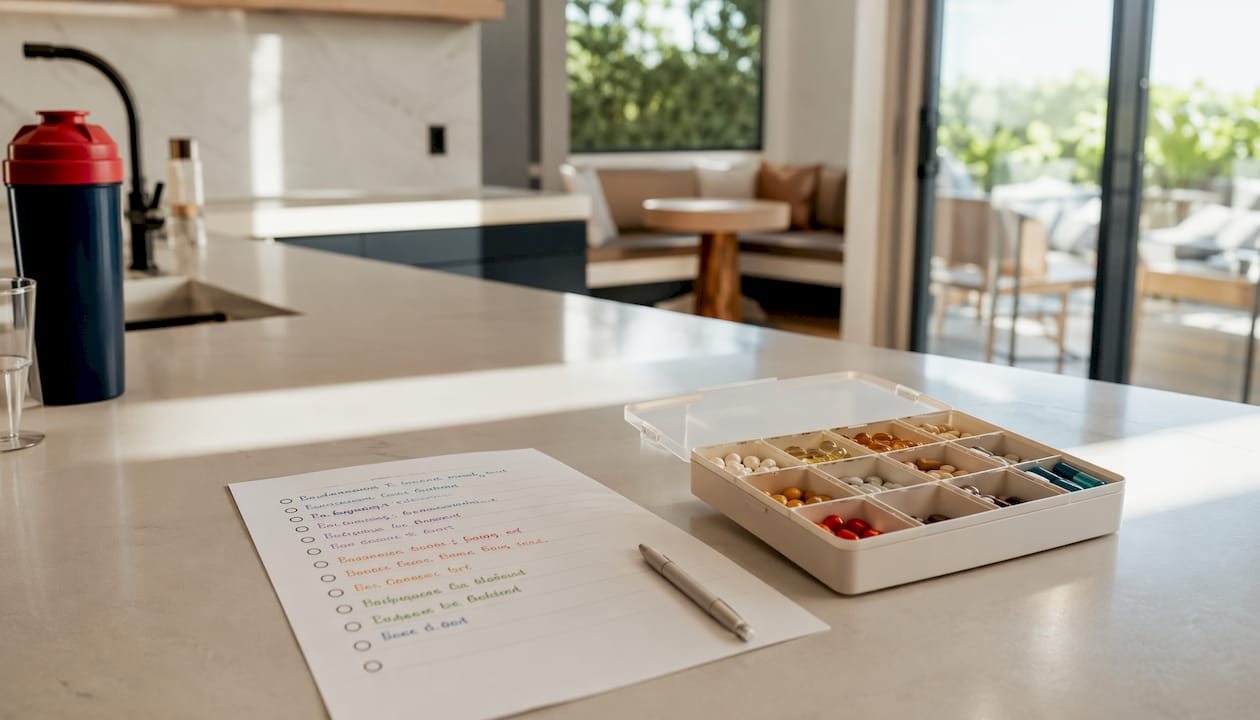
The simplest daily supplement routines share one thing: a small, focused set of supplements taken at consistent times. Here are four beginner-friendly examples you can start with today.
Routine 1: General Wellness Foundation
- Morning with breakfast: Vitamin D3 softgel, Omega-3 fish oil
- Evening after dinner: Magnesium glycinate supplement
- Optional add-on: B-Complex supplement with breakfast
Routine 2: Immune Support Focus
- Morning with breakfast: Vitamin C and Zinc supplements
- Evening: Magnesium glycinate supplement
Routine 3: Sleep and Relaxation Support
- Morning: Vitamin D3 supplement
- Evening 30 minutes before bed: Magnesium glycinate supplement and melatonin
Routine 4: Active Lifestyle and Recovery
- Morning with breakfast: Omega-3 fish oil supplement, B-Complex
- Post-workout or with lunch: Protein supplement (per product serving)
- Evening: Magnesium glycinate supplement
Notice that Vitamin D3, Magnesium glycinate, and Omega-3 fish oil appear across nearly every routine. These three form the backbone of most beginner supplement plans because they address the most common nutritional gaps in modern diets. A core foundational routine typically includes those three plus a B-Complex, covering the basics. Consistency with even one of these routines for two to three months gives your body time to respond before you consider adding anything else.
Pro Tip: Start with Routine 1 if you are completely new. It covers the widest ground with the fewest decisions.

What exactly are dietary supplements, and do you need them?
Dietary supplements are products you take to complement your regular diet. They include vitamins, minerals, herbs, amino acids, and enzymes, and they come in capsules, tablets, softgels, powders, and gummies. They are not medications. They do not treat or cure disease, and the FDA does not approve them before they go to market the way it does with drugs.
What the FDA does require is clear labeling. Supplement labels must include serving size, servings per container, and the amount of each dietary ingredient per serving. That information is your best tool for avoiding accidental doubling up on nutrients, especially when you use combination products.
Most people in the United States do not get optimal amounts of Vitamin D, Magnesium, or Omega-3s from food alone. Indoor lifestyles limit sun exposure, processed foods have displaced magnesium-rich whole grains, and the average American diet skews heavily toward omega-6 fats. Supplements fill those gaps without replacing a good diet.
Key supplement forms at a glance:
- Softgels/liquids: Best for fat-soluble vitamins like D3 and K2; the oil base improves absorption
- Capsules: Convenient for minerals and herbal extracts; easy to swallow
- Tablets: Shelf-stable and cost-effective, though sometimes slower to dissolve
- Powders: Flexible dosing, great for protein and collagen; mix into drinks
- Gummies: Tasty and easy to remember, but check added sugar content
| Feature | Supplements | Medications |
|---|---|---|
| FDA pre-market approval | Not required | Required |
| Intended use | Support nutrition and wellness | Treat, cure, or prevent disease |
| Label requirement | Serving size, ingredient amounts | Drug facts, dosage, warnings |
| Availability | Over the counter, online | Prescription or OTC depending on type |
Vitamin D3 absorbs best in oil-based softgels, and Magnesium glycinate is gentler on the stomach than Magnesium oxide, which has poor absorption. Form matters more than most beginners realize.
Which supplements match your wellness goals?
Your goal shapes your routine more than anything else. A sleep-focused routine looks very different from one built around athletic recovery, and trying to address every goal at once is where most beginners go wrong. Pick one starting point.
Immune support
- Vitamin C (500–1,000 mg daily): antioxidant support, widely studied
- Zinc (15–30 mg daily): supports immune cell function; take with food to avoid nausea
- Probiotics: support gut-associated immunity; look for multi-strain formulas
Sleep and relaxation
- Magnesium glycinate (300–400 mg in the evening): supports muscle relaxation and calm
- Melatonin (0.5–3 mg, 30 minutes before bed): helps regulate sleep timing, not depth
- Ashwagandha: an adaptogen that helps the body manage stress and supports a calmer nervous system
Sports nutrition and recovery
- Protein (whey, plant-based, or collagen): supports muscle repair and daily intake goals
- Creatine (3–5 g daily): well-researched for strength and performance; timing is flexible
- Omega-3 fish oil supplement: supports recovery and reduces exercise-related inflammation
Digestion and gut health
- Probiotics: restore and maintain healthy gut flora
- Digestive enzymes: support breakdown of proteins, fats, and carbohydrates
- Magnesium (in lower doses): supports regular bowel motility
Stress and mood support
- B-Complex (methylated forms preferred): supports nervous system function and energy metabolism
- Ashwagandha: reduces cortisol and supports mental balance
- Magnesium glycinate: doubles as both a sleep and stress support supplement
| Wellness Goal | Key Supplements | Best Timing |
|---|---|---|
| Immune support | Vitamin C, Zinc, Probiotics | Morning with food |
| Sleep support | Magnesium glycinate, Melatonin | Evening, 30 minutes before bed |
| Sports nutrition | Protein, Creatine, Omega-3 | Morning or post-workout |
| Digestion | Probiotics, Digestive enzymes | With meals |
| Stress and mood | B-Complex, Ashwagandha, Magnesium | Morning (B-Complex), evening (Magnesium) |
Collagen peptides are worth a mention here too. If skin health is part of your wellness picture, a morning supplement routine built around collagen can support skin elasticity alongside your foundational supplements. The less-is-more principle applies to supplement stacks just as it does to skincare: a few well-chosen products outperform a cluttered shelf every time.
How do you build a simple supplement routine that actually sticks?
The biggest reason supplement routines fail is not motivation. It is friction. Too many bottles, too many timings, and too many “take with food” notes turn a simple plan into a daily chore. Here is how to build one that you will actually keep.
Step 1: Choose one goal and one supplement to start. Introducing multiple supplements at once makes it impossible to know what is helping and what is causing any side effects. Start with one, give it a week or two, and then add the next. This is the single most practical piece of beginner advice, and most people skip it.
Step 2: Stack supplements onto existing habits. Habit stacking ties your supplement to a trigger you already do, like brewing coffee, eating breakfast, or brushing your teeth at night. When the trigger happens, the supplement follows automatically. This approach reduces missed doses far more reliably than memory or willpower alone.
Step 3: Match timing to the supplement.
- Fat-soluble vitamins (D3, K2, A, E): take with a meal that contains fat
- Magnesium glycinate: evenings work well; it supports relaxation
- B-Complex: mornings are better; B vitamins can be energizing
- Probiotics: follow the label; some work best away from meals
Step 4: Use a weekly pill organizer. Pill organizers reduce daily decision fatigue and improve routine adherence. Filling one on Sunday takes two minutes and removes the daily question of “did I take that already?” Set a phone reminder for the first two to three weeks until the habit locks in.
Step 5: Do a simple weekly check-in. No app required. Once a week, ask yourself: Am I taking this consistently? Do I notice any difference in how I feel? Rate your main goal on a scale of 1–10. Sleep quality, energy, digestion comfort. That simple check keeps you honest without turning your routine into another full-time job.
Pro Tip: Introduce supplements one at a time and track your response for at least a week before adding the next. It makes it much easier to spot what is genuinely helping and what your body does not agree with.
Common beginner pitfalls to avoid:
- Starting with five or six supplements at once, which obscures what is working
- Choosing supplements based on what is trending rather than your actual goal
- Ignoring label overlap, where two products contain the same nutrient at high doses
- Skipping the check-in and never adjusting the routine as your needs change
- Buying supplements you find annoying to take; the best format is the one you will actually use consistently
One more thing: if you take prescription medications, have a chronic health condition, or are pregnant, talk to your healthcare provider before starting any supplement routine. Supplement labels give you the ingredient information you need to have that conversation clearly. Bring your full list, including gummies, powders, and combination products, because interactions can come from unexpected sources.
Ready to build your routine?
Fromwithin makes it easy to start. Whether you are looking for a sleep support supplement for your evening wind-down or a collagen product to work into your morning, Fromwithin’s lineup is built around clinically researched ingredients with clear transparency on what is inside.

Browse Fromwithin’s supplement range and find the right starting point for your routine. Simple, effective, and designed to fit into real life.
Key Takeaways
The most effective daily supplement routine is a small, consistent set of supplements matched to one clear goal, introduced gradually and tied to existing daily habits.
| Point | Details |
|---|---|
| Start with a foundation | Vitamin D3, Magnesium glycinate, and Omega-3 fish oil cover the most common nutritional gaps for most beginners. |
| One supplement at a time | Introducing supplements gradually lets you track what helps and catch any side effects early. |
| Habit stacking works | Tying supplements to an existing trigger like breakfast or brushing teeth reduces missed doses reliably. |
| Use a pill organizer | Filling a weekly organizer reduces daily decision fatigue and improves adherence over time. |
| Match timing to the supplement | Fat-soluble vitamins go with meals, Magnesium glycinate works best in the evening, and B-Complex suits mornings. |
