

on August 03, 2026

Yes, L-theanine supports better sleep. A 2025 systematic review and meta-analysis covering 13 trials and approximately 550 adults found that supplementing with 200–450 mg/day improved sleep latency, sleep maintenance, and subjective sleep quality. The effect sizes were small to moderate, which means this is a genuine, measurable benefit, not a dramatic knockout. Think of it less like a sleeping pill and more like a calm signal your brain actually listens to.
Who benefits most:
- Adults whose sleep trouble is driven by stress, racing thoughts, or evening anxiety
- Busy professionals who need to wind down without feeling groggy the next morning
- People looking for a non-hormonal, non-habit-forming alternative to melatonin
When to expect results: Some users notice calmer evenings within the first week. Consistent improvements in sleep quality tend to appear over 2–4 weeks of nightly use.
The practical starting point: take a moderate dose of isolated L-theanine 30–60 minutes before bed, as part of a consistent wind-down routine.
Table of Contents
- What the clinical evidence says about L-theanine and sleep
- How L-theanine affects your brain to support relaxation
- Practical dosing, forms, and timing for sleep support
- Side effects, safety, and who should be cautious
- How to build L-theanine into your evening wind-down routine
- How does L-theanine compare with melatonin and magnesium?
- How strong is the evidence, and what gaps remain?
- Key Takeaways
- A practical perspective on where L-theanine fits in your sleep toolkit
- Fromwithin’s sleep aid is built around this evidence
- Useful sources and further reading
What the clinical evidence says about L-theanine and sleep
The strongest evidence comes from that 2025 systematic review, which pooled data from 13 trials, including randomized controlled trials (RCTs) and single-arm studies, with a combined sample of roughly 550 participants. Doses across trials ranged from 50–900 mg/day, but benefits were concentrated in trials using at least 200 mg/day. The outcomes that improved most consistently were sleep quality scores and sleep latency (how quickly you fall asleep). Total sleep time showed less consistent improvement across studies.
Key finding: Across included trials, L-theanine at 200–450 mg/day produced small-to-medium effect sizes for sleep quality and latency in healthy adults.
A few things are worth knowing about the trial landscape:
- Most trials ran for 4–8 weeks, with some using a single-dose design
- Sample sizes were generally modest, which limits how broadly the findings apply
- Several trials used combination products (L-theanine plus magnesium or other compounds), making it harder to isolate L-theanine’s contribution alone
- Populations with clinical insomnia were underrepresented; most participants had mild-to-moderate sleep difficulties
Compliance across trials was high, and adverse events were consistently low, with no reports of residual drowsiness or cognitive impairment the following morning. That tolerability profile is one of L-theanine’s clearest advantages over conventional sleep medications.
How L-theanine affects your brain to support relaxation
L-theanine is an amino acid found naturally in tea leaves. It crosses the blood-brain barrier after oral ingestion, allowing it to have a direct effect on brain chemistry. Once there, it works through several overlapping pathways.

The core chain looks like this: you take L-theanine, it reaches the brain within 30–60 minutes, it increases levels of GABA, serotonin, and dopamine while lowering norepinephrine (the alertness neurotransmitter), and it shifts your EEG pattern toward alpha brain waves. Alpha waves are associated with calm, relaxed wakefulness, the mental state you’re in when you’re reading quietly or meditating. That’s the key distinction: L-theanine promotes relaxation without sedation. It doesn’t force you to sleep. It quiets the mental noise that keeps you from getting there naturally.
Lower doses can produce measurable alpha-wave increases, while moderate doses tend to produce the more clinically meaningful sleep improvements seen in trials.
What this means for evening use:
- Reduced racing thoughts and mental chatter
- Lower physiological arousal (less norepinephrine = less “wired” feeling)
- A calmer transition from wakefulness to sleep
On tea vs. supplements: A standard 200 ml cup of brewed tea contains up to about 25 mg of L-theanine, far below the effective supplemental dose. Tea also contains caffeine, which directly counteracts L-theanine’s relaxing effect. Preclinical data even show L-theanine can reverse caffeine-induced sleep disturbances, which underscores why pairing the two at night is counterproductive. For sleep, an isolated supplement is the practical choice.
Pro Tip: If you enjoy an evening herbal tea ritual, keep it. Just take your L-theanine supplement separately, and choose a caffeine-free herbal blend so you’re not working against yourself.
Practical dosing, forms, and timing for sleep support
The research-backed effective window is a moderate dose taken as a single dose before bed. Lower doses reliably shift EEG patterns but tend to produce subtler changes in actual sleep outcomes. If you’re new to L-theanine, starting at 200 mg is a reasonable entry point.
| Dose Range | Expected Effect | Common Form |
|---|---|---|
| 50–200 mg | Alpha-wave increase, mild relaxation | Capsule, tea (low end) |
| 200–450 mg | Improved sleep latency and quality (trial-supported) | Capsule, tablet, powder |
| 900 mg | Observed in some trials; limited safety data at this level | Capsule |
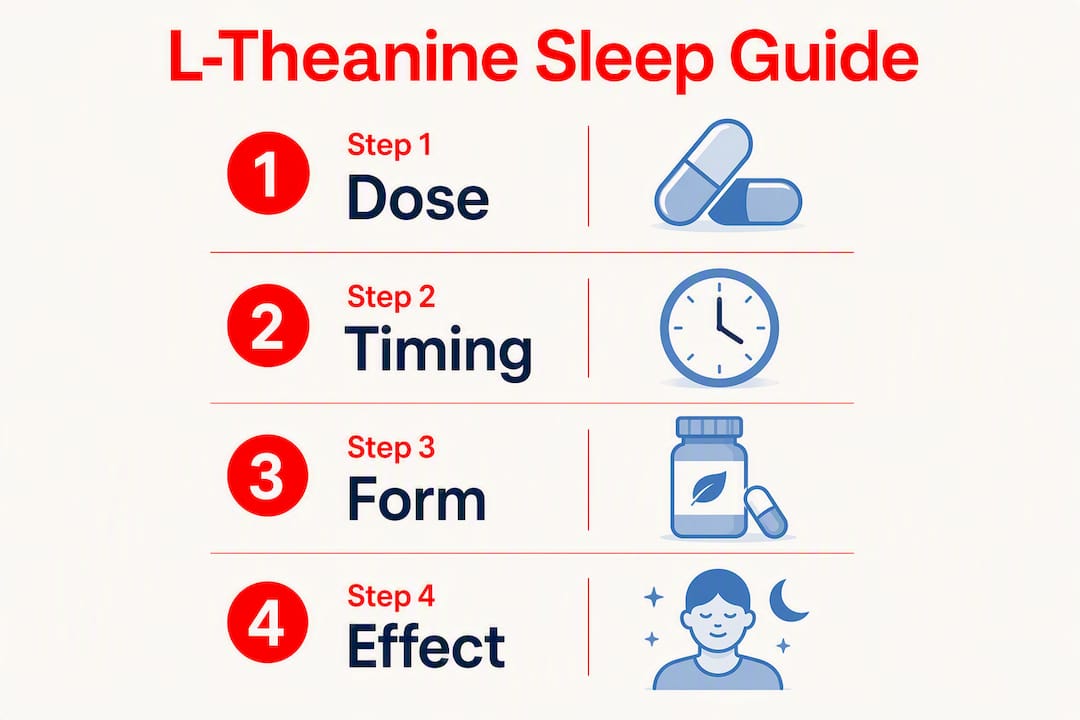
Timing: Most trials instructed participants to take L-theanine immediately before bed or within 30–60 minutes of their intended sleep time. Benefits appear more reliably with consistent nightly use than with sporadic, as-needed dosing.
Choosing a form:
- Capsules and tablets are the most common and convenient. They deliver a precise dose without any taste.
- Powders can be mixed into a warm, caffeine-free drink, which some people find adds to the wind-down ritual.
- Chewables exist but are less common for sleep-specific formulas.
- Tea is not a reliable delivery method for sleep purposes, given the low L-theanine content and caffeine presence.
Pro Tip: Check the supplement label for the amount of L-theanine per serving (not just the total capsule weight), and look for products that have undergone third-party testing, such as NSF Certified for Sport or USP verification, to confirm purity and dose accuracy.
For an evening routine, a single nightly dose works well for most people. Split dosing (morning and evening) is sometimes used for general stress management but is less relevant when the specific goal is sleep support.
Side effects, safety, and who should be cautious
L-theanine has a strong safety profile at the doses studied in trials. The 2025 systematic review reported high compliance and a low incidence of adverse events across included studies, with no consistent cognitive impairment or next-morning drowsiness. The FDA recognizes L-theanine as a food ingredient, consistent with its general safety at common serving sizes, though formal long-term safety data at higher supplemental doses remain limited.
Commonly reported side effects (generally mild and infrequent):
- Headache
- Dizziness
- Nausea (usually at higher doses)
- Gastrointestinal discomfort
Drug interactions to know:
- Sedatives and sleep medications: L-theanine may have additive calming effects when combined with prescription sedatives, benzodiazepines, or other sleep aids. This isn’t necessarily dangerous, but it warrants caution and a conversation with your doctor.
- Blood pressure medications: L-theanine can have mild blood-pressure-lowering effects. If you’re already on antihypertensive medication, monitor for additive effects.
- Stimulants: L-theanine is sometimes used to blunt caffeine’s edge, but combining it with prescription stimulants (e.g., for ADHD) should be discussed with a clinician.
Who should avoid or consult a provider first:
- Pregnant or breastfeeding individuals (insufficient safety data for these populations)
- Children (most trial data is in adults)
- Anyone on a complex medication regimen
- People scheduled for surgery (due to potential blood-pressure effects)
Pro Tip: If you’ve been using L-theanine for 4 weeks and your sleep hasn’t improved at all, that’s a signal worth taking to a healthcare provider. Persistent insomnia often has an underlying cause that a supplement alone won’t address.
How to build L-theanine into your evening wind-down routine
The best results come when L-theanine is part of a consistent routine, not a standalone fix you reach for on bad nights. Pairing it with supportive behaviors amplifies the biochemical relaxation it produces. Here’s a simple 30–60 minute wind-down sequence that works well for busy adults:
- Set a consistent start time. Begin your wind-down at the same time each night, ideally 60 minutes before your target sleep time. Consistency trains your nervous system.
- Dim the lights. Bright overhead lighting suppresses melatonin naturally. Switch to lamps or warm-toned lighting to signal that the day is winding down.
- Take your L-theanine. 200–400 mg with a small glass of water or a warm, caffeine-free herbal tea. This is your anchor moment for the routine.
- Step away from screens. Blue light from phones and laptops delays the brain’s shift toward sleep. Even 20 minutes of screen-free time makes a difference.
- Do something low-stimulation. Light reading, gentle stretching, journaling, or a short breathing exercise (try a 4-7-8 breath pattern) all work well here.
- Set your sleep environment. Cool room temperature (around 65–68°F is commonly recommended), dark curtains, and a consistent bedtime all support the process.
For a more detailed checklist, the evening wind-down routine guide from Fromwithin walks through each step with practical notes.
What to track over 2–4 weeks: How quickly you fall asleep, how often you wake during the night, and how rested you feel in the morning. These are the outcomes that improved most in clinical trials, and they’re easy to log in a simple notes app or sleep journal.
Pro Tip: Consistency matters more than perfection. Taking L-theanine five nights out of seven within a routine will outperform taking a double dose sporadically on the worst nights.
How does L-theanine compare with melatonin and magnesium?
These three are the most common non-prescription sleep supplements, and they work through completely different mechanisms. Choosing the right one depends on what’s actually disrupting your sleep.
L-theanine works by quieting mental arousal. It doesn’t shift your circadian clock or sedate you. It reduces anxiety-driven wakefulness and promotes the calm alpha-wave state that makes falling asleep easier. It’s the right choice when your main problem is a busy, anxious mind at bedtime.
Melatonin signals to your body that it’s nighttime. It’s most effective for circadian timing issues: jet lag, shift work, or delayed sleep phase (when your natural sleep window has drifted later than you want). It’s a hormone, and using it nightly at high doses can blunt your body’s own production over time. Typical effective doses for sleep timing are lower than most over-the-counter products suggest (0.5–1 mg is often sufficient for circadian signaling).
Magnesium (particularly glycinate or threonate forms) supports muscle relaxation and activates GABA receptors. It’s useful when physical tension, restless legs, or mild muscle discomfort are part of the picture. Glycine, another amino acid sometimes grouped with sleep supplements, works similarly by lowering core body temperature and supporting GABA activity.
| Supplement | Main Mechanism | Best For | Common Side Effects |
|---|---|---|---|
| L-theanine | Alpha waves, GABA/serotonin increase | Anxiety-driven sleep trouble | Rare; mild headache or nausea |
| Melatonin | Circadian timing signal | Jet lag, shift work, delayed sleep | Grogginess, vivid dreams |
| Magnesium | GABA activation, muscle relaxation | Tension, restlessness | Loose stools at high doses |
Quick decision guide:
- Racing mind at bedtime? L-theanine is your starting point.
- Traveling across time zones or working nights? Melatonin fits better.
- Physical tension or restless legs? Magnesium glycinate is worth trying.
- Stacking all three? Talk to a provider first. Combining supplements isn’t inherently dangerous, but it makes it harder to know what’s actually helping.
Ashwagandha is another option worth mentioning. Research suggests ashwagandha extract may improve sleep quality, efficiency, and latency, particularly in people with stress-related sleep difficulties. It works through a different pathway (primarily cortisol modulation) and can complement L-theanine rather than replace it, though again, stacking should be done thoughtfully.
How strong is the evidence, and what gaps remain?
The honest answer: the evidence for L-theanine and sleep is promising but not definitive. The 2025 systematic review provides the clearest signal yet, with consistent findings across 13 trials showing improvements in sleep quality and latency at 200–450 mg/day. But the overall evidence base has real limitations.
Evidence quality: Small-to-medium effect sizes; most trials used healthy adults with mild sleep difficulties, not clinical insomnia populations.
Where the evidence is weakest:
- Total sleep time: Improvements here were inconsistent across trials.
- Clinical insomnia: People with diagnosed insomnia disorder were largely absent from the trial pool. L-theanine’s benefits in that population are not well established.
- Long-term use: Most trials ran for 8 weeks or less. There’s no robust data on what happens with years of nightly use.
- Combination products: Several trials used L-theanine alongside magnesium or other compounds, making it difficult to attribute effects to L-theanine alone.
- Objective sleep measures: Many trials relied on self-reported sleep quality rather than polysomnography (the gold standard for measuring sleep architecture). When objective measures were used, they tended to show more modest effects.
What this means practically: If you have mild-to-moderate sleep difficulties driven by stress or anxiety, the evidence is solid enough to make L-theanine worth trying. If you have persistent, severe insomnia, L-theanine may help at the margins, but it’s not a substitute for clinical evaluation and evidence-based treatments like cognitive behavioral therapy for insomnia (CBT-I).
Key Takeaways
L-theanine at moderate doses reliably supports sleep quality and latency in adults with stress-related sleep difficulties, making it one of the most evidence-backed non-hormonal options available.
| Point | Details |
|---|---|
| Effective dose range | 200–450 mg/day, taken 30–60 minutes before bed, based on 13 clinical trials. |
| Best-fit use case | Anxiety-driven sleep trouble; less evidence for clinical insomnia or total sleep time. |
| Safety profile | Well tolerated in trials; caution with sedatives, blood pressure meds, and during pregnancy. |
| Routine matters | Consistent nightly use within a wind-down routine outperforms sporadic dosing. |
| Fromwithin’s approach | Fromwithin’s non-melatonin, non-hormonal sleep aid uses transparent, evidence-aligned ingredients for adults who want calm without grogginess. |
A practical perspective on where L-theanine fits in your sleep toolkit
Here’s where I’d genuinely recommend L-theanine: for the busy professional who lies awake replaying the day, whose mind won’t quiet down even when the body is tired. That specific pattern, stress-driven hyperarousal at bedtime, is exactly where the alpha-wave and GABA-modulating effects of L-theanine are most likely to make a noticeable difference.
What I find underappreciated in most discussions of sleep supplements is the role of behavioral context. L-theanine isn’t doing its best work when you take it and then scroll your phone for another hour. The biochemical relaxation it produces is real, but it’s amplified when you meet it halfway with a consistent routine, dimmed lights, and a screen-free wind-down. The connection between quality sleep and skin health is another reason to take this seriously: better sleep isn’t just about feeling rested. It’s when your body does its deepest repair work.
My honest view on the evidence: the 2025 systematic review is encouraging, but the field still needs larger trials with objective sleep measures and populations that include people with diagnosed insomnia. Until then, L-theanine sits in a useful middle ground: more evidence than most herbal supplements, fewer risks than pharmaceutical options, and a mechanism that makes genuine biological sense. For mild-to-moderate sleep difficulties, it’s a reasonable first step. For persistent insomnia, it’s a supportive adjunct while you pursue proper clinical care, not a replacement for it.
Fromwithin’s sleep aid is built around this evidence
If you’ve read this far and you’re thinking about actually trying L-theanine, the next question is: which product? Fromwithin’s sleep aid is formulated without melatonin and without hormones, which means it supports your body’s natural wind-down process rather than overriding it. The formula uses transparent, clinically researched ingredients at doses that align with the evidence reviewed here, so you know exactly what you’re taking and why.

No grogginess. No dependence. Just a calmer evening and a more natural transition into sleep. It’s designed for exactly the kind of person this article is written for: someone who wants real answers, not just a product that promises everything. If you’re ready to give your evenings the support they deserve, take a look at the Fromwithin sleep aid and see if it fits your routine.
Useful sources and further reading
The findings in this article draw from the following primary studies and clinical resources:
- Europe PMC record of the same systematic review — Useful for accessing the abstract and trial-level data; helpful for readers who want to verify specific trial characteristics.
- L-Theanine Benefits, Cleveland Clinic — Practitioner-oriented explainer emphasizing L-theanine’s supportive (not sedative) role and guidance on when to consult a clinician.
- Effect of Ashwagandha extract on sleep: a systematic review and meta-analysis (PMC) — Relevant for readers comparing L-theanine with ashwagandha for sleep; covers RCT-level evidence for the latter.
