

on September 15, 2026

Magnolia bark can genuinely help you fall asleep faster and feel calmer, largely thanks to two plant compounds called honokiol and magnolol. The evidence is strongest in animal research and still limited in humans, so think of it as a promising, calming ally rather than a proven fix. If you’re on sedatives, pregnant, or breastfeeding, talk to your doctor before trying it.
TL;DR:
- Human studies on magnolia bark mainly involve combinations with other supplements, and large, independent trials are still lacking.
- The active compounds honokiol and magnolol have low natural bioavailability, meaning much of what’s ingested may not reach the bloodstream effectively.
- Magnolia bark appears to primarily reduce anxiety and stress, which in turn can shorten sleep onset, rather than acting as a direct sedative.
- Combining magnolia bark with alcohol or prescription sedatives increases sedation risks, especially if taken near high-stress or demanding activities.
- For best results, choose products with standardized active percentages, third-party testing, and delivery technologies that improve absorption; avoid vague blends.
Table of Contents
- How Magnolia Bark Sleep Support Actually Works in Your Brain
- What Do Human Studies Say About Magnolia Bark for Sleep?
- Is Magnolia Bark Safe? Side Effects and Drug Interactions
- Choosing a Quality Magnolia Bark Extract: What the Label Should Say
- When and How to Take Magnolia Bark for Sleep
- Our Take on Formulation, Transparency, and What Actually Matters
- What matters most before you try it
- Want a Formulated Option Instead of Guesswork?
- Sources
- FAQ
How Magnolia Bark Sleep Support Actually Works in Your Brain
Here’s what’s happening under the hood. Magnolia bark comes from Magnolia officinalis, a tree used in traditional Chinese and Japanese herbal practice for centuries. Its bark contains two related polyphenols, honokiol and magnolol, and these two compounds are doing most of the heavy lifting when people talk about magnolia bark benefits for sleep and calm.
Honokiol appears to work at the benzodiazepine site of the GABAA receptor, the same general neural “brake pedal” that drugs like Valium use, just with a gentler touch. In mouse studies, honokiol at doses of 10 to 20 mg/kg shortened the time it took to fall asleep and increased NREM sleep, the deep, restorative sleep stage your body relies on most.
Statistic callout: When researchers gave mice flumazenil, a drug that blocks the benzodiazepine site, honokiol’s sleep-promoting effects disappeared almost entirely. That’s strong evidence the GABAA pathway is the actual mechanism, not a side effect.
A few caveats matter before you get too excited:
- Animal doses don’t translate directly to human supplement labels; body weight and metabolism differ a lot.
- Honokiol has notoriously low natural bioavailability, meaning much of what you swallow may never reach your bloodstream in an active form.
- The anxiolytic pathway, not sedation, seems to be the main practical mechanism — it quiets a racing mind rather than knocking you out.
What Do Human Studies Say About Magnolia Bark for Sleep?
Human research is where things get more honest, and a little more humble. There is real data, but it’s not the mountain of evidence you’d find behind melatonin.
One of the more compelling studies gave 89 menopausal women a combined supplement of 60 mg magnolia bark extract plus 50 mg magnesium for 24 weeks. Participants reported meaningful improvements in insomnia, anxiety, and mood, a combination that matters because sleep and stress tend to feed each other. If you’re wired at 11 p.m. replaying your inbox, the anxiety piece is often the real culprit.
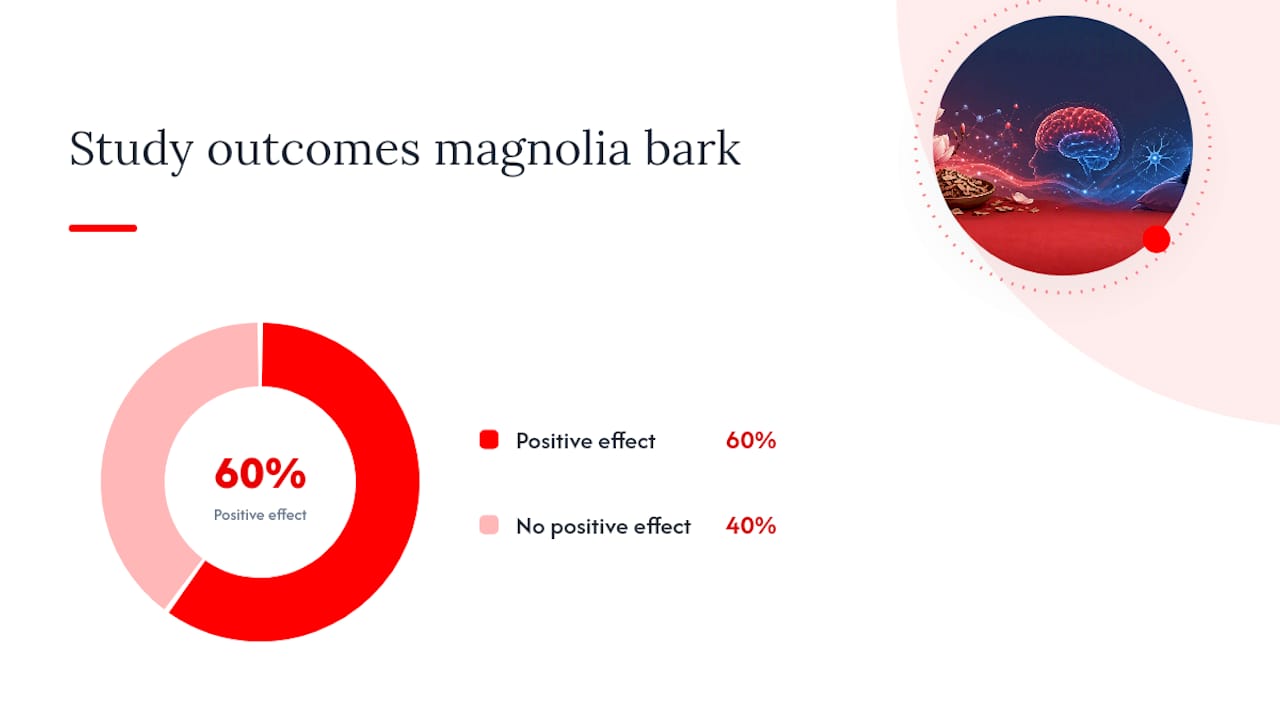
Beyond that trial, the picture gets thinner. Analytical reviews rate magnolia bark’s evidence for insomnia around a “Grade B” tier, based on a small pool of studies, roughly five, including two randomized controlled trials, covering a combined 763 participants. About three out of five of those studies showed a positive effect. That’s encouraging, but it’s not the slam dunk some marketing suggests.
Here’s the honest scorecard:
- Consistent signal: Reduced sleep latency and anxiety symptoms across multiple animal and human data points.
- Thin coverage: Very few large, standalone human RCTs testing magnolia bark alone (most human data involves combinations).
- Comparative weakness: A broader review of herbal sleep aids found that supplements like valerian and melatonin currently have stronger, more consistent RCT backing than magnolia bark.
The fair evidence-grade takeaway: magnolia bark shows moderate, credible promise, especially for stress-linked sleep trouble, but it works best as a supporting player rather than your only strategy.
Is Magnolia Bark Safe? Side Effects and Drug Interactions
Magnolia bark is generally well tolerated in the studies available, but “well tolerated” doesn’t mean “risk free,” and you deserve the real list, not the sanitized one.
Possible side effects include mild digestive upset, headache, and daytime drowsiness, especially if you take it too close to when you need to be sharp. The bigger concern is additive sedation: combining magnolia bark with anything else that slows your central nervous system can stack effects in ways that catch people off guard.
Watch for interactions with:
- Benzodiazepines and other prescription sedatives or sleep medications
- Alcohol, even a single glass, especially on an empty stomach
- Blood thinners, since some botanical compounds can mildly affect clotting
- Diabetes medications, due to possible effects on blood sugar regulation
Clinical guidance is consistent on one point: human interaction data is still limited, so caution beats confidence here. If you’re pregnant or breastfeeding, skip magnolia bark until you’ve talked to your provider. The same goes if you have surgery scheduled. Discontinue it at least a couple of weeks out, since sedative-adjacent supplements can complicate anesthesia planning.
Pro Tip: If you’re already taking a prescription sleep aid or anti-anxiety medication, don’t layer magnolia bark on top without your doctor’s input. “Natural” doesn’t mean “no interaction,” it just means the interaction is less studied.
Choosing a Quality Magnolia Bark Extract: What the Label Should Say
Not all magnolia bark products are built the same, and the dosing story is more complicated than a single number.
Animal studies have used a range of doses in mg/kg that translate to a broad range in human equivalent doses, and it depends heavily on which form you’re taking: raw bark powder, a standardized extract, or an enhanced-bioavailability formulation. Commercial products vary widely in bark extract amounts per serving, and the actual honokiol and magnolol content is more critical for potency.
That distinction is the whole game. Standardized extracts that list exact honokiol and magnolol percentages give you a far more reliable potency estimate than a generic “magnolia bark powder” weight, since raw bark batches vary widely in active compound levels.
Bioavailability technology matters too. Because honokiol absorbs poorly on its own, some oral microparticle formulations have demonstrated substantially higher bioavailability compared to free honokiol, leading to stronger effects in animal models compared to standard honokiol, translating into meaningfully stronger NREM sleep effects in animal models.
Before you buy, run through this checklist:
- Check for standardized actives. Look for a declared honokiol/magnolol percentage, not just total bark milligrams.
- Look for third-party testing. Independent lab verification confirms the label matches what’s actually inside.
- Favor transparency over marketing. A company that explains its sourcing and dosing logic is more trustworthy than one leaning on vague wellness language.
- Start conservative. Begin at the lower end of a product’s suggested dose and adjust rather than maxing out immediately.
Pro Tip: If a product won’t tell you its honokiol or magnolol percentage, treat that silence as information. Some approaches lean on named, measured actives specifically because vague “proprietary blend” labels make it impossible to judge real potency.
When and How to Take Magnolia Bark for Sleep
Timing matters more than most people assume. Most users take magnolia bark 30 to 60 minutes before bed, either nightly for ongoing stress-related sleep trouble or occasionally on high-stress nights. It’s not a fast-acting knockout pill, so don’t expect the same immediacy as an over-the-counter antihistamine.
Combining it with magnesium has actual research behind it. The 24-week trial mentioned earlier paired 60 mg of magnolia bark extract with 50 mg of magnesium, and that combination outperformed expectations for insomnia and mood, likely because magnesium and magnolia bark calm the nervous system through different pathways, which tend to complement rather than duplicate each other.
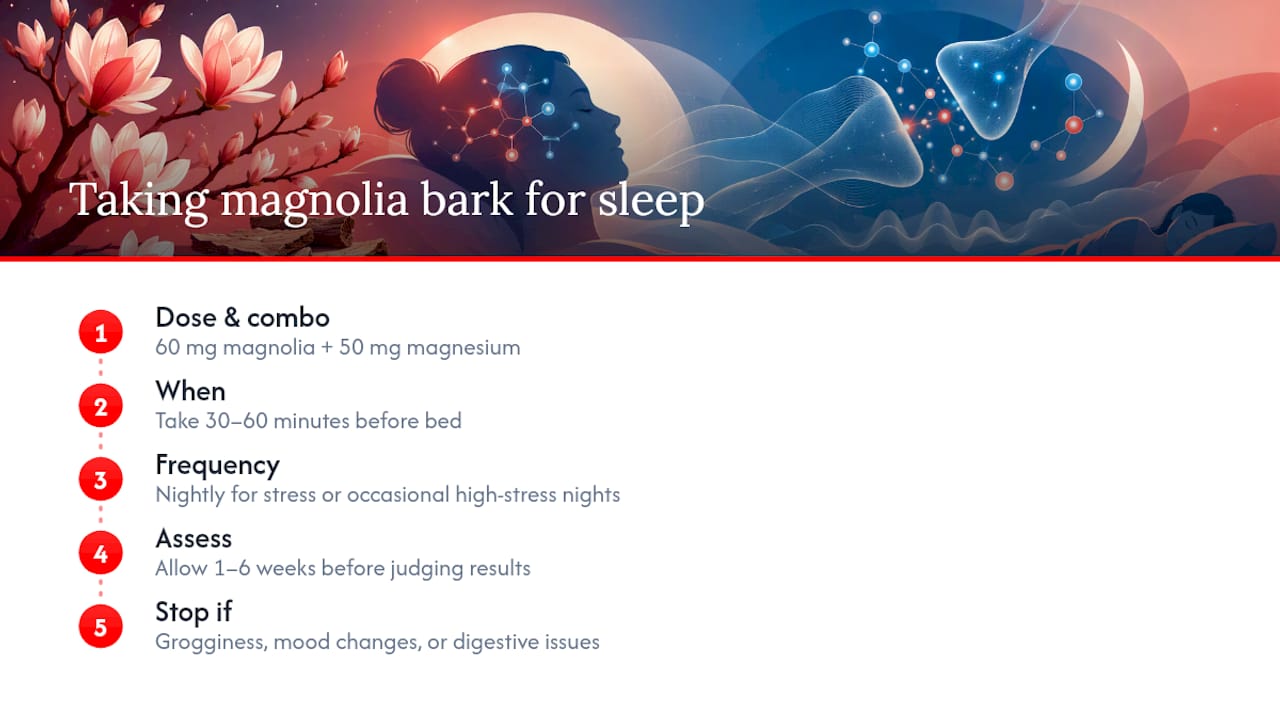
Give it one to six weeks before judging results. If you notice no change by week six, or if you develop excessive grogginess, mood shifts, or digestive issues, stop and check in with a clinician rather than pushing through.
Our Take on Formulation, Transparency, and What Actually Matters
We look at magnolia bark research the same way we look at every ingredient we consider: does the mechanism hold up, and does the delivery method actually work in a human body? Honokiol’s poor natural bioavailability is the part most marketing conveniently skips. A supplement can list an impressive milligram count and still deliver almost nothing active into your bloodstream if the formulation ignores that problem.
That’s why some sleep aids are built around patented peptides designed for bloodstream absorption, not just a bigger number on the label. Some products are non-melatonin and non-hormonal, meant for people who want to wind down without waking up dependent on something stronger than their own biology.
If you’re building a nightly routine, pair whatever supplement you choose with consistent habits. Our evening wind-down checklist and guide to what actually works in sleep supplements go deeper on both fronts.
What matters most before you try it
The research on magnolia bark tells a clear but modest story: the mechanism is real, the animal data is compelling, and the human evidence, while still thin, points in a genuinely encouraging direction for stress-related sleep trouble. Where the conventional advice falls short is in treating “natural” as synonymous with “harmless” and in glossing over the bioavailability problem entirely. A supplement with unmeasured honokiol content and no delivery technology behind it is asking a lot from a compound that struggles to absorb well on its own.
If you’re going to try magnolia bark, prioritize the formulation science over the marketing copy. Look for standardized actives first, safety screening second, and only then consider price or packaging. Sleep supplements aren’t one-size-fits-all, and the people who get the best results tend to be the ones who match the product to their actual physiology, not the ones chasing the prettiest bottle.
— From
Want a Formulated Option Instead of Guesswork?
If you’ve read this far, you already know the hard part of magnolia bark isn’t whether it works, it’s whether the product in front of you was built to deliver it properly. Some sleep aids skip melatonin and hormones entirely, using patented peptides formulated for direct bloodstream absorption, so you’re not left wondering if the active ingredients actually reached your system.

The formulation reflects the same transparency standard covered above: measured actives, not vague blends, and no dependence-forming ingredients. You can see the full breakdown on the sleep aid product page, or browse the wider vitamins and supplements collection if you’re weighing more than one nighttime option. If you currently take a prescription sedative, check with your doctor before adding any new sleep supplement to your routine. Ready to see the full ingredient panel? Head to the sleep aid page and start there.
This article is general information, not a substitute for advice from a qualified doctor. Consult a qualified healthcare professional about your own circumstances before acting on anything here.
Sources
- Honokiol promotes non-rapid eye movement sleep via the benzodiazepine site of the GABAA receptor in mice
- Oral Delivery of Honokiol Microparticles for Nonrapid Eye Movement Sleep
- Magnolia Bark: Benefits, Usage, and Side Effects
- Magnolia Bark for Sleep: Dosage, Benefits, and Risks - Sleep Doctor
FAQ
Does Magnolia Bark Help With Sleep?
Yes, moderate evidence suggests it can help, primarily by calming anxiety and shortening the time it takes to fall asleep, though human trial data is still limited compared to better-studied sleep aids.
Can I Take Magnolia Bark and Magnesium Together?
Yes, a 24-week trial combining 60 mg magnolia bark extract with 50 mg magnesium improved insomnia and mood in menopausal women, and the two work through different calming pathways.
Does Magnolia Bark Cause Drowsiness?
It can, especially at higher doses or when combined with alcohol or sedative medications, so avoid driving or operating machinery until you know how your body responds.
Who Should Not Take Magnolia Bark?
Pregnant or breastfeeding people, anyone on benzodiazepines or other sedatives, and those with upcoming surgery should avoid it or consult a clinician first, since human interaction data remains limited.
