

on August 02, 2026

If you want a quick answer, here it is: the three safest, best-researched non-habit-forming sleep aids are magnesium glycinate or magnesium L-threonate, L-theanine, and low-dose melatonin. Clinical reviews from Q1 2026, along with guidance from the Mayo Clinic and Johns Hopkins Medicine, consistently point to these three as the lowest-risk OTC options for adults who want to wake up clear-headed.
Here’s what makes them stand out:
- Magnesium glycinate/L-threonate: supports GABA activity and circadian temperature regulation; minimal next-day grogginess
- L-theanine: calms racing thoughts by increasing alpha-wave activity; no sedation, no morning fog
- Low-dose melatonin: helps shift your sleep timing for jet lag or occasional onset issues; keep the dose low to avoid suppressing your own rhythm
- Fromwithin’s non-hormonal sleep aid is formulated around the same evidence-based, non-melatonin philosophy, making it a natural fit for health-conscious adults who want ingredient transparency alongside their beauty routine
Table of Contents
- What “non-habit-forming” actually means for sleep supplements
- Evidence-backed options: how they work, dosing, and grogginess risk
- How to pick the right non-habit-forming sleep aid for your situation
- Quick decision guide: which ingredient fits your sleep problem?
- Risks, interactions, and when you need a clinician
- Key Takeaways
- Why I’d keep it simple (and what most people get wrong)
- Fromwithin’s non-hormonal sleep support fits the evidence
- Useful sources
What “non-habit-forming” actually means for sleep supplements
The phrase gets used loosely on a lot of labels, so let’s be specific. A truly non-habit-forming sleep supplement does three things: it creates no physical dependence, it doesn’t build tolerance quickly under typical OTC use, and it doesn’t suppress your body’s own sleep chemistry over time.
That last point matters more than most people realize. Routine high-dose melatonin, for example, can blunt your body’s natural melatonin production. Technically “non-habit-forming” by the pharmaceutical definition, but still disruptive to your endogenous rhythm. Health-conscious adults are increasingly drawing this distinction, preferring mineral or botanical supports that work with the body rather than substituting for it.
Antihistamines like diphenhydramine (Benadryl) and doxylamine (Unisom) sit in a different category. Mayo Clinic notes they’re intended for occasional use only, and Baylor College of Medicine experts warn that their anticholinergic effects, including dry mouth, constipation, and morning grogginess, make them poorly suited for regular use. The “non-habit-forming” label on the box refers to physical dependence, not to the side-effect burden.
Red flags to watch for on labels:
- Proprietary blends with undisclosed doses
- Combinations of multiple sedating ingredients with no individual dosing guidance
- Claims of “deep sleep” without citing a specific mechanism or ingredient
Pro Tip: If a supplement lists “sleep blend” without breaking out individual ingredient amounts, you can’t assess safety or efficacy. Single-ingredient or fully transparent multi-ingredient products are always the safer starting point.
Evidence-backed options: how they work, dosing, and grogginess risk
Magnesium glycinate and magnesium L-threonate
Magnesium supports GABA receptors, the brain’s primary calming system, and helps regulate core body temperature as you drift toward sleep. The glycinate form is gentle on digestion; the L-threonate form crosses the blood-brain barrier more readily. Clinical reviewers in 2026 favor both for their very low grogginess risk, making them a first-line non-hormonal option for stress-related restlessness and sleep maintenance.

L-theanine
Found naturally in green tea, L-theanine increases alpha-wave brain activity, which creates a calm-but-alert state that eases the transition to sleep without sedation. It is particularly useful for people whose minds won’t quiet down at bedtime. The Sleep Foundation highlights its supportive evidence and favorable safety profile.
Low-dose melatonin
Melatonin’s job is phase-shifting, not sedation. Taken 30–90 minutes before your target bedtime, a low dose signals your brain that night is coming. Clinical guidance consistently recommends starting at 0.5 mg rather than the 5–10 mg doses common on store shelves. Higher doses don’t work better and may increase next-day grogginess risk.
Other options worth knowing
Glycine (3 g before bed) shows promising results for sleep quality and next-day alertness in smaller studies. Valerian has mixed evidence; use with caution and avoid combining with other CNS depressants. CBD is dose-dependent and regulation varies by state, so quality control is inconsistent.
| Ingredient | Best for | Mechanism | Typical dose | Onset | Grogginess risk | Evidence level | Safety notes |
|---|---|---|---|---|---|---|---|
| Magnesium glycinate | Stress, restlessness, maintenance | GABA modulation, temp regulation | Moderate dose | 30 min | Very low | Strong | Avoid in kidney impairment |
| Magnesium L-threonate | Cognitive wind-down | Blood-brain barrier penetration | Moderate dose | 30 min | Very low | Moderate-strong | Same as above |
| L-theanine | Racing thoughts | Alpha-wave increase | Moderate dose | 30 min | Minimal | Moderate | Very well tolerated |
| Low-dose melatonin | Jet lag, sleep onset | Circadian phase-shifting | Low dose | 30–90 min | Low (at correct dose) | Strong | Avoid high doses routinely |
| Glycine | Sleep quality, alertness | Lowers core body temp | Moderate dose | 30 min | Very low | Emerging | Generally safe |
| Diphenhydramine | Occasional only | Histamine blockade | Moderate dose | 30 min | High | Established | Not for regular use |
How to pick the right non-habit-forming sleep aid for your situation
Your sleep problem type is the first filter. Trouble falling asleep points toward L-theanine or low-dose melatonin. Waking up at 2 AM and lying there for an hour points more toward magnesium or glycine. These aren’t interchangeable.
Personal factors to check before you start:
- Medications: Magnesium can interact with certain antibiotics and diuretics. Melatonin interacts with blood thinners and immunosuppressants. Always check with your pharmacist.
- Pregnancy or breastfeeding: No OTC sleep supplement has robust safety data for pregnancy. Consult your OB before starting anything.
- Age: Older adults are especially vulnerable to antihistamine side effects, including fall risk and cognitive effects.
- Shift work or irregular schedules: Melatonin timing becomes complicated; magnesium or L-theanine are simpler starting points.
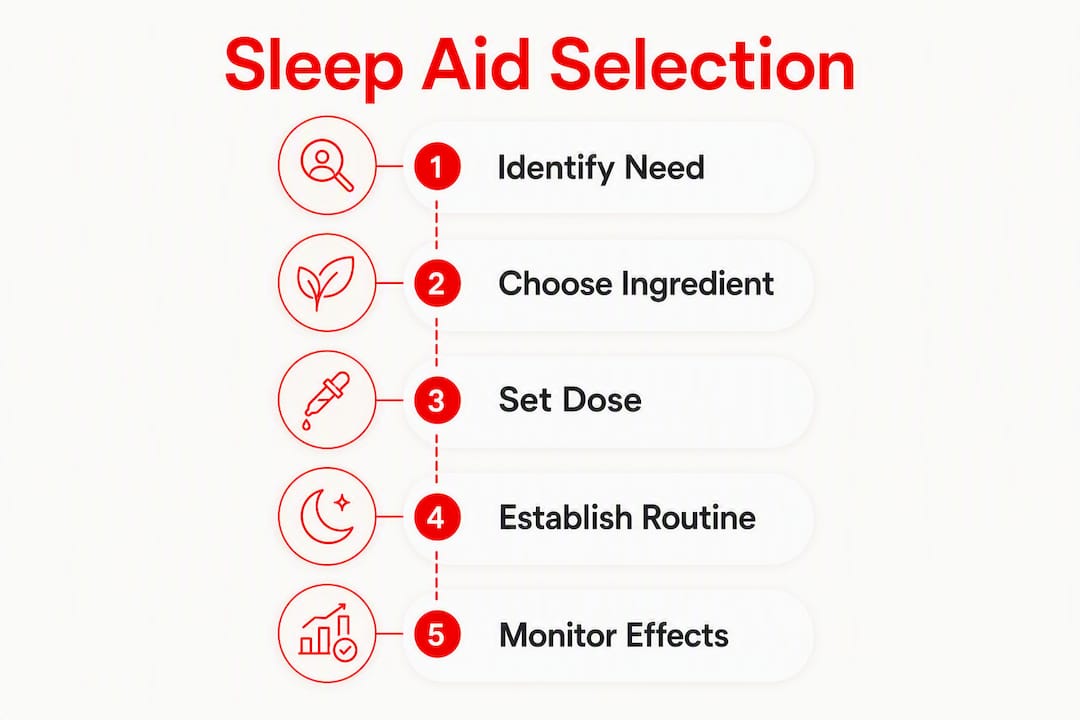
Your step-by-step starting plan:
- Pick one ingredient based on your symptom type above.
- Start at the lowest suggested dose.
- Take it consistently for 7–14 nights before evaluating.
- Track how you feel in the morning, not just at night.
- If no improvement after two weeks, stop and consult a clinician rather than adding more supplements.
- Never combine with alcohol or other sedating substances.
Pairing your supplement with a consistent evening wind-down routine makes a real difference. Supplements work best when the behavioral foundation is already in place.
Quick decision guide: which ingredient fits your sleep problem?
| Situation | Best ingredient | Typical dose | Onset |
|---|---|---|---|
| Jet lag or travel | Low-dose melatonin | 0.5–1 mg | 30–90 min before target bedtime |
| Racing thoughts at bedtime | L-theanine | 100 mg | 30 min |
| Stress-driven restlessness | Magnesium glycinate | 200 mg | 30 min |
| Waking mid-sleep | Magnesium L-threonate or glycine | 3 g | 30 min |
| Occasional sleeplessness, no other issues | Low-dose melatonin | 0.5–3 mg | 30–90 min |
One note: these are starting points, not prescriptions. If your situation involves multiple symptoms or medications, a single conversation with your pharmacist can save you weeks of trial and error.
Risks, interactions, and when you need a clinician
Most non-habit-forming sleep supplements are well tolerated, but “natural” doesn’t mean risk-free.
Common side effects and interactions to know:
- Magnesium in high doses causes loose stools; reduce the dose if this happens. Avoid in kidney disease without medical supervision.
- Melatonin can interact with warfarin, cyclosporine, and diabetes medications.
- Antihistamines carry anticholinergic effects (dry mouth, constipation, urinary retention) that accumulate with repeated use, particularly in older adults where fall risk increases.
Special populations: Pregnancy, breastfeeding, and adults over 65 should consult a clinician before starting any sleep supplement. The risk-benefit calculation is genuinely different in these groups.
Red flags that mean it’s time to call your doctor:
- Insomnia lasting more than two weeks despite good sleep hygiene
- Loud snoring, gasping, or waking with a headache (possible sleep apnea)
- Worsening daytime sleepiness or new cognitive changes
- Needing to increase your dose to get the same effect
Johns Hopkins Medicine is clear: when insomnia persists beyond two weeks, the priority is identifying the underlying cause, not adding more supplements. Sleep apnea, mood disorders, and medication side effects are common culprits that no supplement will fix. Good bedtime supplement practices include knowing when to stop, not just when to start.
Key Takeaways
The safest non-habit-forming sleep aids are magnesium glycinate/L-threonate, L-theanine, and low-dose melatonin (0.5–3 mg), used as targeted support on top of consistent sleep hygiene.
| Point | Details |
|---|---|
| Start with the right ingredient | Match your symptom: L-theanine for racing thoughts, magnesium for restlessness, melatonin for onset or jet lag. |
| Keep doses low | Melatonin works best at 0.5–3 mg; higher doses increase grogginess without improving sleep. |
| Sleep hygiene comes first | A cool bedroom, no screens an hour before bed, and a consistent schedule outperform any supplement alone. |
| Two-week rule | If a supplement hasn’t helped after 14 nights, stop and consult a clinician rather than adding more. |
| Fromwithin’s sleep aid | Fromwithin offers a non-melatonin, non-hormonal sleep aid with transparent ingredients aligned with these evidence-backed options. |
Why I’d keep it simple (and what most people get wrong)
Here’s the thing most sleep supplement articles won’t say: the biggest mistake health-conscious adults make isn’t choosing the wrong ingredient. It’s layering too many at once. I’ve seen people combine melatonin, magnesium, L-theanine, valerian, and CBD in the same evening and then wonder why they can’t tell what’s working. You genuinely can’t evaluate anything that way.
My honest recommendation is to treat your first two weeks like a clean experiment. One ingredient, consistent dose, same timing every night. Track how you feel in the morning, not just whether you fell asleep faster. Sleep quality shows up in your skin, your focus, and your mood the next day, and those signals are just as informative as how quickly you drifted off. There’s real science behind why quality sleep improves skin, and it’s worth paying attention to.
The other thing worth saying: “non-habit-forming” on a label is a starting point, not a guarantee. Read the ingredient list, check the doses, and if a product won’t tell you exactly what’s in it and how much, that’s your answer right there.
Fromwithin’s non-hormonal sleep support fits the evidence
If you’ve read this far and you’re looking for a product that actually matches the criteria above, Fromwithin’s non-hormonal sleep aid is worth a look. It’s formulated without melatonin, without hormones, and with full ingredient transparency, which puts it squarely in line with what clinical reviewers and sleep specialists recommend for busy adults who want support without dependency.

What makes it a practical fit for health-conscious adults is the combination: non-habit-forming sleep support that pairs naturally with Fromwithin’s collagen peptide formulas for a complete evening routine. You’re not just sleeping better; you’re giving your skin the recovery window it needs. The formulation uses patented Wellnex® peptides absorbed directly into the bloodstream for maximum efficacy, and the sleep aid itself is designed to calm without sedating.
Ready to try a cleaner approach to sleep? Visit the Fromwithin sleep aid page to see the full ingredient list and find the option that fits your routine.
Useful sources
- Mayo Clinic: Sleep aids — Comprehensive OTC sleep aid overview including antihistamine side effects and short-term use guidance.
- Johns Hopkins Medicine: Sleep aids — Clinical perspective on sleep hygiene as the foundation and supplements as adjuncts; guidance on when to seek care.
- Sleep Foundation: Natural sleep aids — Evidence summaries for magnesium, L-theanine, melatonin, glycine, valerian, and CBD.
- Baylor College of Medicine: Antihistamine caution — Expert warnings on anticholinergic effects and why antihistamines are unsuitable for regular sleep use.
- Dr. Brighten: Magnesium for sleep — Clinical review of magnesium glycinate and L-threonate dosing, mechanisms, and grogginess risk.
- Ubie Health: Best OTC sleep aids without grogginess — Practical clinician notes on low-dose melatonin timing and non-hormonal alternatives.
- Harvard Healthy Buildings Program: Bedroom tips — Evidence-based environmental sleep hygiene recommendations including temperature and screen guidance.
