

on August 18, 2026

Yes, you can quit melatonin safely, and for most adults, that means stopping tonight without any taper at all. Johns Hopkins Medicine recommends stopping melatonin if it hasn’t helped within one to two weeks, and even for people who do feel it working, nightly use is generally meant to be a short-term bridge for a limited period before you check whether your sleep holds up on its own.
Here’s what to do tonight if you’re ready to start:
- Try one non-melatonin wind-down tactic (dim the lights, skip the last scroll session) instead of reaching for the bottle.
- Jot down your current dose, how often you take it, and what your bedtime routine looks like.
- If you’re anxious about it, plan a short, deliberate break (say, three nights) rather than an open-ended cold stop.
Key Takeaways
Most adults can stop melatonin immediately without physical withdrawal, and lasting sleep improvement comes from behavioral changes, not the pill itself.
| Point | Details |
|---|---|
| No physiological withdrawal | Clinical experts confirm melatonin doesn’t cause physical dependence, so most adults can stop right away. |
| Two-week benefit check | Johns Hopkins Medicine advises stopping if you see no improvement within one to two weeks. |
| Habit, not chemistry | The hardest part of quitting is usually the bedtime ritual and anxiety, not a physical craving. |
| CBT-I is the strongest alternative | Cognitive behavioral therapy for insomnia addresses the anxious thoughts driving sleeplessness more directly than any supplement. |
| Consider a non-melatonin option | Fromwithin’s sleep aid offers a transparent, non-hormonal alternative for ongoing wind-down support. |
This article is general information, not a substitute for advice from a qualified doctor. Consult a qualified healthcare professional about your own circumstances before acting on anything here.
Table of Contents
- Why Quitting Melatonin Safely Can Still Feel Hard
- Your Step-By-Step Plan To Stop Melatonin
- What To Expect After You Stop
- Evidence-Based Alternatives Worth Trying Instead
- When You Need Medical Guidance Before Stopping
- What the Research Actually Shows
- If You Want Support Without the Melatonin Question
- Sources
Why Quitting Melatonin Safely Can Still Feel Hard
Melatonin doesn’t cause physical withdrawal. There’s no chemical hook holding you in place, according to Sleep Review, which reports that most adults can stop immediately without medical tapering. So why does quitting still feel like giving something up?
Because the pill became part of a ritual, not just a chemical. Popping it before bed is a cue, the same way brushing your teeth signals “day is over.” Break the cue and your brain briefly protests, not because it’s chemically dependent, but because it’s confused. University of Michigan Medicine points to psychological dependence, habit and anxiety around sleep, as the real driver behind that “hooked” feeling.
The struggle to quit melatonin is often psychological rather than physical, and cognitive behavioral therapy for insomnia teaches skills that calm the anxious thoughts fueling that struggle.
A few things compound the difficulty:
- Anticipatory worry (“will I sleep without it?”) can itself keep you awake, a self-fulfilling loop.
- Over-the-counter melatonin products vary widely in labeled versus actual dose, which makes it harder to know what you’re even weaning off of.
- Rising overall use, documented by NIH, means more people are hitting this exact wall at once.
Your Step-By-Step Plan To Stop Melatonin
Start by figuring out which camp you’re in. If you’ve been taking melatonin for a few weeks or less, or at a low dose, an immediate stop is usually fine. If you’ve built a strong nightly ritual around it, or you’re anxious about sleeping without it, a short, structured taper over one to two weeks feels gentler and works just as well.
Here’s a plan that covers either path:
- Pick a start date within the next few days, not “someday.”
- Reduce nights or dose. Either cut your dose by a step every one to two weeks, or pre-select two or three “no-melatonin nights” per week to prove to yourself you can sleep without it, an approach clinicians use to reduce anxiety around stopping.
- Lock in sleep hygiene before you drop the pill entirely: consistent wake time, a dark cool bedroom, no screens for 30 minutes pre-bed.
- Track it. A one-line nightly journal (bedtime, wake time, how rested you felt) shows you real progress instead of relying on memory.
- Swap in a replacement ritual. Deep breathing, a simple relaxation sequence, or reading five pages can fill the cue gap the pill used to occupy.
- Escalate to CBT-I if you’re still struggling after two to three weeks.
Before your start date, prep the basics: blackout curtains or an eye mask, phone on do-not-disturb, and a wake time you’ll hold even on weekends.
Pro Tip: Pick your “no-melatonin nights” on days you’re already tired, like after a workout or a long day, so your body has extra help falling asleep without the pill. And consider banking what you’d normally spend on melatonin toward something you actually want; that small reward loop reinforces the change faster than willpower alone.
What To Expect After You Stop
The first night is usually the hardest, mentally more than physically. You might lie there wondering if it’ll work, which is the anxiety talking, not withdrawal. By the first week, most people either notice no real difference or a few nights of lighter, more fragmented sleep.
Between weeks two and four, sleep typically evens back out as your routine (not a supplement) becomes the new cue for rest.
- Night one: Possible racing thoughts, but no physical withdrawal symptoms.
- Week one: Occasional restless nights or vivid dreams as your sleep pattern resets.
- Weeks two to four: Sleep quality usually normalizes if hygiene habits are consistent.
- Beyond four weeks, still struggling: Time to loop in a clinician or sleep specialist.
Nothing about this timeline resembles drug withdrawal. It resembles breaking any habit: a little wobbly at first, steadier once the new routine sticks.
Evidence-Based Alternatives Worth Trying Instead
Melatonin’s own track record is more modest than most people assume. A 2013 meta-analysis found it cuts time to fall asleep by about seven minutes and adds roughly eight minutes of total sleep, on average, a real but small effect for garden-variety insomnia. It shines more clearly for jet lag and circadian rhythm disorders than for everyday sleeplessness.
Where the real evidence is strongest:
- CBT-I (cognitive behavioral therapy for insomnia): the gold standard behavioral treatment, addressing the anxious thoughts and habits that keep sleep elusive, available through therapists or reputable digital programs.
- Morning light exposure: anchors your circadian rhythm without a supplement.
- Stimulus control: only using your bed for sleep, so your brain re-learns the association.
- Consistent sleep scheduling: same wake time daily, even weekends.
- Daytime exercise: regular physical activity measurably improves sleep quality.
- Wind-down relaxation routines: breathing exercises or progressive muscle relaxation replace the pill-taking ritual itself.
For some people, especially those with diagnosed circadian issues, a short course of melatonin alongside CBT-I makes sense. It’s rarely an either/or.
When You Need Medical Guidance Before Stopping
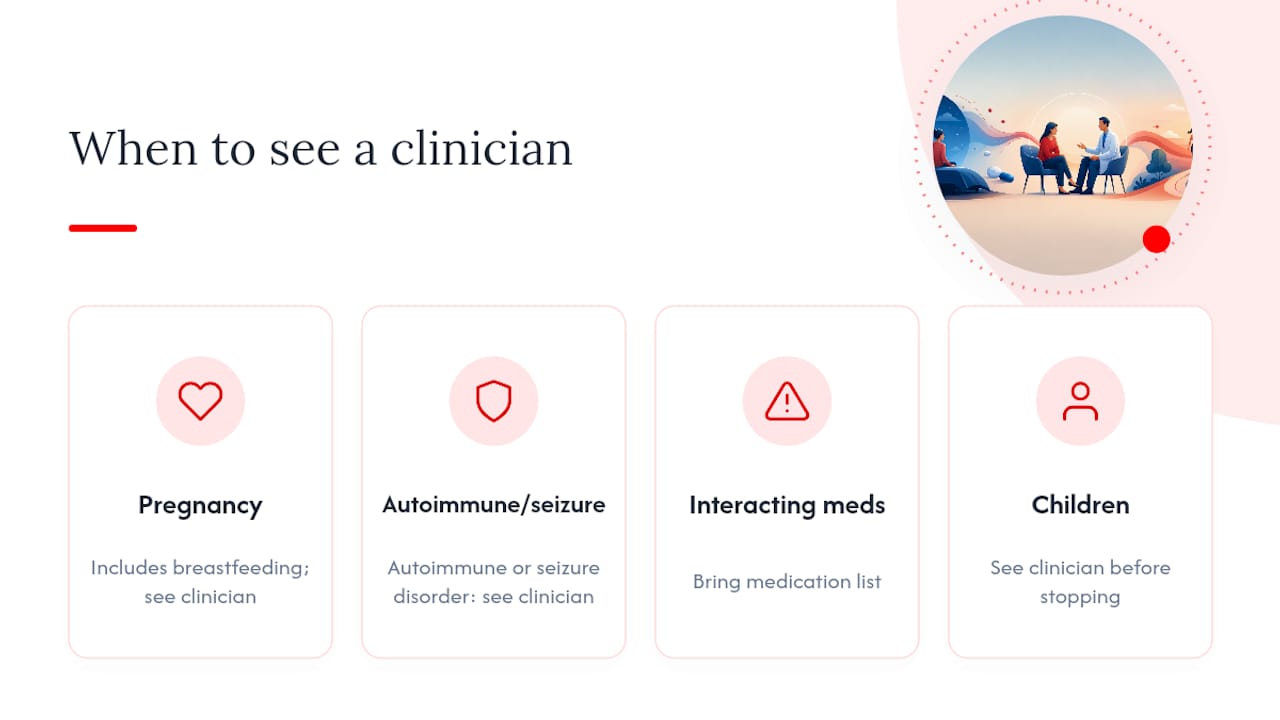
Most adults can quit melatonin cold turkey without incident, but a few groups should check with a clinician first: people who are pregnant or breastfeeding, anyone with an autoimmune condition or seizure disorder, those on interacting medications, and children.
Dosing adds another wrinkle. Research on chronic melatonin use suggests low-to-moderate doses, roughly 5 mg or less, appear safe short-term, but manufacturing variability means the label doesn’t always match what’s in the bottle.
When in doubt, call your doctor and bring specifics: your dose, how often you take it, any other medications, and whether an underlying sleep disorder might be at play.
What the Research Actually Shows
Strip away the marketing, and the science on melatonin is fairly modest and reassuring at the same time. It doesn’t produce dramatic sleep gains, and it doesn’t produce physical withdrawal either.
- Systematic review data shows melatonin’s average effect is a seven-minute reduction in sleep latency, modest, not miraculous.
- Johns Hopkins Medicine advises stopping if there’s no benefit within one to two weeks.
- Clinical reviewers confirm there’s no physiological dependence tied to melatonin, which is why most people can stop without a formal taper.
- Long-term safety data is still limited, another reason not to treat melatonin as a permanent fixture.
A Note From Fromwithin
We built our sleep support around the idea that good sleep shouldn’t require an exit plan. Quitting melatonin is usually straightforward once you understand it’s a habit to retrain, not a drug to detox from, and most people get their sleep back on solid ground within a few weeks of consistent effort.
If You Want Support Without the Melatonin Question
Fromwithin’s sleep aid is built specifically for people who want to skip the melatonin debate entirely. It’s a non-melatonin, non-hormonal formula with transparent, proven ingredients, so there’s no dose-variability guesswork and no “when do I taper off this” conversation down the line.

If you’re mid-taper right now, this is worth considering as your next nightly routine rather than a swap you make cold. It’s designed to support relaxation, not replace your body’s own rhythm, which is the same principle behind everything in this guide. As always, check with your clinician before combining any supplement with existing medications or if you fall into one of the special-consideration groups above. When you’re ready, take a look at the sleep aid page and see whether it fits the wind-down routine you’re building.
Sources
- Melatonin for sleep: Does it work? | Johns Hopkins Medicine
- How to Help Patients Stop Their Use of Melatonin Supplements | Sleep Review
- Chronic Administration of Melatonin: Physiological and Clinical Considerations - PMC
- Meta-analysis of melatonin efficacy (2013) - PLoS One
- If Melatonin Isn’t Addictive, Why Can’t I Stop Taking It? | University of Michigan Medicine
