

on September 08, 2026

Marine collagen can be sustainable, but only when it meets three conditions: it comes from fish sidestreams instead of a fresh catch, its supply chain is traceable through certification or documented chain-of-custody, and it’s processed with low-impact extraction. Before you trust a “sustainable” claim, check the label or brand page for the species source, a certification like MSC, ASC, or Friend of the Sea, and a plain description of how the collagen was extracted.
TL;DR:
- Most sustainable marine collagen comes from fish sidestreams rather than dedicated fishing, reducing ocean pressure and adding value to processing waste.
- Brands should specify raw material sources, extraction methods, and supply chain transparency, with third-party certifications like MSC, ASC, or Friend of the Sea serving as useful indicators.
- The extraction process significantly influences environmental impact and peptide quality, with enzymatic and green solvent methods generally being more eco-friendly than acid-heavy procedures.
- Verifying sustainability claims requires asking brands about water recycling, independent testing, lifecycle assessments, and transparency on scaling practices to avoid marketing myths.
- Certification labels, while helpful, do not guarantee extraction quality or product efficacy; thorough scrutiny and asking specific operational questions remain essential.
Table of Contents
- What Does Sustainable Marine Collagen Actually Mean?
- How Extraction Method Shapes Sustainability and Quality
- What Should You Check to Verify a Sustainability Claim?
- Do MSC, ASC, and Friend of the Sea Certifications Guarantee Sustainability?
- What Should You Ask Brands Before Trusting Their Sustainability Claims?
- A Publisher’s View on Where Marine Collagen Sourcing Needs to Go
- How Fromwithin Approaches Collagen Sourcing and Transparency
- Where to Verify These Claims Yourself
- Sources
What Does Sustainable Marine Collagen Actually Mean?
Marine collagen is a structural protein pulled from fish skins, scales, bones, and connective tissue, then broken down into smaller units called hydrolyzed collagen or collagen peptides so your body can absorb it more easily. That’s the part most labels agree on. What they don’t agree on is what makes the sourcing behind it “sustainable,” and that’s where you, as a careful shopper, need a working definition.
Here’s the honest distinction. Unsustainable marine collagen comes from fish caught or farmed specifically to be turned into collagen. That means added fishing pressure on ocean stocks purely to feed a supplement trend. Sustainable marine collagen, by contrast, comes from sidestreams: the skins, scales, and bones left over after a fish is already processed for food. Nothing new gets pulled from the water. The raw material would otherwise go into landfill or low-value fishmeal, so turning it into collagen adds economic value to a catch that already happened.
This is where the United Nations’ SDG 14, Life Below Water, becomes relevant. SDG 14 pushes for reduced fishing pressure and smarter resource use across ocean industries, and collagen made from sidestreams fits neatly into that circular-economy model: waste in, high-value product out, no additional harvest required. Researchers reviewing marine-derived biopolymers describe this same shift, noting that collagen and chitin produced from processing waste directly support blue-economy goals rather than working against them.
So how do you tell a genuinely circular product from a green-sounding label? Run through this checklist before you buy:
- Source material: Does the brand specify skins, scales, or bones from sidestreams, rather than staying vague about “sustainably sourced fish”?
- Species named: Can you find the actual species, or does the label just say “marine collagen” with no further detail?
- Certification present: Is there an MSC, ASC, or Friend of the Sea mark, or any third-party verification at all?
- Processing disclosed: Does the brand explain its extraction method, even briefly?
- Traceability offered: Is there a batch number, catch-area reference, or supply-chain statement you could actually verify?
If a brand can’t answer two or more of those, treat the sustainability claim as marketing rather than evidence. It’s not that every unlabeled product is harmful. It’s that you can’t verify what isn’t disclosed.
How Extraction Method Shapes Sustainability and Quality
The way collagen is pulled out of fish tissue matters almost as much as where the tissue came from, because extraction determines water use, energy consumption, chemical exposure, and the final peptide’s usefulness in your body.
Peer-reviewed research on marine collagen processing describes several extraction approaches that dominate current manufacturing:
- Acid-solubilized collagen (ASC): Uses dilute acid to dissolve collagen from tissue. Effective, but acid-heavy processes can mean higher chemical input and wastewater treatment demands.
- Pepsin-solubilized collagen (PSC): An enzymatic method using pepsin to break down tissue more selectively, often yielding a cleaner peptide profile with less harsh chemical use.
- Salt-solubilized collagen (SSC): A gentler, lower-yield method sometimes used for producing collagen types is closer to their native structure.
- Ultrasound-aided extraction: Uses sound waves to disrupt tissue structure, which can improve yield while cutting down on the amount of acid or enzyme needed.
- Green solvent or CO2-based methods: Emerging approaches aimed at reducing hazardous chemical use altogether. However, they’re less widespread in commercial production so far.
Method choice doesn’t just affect the factory floor. It changes what you’re actually swallowing. Peptide molecular weight and the degree of hydrolysis, meaning how thoroughly the collagen has been broken down, both shift depending on extraction method, and both influence how easily your body absorbs the resulting peptides. Enzymatic methods tend to produce more consistent, smaller peptides suited for supplement bioavailability, while cruder acid processes can leave a wider, less predictable size range.
From an environmental standpoint, the indicators worth asking about are fairly concrete. Look for evidence of low-temperature processing, since high heat during extraction burns more energy and can degrade peptide structure. Ask whether the facility recycles process water rather than discharging it after a single use. And check whether the brand has moved away from harsh acid-heavy steps toward enzymatic or green-solvent alternatives, since that shift usually correlates with lower hazardous waste output.
Pro Tip: When you contact a brand about sourcing, ask specifically for their extraction method by name (ASC, PSC, ultrasound-aided, etc.) rather than accepting “advanced technology” as an answer. A brand that can’t name its own process likely hasn’t audited it closely, which tells you something about how seriously they take the sustainability claim on their packaging.
None of this means one method is universally “best.” A pepsin-based process might produce excellent peptide quality but demand more energy for temperature control during the enzymatic step. The point isn’t to memorize which acronym wins. It’s to notice whether a brand can even name its method, because that transparency is itself a signal of how much scrutiny their supply chain has already survived.
What Should You Check to Verify a Sustainability Claim?
A sustainability claim on a jar of collagen powder is only as good as what happens across its entire lifecycle, not just the moment the fish left the water. Life-cycle thinking, the same framework used in formal Life Cycle Assessments (LCAs), breaks a product down into stages: raw material sourcing, transport, processing energy, packaging, and what happens to the product at end-of-life. Each stage carries its own footprint, and a brand that only talks about “sustainable sourcing” is usually only telling you about stage one.
Fishing pressure is the most obvious concern, and it’s the one most sustainable marine collagen already solves by relying on sidestreams instead of new catch. But transport and processing energy matter too. Collagen made from sidestreams still has to travel from a fish-processing plant to an extraction facility, sometimes across borders, and that transport carries its own carbon cost. Processing energy, particularly for methods that require sustained heating or extended acid treatment, adds another layer. Packaging and end-of-life, meanwhile, are where a lot of otherwise sustainable products quietly lose points: a collagen powder made from perfectly circular raw material still isn’t doing much good if it ships in non-recyclable plastic with no take-back program.
There’s also a subtler risk worth naming directly: demand-driven harvesting. When a “sustainable” sidestream product becomes wildly popular, there’s a real temptation for a supplier to start processing more fish than the food market actually needs, just to keep collagen production supplied. That flips the entire logic in reverse, turning a byproduct into the primary economic driver of the catch. Reviewers examining marine collagen’s rise have flagged this exact concern, calling for standardized LCA protocols and scalable green extraction methods so the industry can prove, rather than assume, that its growth stays circular.
Here’s how to actually verify a brand’s sustainability claim rather than take it on faith:
- Ask for a valorization percentage. A credible brand can tell you roughly what portion of its sidestream material gets converted into usable collagen versus discarded.
- Ask about water recycling. Facilities that publish or disclose a water reuse rate are demonstrating operational transparency most competitors skip.
- Request an independent LCA report or footprint figure. Even a partial third-party carbon or water footprint assessment beats a brand’s own unverified claim.
- Check packaging end-of-life. Recyclable, refillable, or minimal packaging closes the loop that raw-material sourcing opened.
- Look for growth transparency. If a brand discloses how it’s scaling supply, that’s a signal they’ve thought about demand-driven harvesting risk, rather than ignoring it.
None of these checks require a chemistry degree. They require asking the same five questions of every brand you’re considering and noticing which ones actually answer.
Do MSC, ASC, and Friend of the Sea Certifications Guarantee Sustainability?
Certification helps, but it doesn’t guarantee everything, and knowing exactly what each label covers keeps you from over-trusting a logo.
The Marine Stewardship Council (MSC) certifies wild-caught fisheries against sustainability standards covering stock health, ecosystem impact, and fishery management. When you see an MSC mark on a marine collagen product, it means the underlying fishery met those standards, and the supply chain carried a chain-of-custody audit from boat to product. That’s meaningful. It’s also still a relatively small slice of the market: as of 2023, there were only 37 marine collagen products globally carrying the MSC eco-label, which tells you certified supply is growing but still represents a fraction of what’s on shelves.
The Aquaculture Stewardship Council (ASC) plays a similar role for farmed fish, verifying responsible aquaculture practices around feed sourcing, water quality, and antibiotic use. If your collagen source is farmed rather than wild-caught, ASC certification is the equivalent credential to look for.
Friend of the Sea goes a step further into lifecycle territory. Its collagen standard evaluates not just sourcing but energy use, water stewardship, and valorization targets, meaning it checks whether a facility is actually maximizing how much of its raw material gets converted into product rather than wasted. That broader scope makes it one of the more comprehensive certification frameworks currently applied to marine collagen specifically, since it audits the circular-economy claims a brand makes, not just where the fish came from.
Here’s what none of these certifications guarantee on their own:
- Extraction method quality. Certification covers sourcing and traceability, not necessarily which extraction chemistry was used.
- Peptide bioavailability or efficacy. A certified sustainable source says nothing about how well your body absorbs the final product.
- Full supply-chain transparency down to the batch. Certification confirms the fishery or farm met a standard; it doesn’t always mean you can trace an individual jar back to a specific catch.
Practically, look for the certification logo first, then dig one layer deeper: does the brand publish batch traceability, name the catch area, and disclose species? A journalistic investigation into marine collagen’s sustainability claims found that transparency remains inconsistent industry-wide, and eco-labels, while growing, are still the exception rather than the rule. Certification is a strong starting signal. It’s not the end of your homework.
What Should You Ask Brands Before Trusting Their Sustainability Claims?
Operational details separate genuinely accountable brands from ones that just sound accountable, and a few specific practices are worth asking about directly.
Rapid fish-to-powder timelines matter more than most shoppers realize. The faster raw sidestream material moves from a processing plant into collagen extraction, the less spoilage risk there is and the better the final peptide quality tends to hold up. Facilities that can document a short turnaround are usually the same ones investing in cold-chain logistics and tighter quality control overall, since one tends to require the other.
Third-party lab testing is the next thing to look for. A brand that sends batches to an independent lab for verification, rather than relying solely on internal testing, is opening itself up to outside scrutiny voluntarily. That’s a meaningfully different posture than a brand that simply states “lab tested” with no name attached to who did the testing.
Water and energy management round out the operational picture. Facilities that track and disclose water recycling rates or energy sourcing are demonstrating the kind of lifecycle accountability that certification schemes like Friend of the Sea are built to audit.
Independent lab testing, batch traceability, and published lifecycle assessment data are the most defensible proof points a marine collagen brand can offer. Their absence is a red flag worth taking seriously, regardless of how confident the marketing copy sounds.
If Fromwithin or any brand you’re evaluating publishes clinical data behind its peptide claims, treat that as a meaningful trust signal rather than a nice-to-have. Clinical validation of a specific peptide’s efficacy, when it exists and is disclosed transparently, tells you the brand has invested beyond marketing language into actual measurement.
Before buying from any marine collagen brand, run through this short list:
- Ask what species the collagen comes from and whether it’s sidestream or dedicated catch.
- Ask for the extraction method by name.
- Ask whether independent lab testing verifies peptide content and purity.
- Ask about water or energy stewardship practices at the processing facility.
- Ask whether any clinical research supports the specific peptide formulation, not just “collagen” broadly.
A brand that answers most of these without hesitation has almost certainly done the work behind the label.
A Publisher’s View on Where Marine Collagen Sourcing Needs to Go
The gap between what “sustainable” promises and what it actually delivers is still too wide across this industry, and closing it requires more than a certification sticker. We believe circular sourcing, meaning collagen built exclusively from sidestreams with third-party verification behind it, should be the baseline expectation, not a premium feature brands get to charge extra for.
Where the research is pointing, and where investment genuinely needs to go, is toward standardized life-cycle assessment protocols that let consumers compare brands on equal footing instead of trusting whichever one writes the most convincing paragraph about sustainability. Scalable green extraction, the kind that reduces hazardous solvent use without sacrificing peptide quality, deserves more R&D attention than it currently gets, since right now the greenest methods are often also the least commercially widespread. And sidestream valorization projects, the unglamorous work of building better collection and processing infrastructure around fish waste, matter more to real-world impact than any single ingredient breakthrough.
Here’s the honest ask we’d make of every reader: don’t accept “sustainably sourced” as a complete sentence. Ask the follow-up question. Ask which species, which method, which certification, which lab. The brands doing this right welcome that scrutiny, because they’ve already answered it internally.
— From
How Fromwithin Approaches Collagen Sourcing and Transparency
Some collagen peptides are built around patented peptides designed to absorb directly into the bloodstream, aimed at delivering visible improvements in skin elasticity without the guesswork of vague sourcing language.
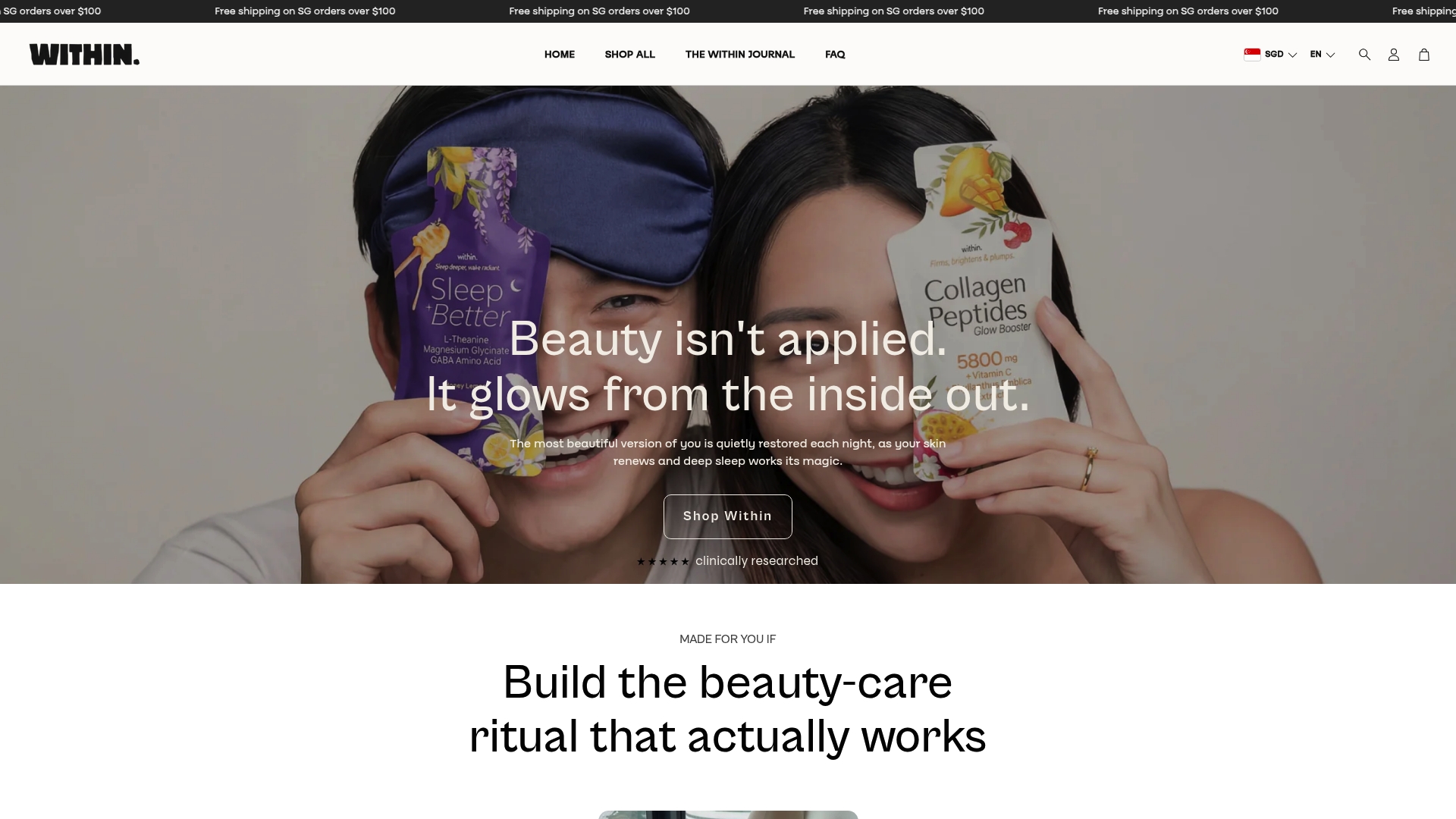
What sets a transparent collagen brand apart from the noise isn’t a single certification badge. It’s whether the ingredient story holds up when you ask the questions this article just walked you through: what species, what extraction, what proof. The Fromwithin collagen page lays out ingredient details and sourcing notes so you can evaluate the product the same way you’d evaluate any brand claiming sustainability, on its actual specifics rather than its marketing tone.
If you’re comparing collagen peptide options and want a formulation built for direct absorption rather than sitting in your gut wondering if it’s working, the Collagen Peptides Glow Booster is worth a look at its ingredient panel and sourcing information. Browse the full skin-focused collection to compare formats, then check the product page details before you add anything to your cart.
Where to Verify These Claims Yourself
If you want to go deeper than any single article, a handful of sources are worth bookmarking. The peer-reviewed review on marine collagen extraction methods and applications breaks down processing science in far more technical detail than a consumer guide can cover. The EcoeFISHent Project research offers hard yield data on sidestream valorization specifically. For certification details, Friend of the Sea’s collagen standard lays out its full audit criteria publicly. And for a clear-eyed look at where the industry still falls short, the CBC investigation into marine collagen sustainability is one of the more candid pieces of journalism on the topic available right now.
Sources
Marine collagen shows up in three main product categories: oral supplements (powders and drinks), topical cosmetics (serums and creams), and, less commonly for consumers, biomedical applications like wound-care materials. Each category leans on the same underlying protein, just processed and delivered differently.
On the evidence side, research on collagen peptides generally points toward measurable improvements in skin elasticity and hydration with consistent oral supplementation, alongside more limited but encouraging signals for joint comfort. That evidence base is real but still developing, and results vary based on peptide type, dose, and how consistently someone takes it. Nobody should expect an overnight transformation. What the research supports is a gradual, cumulative effect tied to how well your body absorbs the specific peptides you’re taking.
That absorption question comes down to a few technical terms worth understanding before you compare products:
- Marine collagen is all the rage in anti-aging. What does that mean for fish?
- Sustainable Collagen - Friend of the Sea
When it comes to comparing marine collagen against bovine or porcine sources, the sustainability picture tends to favor marine sidestreams, since cattle and pig farming carry substantially heavier land, water, and greenhouse gas footprints per unit of protein produced. Plant-based “collagen boosters” aren’t collagen at all. They’re typically vitamin C, amino acids, or botanical extracts that support your body’s own collagen production rather than supplying the protein directly, which makes them a different category rather than a true substitute. On efficacy, marine peptides are frequently cited for smaller molecular size and faster absorption compared to bovine collagen, though quality varies enormously by brand and extraction method regardless of source species.
For a product page to earn your trust on both fronts, sustainability and efficacy, it should show its source species, its extraction method, some indication of peptide size or hydrolysis degree, and ideally a certification mark or supply-chain statement. A well-built collagen supplement page will usually volunteer most of this without you having to dig for it.
