

on August 08, 2026

When you’re shopping for supplements, the seals that actually matter are USP Verified, NSF Certified for Sport, BSCG Certified Drug Free, Informed-Sport, and Informed-Choice. ConsumerLab and Labdoor round out the list as independent testing organizations worth trusting. The Operation Supplement Safety (OPSS) program recommends all of these by name, and that endorsement carries real weight.
Here’s how to verify a bottle in under five minutes:
- Check the label for a named seal from one of the programs above, not just the phrase “third-party tested.”
- Visit the certifier’s registry (USP, NSF, BSCG, or Informed-Sport each maintain searchable databases) and confirm the product is listed.
- Locate the lot number on the bottle and cross-reference it with the certifier’s certificate of analysis if you want the deepest level of confirmation.
The phrase “third-party tested” is an unregulated marketing claim that can mean anything from a single brand-commissioned lab test to full ongoing certification. A named seal from a recognized certifier is the difference between a marketing line and a verifiable quality standard.
Key Takeaways
Trustworthy third-party certification requires a named seal from a recognized program, a searchable public registry, and ongoing off-the-shelf testing, not just a one-time lab report.
| Point | Details |
|---|---|
| Seals to trust | USP Verified, NSF/NSF Certified for Sport, BSCG, Informed-Sport, and Informed-Choice are the recognized programs. |
| Always verify in the registry | Search the certifier’s public database by product name or lot number before buying. |
| Certification has limits | It confirms label accuracy and contaminant levels, not clinical efficacy or complete safety. |
| Facility audits matter | Programs requiring on-site GMP audits (USP, NSF) offer stronger ongoing oversight than test-only programs. |
| Fromwithin products | Fromwithin prioritizes clinically researched ingredients and transparent sourcing, consistent with the verification standards described here. |
Table of Contents
- What each major certification program actually verifies
- How third-party testing and certification actually work
- How to verify a supplement’s third-party certification claim
- What clinicians and trusted sources recommend
- Your buying checklist and the red flags to watch for
- How to spot fake or misleading third-party seals
- Why verification is the first thing I look for
- Fromwithin’s approach to verified, clinically sourced supplements
- Authoritative sources and registries for supplement verification
What each major certification program actually verifies
Not every seal covers the same ground. Knowing what each one checks helps you match the right certification to your actual concern.
USP Verified USP’s program requires a manufacturing facility audit aligned with USP <2750> and FDA cGMP (21 CFR Part 111), a full document review, laboratory testing against pharmacopeial standards, and off-the-shelf testing after the mark is awarded. It covers identity, potency, and selected contaminants. Verify at the USP Verified Listings page by searching the product or brand name. A survey of licensed practitioners found USP Verified is the most recommended quality seal for patients in the U.S., largely because of that facility audit requirement.
NSF / NSF Certified for Sport NSF certifies supplements to NSF/ANSI 173, which covers identity, potency, and contaminants. The Certified for Sport program goes further, screening for a comprehensive list of banned substances and requiring periodic audits and retesting. Athletes subject to drug testing should prioritize this seal. Verify at the NSF certified products database by entering the brand or product name.
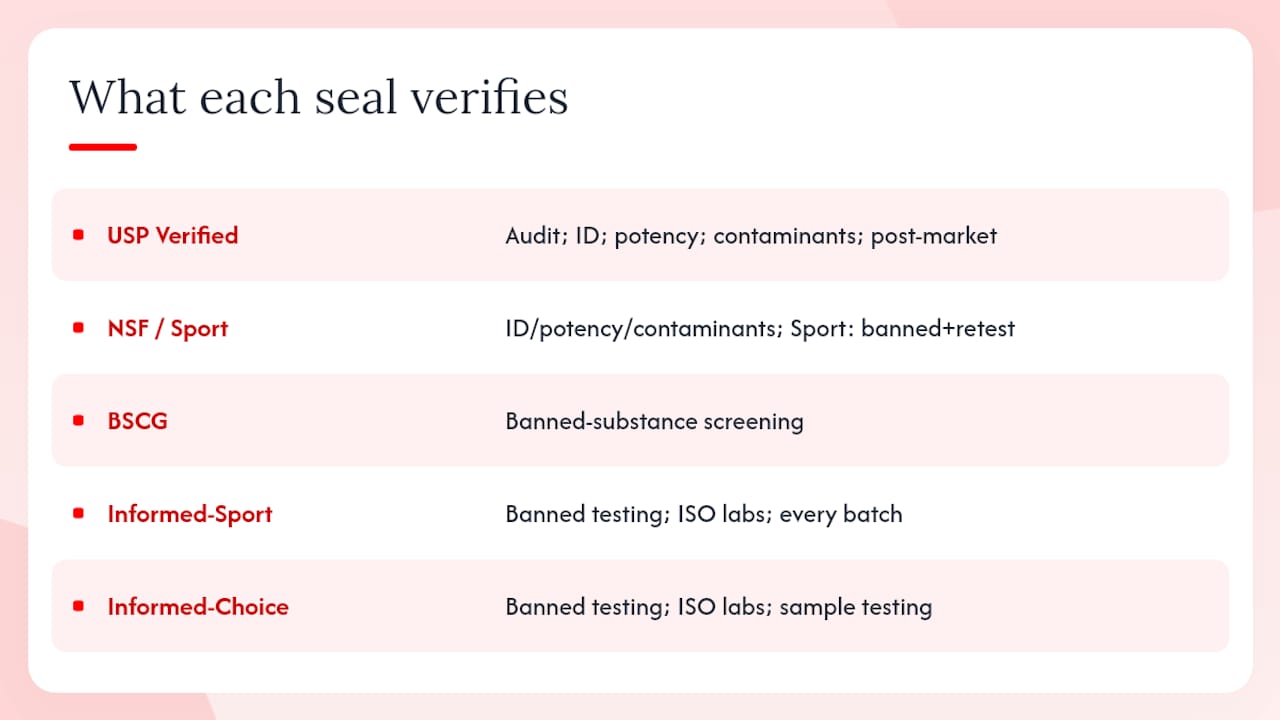
BSCG Certified Drug Free BSCG focuses specifically on banned substance screening, covering drugs, stimulants, and performance-enhancing compounds. It’s a strong choice for competitive athletes. Verification is available through BSCG’s online certified products list.
Informed-Sport / Informed-Choice Both programs are run by LGC Group and test for banned substances using ISO-accredited labs. Informed-Sport tests every production batch; Informed-Choice tests representative samples. Verify at the Informed-Sport or Informed-Choice product search pages. OPSS highlights these alongside BSCG as the sport-focused seals to prioritize.
ConsumerLab ConsumerLab purchases products off the shelf and tests them independently, then publishes pass/fail results. It doesn’t award a label seal in the same way, but its published reports are a strong signal of independent quality review. Access results through a ConsumerLab subscription.
Labdoor Labdoor buys products retail, sends them to FDA-registered labs, and publishes grades for label accuracy, product purity, and nutritional value. Results are free to browse on the Labdoor website. It’s a useful cross-check, especially for collagen and protein supplements.
How third-party testing and certification actually work
Understanding the process helps you judge whether a program’s claims represent ongoing oversight or a one-time lab event.
Sample selection is the first fork in the road. Brand-submitted samples let the manufacturer choose what gets tested. Independent or off-the-shelf sampling, where the certifier buys the product from a retailer, removes that control entirely. Off-the-shelf testing and public registries are consistently linked to better verifiability and lower risk of undisclosed adulterants.

Lab accreditation matters just as much as who does the sampling. ISO/IEC 17025 is the international standard for testing and calibration laboratories. A lab holding this accreditation has demonstrated technical competence and measurement reliability to an independent body. When a certifier says its testing is conducted in ISO/IEC 17025-accredited labs, that’s a meaningful quality floor.
Facility audits check whether the manufacturing plant follows current good manufacturing practices (cGMP) under FDA’s 21 CFR Part 111. Not every certification program requires an on-site audit. USP and NSF both do, which is a key reason clinicians favor them. A program that only tests a finished product without ever reviewing the facility is missing a significant layer of oversight.
Off-the-shelf testing and periodic retesting mean the certifier continues to pull products from retail after the initial certification. This catches quality drift, reformulations, or contamination events that a one-time test would never reveal.
Pro Tip: When evaluating a certification program, look for a published standard number like NSF/ANSI 173. A named, published standard means the program has defined pass/fail thresholds that aren’t set by the brand, which is a quick way to separate real certification from vague quality claims.
Quick glossary:
- Off-the-shelf testing: The certifier purchases the product from a retailer rather than receiving samples from the manufacturer.
- ISO/IEC 17025: International accreditation standard for testing labs, confirming technical competence.
- Certificate of analysis (COA): A document from the testing lab listing the results for a specific product lot.
How to verify a supplement’s third-party certification claim
Follow these steps in order for any U.S. supplement product.
- Read the label carefully. Look for a named seal (USP Verified, NSF, BSCG, Informed-Sport, Informed-Choice) with a standard number or program name printed clearly. A vague “lab tested” or “quality assured” badge with no certifier name is a red flag.
- Find the certifier’s name and any standard number. Note it exactly as it appears on the label.
-
Search the certifier’s public registry. Go directly to the certifier’s website (not a third-party aggregator) and enter the brand name, product name, or lot number.
- USP: usp.org/verification-services/verified-mark
- NSF: nsf.org (certified products database)
- BSCG: bscg.org (certified products list)
- Informed-Sport: informed-sport.com (product search)
- Confirm the lot or certificate number. The lot number is usually printed on the bottom or side of the bottle. Match it to the certifier’s record or the certificate of analysis on the product page.
- Request documentation if needed. If the product isn’t in the registry or you can’t find a COA, email the brand’s customer service with this message:
A brand with genuine third-party certification will answer that question quickly and specifically.
What clinicians and trusted sources recommend
Healthcare providers don’t all agree on supplements, but they do tend to agree on which seals to trust. Here’s the evidence-backed priority order.
- Dietary Supplement Manufacturing - USP Verified Mark | USP
- Why is Third-Party Certification Important for Dietary Supplements?
- Third-Party Tested: What It Really Means on Products | R3
- Product and Ingredient Certification | NSF
- Questions and answers for consumers about dietary supplements | FDA
- PubMed record supporting third-party oversight as a market solution
- NCBI PMC article about supplement testing and safety
- How to choose supplements wisely | Consumer Reports
When multiple seals appear on a single product, USP Verified or NSF Certified for Sport carries the most weight because both require ongoing audits, not just a one-time test.
Your buying checklist and the red flags to watch for
Use this when you’re standing in a store aisle or scrolling a product page.
Green lights:
- Named certifier seal (USP, NSF, BSCG, Informed-Sport, Informed-Choice) printed clearly on the label
- Product appears in the certifier’s public registry
- Lot number visible on the packaging
- Certificate of analysis available on the product page or by request
- Ingredient amounts listed individually, not hidden in a proprietary blend
- Published testing scope or standard number (e.g., NSF/ANSI 173)
Red flags:
- “Third-party tested” with no certifier name
- No lot number on the packaging
- Product not found in any certifier’s registry
- Proprietary blend with no individual ingredient amounts
- Unrealistic health claims (“reverses aging,” “guaranteed results”)
- A seal that looks official but has no searchable registry or verifiable certificate
Questions worth asking customer service:
- “Which third-party certifier verified this product, and is it listed in their registry?”
- “Can you provide the certificate of analysis for the current lot?”
- “Does your facility hold a current cGMP certification?”
Consumer Reports advises looking for transparent labels and third-party testing information as baseline requirements before purchasing any supplement.
How to spot fake or misleading third-party seals
This is where things get genuinely tricky. Not every seal on a supplement label represents real independent oversight.
The “house seal” problem. Some brands create their own quality badges that look like third-party certification marks. They might say “Quality Assured,” “Lab Verified,” or “Tested for Purity” with a professional-looking logo. These are self-issued and carry no independent verification whatsoever.
Unverifiable “certifiers.” A handful of lesser-known organizations sell certification-style seals without conducting meaningful audits or maintaining public registries. If you search for a certifier’s name and can’t find a searchable product database, a published standard, or any information about their lab accreditation, treat the seal as unverified.
Single-test claims dressed up as certification. A brand can commission one lab test on one batch, receive a passing result, and then print “third-party tested” on every bottle it sells going forward. That single test doesn’t cover future production runs, doesn’t involve a facility audit, and doesn’t require retesting. The label claim is technically true and practically meaningless.
Scope mismatch. A seal might confirm the product is free of heavy metals but say nothing about potency or banned substances. If the certifier’s scope doesn’t match your concern, the seal doesn’t answer your question, even if it’s from a legitimate organization.
The simplest filter: if the certifier doesn’t maintain a public, searchable registry where you can confirm your specific product and lot number, the seal doesn’t meet the standard of meaningful third-party certification.
Why verification is the first thing I look for
Here’s my honest take: the supplement industry’s biggest problem isn’t bad ingredients. It’s the gap between what a label says and what’s actually in the bottle. Most people assume that if a product is on a shelf at a reputable retailer, someone checked it. The FDA’s premarket framework for supplements doesn’t work that way, and the “third-party tested” phrase has been stretched so thin it barely signals anything on its own.
What I find most telling is the facility audit requirement. A brand that allows an independent auditor to walk through its manufacturing plant, review its documentation, and pull products off store shelves for retesting is making a very different commitment than one that commissioned a single lab test three years ago. That distinction is worth paying attention to, especially for supplements you plan to take consistently.
For categories like collagen peptides and sleep support, where ingredient quality and bioavailability directly affect results, the difference between a certified and an uncertified product can be the difference between something that works and something that doesn’t. Choosing clinically tested beauty supplements with verifiable sourcing isn’t overcautious. It’s just smart.
Fromwithin’s approach to verified, clinically sourced supplements
If you’ve read this far, you already know what to look for. Fromwithin’s collagen products and sleep aid are built around clinically researched ingredients, including patented Wellnex® collagen peptides with documented bioavailability. Ingredient transparency isn’t a marketing line here. It’s the starting point.
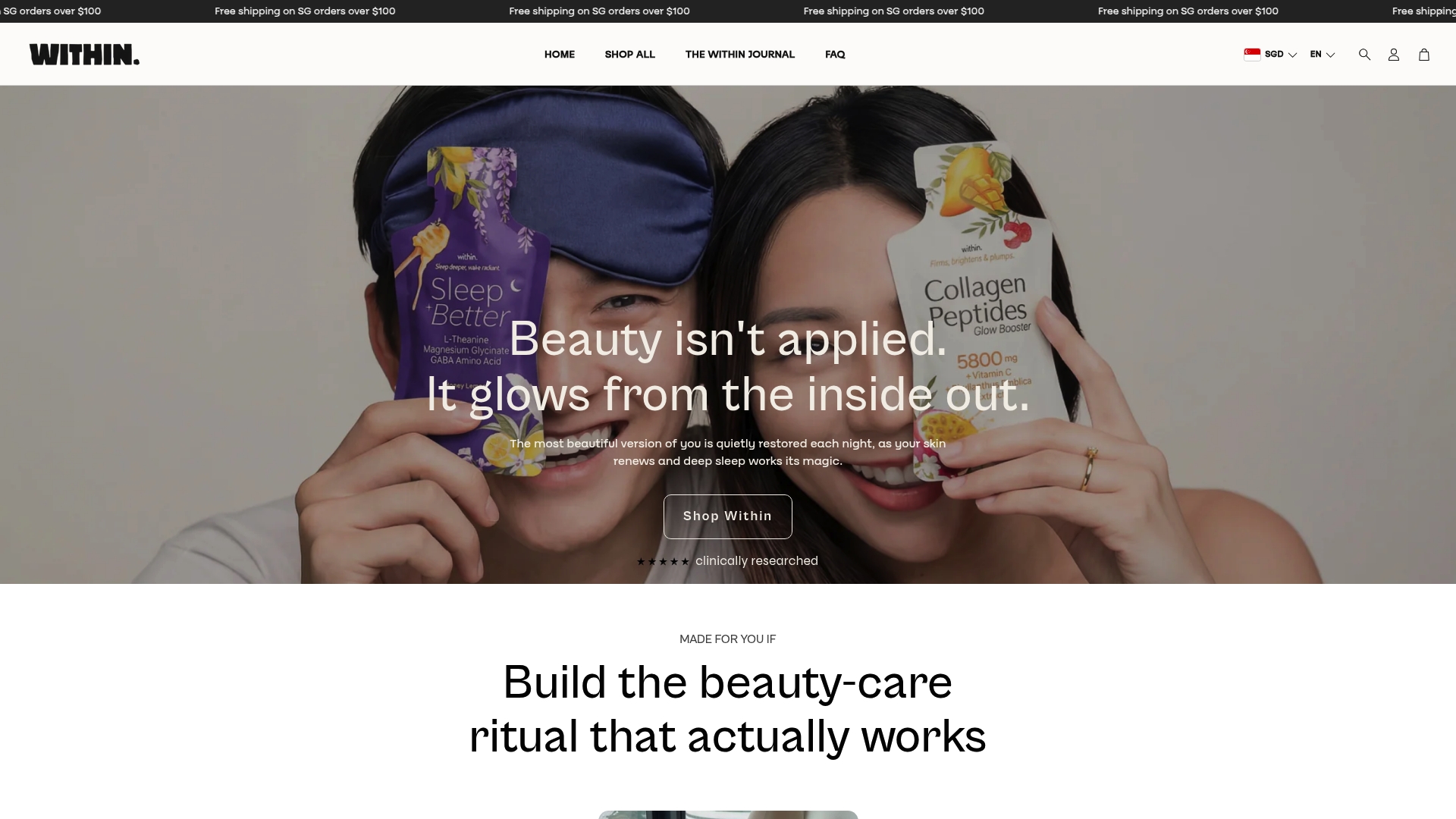
You can check the product pages directly for ingredient specifications and sourcing details. If you want to go deeper on what’s in your collagen or sleep supplement before you commit, the product pages are the right place to start. Look for the ingredient list, check the sourcing notes, and reach out to the team if you want documentation on specific formulations. That’s the kind of verification conversation a brand confident in its products is always ready to have.
Authoritative sources and registries for supplement verification
Use these directly when verifying a product or seal.
| Registry / Resource | Best for | How to use it |
|---|---|---|
| USP Verified Listings | General quality, potency, contaminants | Search by brand or product name; confirm facility audit status |
| NSF Certified Products Database (nsf.org) | General quality (NSF/ANSI 173) and sport banned substances | Search by product name; filter by “Certified for Sport” for athlete use |
| BSCG Certified Products (bscg.org) | Banned substance screening | Search by brand; results show certification scope and date |
| Informed-Sport Product Search (informed-sport.com) | Batch-level banned substance testing | Search by product; batch certification shown per lot |
| OPSS Scorecard | Sport and general consumer guidance | Use the Scorecard tool to check a product’s certification status |
| FDA Dietary Supplement Q&A | Regulatory context | Reference for understanding FDA’s premarket role and limits |
How to read a registry result:
- A listed product confirms the certifier has verified that specific product, not just the brand.
- A lot number match confirms the specific production batch you’re holding was tested.
- An expired or lapsed certification means the product hasn’t been reverified recently. Treat it the same as no certification until the brand confirms renewal.
Pro Tip: For sport supplements specifically, always use the Informed-Sport or NSF Certified for Sport registry rather than relying on the label alone. Batch-level certification, where every production run is tested, is the gold standard for athletes.
