

on July 18, 2026

Amino acids are the molecular building blocks of every protein your skin depends on, from collagen and keratin to the compounds that keep your skin hydrated and resilient. The role of amino acids in skin goes far beyond simple nutrition. They regulate moisture, support structural repair, buffer your skin’s pH, and drive the cellular processes that keep your complexion looking fresh and bouncy. If your skin feels dry, dull, or slow to recover, amino acid availability is one of the first places to look.
How do amino acids support skin hydration and barrier function?
Amino acids make up 40–50% of the skin’s Natural Moisturizing Factor (NMF), the collection of water-binding compounds found naturally in the outermost layer of your skin. That number tells you something important: without enough amino acids, your skin’s ability to hold onto moisture is fundamentally compromised.
The NMF is not a single ingredient. It is a complex mix, and amino acids sit at its core. Specific amino acids each play a distinct role in keeping your skin barrier intact:
- Serine binds water directly and contributes to the skin’s acid mantle, which protects against bacteria and irritants.
- Glycine supports the structural proteins that give skin its firmness and helps regulate the barrier’s permeability.
- Alanine works alongside serine and glycine to reduce transepidermal water loss (TEWL), the invisible evaporation of moisture through your skin.
- PCA (pyrrolidone carboxylic acid), derived from glutamine, is one of the most effective natural humectants in the NMF.
Balanced amino acid mixes in skincare products mimic the skin’s natural amino acid profile better than isolated single amino acids. That means better hydration and a stronger barrier response compared to products that rely on just one or two amino acids.
Pro Tip: When reading a skincare label, look for products that list multiple amino acids rather than just one. A mix of serine, glycine, alanine, and PCA more closely mirrors your skin’s own NMF and delivers more consistent hydration results.

What is the role of amino acids in collagen synthesis and skin repair?
Collagen is the most abundant protein in your skin, and it is almost entirely built from amino acids. Understanding how amino acids improve skin means understanding collagen’s structure. The collagen triple helix requires a precise repeating sequence where glycine occupies every third position. Without adequate glycine, the helix cannot form correctly.
The four amino acids most critical to collagen production are:
- Glycine forms the backbone of the collagen triple helix and is the most abundant amino acid in collagen by weight.
- Proline provides rigidity to the helix structure and must be converted to hydroxyproline by an enzyme that requires vitamin C to function.
- Lysine is hydroxylated to form cross-links between collagen fibers, giving skin its tensile strength.
- Hydroxyproline stabilizes the triple helix and is a marker of collagen turnover in clinical research.
The connection between systemic amino acid supply and skin repair goes deeper than structure. Nutricosmetic amino acid metabolites promote fibroblast anabolism and reduce oxidative stress markers in skin cells. Fibroblasts are the cells that produce collagen and elastin. When they receive adequate amino acid support, they work more efficiently and age more slowly.
Clinical evidence backs this up. Amino acid-enriched hyaluronic acid improves wrinkle severity, dermal thickness, and cell viability in facial rejuvenation treatments. That combination of immediate hydration and long-term structural remodeling is what makes amino acids so valuable for anti-aging skincare.
Oral ingestion of amino acid-rich keratin hydrolysates increases glycosaminoglycans by 11% and hyaluronan release by 43% in human dermal fibroblasts. This means that what you consume can directly shift how your skin cells produce the compounds responsible for plumpness and bounce. The skin repair benefits of amino acids are not limited to what you apply topically. They start from within.
For a deeper look at how collagen peptides support skin at the cellular level, the science is both clear and encouraging.
Topical vs. systemic amino acids: what is the real difference?
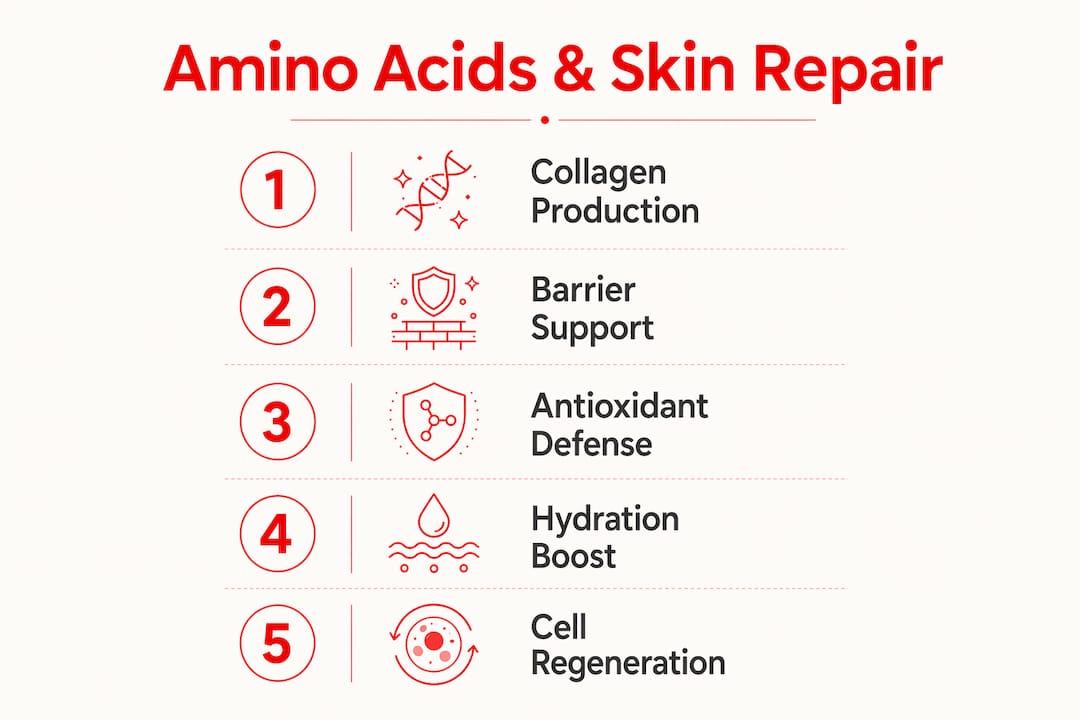
This is one of the most misunderstood areas in skincare. Topical amino acids and systemic amino acids do different jobs, and neither fully replaces the other.
| Approach | Primary function | Limitation |
|---|---|---|
| Topical amino acids | Moisture binding, barrier reinforcement, surface hydration | Cannot penetrate deeply enough to drive collagen synthesis |
| Systemic amino acids (diet or supplements) | Collagen and elastin production, fibroblast support, NMF replenishment | Require consistent intake and proper digestion for skin delivery |
Topical amino acids primarily provide hydration and barrier reinforcement but do not substitute for the systemic amino acid availability needed for collagen and elastin production. Think of topical products as maintaining the surface while your nutrition handles the deeper structural work.
Skin is a high-turnover tissue. It constantly sheds and regenerates, which means it has a continuous demand for amino acids. People with dietary restrictions, low protein intake, or high physical stress often show this deficit in their skin first. Dullness, slow wound healing, and loss of elasticity can all signal that systemic amino acid supply is falling short.
Pro Tip: If you are vegan or follow a low-protein diet, pay close attention to your intake of glycine, lysine, and proline. These amino acids are less abundant in plant proteins and are the exact ones your skin needs most for collagen production.
Which amino acids matter most for your skin?
Not all amino acids are equal when it comes to skin health. They fall into three categories: essential (your body cannot make them), non-essential (your body synthesizes them), and conditionally essential (your body needs more of them under stress or during repair).
Specific amino acids like glycine, proline, lysine, arginine, and glutamine have distinct biochemical roles that directly affect how your skin looks and functions. Here is what each one does:
- Glycine: Forms the structural backbone of collagen. Every third amino acid in the collagen triple helix is glycine. Without it, collagen cannot assemble properly.
- Proline: Provides rigidity to collagen fibers. Its conversion to hydroxyproline requires vitamin C, which is why vitamin C serums and amino acid intake work well together.
- Lysine: Creates cross-links between collagen fibers. These cross-links give skin its firmness and resistance to sagging.
- Arginine: Buffers skin pH and supports tissue repair. It also plays a role in wound healing and microcirculation in the skin.
- Serine: A key NMF component that binds water and helps maintain the skin’s acid mantle.
- Glutamine: Supports cell proliferation and acts as a precursor to glutathione, one of the body’s most powerful antioxidants. This makes it central to both skin repair and protection against environmental damage.
Keratin, the protein that forms your skin’s outer protective layer, depends heavily on cysteine. Cysteine-containing disulfide bonds give keratin its mechanical strength and chemical resistance. This is why amino acid availability connects directly to how tough and resilient your skin barrier actually is.
Using a balanced mix of these amino acids, rather than supplementing with just one, better mimics how your skin naturally functions. Your skin does not work with isolated ingredients. It works with a full spectrum.
How to incorporate amino acids into your skincare routine
Getting more amino acids into your skin health routine does not have to feel like another full-time job. The most effective approach combines what you eat, what you supplement, and what you apply.
- Prioritize dietary protein. Collagen-rich foods like bone broth, fish, and eggs deliver glycine, proline, and hydroxyproline directly. These are the amino acids your skin uses most for repair and structure.
- Consider targeted supplements. Collagen peptide supplements provide pre-formed amino acid sequences that your body absorbs efficiently. Oral supplementation with peptides supports fibroblast activity and skin hydration from the inside out.
- Choose skincare with amino acid mixes. Look for serums and moisturizers that list multiple amino acids. The cosmetic effectiveness of amino acids depends on concentration, pH, and formulation. A product with the right pH (slightly acidic, around 4.5–5.5) will deliver amino acids more effectively to the skin surface.
- Pair amino acids with vitamin C. Proline and lysine require vitamin C for their enzymatic conversion into the forms that build collagen. Using both together amplifies the benefit.
- Address gaps if you have dietary restrictions. People following vegan, low-calorie, or highly restrictive diets often have lower circulating levels of the amino acids skin needs most. Targeted supplementation fills that gap without requiring a complete diet overhaul.
Pro Tip: When choosing a collagen supplement, look for products that list the specific peptide types or amino acid profile on the label. Transparency about ingredient sourcing and molecular weight tells you the brand has done the science, not just the marketing.
Key Takeaways
Amino acids are the foundation of every major skin protein, and both topical and systemic supply matter for real, visible results.
| Point | Details |
|---|---|
| Amino acids and the NMF | Amino acids make up 40–50% of the skin’s Natural Moisturizing Factor, directly controlling hydration. |
| Collagen needs specific amino acids | Glycine, proline, lysine, and hydroxyproline are the core building blocks of collagen structure. |
| Topical and systemic roles differ | Topical amino acids hydrate the surface; systemic intake drives collagen and elastin production. |
| Supplements show measurable results | Oral amino acid intake increases hyaluronan synthesis by 43% in dermal fibroblasts, supporting skin bounce. |
| Balanced mixes outperform single amino acids | Products and supplements with multiple amino acids better mirror the skin’s natural function. |
Why I think most people are missing half the amino acid picture
Here is what I have come to believe after spending years looking at the science and talking to people about their skin: most skincare conversations stop at the surface. People invest in serums, treatments, and topical products, and they wonder why their results plateau. The answer, almost always, is that the inside half of the equation is being ignored.
Amino acids are not a magic ingredient you apply and forget. They are a continuous supply chain. Your skin is constantly breaking down and rebuilding proteins. That process requires a steady flow of raw materials, and those materials come from what you eat and supplement, not just what you put on your face.
I also think there is a real misconception that “more is better” when it comes to individual amino acids. Flooding your system with a single amino acid like glycine, without the supporting cast of proline, lysine, and vitamin C, does not produce better collagen. Skin biology is a team effort. The collagen and elastin relationship is a perfect example of how these systems depend on each other.
The people I see getting the best skin results are the ones who treat nutrition and skincare as two parts of one routine, not two separate categories. They eat enough protein, they supplement thoughtfully, and they use topical products that reinforce what their body is already doing. That combination is where real skin improvement lives.
— From
Fromwithin’s collagen supplements and your skin’s amino acid needs
Your skin’s demand for amino acids does not pause. Every day, it breaks down old collagen and builds new fibers, repairs the barrier, and replenishes the NMF. Fromwithin’s collagen supplement range is built around this reality. The products use Wellnex® peptides, which are absorbed directly into the bloodstream for maximum delivery to skin tissue. That means the glycine, proline, and hydroxyproline your skin needs for repair are actually reaching the cells that use them. If you want to support your skin from the inside out, the Collagen Peptides Glow Booster is a good place to start.
FAQ
What is the role of amino acids in skin health?
Amino acids are the building blocks of skin proteins like collagen and keratin, and they make up 40–50% of the skin’s Natural Moisturizing Factor. They control hydration, structural integrity, barrier function, and cellular repair.
Can topical amino acids replace a collagen supplement?
No. Topical amino acids hydrate and reinforce the skin surface but cannot drive the deep collagen synthesis that systemic amino acid intake supports. Both approaches work best when used together.
Which amino acids are most important for anti-aging skin care?
Glycine, proline, lysine, and hydroxyproline are the most critical for collagen production. Glutamine supports antioxidant defense, and arginine aids tissue repair and pH balance.
How do amino acids improve skin hydration specifically?
Amino acids bind water in the NMF and reduce transepidermal water loss. Serine, glycine, alanine, and PCA are the most effective at keeping moisture locked into the skin’s outer layers.
Do amino acid supplements actually work for skin?
Clinical research shows that oral amino acid intake increases hyaluronan synthesis by 43% in dermal fibroblasts and improves wrinkle severity and dermal thickness. The results depend on consistent intake and the quality of the supplement formulation.
