

on July 09, 2026

A peer-reviewed ingredient study is research on an ingredient evaluated by independent scientific experts before publication, confirming its validity and reliability. If you’ve ever flipped a supplement bottle to check the label or searched for proof that a beauty ingredient actually works, you’ve already felt the pull toward this kind of evidence. Understanding what peer review really means, and what it doesn’t guarantee, is the clearest way to cut through marketing noise and make choices your skin and body will thank you for.
What is a peer-reviewed ingredient study, and how does it work?
A peer-reviewed ingredient study is a research paper evaluated by at least two qualified independent experts before it appears in an academic journal. Those reviewers assess the study’s design, methodology, data analysis, and conclusions. Only research that meets the journal’s scientific standards gets published. This process is the closest thing science has to a quality checkpoint.
Here’s how the process typically unfolds:
- Submission. A research team submits their ingredient study to an academic journal relevant to their field, such as dermatology, nutrition, or biochemistry.
- Editor screening. The journal’s editor checks whether the paper fits the journal’s scope and meets basic formatting and ethical requirements.
- Reviewer selection. The editor assigns two or more scientists with expertise in the ingredient’s field. They review the paper without knowing the authors’ identities, and vice versa.
- Scientific assessment. Reviewers evaluate study design, sample size, controls, statistical methods, and whether the conclusions match the data.
- Decision. The journal accepts the paper, requests revisions, or rejects it. Revision requests are common and often improve the final published version.
- Publication. Accepted studies appear in indexed journals, making them searchable in databases like PubMed.
Pro Tip: When a brand cites a study, check whether it was published in a peer-reviewed, indexed journal. A press release or a brand’s own website does not count as peer-reviewed evidence.
This workflow is why peer-reviewed research carries more weight than a brand’s internal testing. The independent review process removes the conflict of interest that comes with self-reported results.

What research methods appear in ingredient studies?
Peer-reviewed ingredient studies use several distinct research designs, and the type of study matters as much as the result.
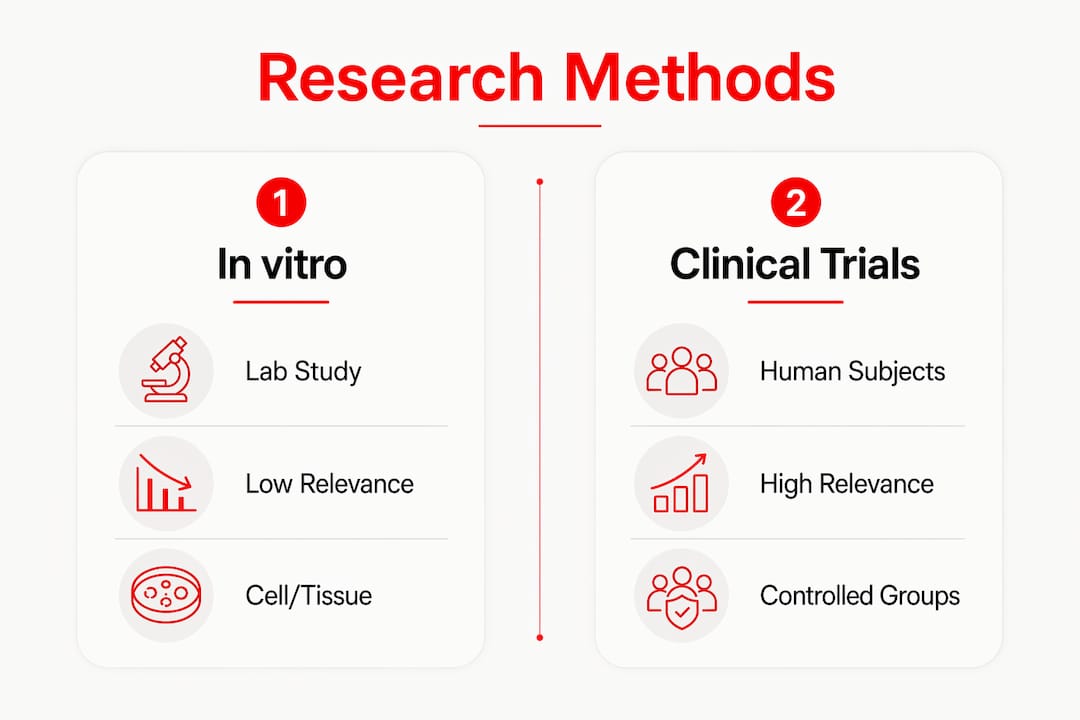
- In vitro studies test an ingredient on cells or tissues in a lab setting. They are fast and inexpensive but cannot predict how an ingredient behaves inside a living body.
- Animal models move one step closer to biological reality. They reveal how an ingredient is absorbed, metabolized, and tolerated, but results do not always translate to humans.
- Human clinical trials are the most relevant for consumers. Randomized controlled trials (RCTs) assign participants to an ingredient group or a placebo group, controlling for variables like age, diet, and sun exposure.
- Systematic reviews and meta-analyses pool data from multiple studies. A 2025 review scored 1,750 photoprotection ingredients based on evidence strength and volume, demonstrating how this method creates a ranked picture of what actually works.
The specific endpoints studied also matter. Researchers measure outcomes like skin hydration levels, UV protection markers, collagen synthesis rates, or cellular antioxidant activity. A study measuring skin hydration after four weeks of oral collagen tells you something very different from one measuring a compound’s antioxidant capacity in a test tube.
| Study type | Setting | Relevance to consumers |
|---|---|---|
| In vitro | Lab (cells/tissues) | Low. Shows potential, not real-world effect. |
| Animal model | Live animals | Moderate. Useful for safety and absorption data. |
| Human clinical trial | Human participants | High. Most directly applicable to product claims. |
| Systematic review | Aggregated studies | Highest. Reflects consensus across multiple trials. |
One detail many people miss: studies on isolated compounds often use different forms or doses than what appears in a finished product. A collagen peptide studied at 10 grams per day in a clinical trial is not the same as a product containing 2.5 grams of a different peptide form. Matching the study’s ingredient form and dose to the product label is a non-negotiable step in evaluating any claim. Fromwithin addresses this directly by building products around patented wellness ingredients with their own published research, not borrowed data from unrelated compounds.
How do you interpret peer-reviewed ingredient studies critically?
Peer review is a quality filter, not a guarantee of truth. Even peer-reviewed papers can contain flawed designs, small sample sizes, or conclusions that overreach the data. Knowing how to read a study critically protects you from being misled by a single impressive-sounding result.
Watch for these common issues:
- Single studies. One positive result means very little on its own. Reproducibility across multiple studies is what builds real scientific confidence in an ingredient.
- Industry-funded research. Studies funded by the company selling the ingredient carry a higher risk of bias. Independent, third-party research is more reliable.
- “Borrowed science.” This is when a brand uses research on a patented or branded ingredient version to market a generic version of that ingredient. The generic may not behave the same way at all.
- Ingredient versus product studies. Most consumers assume “clinically studied ingredients” means the finished product was tested. Often, only the individual compound was studied, in a different form or dose than what is in the bottle.
- Analytical consistency gaps. Even when an ingredient is validated in peer-reviewed research, active ingredient levels in finished products can vary due to complex ingredient interactions, manufacturing differences, and storage conditions.
Pro Tip: Look for studies with at least 30 human participants, a control group, and a duration of eight weeks or longer. Short studies on small groups rarely produce findings that hold up at scale.
A 2026 dermatology review analyzed 18 K-beauty ingredients and found that most lacked adequate controlled human trial data. That finding illustrates how widespread the gap is between marketing claims and actual scientific evidence. Niacinamide and broad-spectrum sunscreen were among the few with strong clinical backing. The lesson: popularity does not equal proof.
How can you use ingredient research to evaluate product claims?
You do not need a science degree to verify whether an ingredient has real evidence behind it. A few practical steps put solid information within reach.
- Search PubMed. PubMed is the authoritative biomedical database for checking whether an ingredient’s research appears in reputable, indexed journals. Type the ingredient name plus the health outcome you care about, such as “collagen peptides skin elasticity.”
- Check the journal’s reputation. Indexed journals listed in databases like MEDLINE or Scopus meet minimum quality standards. Journals not listed in any major index are a red flag.
- Match the dose and form. Compare the ingredient form and daily dose in the study to what is listed on the product label. A mismatch means the study’s results may not apply to that product.
- Ask the brand for references. Reputable brands share study citations directly. If a brand cannot or will not provide them, that tells you something important.
- Prioritize systematic reviews. A systematic review aggregating data from multiple trials gives you a more reliable picture than any single study. Search for “[ingredient name] systematic review” on PubMed.
- Recognize marketing language. Phrases like “clinically inspired,” “science-backed formula,” and “dermatologist-tested” are not the same as “published in a peer-reviewed journal.” Read labels carefully and ask for specifics.
Knowing how to find a quality collagen supplement starts with exactly these steps. The brands worth trusting are the ones that make this verification easy, not the ones that bury their evidence in vague claims.
Key Takeaways
Peer-reviewed ingredient studies are the strongest available evidence for ingredient efficacy, but only when the study design, dose, and ingredient form match the product being evaluated.
| Point | Details |
|---|---|
| Peer review is a quality filter | At least two independent experts assess every study before publication in an indexed journal. |
| Study type determines relevance | Human clinical trials and systematic reviews carry far more weight than in vitro or animal studies. |
| Dose and form must match | A study on one collagen peptide form does not validate a different form at a different dose. |
| Borrowed science misleads | Research on branded ingredient versions does not automatically apply to generic equivalents. |
| Reproducibility builds confidence | A single positive study means little. Consistent results across multiple independent trials signal real efficacy. |
Why I think one peer-reviewed study is never enough
I’ve spent a lot of time reading ingredient research, and the single biggest misconception I see is treating one peer-reviewed study like a verdict. It isn’t. It’s a data point. Science works through accumulation, not single moments of proof.
The brands I trust most are the ones that cite multiple independent studies, disclose the exact ingredient form and dose used in their products, and don’t hide behind vague phrases like “clinically inspired.” When Fromwithin points to Wellnex® peptides, for example, the research trail leads to the specific patented form, not a generic stand-in. That specificity is what separates genuine transparency from polished marketing.
My honest advice: use peer-reviewed research as your starting point, not your finish line. Cross-reference findings, look for systematic reviews, and pay attention to who funded the study. A little healthy skepticism, paired with the right tools, makes you a far sharper consumer than most. Your skin and your wallet will both benefit.
— From
Fromwithin’s commitment to ingredient transparency
Fromwithin builds every product around ingredients with their own published research, not borrowed claims from unrelated compounds. The patented Wellnex® collagen peptides in Fromwithin’s formulas are absorbed directly into the bloodstream, and the studies supporting them use the same form and dose you find on the label. That kind of specificity is rare, and it matters. If you want to put what you’ve learned here into practice, Fromwithin’s collagen supplements are a clear place to start. You can also browse the full skin support collection to see how evidence-backed ingredients translate into real results.
FAQ
What does peer-reviewed mean for an ingredient study?
A peer-reviewed ingredient study has been evaluated by at least two independent scientific experts before publication in an academic journal. Those reviewers assess the study’s design, methodology, and data to confirm it meets scientific standards.
Is one peer-reviewed study enough to trust an ingredient?
One study is a starting point, not proof. Reproducibility across multiple independent studies is what builds genuine scientific confidence in an ingredient’s efficacy and safety.
What is “borrowed science” in ingredient marketing?
Borrowed science is when a brand uses research on a patented or branded ingredient to support claims about a generic version of that ingredient. The two may not perform the same way, making the cited research misleading.
How do I verify if an ingredient study is credible?
Search for the ingredient on PubMed and check whether the study appears in an indexed journal. Then confirm that the ingredient form and dose in the study match what is listed on the product label.
What is the difference between a clinical trial and a systematic review?
A clinical trial tests an ingredient on human participants under controlled conditions. A systematic review aggregates findings from multiple trials, making it a more reliable guide to an ingredient’s overall evidence base.
