

on September 01, 2026

Yes, and the science backs it up: clinical trials show ashwagandha produces a small but statistically significant improvement in sleep quality and sleep latency. The benefit shows up most clearly at doses of 600 mg per day or higher, taken consistently for a duration of several weeks, and it works best for people whose sleep struggles are tied to stress rather than a diagnosed sleep disorder. It’s not a sedative, and it’s not instant. If you’re hoping for a knockout pill, this isn’t it. If you want a gentle, research-backed nudge toward calmer nights, keep reading.
TL;DR:
- Higher doses of 600 mg per day and treatment durations of at least eight weeks show the most consistent improvements in sleep quality.
- Most studies confirm modest benefits such as faster sleep onset, increased total sleep time, and fewer nighttime awakenings when using standardized extracts like KSM-66 or Shoden®.
- Ashwagandha mainly helps by reducing stress and calming the HPA axis rather than acting as a sedative or providing instant effects.
- Its sleep benefits are less reliable in short-term trials, small sample sizes, or when using non-standardized or uncertified forms of the supplement.
- People with thyroid issues, autoimmune conditions, pregnancy, or on hormone or immune medications should consult a healthcare professional before trying ashwagandha.
Table of Contents
- What Does the Research Say About Ashwagandha and Sleep Quality?
- How Does Ashwagandha Help With Sleep, Biologically Speaking?
- What Dose and Extract Actually Work for Sleep?
- What Are the Side Effects and Who Should Avoid Ashwagandha?
- How Do You Actually Try Ashwagandha for Sleep Safely?
- Who Should Try It, and Who Should See a Doctor First?
- Why Fromwithin Built a Sleep Aid Around This Kind of Evidence
- A Non-Hormonal Option Worth Adding to Your Routine
- Where to Read More on Ashwagandha and Sleep
- Sources
What Does the Research Say About Ashwagandha and Sleep Quality?
Let’s start with the number that matters most. A 2021 systematic review and meta-analysis pooled five randomized controlled trials involving roughly 400 participants and found ashwagandha extract produced a standardized mean difference of −0.59 (95% CI −0.75 to −0.42) for overall sleep quality. In plain English, that’s a small to moderate effect. It won’t turn a chronic insomniac into someone who sleeps like a rock, but it’s a real, measurable shift, not a placebo shrug.
Here’s the detail that changes how you should think about dosing: the review found stronger effects specifically at doses of 600 mg per day or more, and in trials lasting about eight weeks or longer. Shorter trials and lower doses showed weaker results. That single finding explains why so many people try ashwagandha for two weeks, feel nothing dramatic, and give up right before the window where it tends to start working.
The bottom line in numbers: SMD −0.59 for sleep quality overall, with the clearest benefit appearing at ≥600 mg/day sustained for ≥8 weeks. That’s the dose and duration range every other finding in this article circles back to.
Several individual trials help fill in the picture the meta-analysis draws in broad strokes:
- A six-week trial using Shoden® extract found 72% of participants reported improved sleep quality, compared to just 29% in the placebo group, according to the NIH Office of Dietary Supplements. That’s a wide gap for a single supplement ingredient, and it’s one of the more frequently cited numbers in the ashwagandha-for-sleep literature.
- An eight-week double-blind trial compared ashwagandha root extract (300 mg twice daily) against melatonin (3 mg/day), a combination of both, and placebo. Both active ingredients improved sleep on their own, but the combination group showed the largest gains in sleep onset latency and sleep efficiency, with results reaching strong statistical significance (p < 0.0001).
- Multiple RCTs using objective actigraphy rather than just self-reported sleep diaries confirmed improvements in sleep efficiency and reduced wake-after-sleep-onset when participants took standardized extracts like KSM-66 or Shoden®. That objective confirmation matters because self-reported sleep data is notoriously unreliable, people tend to guess.
- The Sleep Foundation’s synthesis of the trial base echoes the same pattern: falling asleep faster, higher total sleep time, and fewer nighttime awakenings, with the most consistent benefits reported at 500 to 600 mg per day.
Now for the honest caveats, because a science-first article owes you the full picture, not just the flattering half. Most of these trials are small, often with under 150 participants, and many were conducted in specific populations in India, where ashwagandha has traditional use. The extracts used across studies weren’t identical either. Some trials used KSM-66, a full-spectrum root extract standardized to a specific withanolide content. Others used Shoden®, a leaf-and-root extract standardized differently. Treating “ashwagandha” as one uniform ingredient across all these studies is a bit like treating “coffee” as one drink when a shot of espresso and a cup of drip coffee behave very differently in your body.
Clinicaltrials suggest researchers are aware of these gaps and are actively working to standardize dosing and extend trial duration. The evidence base is growing, not static. But as of right now, what you have is a consistent, modest signal across several well-designed studies, not a slam-dunk cure.
How Does Ashwagandha Help With Sleep, Biologically Speaking?
Ashwagandha’s active compounds are called withanolides, steroid-like molecules found in the root and leaves of the Withania somnifera plant. They’re the reason this herb shows up in sleep research at all, and understanding how they behave gives you a much clearer sense of what to expect.
Here’s the mechanism in a nutshell: withanolides appear to interact with your HPA axis, the hypothalamic-pituitary-adrenal system that governs your stress response and cortisol output. When your HPA axis is chronically activated (think: racing thoughts at 11 PM, a mind that won’t quit reviewing tomorrow’s meeting), your body stays in a low-grade fight-or-flight state that makes falling asleep genuinely harder. Ashwagandha appears to calm that axis down, which lowers the physiological noise keeping you awake.
There’s also a GABAergic angle worth knowing. GABA is your brain’s primary “braking” neurotransmitter, the one that dials down neural excitability so your mind can quiet enough to drift off. Some withanolides show affinity for GABA receptor sites in preclinical research, which may partly explain the calming, non-sedating effect many people describe.
A few things about the mechanism remain genuinely unresolved:
- Researchers aren’t certain how much of the sleep benefit comes from direct brain chemistry versus indirect stress relief that happens to improve sleep as a side effect.
- Dose-response at the receptor level in humans hasn’t been mapped precisely, most mechanistic data comes from cell and animal studies, then gets inferred onto human trial results.
- It’s unclear whether benefits plateau at a certain dose or continue scaling with higher intake, since most human trials cluster around similar dose ranges.
The practical takeaway: ashwagandha likely helps you sleep by turning down your stress response rather than sedating you directly. That’s why it tends to help most with stress-related sleep disruption and does less for structural sleep disorders.
What Dose and Extract Actually Work for Sleep?
Dosage is where most people go wrong, either by taking too little to see any effect, or by grabbing a random bottle without checking what’s actually standardized inside it. Trial protocols give you a fairly clear map to follow.
The most commonly studied regimens fall into a few patterns:
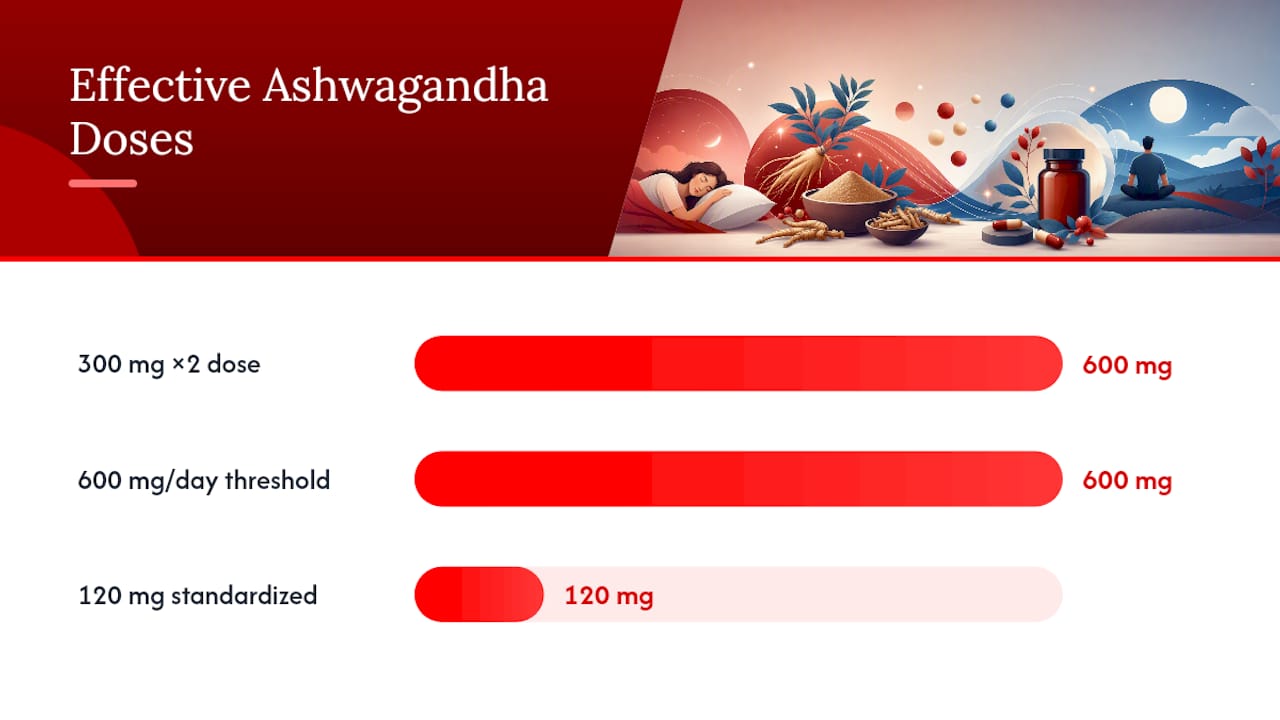
- 300 mg twice daily (600 mg/day total) of ashwagandha root extract, the dose used in the melatonin-comparison trial and several others.
- 600 mg/day as a single or split dose, the threshold the 2021 meta-analysis flagged as the point where effects on sleep quality became more pronounced.
- 120 mg of a withanolide-standardized capsule, used in some smaller trials, though results here were more modest than the higher-dose protocols.
Standardization is the detail most shoppers skip, and it’s the one that actually determines whether a supplement will behave anything like the ones tested in trials. KSM-66 is a full-spectrum root extract, typically standardized to around 5% withanolides, and it’s the extract behind many of the larger RCTs. Shoden® is a different proprietary extract, often standardized to a higher withanolide concentration from a smaller dose, which is why the six-week trial using it could show strong results at a comparatively modest milligram amount. A bottle labeled simply “ashwagandha root powder” with no withanolide percentage listed is not the same product tested in these studies, and there’s no guarantee it behaves the same way in your body.
Pro Tip: Flip the bottle over before you buy. If the label doesn’t state the withanolide percentage or name a specific standardized extract, you have no way to compare it to what actually worked in clinical trials. Treat that missing detail as a red flag, not a minor omission.
On timing: most trials didn’t specifically test bedtime dosing against morning dosing, they simply had participants take it consistently, often split into two doses. That said, since ashwagandha’s mechanism leans toward stress reduction rather than direct sedation, taking a dose in the evening as part of a wind-down routine makes intuitive sense, especially if you notice any mild drowsiness after taking it. If a dose leaves you feeling sleepy during the day, shift your schedule so the bulk of your intake lands closer to evening.
A quick label checklist before you buy anything:
- Named, standardized extract (KSM-66, Shoden®, or equivalent), not just “ashwagandha powder”
- Withanolide percentage clearly stated
- Total daily milligrams that land in or near the 300 to 600 mg range studied in trials
- Third-party testing or quality certification, since supplement regulation varies by market
What Are the Side Effects and Who Should Avoid Ashwagandha?
Most people tolerate ashwagandha well in the studied doses, but “well tolerated” doesn’t mean “risk-free for everyone,” especially for those with ongoing health conditions.
Common, mild side effects reported across trials include:
- Gastrointestinal upset, mild nausea, stomach discomfort, or loose stools, especially when taken without food
- Drowsiness or a sense of mental calm strong enough to feel groggy if taken during the day
- Headache, reported occasionally in trial adverse-event logs
Rare but more serious concerns have surfaced in case reports and post-market surveillance, particularly around liver function and thyroid activity. Ashwagandha can influence thyroid hormone levels, which matters a great deal if you already have a thyroid condition, and isolated reports of liver-related issues mean it’s not something to treat as automatically safe just because it’s herbal.
Certain groups should skip ashwagandha entirely or talk to a clinician first:
- Pregnant or breastfeeding people, since safety data in these populations is lacking and some traditional use suggests it may affect uterine activity.
- Anyone with an autoimmune condition, because ashwagandha may stimulate immune activity, which can be counterproductive for conditions like rheumatoid arthritis or lupus.
- People with thyroid disorders, given its documented influence on thyroid hormone levels.
- Anyone with a hormone-sensitive cancer history, since some evidence suggests ashwagandha may influence hormone pathways.
Medication interactions deserve their own careful look. Ashwagandha can interact with:
- Blood pressure medications, potentially amplifying blood-pressure-lowering effects
- Diabetes medications, since ashwagandha may lower blood sugar on its own
- Thyroid medications, given its hormonal influence noted above
- Immunosuppressants, because of its potential immune-stimulating effect
- Sedatives or sleep medications, where combining calming compounds can compound drowsiness beyond what either produces alone
The NCCIH’s safety summary is blunt about the gap here: long-term safety data simply doesn’t exist yet at the depth we’d like. Most trials run between 6 to 12 weeks. There is limited data on long-term daily use beyond this period. If any of the categories above apply to you, a conversation with your doctor before starting isn’t optional caution, it’s the responsible move.
How Do You Actually Try Ashwagandha for Sleep Safely?
If the evidence has convinced you it’s worth a trial, treat it like the clinical studies did: structured, monitored, and time-bound. Here’s a sensible protocol built directly from trial patterns.
- Start with a one-week tolerance check. Take 300 mg once daily, ideally with food, and pay attention to digestion, mood, and any grogginess.
- Step up to the studied dose if tolerated. Move to 300 mg twice daily (600 mg/day total), matching the dose range where the meta-analysis found the clearest sleep benefit.
- Commit to at least six to eight weeks before judging results. This is the single most-skipped step. Trials that showed real improvement ran this long or longer; two weeks of impatience will make you miss the effect entirely.
- Track specific sleep metrics, not just “did I sleep better.” Log sleep latency (minutes to fall asleep), total sleep time, number of nighttime awakenings, and how alert you feel the next afternoon. A simple notes app works, or a wearable with sleep tracking if you already own one.
- Reassess at the eight-week mark. If you’re seeing measurable improvement, continue. If nothing has shifted, it’s reasonable to stop, this isn’t an ingredient that works for everyone.
- Consider a two to four week break every few months if you continue long-term. Since long-term safety data is thin, cycling off periodically is a conservative approach many clinicians recommend rather than staying on indefinitely without a pause.
Pro Tip: Don’t isolate ashwagandha as your only sleep strategy. Pair it with consistent sleep hygiene, a fixed wake time, no screens in the last 30 minutes, a cool dark room, since even the trials showing the strongest effects were run on top of otherwise normal sleep behavior, not as a replacement for it.
One more thing worth knowing before you start: some people combine ashwagandha with other sleep-supportive approaches rather than using it alone. If you’re exploring how different sleep supplement formulations compare, it helps to understand what’s actually in the bottle before combining ingredients, since stacking multiple calming compounds without knowing their interactions is how people end up groggy rather than rested.
Who Should Try It, and Who Should See a Doctor First?
Ashwagandha makes the most sense for people whose sleep problems are tangled up with everyday stress, a busy mind at bedtime, tension that won’t switch off, mild-to-moderate difficulty falling or staying asleep without a diagnosed sleep disorder behind it. For that group, six to eight weeks at 600 mg/day gives you a realistic shot at the same small-to-moderate improvement seen across the trial data.
It makes far less sense as a first move if you have a complex medical condition, take medication for blood pressure, blood sugar, or thyroid function, or you’re pregnant or breastfeeding. In those cases, a conversation with your doctor comes before the supplement, not after.
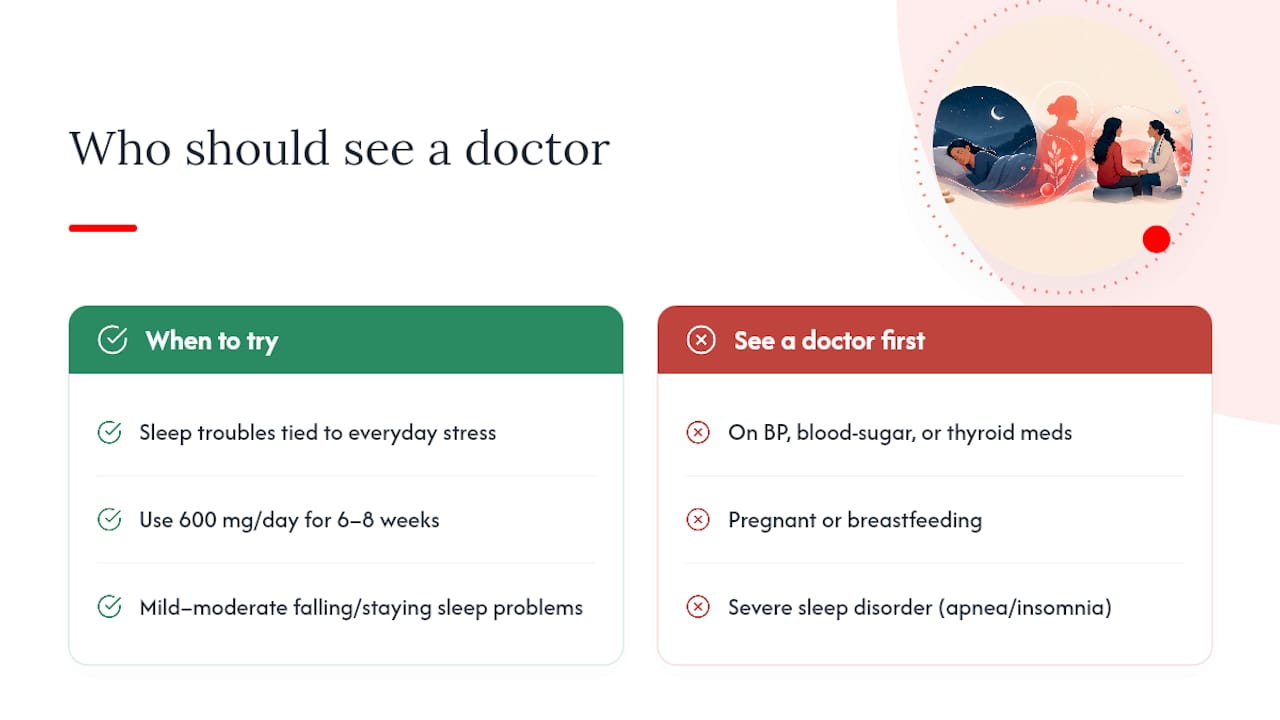
And one boundary matters more than any other: ashwagandha is not a treatment for sleep apnea, severe chronic insomnia, or other diagnosed sleep disorders. If your sleep problems are severe, persistent, or accompanied by loud snoring, gasping, or extreme daytime fatigue, that calls for a sleep specialist, not an herbal trial.
Why Fromwithin Built a Sleep Aid Around This Kind of Evidence
We built our approach around a simple frustration: most sleep products lean on melatonin or vague “calming blends” with no transparency about what’s actually inside or why. Fromwithin’s sleep aid uses a formulation grounded in transparent, researched ingredients rather than hormonal shortcuts, paired with our patented Wellnex® peptide delivery, absorbed directly into the bloodstream rather than relying on slower digestive breakdown.
We don’t position this as a replacement for a clinician’s care or for evidence-backed compounds like ashwagandha. It’s a complementary layer, something that works alongside stress-modulating ingredients and solid sleep habits, not instead of them. If you’re curious about formulation details or want the fuller picture on how sleep quality connects to how your skin looks and recovers overnight, our journal on sleep and skin health is worth a read.
— From
A Non-Hormonal Option Worth Adding to Your Routine
If the idea of relying on melatonin every night doesn’t sit right with you, you’re not alone. A lot of people want something that supports wind-down without training their body to depend on a hormone it should be making on its own. That’s the gap Fromwithin’s sleep aid was built to fill: a non-melatonin, non-hormonal formula designed to support natural relaxation, with ingredients listed plainly, not buried behind a “proprietary blend” label.

Think of it as a companion to the kind of evidence-based approach this article just walked through, useful alongside consistent sleep hygiene and, if you choose to try it, alongside a compound like ashwagandha rather than as a substitute for either. For readers managing stress alongside restless nights, pairing a transparent formulation with proven levers like regular movement and hydration tends to compound the benefit rather than relying on any single ingredient to do all the work.
If you want to see exactly what’s in it and how it’s dosed, visit the sleep aid product page to check the full ingredient list and start your first order tonight.
Where to Read More on Ashwagandha and Sleep
- Systematic review and meta-analysis — the core clinical evidence on sleep outcomes
- NIH ODS fact sheet — trial summaries and safety notes for professionals
- Sleep Foundation overview — consumer-facing dosing and effect summaries
- Harvard Health safety review — balanced perspective on limits of the evidence
- NCCIH safety summary — interaction and contraindication details
This article is general information, not a substitute for advice from a qualified doctor. Consult a qualified healthcare professional about your own circumstances before acting on anything here.
Sources
- Effect of Ashwagandha (Withania somnifera) extract on sleep: A systematic review and meta-analysis
- Ashwagandha: Is it helpful for stress, anxiety, or sleep? (NIH ODS fact sheet for health professionals)
- Comparative evaluation of Ashwagandha root extract and melatonin for improving sleep quality in adults (PMC)
- Ashwagandha: Benefits, side effects, and safety concerns (Harvard Health)
