

on September 07, 2026

Native collagen has a molecular weight of approximately 300 kDa (roughly 300,000 g·mol⁻¹), forming a triple helix about 280 to 300 nanometers long and only 1.4 to 1.5 nanometers in diameter. Hydrolyzed collagen peptides, the form found in most supplements, run far smaller, typically below around 10 kDa. That size difference is not a footnote. It shapes how collagen dissolves, absorbs, and behaves in both a test tube and your gut.
TL;DR:
- Native collagen has a molecular weight of about 300 kDa, with a length of 280 to 300 nanometers and a diameter of only 1.4 to 1.5 nanometers, forming a triple helix.
- Collagen supplements contain much smaller peptides, typically under 10 kDa, which improve solubility and absorption but do not revert to native collagen in the body.
- Accurate measurement of collagen’s molecular weight depends heavily on the method used, with chromatography and rheology offering the most reliable results for different sample types.
- Molecular weight alone does not predict biological efficacy, as the digestibility and activity depend heavily on peptide sequence and dose, not just size.
- Consumer labels claiming specific low molecular weights should be viewed as marketing estimates, as actual peptide distributions vary and require detailed reporting.
Table of Contents
- What 300 kDa Actually Tells You About Collagen’s Structure
- Native Collagen vs. Hydrolyzed Collagen: Comparing the Weight Classes
- How Scientists Actually Measure Collagen’s Molecular Weight
- Why Molecular Weight Matters for Supplement Efficacy Claims
- Preserving Native Structure for Accurate Lab Measurement
- What Molecular Weight Data Really Tells Product Developers
- Get Precisely Characterized Collagen Peptides, Not Just a Number on a Label
- Sources
What 300 kDa Actually Tells You About Collagen’s Structure
If you’ve ever wondered why collagen research keeps citing the same 300 kDa figure, here’s the reasoning behind it. Native collagen, sometimes called tropocollagen, is built from three separate polypeptide chains, each weighing in around 100 kDa. Wind those three chains together into a triple helix and you get a rod shaped molecule with a combined mass near 300 kDa, stretching roughly 280 to 300 nanometers with a diameter of just 1.4 to 1.5 nanometers.
That geometry is not a coincidence. Each alpha chain adopts a left-handed helical twist, and the three chains wrap around a shared axis in a right-handed superhelix. This arrangement produces a molecule far longer than it is wide, which explains both its structural strength and its tendency to self-assemble into fibrils once outside the cell. The structural stability of the triple helix depends on that specific geometry, including the repeating glycine-proline-hydroxyproline pattern that lets the chains pack tightly without steric clash.
Reporting a single molecular weight works fine when you’re describing an idealized, intact tropocollagen unit in solution. It gets misleading fast once you’re looking at:
- Fibrillar or cross-linked collagen, where individual units have aggregated into much larger assemblies
- Partially degraded native samples, which almost always contain a low-level distribution of smaller fragments alongside intact molecules
- Any hydrolyzed or processed collagen product, where a single number obscures a wide spread of peptide sizes
For intact, freshly isolated tropocollagen, 300 kDa is a genuinely useful reference point, one you’ll see repeated across structural biology literature for good reason. But the moment collagen is processed, cross-linked, or partially broken down, distribution reporting (mean, range, spread) tells you far more than a single averaged value ever could. Anyone characterizing a real-world sample rather than a textbook molecule should expect to report a range, not a point estimate.
Native Collagen vs. Hydrolyzed Collagen: Comparing the Weight Classes
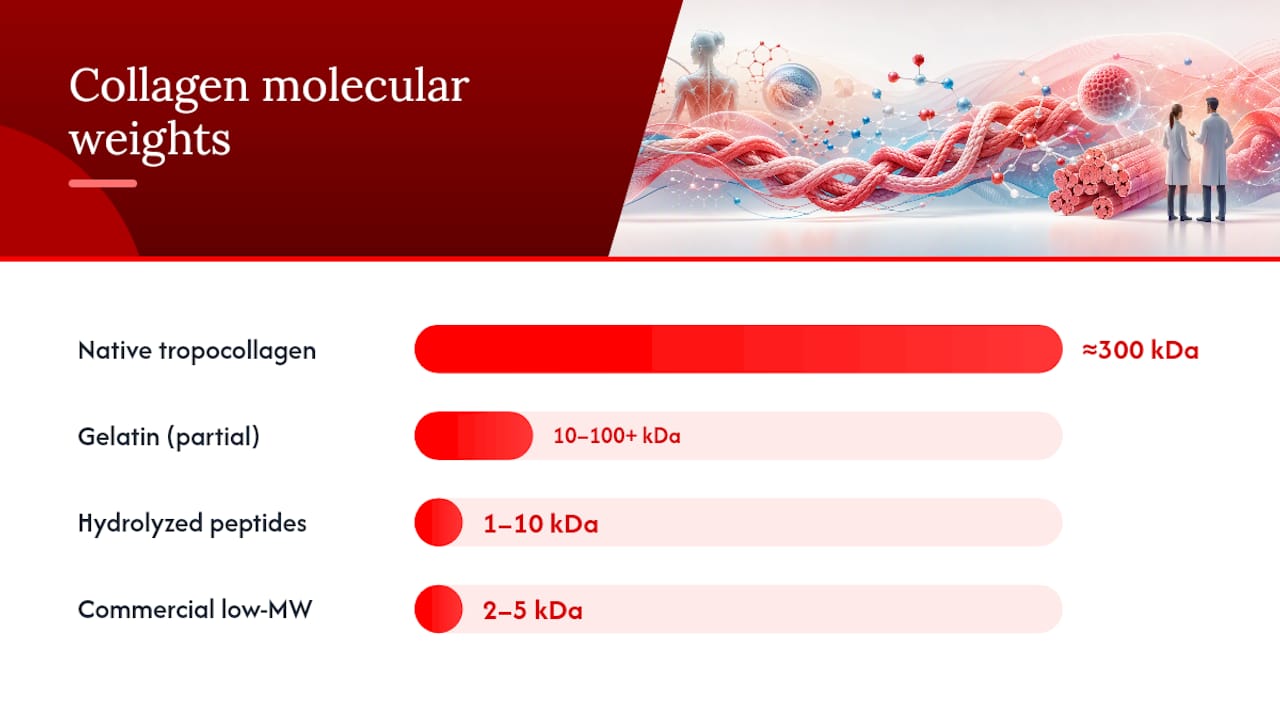
The gap between native collagen and the collagen peptides in your supplement drawer isn’t subtle. It’s roughly a hundredfold difference in mass, and it’s the single most important number for anyone evaluating a collagen product.
Collagen weight comparison, in real numbers:
- Native tropocollagen: ≈300 kDa, intact triple helix
- Gelatin (partially hydrolyzed, heat-denatured): typically tens to over 100 kDa, depending on processing severity
- Hydrolyzed collagen peptides (enzymatically processed): commonly under 1 to 10 kDa
- Commercial low-molecular-weight peptide blends: frequently marketed in the 2 to 5 kDa range
Pro Tip: If a product label claims a specific molecular weight without citing a distribution or a measurement method, treat that number as a marketing shorthand, not a lab result. Real peptide mixtures span a range; a single figure on a bottle is almost always a rounded average of something more complicated.
Hydrolysis is what gets you from a 300 kDa rod to a scoopable powder. Manufacturers use enzymatic or acid hydrolysis to cleave the peptide bonds holding those long alpha chains together, breaking the triple helix into short chains of amino acids. The shorter the resulting peptides, the more soluble the powder and the more uniform it dissolves in liquid, which is exactly why smaller molecular weight has become a selling point in the collagen supplement category.
Here’s the part that gets glossed over in marketing copy: smaller peptides absolutely improve solubility and appear to support intestinal uptake more efficiently than intact collagen would (which your gut cannot absorb in its native form anyway). But smaller molecular weight does not mean the peptides get redeposited into your skin as intact collagen. Harvard Health notes that collagen supplements are mixtures of peptides, and those peptides have to be broken down further, into amino acids and small di- or tripeptides, before your body can absorb and use them at all.
That distinction matters for how you read a product label. “Low molecular weight” is a real, measurable claim about solubility and processing. It is not, by itself, a claim about biological efficacy, and the two get conflated constantly in consumer marketing. A rigorous evaluation separates the two questions: how small are the peptides, and does that size correlate with any measured physiological outcome?
How Scientists Actually Measure Collagen’s Molecular Weight
Getting a trustworthy molecular weight number out of a collagen sample is harder than it sounds, and the method you choose determines what you’ll find.
-
Gel permeation chromatography with light scattering (GPC/SEC with MALS). This pairs size-exclusion chromatography, which separates molecules by hydrodynamic size, with multi-angle light scattering, which gives an absolute molecular weight independent of column calibration. It’s the closest thing to a gold standard for soluble collagen and peptide fractions, but it depends heavily on proper calibration standards and can misrepresent aggregated or partially denatured samples if you’re not careful about sample prep.
-
SDS-PAGE (gel electrophoresis). Useful, fast, and widely available, but it denatures the sample by design. That means SDS-PAGE can underrepresent very high molecular weight species or cross-linked aggregates that don’t migrate cleanly through the gel. Treat it as a complementary check against chromatography results, not a standalone answer.
-
Rheological analysis combined with machine learning. For insoluble collagen gels and fibers, which can’t be run through a standard column, rheology measures how the material deforms under stress and infers molecular weight from that mechanical behavior. One study using this approach reported detecting higher molecular weight fractions near 600 kDa in collagen gel samples, values that chromatography of soluble fractions alone would have completely missed.
-
Static and dynamic light scattering, standalone. Gives you size and aggregation state without a chromatographic separation step, useful for spotting aggregation early in a workflow.
Pro Tip: Watch your sample temperature. Collagen triple helices begin denaturing above roughly 40°C, and mechanical shear during handling or pumping can fragment native structure before it ever reaches your instrument. A molecular weight result is only as good as the sample that produced it.
The practical pitfall across all of these methods is the same: solubility limits, denaturation, and shear damage can each produce an artificially low or skewed molecular weight reading that has nothing to do with your actual sample. That 600 kDa rheology finding is a useful reminder that the method you pick determines what you’re capable of seeing.
Why Molecular Weight Matters for Supplement Efficacy Claims
Here’s the fact that trips up a lot of otherwise careful reasoning: native collagen is never absorbed whole. Your digestive system breaks every collagen molecule, native or supplemental, down into peptides and free amino acids before absorption happens. That means the ≈300 kDa figure for native collagen is structurally important but is not, on its own, a claim about what a supplement delivers to your bloodstream.
What actually reaches circulation are amino acids like glycine, proline, and hydroxyproline, along with specific small peptides such as Pro-Hyp dipeptides that have been measured directly in blood after ingestion. Some evidence points to these sequence-specific fragments, not molecular weight in the abstract, as the more relevant driver of downstream signaling in skin cells.
So what does molecular weight actually predict?
- Smaller peptides generally dissolve and disperse better in liquid formulations
- Smaller peptides tend to be absorbed more readily across the intestinal lining than larger fragments
- Molecular weight alone does not predict which specific amino acid sequences end up in circulation, and sequence appears to matter for biological activity
On the clinical side, the evidence timeline is worth knowing if you’re evaluating study design. An umbrella review pooling 16 systematic reviews across 113 randomized controlled trials and nearly 8,000 participants found consistent, favorable outcomes for skin and musculoskeletal endpoints with collagen supplementation, though the reviewers flagged heterogeneity across formulations and dosing. Separately, meta-analyses tracking skin hydration and elasticity generally report measurable improvement after 8 to 12 weeks of consistent use, with some trials extending to 90 days before assessing outcomes.
Molecular weight is one input into that evidence, not the whole story. Peptide sequence, daily dose, formulation quality, and study duration all interact with size to determine what a given product can plausibly deliver. A 2 kDa peptide blend with a poorly chosen sequence and an underpowered trial will not outperform a well-studied formulation just because its molecular weight looks impressive on a spec sheet.
Preserving Native Structure for Accurate Lab Measurement
Getting a molecular weight reading you can trust starts well before the sample hits an instrument. Follow this sequence to avoid the most common artifacts:
-
Control temperature throughout handling. Keep samples below roughly 40°C at every stage, extraction, storage, and analysis. Collagen’s triple helix denatures into random-coil gelatin above this threshold, and that transition will silently corrupt your molecular weight result.
-
Minimize mechanical shear. Avoid vigorous pipetting, vortexing, or pumping through narrow tubing wherever possible. Shear forces fragment the long, rod-shaped tropocollagen molecule, which artificially lowers the apparent molecular weight you’ll measure downstream.
-
Add protease inhibitors when appropriate. If your extraction protocol carries any risk of residual proteolytic activity, inhibitors prevent enzymatic degradation from skewing your sample toward smaller fragments before you’ve even started the analysis.
-
Match your method to your sample’s solubility. Soluble collagen fractions are best characterized with GPC/SEC paired with light scattering. Insoluble gels and fibrillar samples need rheological approaches, ideally cross-validated against chromatography or SDS-PAGE on any soluble fraction you can extract.
-
Report full characterization detail, not a single number. A defensible molecular weight report includes sample preparation steps, the specific detectors used, calibration standards, and distribution metrics like number-average (Mn), weight-average (Mw), and polydispersity index, rather than one isolated figure with no context.
The consistent theme across every step: collagen’s structure is fragile in ways that are easy to damage and easy to miss. A result that isn’t accompanied by method, temperature control notes, and distribution data is a result that’s difficult for anyone else to verify or reproduce.
What Molecular Weight Data Really Tells Product Developers
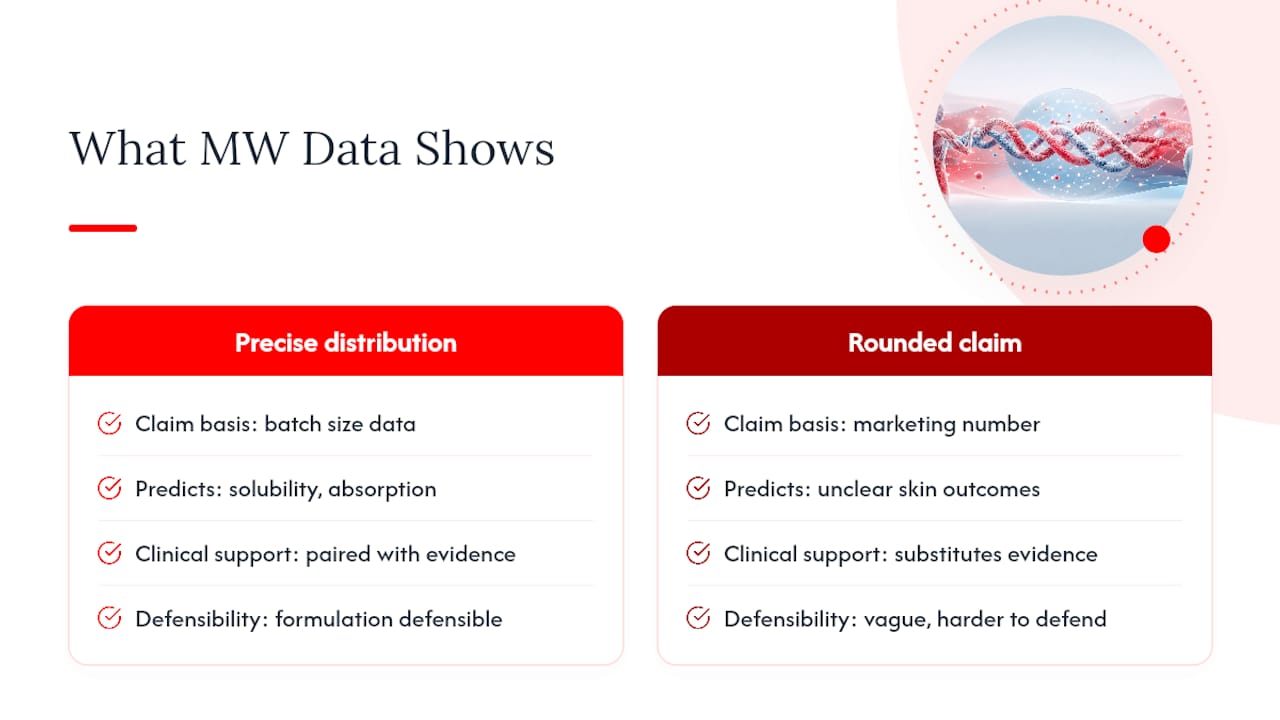
Precise molecular weight characterization is not an academic exercise removed from real products. It’s the difference between a formulation built on a defensible claim and one built on a rounded marketing number. When you know the actual distribution of peptide sizes in a given batch, not just an average, you can speak honestly about solubility, absorption potential, and what the clinical evidence can and cannot support.
That’s the standard to which these collagen peptide formulations are held. The peptide technology is built around getting small, well-characterized peptides into circulation efficiently, rather than leaning on an impressive-sounding but vague molecular weight claim. The gap between what a molecular weight number promises and what it actually predicts about skin outcomes is real, and closing that gap requires pairing size data with the kind of clinical evidence discussed above, not substituting one for the other.
— From
Get Precisely Characterized Collagen Peptides, Not Just a Number on a Label
If you’ve made it this far, you understand why “low molecular weight” alone tells you very little without the data behind it. That’s exactly the gap Fromwithin’s collagen peptide formulations are built to close, pairing patented Wellnex® peptide technology with the kind of transparent formulation detail this article just walked you through, rather than a vague size claim on a label.

The Collagen Peptides Glow Booster is formulated for absorption into the bloodstream, giving busy professionals a way to support skin elasticity and hydration without guessing whether the peptides in their drink are actually small enough, or well characterized enough, to do anything. If skin research is what brought you here, the next step is straightforward: visit the collagen product page and see how the formulation compares to what you’ve just learned about molecular weight, distribution, and absorption.
This article is general information, not a substitute for advice from a qualified doctor. Consult a qualified healthcare professional about your own circumstances before acting on anything here.
Sources
For readers verifying these figures directly, the PMC review on hydrolyzed collagen sources covers native molecular weight and geometry, while the umbrella review of meta-analyses and Cleveland Clinic’s collagen overview address clinical outcomes and absorption. Check each paper’s methods section for protocol specifics before citing a figure elsewhere.
- Hydrolyzed Collagen—Sources and Applications - PMC - NIH
- Considering collagen drinks and supplements? - Harvard Health
- Rheological method for determining the molecular weight of collagen gels by using a machine learning technique (Polymers)
