

on July 22, 2026

A strong sleep hygiene routine for professionals comes down to four non-negotiables: a consistent wake time every day, a 1.5-hour wind-down before bed, a cool and dark bedroom, and caffeine cut off by early afternoon. That’s the foundation. Everything else builds on it. Here’s what that looks like in practice:
- Wake up at the same time every day, including weekends. This anchors your circadian rhythm more reliably than any other single habit.
- Start winding down 1.5 hours before bed by dimming lights, putting away screens, and shifting to low-stimulation activities.
- Keep your bedroom between 65°F and 68°F, dark, and quiet. Even small light sources can suppress melatonin.
- Cut caffeine by 1:00 PM. With a half-life of 5–6 hours, an afternoon coffee is still active in your system at midnight.
- Do a “brain dump” before bed. Write down tomorrow’s tasks and worries to clear your mental queue before your head hits the pillow.
If your schedule is unpredictable, that’s okay. Small, consistent improvements beat a perfect routine you can’t sustain.
Why sleep hygiene matters more when you’re a professional under pressure
Sleep hygiene is the collection of daily habits and environmental conditions that shape how well you sleep. Harvard Health defines it as practices that help your body experience the physical repair, immune support, and cognitive renewal that sleep provides. For professionals, the stakes are higher than most people realize.
Poor sleep hygiene significantly raises the risk of impaired decision-making, professional errors, and safety issues, especially during high-stress periods. Your prefrontal cortex, the part of the brain responsible for judgment and risk assessment, is one of the first systems to degrade when sleep is cut short. That’s a real problem when your job demands sharp thinking.
Your circadian rhythm, the internal 24-hour clock that regulates alertness and sleepiness, responds directly to light, temperature, and routine. When your schedule is irregular, that clock drifts, and you end up fighting your own biology every morning. Good sleep hygiene supports cognitive sharpness and risk management, which matters most when professional stress is highest.
| Sleep hygiene element | Why it matters for professionals |
|---|---|
| Consistent wake time | Stabilizes circadian rhythm, reduces morning grogginess |
| Wind-down routine | Lowers cortisol and prepares the nervous system for sleep |
| Bedroom environment | Reduces sleep fragmentation from light and noise |
| Caffeine timing | Prevents stimulant interference with sleep onset |
| Stress management | Reduces cognitive arousal that delays sleep |
Practical tips to build a bedtime routine that actually fits your schedule
The biggest mistake busy professionals make is trying to build a perfect routine all at once. Start with two or three changes, get consistent, then layer in more. Here’s what the evidence supports most strongly.
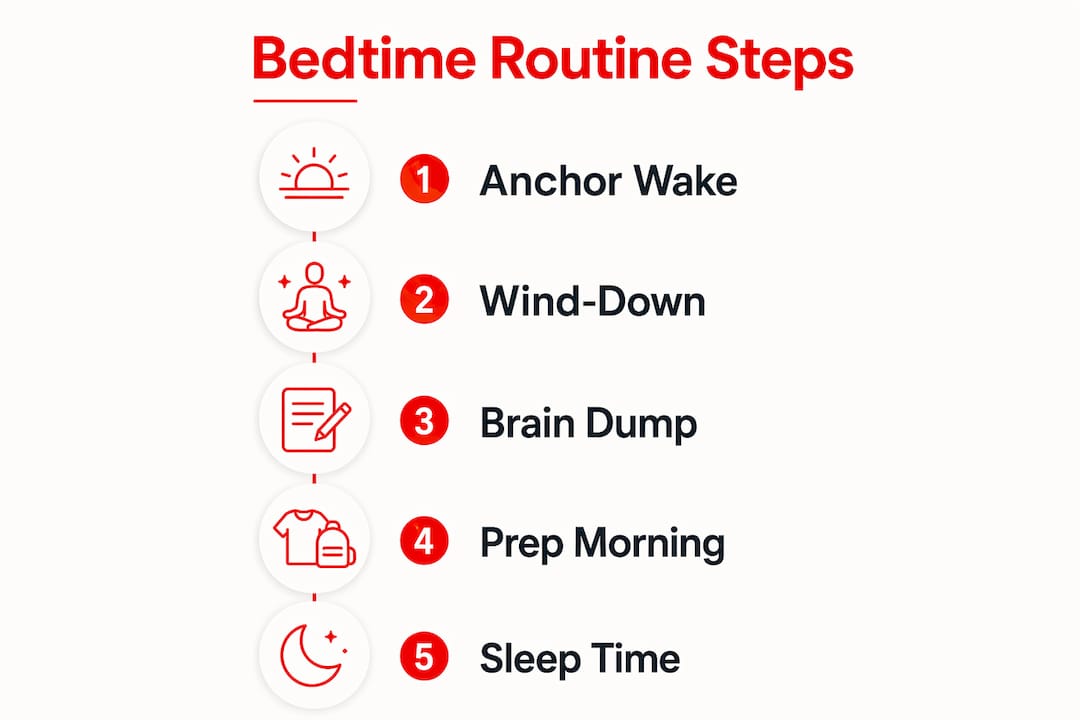
Anchor your wake time first. Consistent wake times stabilize your circadian rhythm more effectively than consistent bedtimes. Set your alarm for the same time seven days a week, even after a late night. Your body will adjust its sleep pressure accordingly.

Design a realistic wind-down window. The CDC recommends starting your pre-sleep routine about 1.5 hours before bed. That doesn’t mean an elaborate ritual. It means dimming the lights, stepping away from work email, and doing something genuinely low-stimulation: reading for pleasure, light stretching, a warm bath, or a guided breathing exercise.
Optimize your bedroom environment. Keep the room cool within a comfortable temperature range. Use blackout curtains or an eye mask, because even faint light sources like a phone screen or streetlight glow can suppress melatonin and fragment your deep sleep cycles. A white noise machine or a simple fan handles ambient noise without requiring earplugs every night.
Manage caffeine and meals with intention. Avoid caffeine after 1:00 PM and keep evening meals at least three hours before bed. Alcohol is worth mentioning here too: it may help you fall asleep faster, but it reduces REM sleep and tends to cause wakefulness in the second half of the night.
- Swap a late-afternoon coffee for a short walk or a 10–20 minute nap before 3:00 PM.
- Keep a glass of water on your nightstand instead of your phone.
- Set a “screens off” alarm 1.5 hours before your target bedtime.
Use the brain dump technique. Writing down your pending tasks and worries 30 to 60 minutes before bed reduces the cognitive arousal that keeps professionals staring at the ceiling. It’s not journaling for its own sake. It’s psychological closure, a way of telling your brain the day is done.
Pro Tip: Automate your routine decisions in advance. Lay out tomorrow’s clothes, prep your morning coffee, and set your wind-down alarm the night before. The less willpower your routine demands at 10:00 PM, the more likely you are to actually follow it.
How to push past the barriers that derail your sleep routine
You know what to do. The harder question is why it keeps not happening. For most professionals, the culprits are predictable: irregular schedules, work anxiety that follows you to bed, late-night screen use, and exercise or caffeine timing that quietly undermines everything else.

Work anxiety and mental overactivity are the most common reasons professionals lie awake. Your brain treats unresolved tasks as open loops, and it keeps cycling through them. The brain dump technique mentioned earlier addresses this directly. For deeper anxiety, try a simple relaxation approach like progressive muscle relaxation or box breathing, both of which activate the parasympathetic nervous system within minutes.
Technology and evening work are harder to manage because the boundary between “work mode” and “rest mode” has essentially disappeared for most professionals. The fix isn’t willpower. It’s a physical boundary: chargers in another room, a specific time when your laptop closes, and notifications silenced after a set hour. The CDC recommends turning off electronic devices at least 30 minutes before bed, though 90 minutes is more effective for most people.
Exercise timing trips up a lot of professionals who work out in the evening. For many people, vigorous exercise within two hours of bedtime delays sleep onset. If evening is your only window, experiment with lower-intensity options like yoga or a walk. Finishing a workout at least three hours before bed is the safer target.
Irregular schedules and shift work require a slightly different approach. If your hours rotate, prioritize keeping your wake time as consistent as possible even when your bedtime shifts. Use blackout curtains and earplugs for daytime sleep, limit caffeine to the first part of your shift, and reduce shift changes where you have any control over your schedule.
If you’ve spent 20 minutes in bed and sleep hasn’t come, get up and do something quiet until you feel genuinely sleepy. Lying in bed awake trains your brain to associate the bedroom with wakefulness, which is the opposite of what you want.
What recent research says about sleep hygiene for professionals
The science on sleep hygiene has gotten more specific, and more practical, over the past few years. Here’s what holds up.
Seven to eight hours is the evidence-based target. Most healthy adults need 7–8 hours of sleep per night to function well. Professionals who routinely sleep less than that accumulate a cognitive debt that a single long weekend sleep session doesn’t fully repay.
Caffeine’s half-life is longer than most people assume. With a 5–6 hour half-life, a 3:00 PM coffee still has half its stimulant load in your system at 9:00 PM. Cutting off by early afternoon isn’t overly cautious. It’s just math.
Light exposure is a two-sided lever. Bright light in the morning strengthens your circadian rhythm and promotes alertness during the day. Dim light in the evening signals your brain to start producing melatonin. Most professionals get this backwards, spending mornings in dim offices and evenings under bright overhead lights with screens.
The Harvard Health guidance on tailoring your routine is worth taking seriously. Sleep hygiene is not one-size-fits-all. The most sustainable approach is identifying the two or three factors most disrupting your sleep and fixing those first, rather than overhauling everything at once.
According to the CDC, more than one-third of adults in the U.S. don’t get enough sleep. For professionals managing high cognitive loads, that gap between needed sleep and actual sleep compounds over time in ways that show up as slower reaction times, worse judgment, and lower emotional resilience.
How to use power naps without wrecking your nighttime sleep
A well-timed nap is one of the most underused tools in a professional’s day. Done right, a short rest in the afternoon can restore alertness, improve mood, and carry you through the rest of the workday without the crash that follows a second cup of coffee.
The sweet spot is 10–20 minutes. That duration keeps you in light sleep, so you wake up refreshed rather than groggy. Longer naps push you into deeper sleep stages, and waking from those mid-cycle leaves you feeling worse than before. Sleep experts recommend keeping naps to half an hour or less, and finishing them well before late afternoon.
Timing matters as much as duration. The natural circadian dip hits most people between 1:00 PM and 3:00 PM. A nap in that window works with your biology. A nap after 3:00 PM starts competing with your nighttime sleep drive, making it harder to fall asleep at your regular bedtime.
For professionals who work in offices, the logistics can feel awkward. A few practical options: a quiet conference room with the lights off, noise-canceling headphones at your desk with a sleep timer, or a short rest in your car during a lunch break. The afternoon energy dip that tempts you toward a third coffee is often better managed by a short nap or light movement than by more caffeine.
Pro Tip: Set a 25-minute timer when you lie down for a nap. That gives you five minutes to fall asleep and 20 minutes of actual rest, and the alarm prevents you from drifting into deep sleep.
If you’re a shift worker or your schedule rotates, naps become even more valuable. Extending total sleep time through strategic napping, combined with a consistent approach to your sleep environment, can meaningfully offset the circadian disruption that comes with irregular hours.
Key Takeaways
A consistent sleep hygiene routine for professionals works because it removes friction, anchors your body clock, and protects the cognitive performance your work depends on.
| Point | Details |
|---|---|
| Anchor your wake time | Consistent wake times stabilize your circadian rhythm more effectively than consistent bedtimes. |
| Start winding down early | The CDC recommends beginning your pre-sleep routine 1.5 hours before bed to ease the transition to sleep. |
| Protect your sleep environment | Keep your bedroom cool, fully dark, and quiet; even faint light suppresses melatonin. |
| Cut caffeine by early afternoon | Caffeine’s 5–6 hour half-life means a 3:00 PM coffee still affects your sleep at 9:00 PM. |
| Nap strategically | A 10–20 minute nap before 3:00 PM restores alertness without disrupting nighttime sleep. |
Sleep better tonight with support from Fromwithin

Getting your routine right is a great start. But if you’re doing everything above and still struggling to wind down, your body might need a little extra support. Fromwithin’s natural sleep aid is designed for exactly this: professionals who need genuine, dependable rest without relying on prescription medications. It works with your body’s natural rhythms, not against them.
And while you’re at it, quality sleep is one of the best things you can do for your skin. Fromwithin’s wellness supplements pair beautifully with a consistent nighttime routine, supporting your skin’s repair process from the inside while you rest. For professionals who want concierge-level wellness care alongside their supplement routine, that option exists too.
Your best sleep is closer than you think. Start with one change tonight.
