

on July 25, 2026

What sleep quality really means and why it changes everything
Sleep quality is not just about how many hours you log. It covers how consistently you fall asleep, how satisfied you feel when you wake up, how efficiently your body cycles through sleep stages, and whether you stay alert throughout the day. Sleep researcher Daniel Buysse identifies six core dimensions of sleep health: regularity, satisfaction, alertness, timing, efficiency, and duration. Focusing only on duration misses the bigger picture entirely.
Why does this matter? Because poor sleep quality, even when total hours seem fine, drives real health consequences. The American Heart Association now lists sleep alongside diet and exercise as a foundational pillar of cardiovascular health. Fragmented, inconsistent sleep disrupts your body’s repair cycles, hormonal rhythms, and immune defenses in ways that accumulate quietly over time.
Here is a quick look at what good sleep quality actually includes:
- Falling asleep within a reasonable time after lying down
- Waking no more than once during the night
- Feeling genuinely refreshed and alert in the morning
- Maintaining a consistent sleep and wake schedule
- Spending enough time in deep, restorative sleep stages
- Experiencing minimal daytime sleepiness
Table of Contents
- How sleep quality shapes your heart and circulatory system
- How sleep quality affects your hormones and metabolism
- How quality sleep keeps your immune system strong
- Cognitive and emotional advantages of sleeping well
- What the latest science says about sleep and long-term health
- Fromwithin supports your sleep and recovery from the inside out
- Key Takeaways
How sleep quality shapes your heart and circulatory system
Your heart gets its most important break while you sleep. During non-REM sleep, blood pressure and heart rate naturally drop, a process called nocturnal blood pressure dipping. This nightly dip gives your cardiovascular system time to recover and repair. When sleep fragmentation disrupts this process, blood pressure stays elevated through the night, placing sustained stress on your arteries and heart.

The American Heart Association’s scientific statement confirms that poor sleep quality and inconsistency carry cardiometabolic risks comparable to those of poor diet or physical inactivity. Snoring, frequent awakenings, and irregular sleep timing all prevent normal overnight blood pressure reduction. Excessive daytime sleepiness, a direct sign of poor sleep quality, is also linked to increased heart disease and stroke mortality.
Key cardiovascular effects of poor sleep quality include:
- Failure of nocturnal blood pressure dipping, raising hypertension risk
- Increased inflammation in blood vessel walls
- Higher risk of heart attack, stroke, and arrhythmia
- Elevated sympathetic nervous system activity during sleep
- Greater likelihood of developing metabolic syndrome
How sleep quality affects your hormones and metabolism
Sleep does not just rest your body. It actively regulates the hormones that control hunger, blood sugar, and fat storage. When sleep quality drops, ghrelin (your hunger hormone) rises and leptin (your fullness signal) falls, according to Stanford Lifestyle Medicine. The result? You feel hungrier, crave fatty and sugary foods, and your body becomes less efficient at burning what you eat.
Insulin sensitivity also takes a hit. Poor sleep quality causes your cells to respond less effectively to insulin, pushing blood glucose higher and raising your risk of type 2 diabetes over time. The NHLBI confirms that sleep deficiency disrupts the hormonal balance controlling hunger and glucose regulation, contributing directly to obesity and metabolic syndrome. Irregular sleep timing compounds this, because your body’s metabolic processes are tied to circadian rhythms that depend on consistent sleep patterns.
Hormonal and metabolic pathways affected by poor sleep quality:
- Elevated ghrelin, driving increased appetite and caloric intake
- Reduced leptin, impairing satiety signals
- Impaired insulin response, raising blood sugar levels
- Disrupted cortisol rhythms, increasing daytime stress load
- Reduced growth hormone secretion during deep sleep
How quality sleep keeps your immune system strong
Your immune system does some of its best work while you sleep. During quality sleep, your body produces cytokines, proteins that help fight infection, inflammation, and stress. Deep sleep also triggers the release of growth hormone, which repairs tissues, rebuilds muscle, and supports cellular recovery throughout the body. The American Academy of Sleep Medicine notes that even short-term sleep deprivation impairs immune response and memory consolidation.
Fragmented sleep interrupts these repair cycles. You might spend eight hours in bed but still wake feeling run-down if your sleep is broken repeatedly through the night. That is because the most restorative immune and tissue repair work happens in the deeper stages of sleep, which fragmented sleep cuts short. Pairing quality sleep with a good overnight skin repair routine can support your skin’s own nightly recovery process.
Immune and repair processes that depend on quality sleep:
- Cytokine production to regulate immune response and fight infection
- Growth hormone release for muscle and tissue repair
- T-cell activity, which strengthens adaptive immunity
- Reduction of inflammatory markers in the bloodstream
- Cellular waste clearance via the glymphatic system in the brain
Cognitive and emotional advantages of sleeping well
Your brain uses sleep as its maintenance window. During deep sleep, the glymphatic system flushes out metabolic waste products, including proteins linked to cognitive decline. When sleep is fragmented, this cleaning process is interrupted, leaving residual fatigue even after a full night in bed. Memory consolidation, the process by which your brain transfers learning into long-term storage, also depends heavily on uninterrupted sleep cycles.

The emotional stakes are just as high. The NHLBI reports that sleep deficiency alters activity in brain regions responsible for decision-making, emotional regulation, and mood control. Poor sleep quality is strongly linked to anxiety, depression, and reduced stress resilience. On the productivity side, sleep-deficient people take longer to complete tasks, make more errors, and react more slowly, with driver sleepiness estimated to factor into about 100,000 car accidents each year in the United States.
Cognitive and emotional benefits of good sleep quality:
- Stronger memory consolidation and faster learning
- Better emotional regulation and mood stability
- Sharper decision-making and problem-solving
- Reduced anxiety and lower risk of depressive symptoms
- Faster reaction times and fewer errors at work or behind the wheel
The American Academy of Sleep Medicine’s 2025 position statement ranks sleep quality as one of the most influential lifestyle factors for depressive symptoms, second only to physical activity and diet.
Pro Tip: If you lie awake worrying about not getting enough hours, shift your focus to sleep efficiency instead. Aim for consistent wake times, limit time in bed to actual sleep, and let the hours follow naturally. Anxiety about duration often makes quality worse.
What the latest science says about sleep and long-term health
Recent research has moved decisively toward treating sleep as a multidimensional health construct, not a simple on/off switch. The American Heart Association’s Life’s Essential 8 framework, supported by Harvard research, now formally includes sleep health as one of eight core cardiovascular metrics. Studies show that combining quality sleep with exercise, a healthy diet, and not smoking lowers heart disease risk more than any of those factors alone.
The glymphatic system finding is one of the most striking recent advances. Deep, uninterrupted sleep is when the brain clears the metabolic waste that accumulates during waking hours. Disrupting that process repeatedly over years is now associated with increased neurodegenerative risk. Sleep is, in the most literal sense, an active neurological maintenance period.
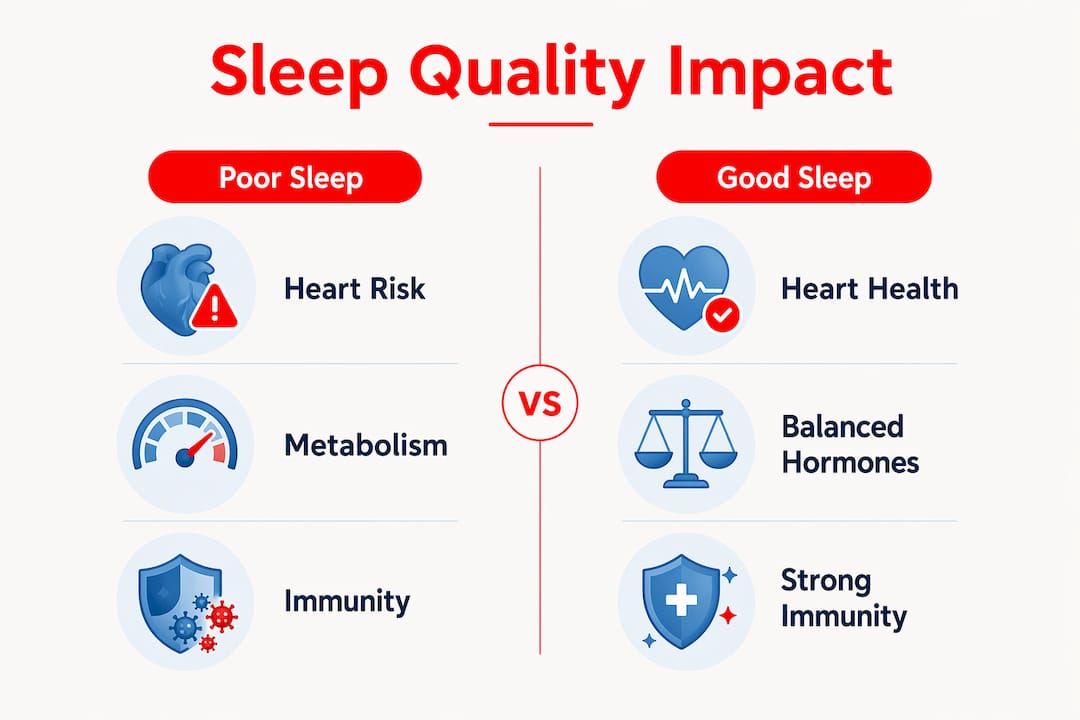
| Health dimension | Risk with poor sleep quality | Benefit with good sleep quality |
|---|---|---|
| Cardiovascular | Hypertension, stroke, heart disease | Normal blood pressure dipping, lower heart disease risk |
| Metabolic | Obesity, type 2 diabetes, metabolic syndrome | Balanced hunger hormones, healthy insulin response |
| Immune | Frequent illness, slow tissue repair | Strong cytokine production, faster recovery |
| Cognitive | Memory loss, poor focus, accident risk | Sharper memory, faster reaction time |
| Emotional | Anxiety, depression, mood instability | Emotional resilience, stable mood |
| Longevity | Chronic disease accumulation | Reduced all-cause mortality risk |
The NHLBI confirms that adults who regularly get quality sleep have a lower risk of obesity, high blood pressure, and cardiovascular disease. But the quality piece matters just as much as the hours. You can explore how sleep quality connects to your skin’s nightly repair process in Fromwithin’s guide on sleep and skin health, or get practical with an evening wind-down checklist designed to help you actually get there.
Fromwithin supports your sleep and recovery from the inside out
Good sleep is the foundation, and what you put into your body each evening shapes how well that foundation holds. Fromwithin was built for people who take their wellness seriously and want support that actually works, without relying on prescription medications or synthetic shortcuts.

Fromwithin’s natural sleep aid is formulated to promote genuine relaxation and help you wind down at the end of the day, so your body can do the repair work it was designed to do. For skin health, the brand’s collagen supplements use patented Wellnex® peptides that absorb directly into the bloodstream, supporting the collagen synthesis your skin depends on during those deep sleep hours. Both products are built around ingredient transparency and clinical research, not marketing claims. If you are ready to support your body’s recovery from the inside, Fromwithin is a good place to start.
Key Takeaways
Sleep quality, not just duration, determines how well your body repairs, regulates hormones, fights illness, and supports cognitive and emotional health every single night.
| Point | Details |
|---|---|
| Quality beats quantity | Six dimensions of sleep health predict outcomes better than hours alone. |
| Heart health depends on it | Poor sleep prevents nocturnal blood pressure dipping, raising hypertension and stroke risk. |
| Hormones go off-balance | Sleep deficiency raises ghrelin and lowers leptin, impairing hunger control and insulin response. |
| Brain maintenance happens at night | The glymphatic system clears cognitive waste only during deep, uninterrupted sleep. |
| Fromwithin supports recovery | Fromwithin’s sleep aid and Wellnex® collagen supplements help your body do its nightly repair work naturally. |
