

on September 03, 2026

Yes, caffeine disrupts sleep for most adults, even when you fall asleep just fine. It blunts deep sleep and stretches out how long it takes to drift off, and the effect lingers longer than the “jittery” feeling does. The safest bet: skip large doses within about 12 hours of bedtime, and for a normal cup or two, aim for an 8-hour cutoff. Sensitivity varies a lot, though, and we’ll show you how to find your own number.
TL;DR:
- Even small doses of caffeine taken more than 8 hours before bed can impair sleep, with 400 mg doses disrupting sleep up to 12 hours prior.
- Genetics, age, medication, and habits influence individual sensitivity to caffeine’s sleep-disrupting effects.
- A two-week trial shifting your last caffeine intake two to three hours earlier can clarify its impact on your sleep quality.
- For sensitive individuals, avoiding caffeine within 10 or more hours of bedtime is safest, especially if over 40 or pregnant.
- Using sleep aids like Wellnex® peptides can support relaxation but should complement, not replace, proper caffeine timing and sleep hygiene.
Table of Contents
- How Caffeine Affects Sleep Physiology and Architecture
- Dose and Timing Evidence: What the Best Studies Show
- Why Some People Handle Caffeine and Others Don’t
- How to Tell if Caffeine Is Affecting Your Sleep
- Practical Timing Rules and a Dose-Aware Cutoff
- Alternatives to Late-Day Caffeine for Alertness
- Where a Non-Hormonal Sleep Aid Fits Into a Caffeine Plan
- What Happens to Your Sleep When You Cut Caffeine
- Caffeine’s Role in Insomnia and Sleep Apnea
- A Realistic Take on Caffeine and Sleep for Busy Professionals
- A Sleep Aid Built for the Nights Timing Alone Doesn’t Fix
- Sources
How Caffeine Affects Sleep Physiology and Architecture
Caffeine doesn’t just make you feel awake. It changes the actual chemistry your brain uses to fall asleep in the first place.
Throughout the day, a molecule called adenosine builds up in your brain and creates “sleep pressure,” that heavy, ready-for-bed feeling you get by evening. Caffeine works by blocking the receptors adenosine normally binds to. Your brain still produces adenosine, but it can’t do its job, so you feel more alert even though the biological drive to sleep hasn’t gone anywhere. It’s less like caffeine erasing tiredness and more like caffeine putting tape over the warning light.
This blockade has measurable downstream effects on sleep itself, not just on how quickly you nod off:
- Longer sleep onset latency, meaning it takes more time to fall asleep once you’re in bed
- More wake after sleep onset, which shows up as fragmented, restless sleep in the middle of the night
- Reduced deep sleep (N3 sleep), the stage tied to physical recovery and the kind of rest that actually leaves you refreshed
Here’s the part most people miss: you can feel like you slept “fine” while your sleep architecture took a real hit. NIH consumer health research describes this as the “tired or wired” phenomenon, where subjective sleepiness and objective sleep disruption don’t line up. You might not remember waking up at 3 a.m. for ninety seconds, but a wearable or a sleep lab would.
Dose and Timing Evidence: What the Best Studies Show
The research on caffeine and sleep quality is more specific than most people expect, and the numbers matter more than the vague “don’t drink coffee at night” advice you’ve probably heard.
A 2023 systematic review and meta-analysis pooling 24 studies found caffeine reduced total sleep time by about 45 minutes, increased sleep onset latency by roughly 9 minutes, added about 12 minutes of wake after sleep onset, and cut deep sleep proportion by about 1.4%. Those numbers sound modest individually, but stacked together, they describe a night that’s shorter, choppier, and lighter than it should be.
Dose changes the picture dramatically. A randomized clinical crossover trial using in-home polysomnography tested 100 mg and 400 mg doses at 4, 8, and 12 hours before bedtime. The 100 mg dose produced no significant effect on sleep at any of those windows. The 400 mg dose, taken even 12 hours before bed, still significantly delayed sleep onset and altered sleep architecture. A separate home-based trial backs this up: a single 400 mg dose taken 0, 3, or 6 hours before bedtime cut total sleep time by up to an hour and increased sleep disturbance, regardless of exactly when it was consumed within that window.
| Dose | Rough drink equivalent | Timing risk |
|---|---|---|
| 100 mg | One cup of brewed coffee | Generally low risk after about 4 hours |
| 200 mg | Large coffee or 2 espresso shots | Moderate risk within 6–8 hours |
| 400 mg | Two to three cups, or one strong energy drink or pre-workout | Disrupts sleep even 12 hours out |
A single 400 mg dose can measurably disrupt sleep architecture up to 12 hours before bedtime, according to the crossover trial above, which is far more conservative than most public guidance assumes.
Why Some People Handle Caffeine and Others Don’t
Two people can drink the same afternoon latte and get completely different nights. The gap usually comes down to biology, not willpower.
Genetics plays a bigger role than most people realize. Variants in the CYP1A2 gene control how fast your liver metabolizes caffeine, meaning some people clear it in a few hours while others take twice as long. Variants in ADORA2A, the gene coding for one of the adenosine receptors caffeine blocks, influence how sensitive your brain is to that blockade in the first place. Beyond genetics, several other factors shift your personal risk:
- Age: caffeine clearance slows as you get older, so a cutoff that worked at 25 may not work at 45
- Pregnancy and liver disease: both extend caffeine’s half-life significantly
- Certain medications and smoking status: both can speed up or slow down clearance
- Habitual, heavy use: builds tolerance to the jittery feeling, but doesn’t protect deep sleep
That last point trips people up constantly. Feeling “used to” caffeine only means the alertness effect has dulled. The dose and timing trial that tested high and low doses found architecture disruption regardless of habitual intake, so tolerance is not the same as protection.
Pro Tip: If you’re over 40, pregnant, or on a medication that affects liver metabolism, treat every cutoff guideline in this article as a floor, not a target. Push your last cup at least two hours earlier than the “typical adult” recommendation.
How to Tell if Caffeine Is Affecting Your Sleep
You don’t need a sleep lab to figure out whether caffeine is the culprit behind your restless nights. You need two weeks and a little curiosity.
Start by watching for the usual signs: taking longer than 20 minutes to fall asleep, waking up multiple times overnight, or feeling groggy despite logging a full eight hours. Those are subjective clues. For something more objective, a basic sleep diary or a wearable tracking sleep stages gives you real data to compare against a timestamped log of what you drank and when.
Then run a simple test:
- Track your current caffeine timing and sleep metrics (latency, wake-ups, total sleep time) for one week as your baseline.
- For the second week, move your last caffeine intake at least two to three hours earlier, keeping the amount the same.
- Compare the two weeks side by side, focusing on sleep latency and how rested you feel in the morning, not just total hours logged.
If week two looks meaningfully better, you’ve found your answer without guessing.
Practical Timing Rules and a Dose-Aware Cutoff
Most caffeine advice gives you one number: “stop by 2 p.m.” That’s a reasonable starting point, but it ignores dose entirely, and dose is half the equation.
The idea is straightforward even without doing math: a bigger dose takes longer to clear your system, and caffeine’s half-life (roughly 5 to 6 hours for most adults) means a late double espresso is still meaningfully present at bedtime, while a single cup cleared hours earlier barely registers. A caffeine cutoff model that separates dose, half-life, and a target residual level at bedtime makes this concrete, but you don’t need a calculator to apply the general logic.
Use these guardrails instead of one blanket rule:
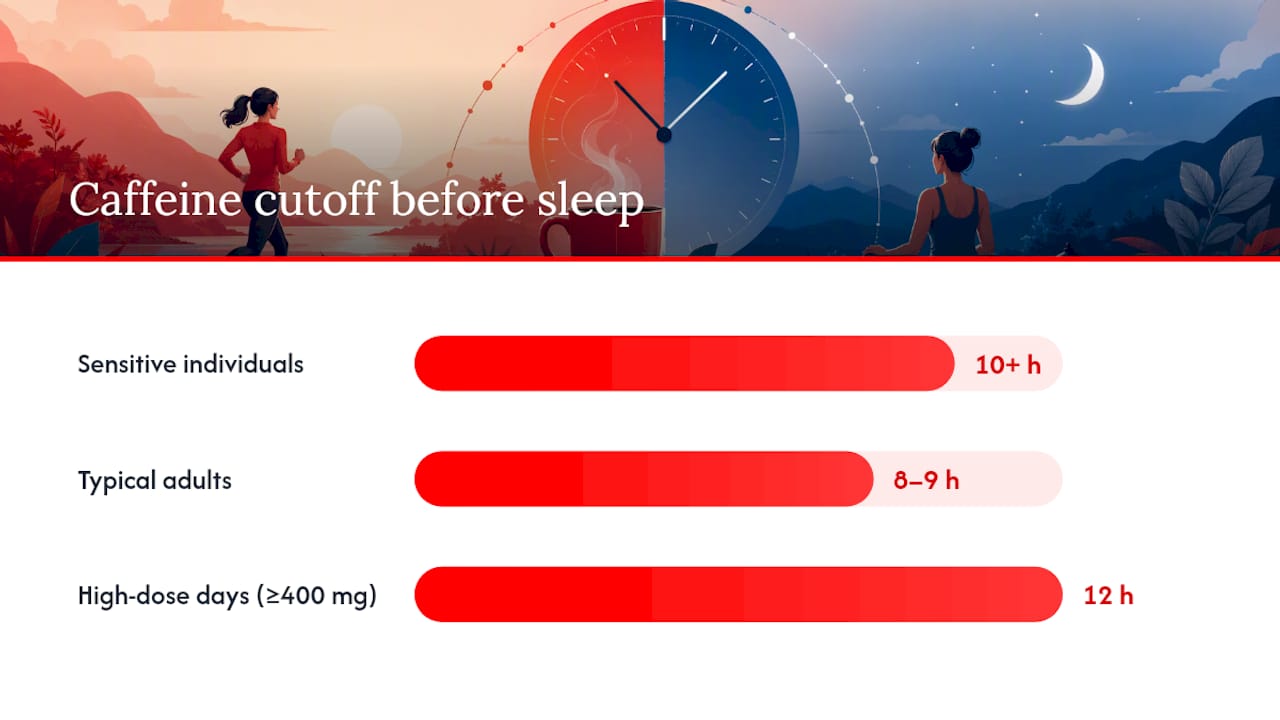
- Sensitive individuals (slow metabolizers, older adults, pregnant, or anyone who’s noticed problems before): avoid caffeine within 10 or more hours of bedtime.
- Typical adults with a single cup or moderate dose: an 8 to 9 hour cutoff works well for most people.
- High-dose days (400 mg or more, from strong coffee, energy drinks, or pre-workout supplements): avoid intake within 12 hours of bedtime.
For a 10 p.m. bedtime, that means a sensitive person’s last cup should land by noon, a typical adult can go until roughly 1 or 2 p.m., and anyone loading up on a 400 mg energy drink should stop by 10 a.m.
Pro Tip: Pre-workout supplements are the most underestimated source of late caffeine. Many contain 200 to 400 mg per scoop, which pushes an afternoon gym session’s caffeine well past a safe evening cutoff.
Alternatives to Late-Day Caffeine for Alertness
Cutting caffeine earlier doesn’t mean tolerating a 3 p.m. slump. A few substitutes work almost as well without touching your sleep.
- A short nap, capped at 20 minutes and taken before 3 p.m., restores alertness without the grogginess of a longer sleep cycle.
- Ten minutes of morning sunlight helps set your circadian rhythm, which reduces the afternoon energy dip in the first place.
- A brisk walk or light exercise raises alertness through blood flow and body temperature changes, not stimulant chemistry.
- A consistent sleep and wake schedule, paired with an evening wind-down routine, reduces how much you lean on caffeine to cover for poor sleep the night before.
That last point matters because caffeine and sleep debt tend to feed each other in a loop: poor sleep drives more caffeine consumption the next day, which then disrupts the following night. Breaking it usually takes a behavioral fix, not just willpower at 2 p.m.
Where a Non-Hormonal Sleep Aid Fits Into a Caffeine Plan
Adjusting your caffeine cutoff handles half the equation. The other half is what your body does in the hours before bed, and that’s where a wind-down supplement can genuinely help rather than just mask the problem.
Fromwithin’s sleep aid is built around Wellnex® peptides, absorbed directly into the bloodstream rather than relying on melatonin or sedating hormones, which matters if you’re trying to support natural relaxation without building dependence…
A supplement can support your wind-down process, but it works alongside better timing habits, not instead of them. It’s an adjunct for occasional evenings when your mind won’t switch off, not a fix for a caffeine habit that’s still running until 6 p.m.
If you’re dealing with persistent insomnia, are pregnant, or take medications that interact with sleep supplements, talk to a clinician before adding anything new to your routine.
What Happens to Your Sleep When You Cut Caffeine
Quitting caffeine, even for a few days, doesn’t feel great at first, and that’s worth knowing before you attempt a sudden cutoff.
Caffeine withdrawal commonly triggers headaches, irritability, and fatigue within 12 to 24 hours of your last dose, peaking around day two. Less talked about is what it does to sleep specifically: some people experience rebound insomnia in the first few nights, where sleep feels lighter or more fragmented even though caffeine is no longer in their system. This isn’t caffeine still disrupting sleep. It’s your brain adjusting to a sudden drop in adenosine receptor blockade after weeks or months of it being routinely suppressed.
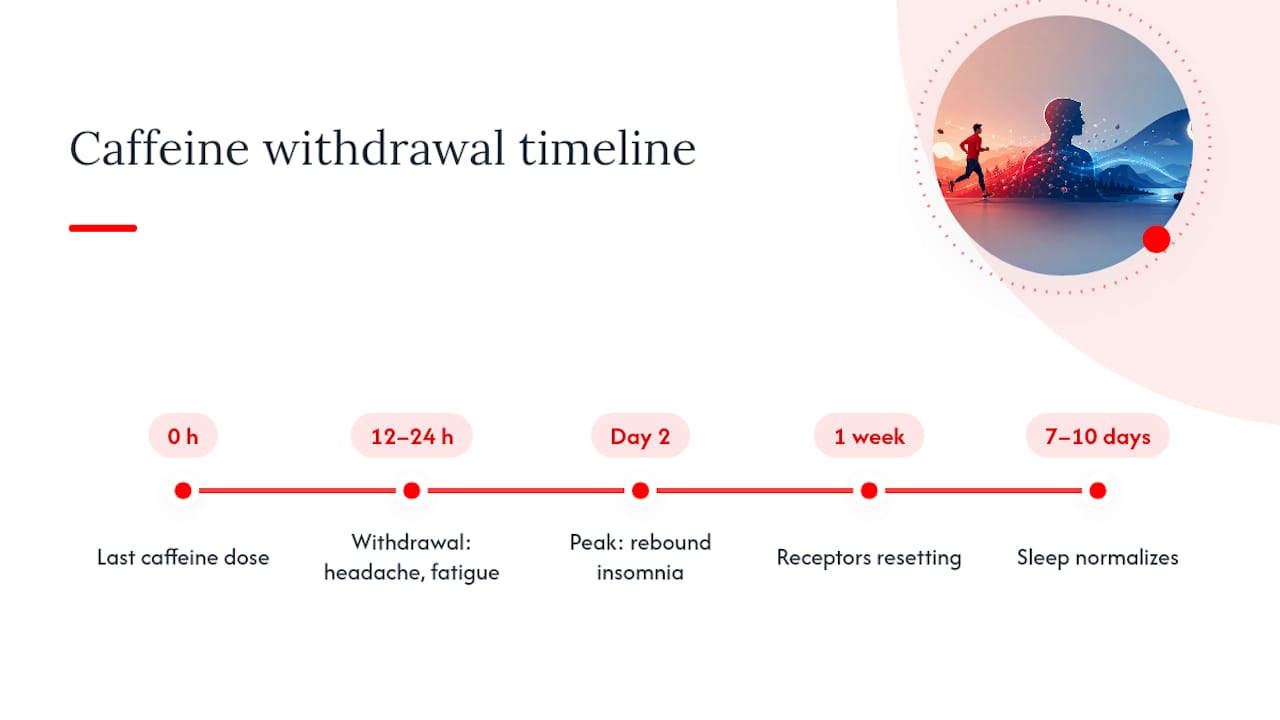
The adjustment period typically resolves within a week to ten days as your receptor sensitivity resets. For most health-conscious adults, the better move isn’t quitting cold. It’s shifting your cutoff earlier gradually, over one to two weeks, which sidesteps most of the withdrawal whiplash while still improving your sleep architecture. A slow taper gets you the sleep benefits without the days of headaches that make people give up and go back to their old habits by Thursday.
Caffeine’s Role in Insomnia and Sleep Apnea
If you already struggle with a diagnosed sleep disorder, caffeine’s effects don’t just add on top of the problem. They often compound it in ways that are easy to miss.
For people with chronic insomnia, the stakes around timing are higher, not lower. An insomnia-prone brain often has heightened arousal systems to begin with, so blocking adenosine receptors on top of that can extend an already-long sleep onset latency even further. The conservative “10 or more hours” cutoff mentioned earlier isn’t excessive advice for this group. It’s closer to a floor.
Caffeine’s relationship with sleep apnea is more nuanced. Some research suggests caffeine’s stimulant effect on breathing muscles could offer minor, short-term improvements in airway tone, but that potential upside is easily outweighed by caffeine’s tendency to fragment sleep and worsen daytime fatigue, which sleep apnea already causes. Anyone using a CPAP machine or managing apnea symptoms should treat late caffeine as a bigger liability than a typical sleeper would, since fragmented sleep and apnea-related arousals compound each other.
In both cases, timing rules aren’t optional extras. They’re the first lever to pull before assuming a sleep disorder needs a more aggressive medical intervention, and they cost nothing to try.
A Realistic Take on Caffeine and Sleep for Busy Professionals
Most people don’t need to quit caffeine. They need two weeks and a willingness to move their last cup earlier by a couple of hours, then actually look at what changed. Small, testable shifts stick far better than an all-or-nothing detox that lasts four days before a rough Tuesday brings the afternoon latte right back.
Measure it, adjust it, and build an evening routine that doesn’t depend on caffeine timing being perfect every single day. If you want a starting point, our guide on how to protect hair at night is a reasonable place to begin, especially as evening routines often cross over into skincare and sleep habits.
— From
A Sleep Aid Built for the Nights Timing Alone Doesn’t Fix
Even with a perfect caffeine cutoff, some nights your mind just won’t slow down, and that’s a different problem than caffeine timing solves. Fromwithin’s sleep aid is built for exactly that gap: a non-hormonal, non-melatonin formula using Wellnex® peptides absorbed directly into the bloodstream, designed to support natural relaxation without creating dependence.

It’s not a replacement for the timing rules in this article or for good sleep hygiene generally. Think of it as backup for the evenings when your schedule, stress, or an afternoon coffee you couldn’t skip leave you wired past bedtime. If skin recovery is also on your radar, deep sleep and skin repair are closely linked, which is worth exploring alongside a collagen routine if visible results matter to you too.
Read the ingredient list, try it on a night when wind-down feels harder than usual, and check with a clinician first if you’re pregnant or on medication that affects sleep.
This article is general information, not a substitute for advice from a qualified doctor. Consult a qualified healthcare professional about your own circumstances before acting on anything here.
Sources
- The effect of caffeine on subsequent sleep: A systematic review and meta-analysis
- Dose and timing effects of caffeine on subsequent sleep: a randomized clinical crossover trial
- Caffeine effects on sleep taken 0, 3, or 6 hours before going to bed
- Caffeine and sleep
