

on July 27, 2026

A simple, consistent evening routine speeds sleep onset and improves sleep quality by sending clear physiological and psychological signals to your brain and body. Think of it less like a rigid checklist and more like a gentle dimmer switch, gradually telling your nervous system that the day is done.
Two things happen almost immediately when you build this habit:
- Physiological cue: A warm shower about 60–90 minutes before bed triggers a core-temperature drop afterward, one of the strongest natural signals your body uses to initiate sleep.
- Psychological cue: Writing a quick to-do list for tomorrow offloads mental clutter, reducing the rumination that keeps you staring at the ceiling.
Research shows that tablet-based reading can delay melatonin onset by as much as 90 minutes compared with printed books. That single swap, screens out for something calming, can shift your sleep timing noticeably.
Table of Contents
- Why evening routines improve sleep: the science behind the shift
- What does an effective evening routine actually include?
- A 10-minute evening routine you can actually do tonight
- How long until you actually notice a difference?
- What if your schedule keeps getting in the way?
- Can supplements support your evening routine?
- Key Takeaways
- The honest truth about evening routines
- Fromwithin’s sleep and skin support products
- Sources and further reading
Why evening routines improve sleep: the science behind the shift
Your brain and body do not switch off like a light. They need a gradual transition, and a consistent routine provides exactly that by triggering four overlapping mechanisms.
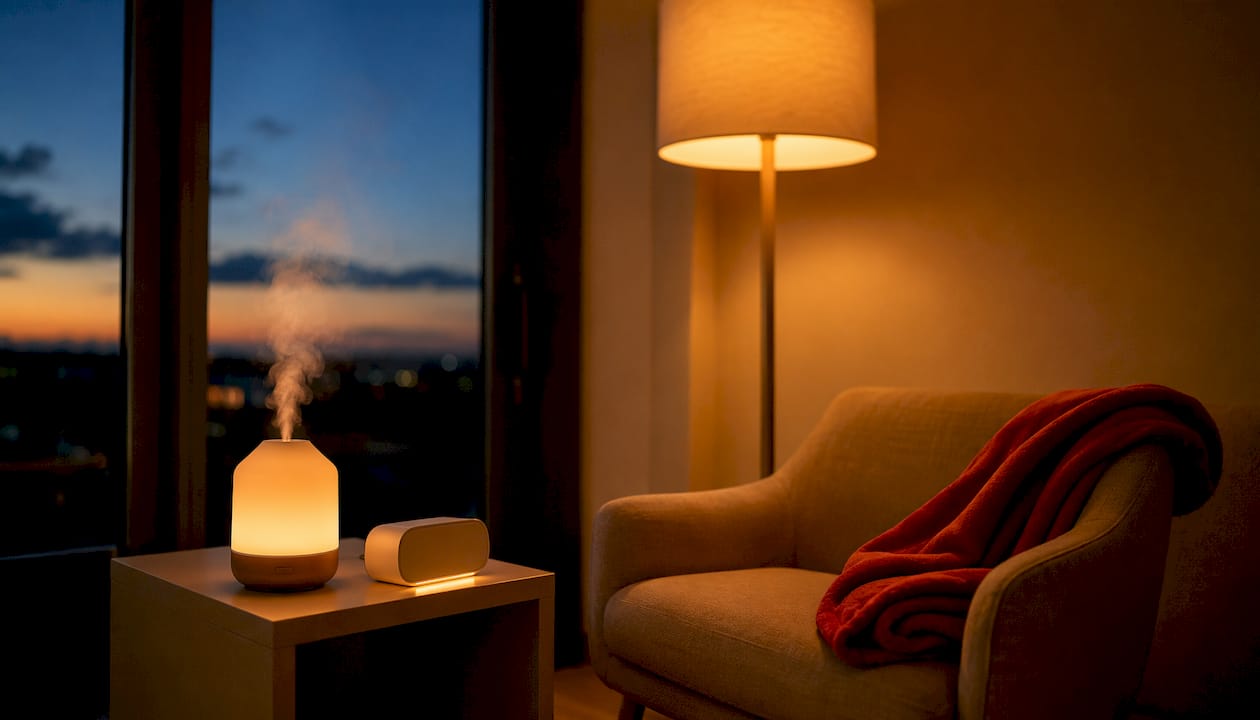
Circadian anchoring and melatonin. Your internal clock, the circadian rhythm, responds to repeated cues at consistent times. Dim light and stable evening habits help your brain time melatonin release more reliably, making it easier to fall asleep and wake up refreshed.
Body-temperature cueing. A warm bath or shower dilates peripheral blood vessels. The subsequent core-temperature drop signals your hypothalamus to initiate sleep. Dr. Seema Khosla, a sleep medicine physician, describes this as one of the most powerful physiological cues for faster sleep onset.
Brainwave shifts. Slow breathing at roughly 6 breaths per minute for 10 minutes increases alpha brainwave power and reduces beta power on EEG, supporting the pre-sleep relaxation state your brain needs before dropping into deeper stages.
Cognitive offloading. Writing tomorrow’s to-do list moves unfinished mental tasks out of working memory, cutting the intrusive thoughts that delay sleep onset.
Here is a quick summary of the mechanisms:
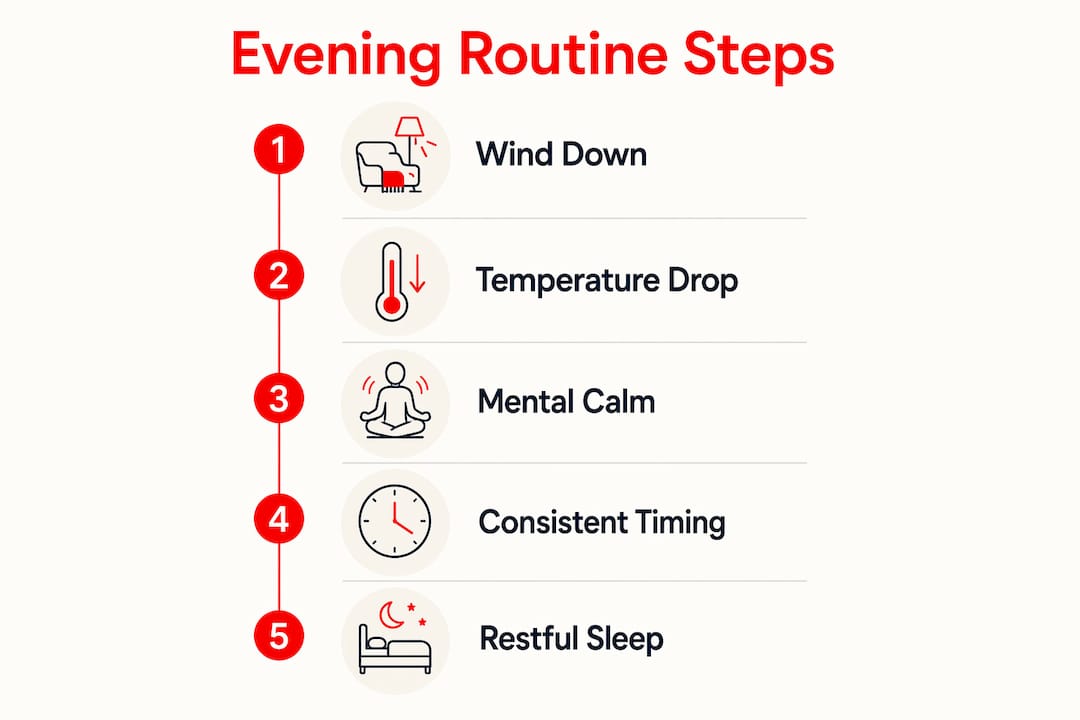
- Dim light → melatonin release → drowsiness
- Warm bath/shower → temperature drop → sleep initiation
- Slow breathing → alpha brainwave increase → relaxation
- To-do list → cognitive offload → fewer intrusive thoughts
The GW Cancer Prevention and Wellness Center recommends a 30–60 minute wind-down period for exactly this reason: physiological de-escalation takes time, and rushing it undermines the whole process.
What does an effective evening routine actually include?
The components that reliably cue a nervous-system downshift are simpler than most people expect. You do not need a spa-level ritual. You need a few consistent anchors.
- Dim lights 60–90 minutes before bed. Bright overhead lighting suppresses melatonin. Softer, warm-toned light mimics sunset and cues your circadian rhythm to wind down, per Mayo Clinic sleep guidance.
- Cool your bedroom to roughly 65–68°F. A cooler environment supports the body’s natural temperature drop during sleep and reduces nighttime arousals.
- Screen curfew in the final hour. Blue light from phones and tablets delays melatonin onset. Swap scrolling for reading, light stretching, or journaling.
- Cognitive offload. Spend 5 minutes writing tomorrow’s priorities. This one habit alone can meaningfully speed sleep onset by clearing mental loops.
- Calming movement or breathing. Even 5 minutes of gentle stretching or slow breathing lowers stress hormones and signals your nervous system to ease off.
For skin health specifically, your evening skincare steps can double as a calming ritual. Repeating the same sequence each night conditions your brain to associate those actions with bedtime.
Pro Tip: Pick one or two anchors you can do every single night, even when you get home late. Sequence consistency often matters more than clock-time consistency, so repeating the same two cues in the same order is more effective than a perfect 9 PM bedtime you can only hit three nights a week.
A 10-minute evening routine you can actually do tonight
A reliable 10-minute routine triggers the same physiological cues as longer rituals when it focuses on the right anchors. Here is a sequence that works for busy professionals.
- Minutes 1–5: Cognitive offload. Write tomorrow’s top three priorities on paper. Close your laptop. Put your phone across the room.
- Minutes 6–8: Warm shower or foot soak. If time allows, a warm shower now sets up the temperature drop that speeds sleep onset. A warm foot soak works when a full shower is not practical.
- Minutes 8–10: Slow breathing. Sit or lie down. Breathe in for 4 counts, out for 6. Aim for roughly 6 breaths per minute. Dim the lights before you start.
That is it. Three steps, two anchors you can repeat anywhere.
3-minute micro-routine for travel or late nights:
- Dim your phone screen to minimum brightness and put it face-down.
- Write one sentence: the single most important thing for tomorrow.
- Take 10 slow, deliberate breaths before closing your eyes.
Use the full 10-minute version on regular worknights. Switch to the micro-routine when you are traveling, dealing with childcare, or finishing work past 11 PM. The goal is to keep some version of the sequence alive every night, not to execute it perfectly. For a ready-made wind-down checklist, Fromwithin has one you can follow step by step.
How long until you actually notice a difference?
Expect measurable change in 2–6 weeks of consistent practice. Some metrics shift faster than others.
- Sleep onset latency (how long it takes to fall asleep): often the first metric to improve, sometimes within the first week of consistent warm baths and cognitive offloading.
- Total sleep time: tends to increase gradually as your circadian rhythm stabilizes.
- Sleep efficiency (percentage of time in bed actually asleep): improves as nighttime arousals decrease.
- Subjective sleep quality and daytime alertness: usually noticeable by weeks 2–4.
For tracking, a phone sleep app, a wearable like a Fitbit or Oura Ring, or a simple paper sleep diary all work. The metric that matters most for recovery and skin health is sleep efficiency, since fragmented sleep disrupts the overnight repair processes that support collagen production and skin renewal. You can read more about that connection in Fromwithin’s piece on sleep and skin appearance.
Harvard Medical School sleep research confirms that even partial adherence to good sleep habits produces meaningful improvements. You do not need a perfect routine every night to see results.
What if your schedule keeps getting in the way?
Obstacles are solvable with anchor-focused adjustments, not all-or-nothing thinking. Here are the most common barriers and quick fixes:
- Late work or evening calls: Use blue-light filter mode on your devices and dim ambient lighting as soon as the call ends. The screen curfew starts the moment you close the laptop, not at a fixed clock time.
- Travel and hotel rooms: Pack a portable eye mask and a pair of earplugs. Repeat your two core anchors (breathing + cognitive offload) regardless of time zone. Reduced stimulation matters more than a perfect environment.
- Shift work or irregular hours: Anchor your routine to your sleep opportunity, not the clock. If you sleep at 6 AM, dim lights and do your offload ritual 60 minutes before that, every time.
- Childcare or unpredictable evenings: The micro-routine exists for exactly this. Three minutes of the same sequence still sends a signal.
Pro Tip: When clock time shifts, keep the sequence identical. Your nervous system responds to repeated patterns, so the same three cues in the same order, even at 2 AM, still tell your brain that sleep is coming.
If rumination is your biggest obstacle, Fromwithin’s guide on stopping bedtime overthinking walks through simple relaxation steps that pair well with the routine above.
Can supplements support your evening routine?
Supplements work best as adjuncts to behavioral routines, not replacements for them. The routine drives sleep timing; the right supplement can support the relaxation biology that makes the routine more effective.
- Magnesium glycinate or threonate: Both forms support nervous-system downshift and are among the most studied for sleep-adjacent relaxation. Look for clinically researched doses and clear ingredient labeling.
- Collagen peptides: Overnight is when your skin does most of its repair work. A collagen supplement taken in the evening can support skin elasticity and renewal during those hours, especially relevant if you are tracking both sleep quality and skin outcomes.
- Non-sedating botanicals: Ingredients like ashwagandha and L-theanine have evidence for reducing stress markers without causing next-day grogginess. Avoid combining sedating supplements without guidance from a clinician.
Fromwithin formulates its sleep aid with ingredient transparency and non-habit-forming compounds in mind, and its collagen line uses patented Wellnex® peptides absorbed directly into the bloodstream for maximum efficacy. Neither product is a substitute for the behavioral routine, but both are designed to complement it.
Pro Tip: Take your sleep-support supplement 30–60 minutes before your routine begins, not right at lights-out. Timing it with your wind-down period lets the ingredients work alongside your physiological cues rather than after the fact.
Key Takeaways
A consistent evening routine anchors your circadian rhythm, lowers body temperature, and offloads mental clutter, making faster, deeper sleep the natural result.
| Point | Details |
|---|---|
| Start with two anchors | Pick one or two cues you can repeat every night; sequence consistency matters more than a fixed bedtime. |
| Temperature is a powerful cue | A warm shower 60–90 minutes before bed triggers a core-temperature drop that speeds sleep onset. |
| Offload before you lie down | A 5-minute to-do list reduces intrusive thoughts and can meaningfully shorten the time it takes to fall asleep. |
| Track sleep onset latency first | Expect measurable improvement in 2–6 weeks; sleep onset latency is usually the first metric to shift. |
| Fromwithin complements the routine | Fromwithin’s clinically researched sleep aid and collagen peptides are designed to support relaxation and overnight skin repair alongside your behavioral routine. |
The honest truth about evening routines
Here is what most sleep content gets wrong: it treats the routine as the goal. You end up with a 12-step checklist that feels like another full-time job, and when you skip step 7, you feel like you have failed. That is not how habits actually work.
The evidence points to something simpler. Two or three consistent anchors, repeated in the same order, do most of the work. The nervous system responds to patterns, not perfection. A 3-minute micro-routine on a chaotic Tuesday still sends a signal. A missed night does not erase the progress from the previous two weeks.
Fromwithin’s approach to sleep and skin health reflects this same thinking: clinically researched ingredients, transparent formulations, and no dependency on prescription-strength compounds. The goal is to support what your body already knows how to do, not override it. Start with the routine. Add a supplement if you want extra support. Track your sleep onset latency for a few weeks and let the data tell you what is working.
Fromwithin’s sleep and skin support products
Your evening routine does the heavy lifting. Fromwithin is there to support what happens at the cellular level while you sleep.

Fromwithin’s sleep aid uses non-habit-forming, clinically researched compounds designed to complement your wind-down, not sedate you into it. The collagen line features patented Wellnex® peptides that absorb directly into the bloodstream, supporting overnight skin repair and elasticity while you get the rest your body needs. Both are formulated with full ingredient transparency, so you know exactly what you are taking and why.
Ready to pair your routine with evidence-backed support? Browse Fromwithin’s full vitamins and supplements collection and pick one product to try alongside your 10-minute routine. Track your sleep onset latency for 2–4 weeks and see what shifts.
Sources and further reading
The claims in this article draw from authoritative clinical and research sources. Here is where to go if you want to dig deeper:
- GW Cancer Prevention and Wellness Center: Practical guidance on building a wind-down routine, including the dimmer-switch framing for physiological de-escalation.
- Sleep Foundation: Evidence on circadian anchoring, body-temperature cueing, and cognitive offloading via to-do lists.
- NPR: Clinician perspectives from Dr. Seema Khosla on temperature manipulation and sleep onset.
- Mayo Clinic: Environmental recommendations including bedroom temperature and light exposure.
- Harvard Medical School: Research on partial adherence to sleep habits and measurable outcomes.
- Neurosity: EEG findings on slow breathing and brainwave shifts; data on melatonin suppression from screen use.
Fromwithin further reading:
- Sleep hygiene routine for professionals: Practical sleep-hygiene steps tailored to busy schedules.
- Why relaxation aids sleep quality: Research-backed explanations of relaxation practices and their effect on sleep.
- Why sleep matters more than you think for skin health: The downstream cosmetic and recovery benefits of restorative sleep.
This article is general information, not medical advice. Confirm current recommendations with a qualified healthcare professional for your specific situation.
