

on September 13, 2026

Yes, but modestly. Clinical trials show chamomile tea and extracts can improve sleep quality and reduce nighttime awakenings, not dramatically extend total sleep time. For the best shot at benefit, drink your cup about 45 to 60 minutes before bed. If you have allergies to ragweed or daisy-family plants, or you take blood thinners or sedatives, check with your doctor first.
TL;DR:
- Chamomile can modestly improve sleep quality and reduce nighttime awakenings, but it does not significantly increase total sleep time or efficiency.
- Drinking chamomile tea 45 to 60 minutes before bed offers the best chance of experiencing benefits, especially when consumed from a single-ingredient source.
- Standardized chamomile extracts provide more consistent dosing and effects than tea, but both should be used with caution if you take blood thinners or have allergies.
- Chamomile works by mildly interacting with GABA receptors, producing a calming effect rather than a knockout, which explains its limited impact on sleep duration.
- For more reliable sleep support, consider using a product with measurable amounts of active ingredients rather than relying on variable-strength tea alone.
Table of Contents
- Does Chamomile Tea Help Sleep? What the Clinical Evidence Says
- How Does Chamomile Work to Promote Relaxation?
- How to Use Chamomile Tea for Better Sleep
- Is Chamomile Tea Safe? Side Effects and Interactions to Know
- Lemon Balm, L-Theanine, or Melatonin: Which One Fits Your Sleep Problem?
- Our Take: Treat Chamomile as a Low-Risk First Step, Not a Fix
- A More Predictable Option for Consistent Sleep Support
- Sources
- FAQ
Does Chamomile Tea Help Sleep? What the Clinical Evidence Says
Here’s the honest answer: chamomile helps, but it’s not going to knock you out cold. A 2024 systematic review and meta-analysis pooled ten clinical trials involving 772 people and found chamomile significantly lowered scores on the Pittsburgh Sleep Quality Index, or PSQI, the standard tool researchers use to measure how well someone actually sleeps.
What does that number mean for you? A drop in PSQI score signals better subjective sleep quality. It’s not a massive shift, but it’s a real, measurable one, and it’s consistent enough across those ten trials to take seriously.
Here’s where the evidence gets specific about what actually improved:
- Sleep quality ratings went up across most trials, meaning people simply felt they slept better.
- Number of nighttime awakenings dropped, which lines up with why people say chamomile “helps them stay asleep.”
- Sleep onset latency (how fast you fall asleep) improved in some trials but not consistently across all of them.
- Total sleep time and sleep efficiency showed no meaningful improvement in most studies, including a placebo-controlled pilot trial of a standardized chamomile extract.
That pilot study is worth pausing on. Researchers gave adults with chronic primary insomnia either a standardized chamomile extract twice daily or a placebo for a period of weeks. The chamomile group saw modest gains in falling asleep faster and waking up less, but no real difference in how long they slept overall or how efficiently they slept. That’s the pattern showing up again and again: chamomile nudges the quality of sleep, not the quantity.
Why the mixed signals? A few reasons. Most trials work with small sample sizes, and participants range from healthy adults to people with diagnosed insomnia, which makes it hard to compare results directly. Adverse events are usually tracked passively, meaning researchers rely on participants to report problems rather than actively screening for them. And many studies never test the actual potency of the chamomile product used, so a “chamomile tea” in one trial might contain a fraction of the active compounds found in another.
The takeaway for you: think of chamomile as a supporting player, not a solo act. It’s a reasonable adjunct for mild sleep complaints and evening relaxation, but it’s not a substitute for medical treatment if you’re dealing with chronic, severe insomnia.
How Does Chamomile Work to Promote Relaxation?
Chamomile’s calming reputation isn’t just folklore. The flower contains apigenin, a flavonoid that binds to GABA receptors in the brain, the same receptors targeted by many prescription sedatives, though far more gently. GABA is your brain’s primary “calm down” signal, and when apigenin interacts with those receptor sites, it likely produces a mild sedative and antianxiety effect.
Chamomile also contains other flavonoids and terpenoids that may contribute to its relaxing profile, though apigenin gets most of the research attention. This mechanism lines up neatly with what trials actually observe: fewer awakenings and a sense of calmer, higher-quality sleep, rather than a knockout effect on total sleep duration.
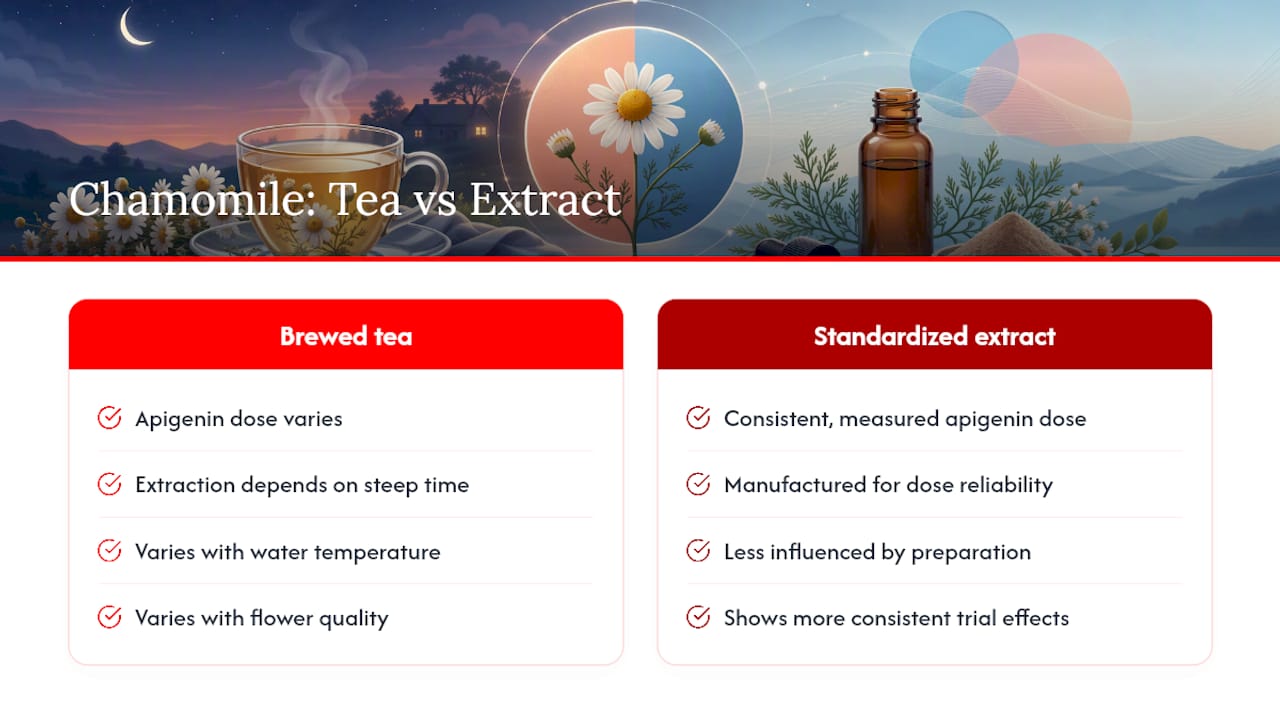
One detail matters here, and it’s one most articles skip: a brewed cup of chamomile tea and a standardized extract are not delivering the same dose. Steeping dried flowers in hot water extracts some apigenin, but the concentration varies with steep time, water temperature, and the quality of the flowers themselves. A standardized extract, by contrast, is manufactured to contain a consistent, measured amount of active compound. That’s likely part of why pilot trials using extracts show more consistent (if still modest) results than the general body of tea-based research. If you’re chasing a specific effect, that inconsistency is worth knowing before you brew.
How to Use Chamomile Tea for Better Sleep
Getting the timing and form right matters more than most people realize. Here’s how to set yourself up for the best shot at chamomile’s modest sleep benefits:
- Time it for 45 to 60 minutes before bed. This window matches what researchers used in trials showing improved sleep quality, giving apigenin time to take effect before you’re trying to fall asleep.
- Choose a single-ingredient chamomile tea. Skip blends that mix in caffeinated black or green tea for flavor. Loose-leaf chamomile tends to have a fresher, more concentrated flavor than teabags, though both work fine for a nightly ritual.
- Stick to one cup nightly. That’s the dose most trials used, and it’s a sensible starting point before considering anything stronger.
- Consider a standardized extract if you want more consistency. If tea’s variable potency bothers you, an extract with a labeled apigenin content gives you a more predictable dose, though it deserves the same caution around interactions as any concentrated supplement.
- Pair it with a short wind-down routine. Chamomile works better as part of a broader signal to your body that it’s time to slow down. A consistent evening wind-down routine stacked on top of your tea ritual tends to compound the benefit.
Pro Tip: If you find yourself waking up to use the bathroom, that’s not a chamomile problem. It’s a fluids-before-bed problem. Move your cup earlier in the evening, closer to two hours before bed, so your body has time to process the liquid before you’re trying to sleep through the night.
Always check the label on blended or flavored chamomile products. Some contain other herbs or added caffeine sources that can undercut the exact effect you’re trying to create.
Is Chamomile Tea Safe? Side Effects and Interactions to Know
Chamomile is generally considered safe in the amounts typically found in tea, and most healthy adults can drink a nightly cup without issue. That said, a few groups need to pay closer attention:
- Allergy risk: Chamomile belongs to the Asteraceae, or daisy, family. If you’re allergic to ragweed, marigolds, or chrysanthemums, you have a real chance of reacting to chamomile too.
- Medication interactions: Chamomile may interact with blood thinners like warfarin, sedatives, and certain medications metabolized through liver enzyme pathways (CYP substrates). If you’re on any prescription medication, run it by your doctor before adding a daily cup.
- Pregnancy and breastfeeding: Data here is limited, so caution and a conversation with your doctor are the safer path.
- Concentrated extracts need more oversight. A cup of tea is a very different dose than a standardized supplement, and NCCIH specifically flags that concentrated forms warrant clinician input, especially alongside other medications.
If your insomnia has stuck around for weeks, or you’re managing multiple health conditions and medications, that’s your cue to talk to a doctor rather than lean harder on tea.
Lemon Balm, L-Theanine, or Melatonin: Which One Fits Your Sleep Problem?
Chamomile isn’t the only herb on the shelf, and matching the remedy to your actual problem matters more than picking whatever’s trending. Lemon balm shows a growing research signal for easing tension and supporting sleep quality and mood, making it a reasonable option if evening anxiety is what’s keeping you wired. L-theanine, an amino acid found in tea leaves, works differently. It’s often used for calming a racing mind without sedation, which makes it worth a look if racing thoughts rather than physical restlessness are your barrier to sleep.
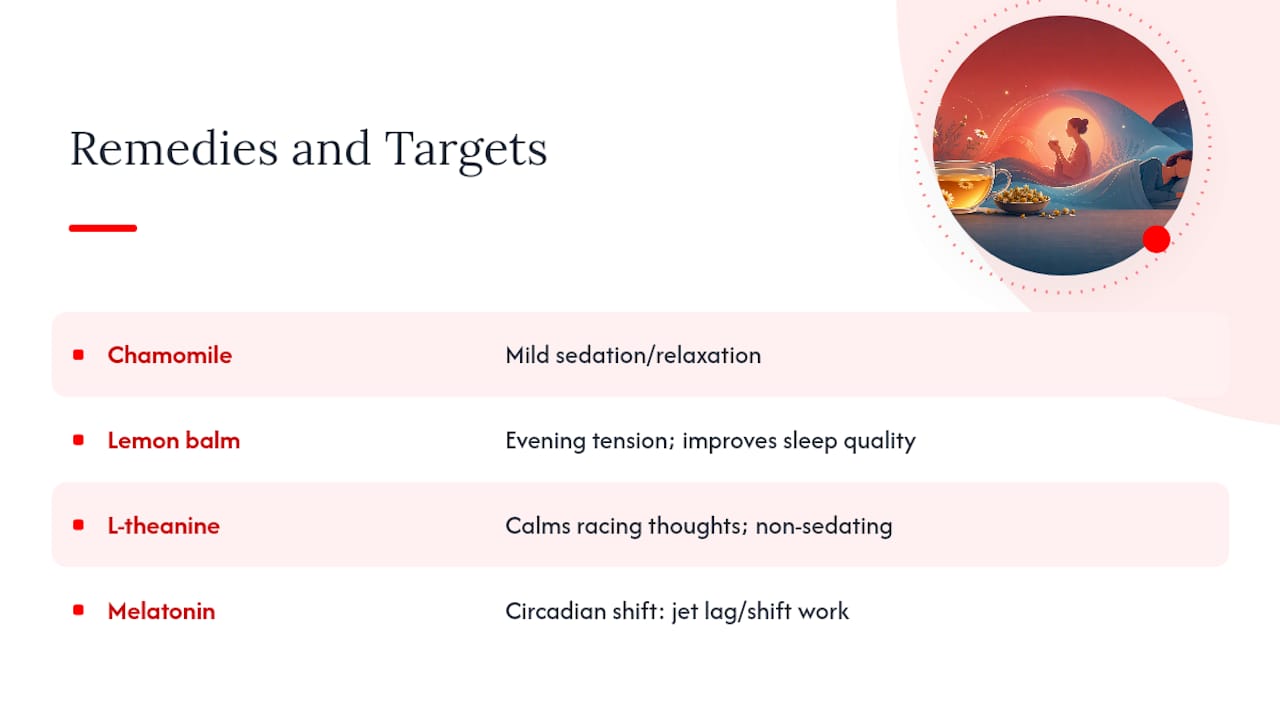
Melatonin belongs in a different category entirely. It regulates your circadian rhythm, so it’s genuinely useful for jet lag or shift work, but it’s not solving the same problem as chamomile’s mild sedative effect. If your sleep trouble is chronic rather than situational, none of these herbs substitute for a conversation with a clinician.
Our Take: Treat Chamomile as a Low-Risk First Step, Not a Fix
Chamomile tea earns its spot in a sleep routine. It’s low-risk, backed by real (if modest) clinical data, and worth trying before you reach for anything stronger. What it isn’t is a cure for chronic insomnia.
Track your sleep for a couple of weeks, whether with a simple notebook or a PSQI-style questionnaire, before deciding whether it’s working for you. And if you’re shopping for a chamomile extract instead of tea, favor brands that disclose actual apigenin content. Potency varies wildly, and a vague label tells you nothing about what you’re actually drinking.
— From
A More Predictable Option for Consistent Sleep Support
If chamomile’s variable potency is exactly what’s holding you back from relying on it, you’re not wrong to want something more predictable. A cup of tea gives you an estimate of active compound, not a measured dose, which is fine for casual relaxation but frustrating if you want to know what you’re actually taking each night.

A sleep aid on the market takes a different approach: a non-melatonin, non-hormonal formula with transparent, clinically researched ingredients delivered through peptides absorbed directly into your bloodstream. It’s built for the same goal chamomile serves, easing you into rest without dependence on prescription sedatives, but with the kind of ingredient consistency a loose-leaf tea simply can’t promise. Chamomile tea still earns its place as a low-risk evening ritual. If you want standardized dosing alongside it, or in place of it, check out the Sleep Better liquid calm and deep sleep support formula to see whether it fits your routine. As always, talk to your doctor first if you’re managing multiple medications.
Sources
- Effects of chamomile (Matricaria chamomilla L.) on sleep: A systematic review and meta-analysis of clinical trials
- Chamomile: Usefulness and Safety | NCCIH
- Preliminary examination of the efficacy and safety of a standardized chamomile extract for chronic primary insomnia: A randomized placebo-controlled pilot study
FAQ
Does drinking chamomile tea really help you sleep?
Yes, modestly. Clinical trials show chamomile improves sleep quality and reduces nighttime awakenings, though it doesn’t significantly extend total sleep time.
How fast does chamomile tea make you sleepy?
Chamomile doesn’t work like a sedative with an immediate knockout effect. Trials that showed benefit had participants drink it about 45 to 60 minutes before bed, giving the calming compounds time to take effect.
What are the side effects of chamomile tea?
For most adults, chamomile tea is safe in typical amounts, but people allergic to ragweed or other daisy-family plants can react, and it may interact with blood thinners or sedatives.
Which tea is best for sleeping?
Chamomile has the strongest clinical backing among common sleep teas, particularly for improving sleep quality and reducing awakenings, though lemon balm is a reasonable alternative if evening anxiety is your main issue.
