

on September 17, 2026

Collagen may reduce nighttime awakenings for some people, and the likely reason is glycine, an amino acid that makes up about a third of collagen’s structure. In a small clinical trial, participants who drank 15 grams of collagen peptides an hour before bed woke up less often overnight than when they took a placebo. That’s genuinely encouraging, but the study involved just 13 young, athletic men, so treat it as a promising early signal rather than a settled fact.
TL;DR:
- Collagen supplements typically provide around 3 to 3.5 grams of glycine per dose, which aligns with amounts proven to support sleep in early trials.
- The small study showing reduced overnight awakenings used 15 grams of collagen peptides taken one hour before bed, but results remain preliminary and limited to young, active men.
- Glycine’s role in calming nerve signals and lowering core body temperature explains its potential to improve sleep quality, especially in terms of fewer disruptions.
- Consistent nightly intake over at least a week is necessary to see any sleep benefits, as sporadic use is unlikely to replicate research conditions.
- People with sleep problems more severe or persistent should consult a healthcare professional before relying on collagen as a sleep aid, since current evidence only covers mild, occasional disruptions.
Table of Contents
- How Glycine in Collagen Works: The Sleep Mechanisms
- What the Human Studies Actually Show
- Dosage, Timing, and How to Read the Label
- Who Is Likely to Benefit, and When to Talk to a Doctor
- A Practical Checklist for Choosing an Evening Collagen Product
- How Fromwithin’s Products Line Up With the Evidence
- Building a Sleep Routine Around Collagen: An Editorial Take
- Try an Evidence-Aligned Evening Routine From Fromwithin
- Sources
- FAQ
How Glycine in Collagen Works: The Sleep Mechanisms
Glycine isn’t just a building block for skin and joints. It’s also one of the more interesting amino acids in sleep science, and understanding why helps explain why a beauty-focused supplement might quietly moonlight as a sleep aid.
Your body uses glycine as an inhibitory neurotransmitter, meaning it calms nerve signaling rather than exciting it. Researchers believe it acts on NMDA receptors in the suprachiasmatic nucleus, or SCN, the part of your brain that runs your circadian clock. Glycine also appears to lower your core body temperature slightly, and a drop in core temperature is one of the physiological cues that helps usher you into sleep. Both of these mechanisms are tied to improved sleep onset and continuity, which is a fancier way of saying fewer middle-of-the-night wake-ups and an easier time drifting off in the first place.
Collagen supplies glycine naturally because it’s woven into collagen’s amino acid backbone. So do everyday foods, for what it’s worth:
- Red meat
- Peanuts
- Dairy products
- Seafood
The catch is that eating a steak for dinner doesn’t deliver a concentrated, standardized glycine dose the way a measured collagen peptide supplement can. That’s the practical distinction that makes supplementation worth discussing separately from diet.
In the human trial that anchors most of this conversation, the collagen peptides delivered a glycine dose roughly equivalent to amounts used in standalone glycine trials that showed sleep benefits.
There’s also early animal research suggesting collagen-derived peptides can reach the cerebrospinal fluid and may influence brain-derived neurotrophic factor, or BDNF, a protein involved in neural plasticity and, potentially, sleep regulation. This is worth mentioning honestly: it’s animal data, not human proof, and the pathway from “peptides showed up in rodent CSF” to “your sleep improved” has real gaps that scientists haven’t closed yet. Glycine is the better-supported piece of this puzzle. The peptide-to-brain story is the intriguing, unproven subplot.
What the Human Studies Actually Show
The trial getting the most attention in this space is a randomized crossover study that gave 13 physically active men either 15 grams of glycine-rich collagen peptides or a placebo, each for seven nights, an hour before bed. Researchers then measured sleep with polysomnography, the gold-standard overnight sleep recording method, plus subjective sleep diaries and a next-morning cognitive test.
The results were specific, not sweeping. Awakenings dropped in a measurable way, but total sleep time, how long it took to fall asleep, and overall sleep efficiency stayed essentially unchanged.
That last row matters more than it might look. Participants performed better on a Stroop test, a standard measure of attention and cognitive control, the morning after taking collagen peptides. Fewer fragmented awakenings overnight plausibly translated into sharper thinking the next day, though the study wasn’t designed to prove that link directly.
Glycine-only research tells a complementary story. Several trials using roughly 3 grams of glycine before bed report reduced daytime sleepiness and a shorter time to fall asleep, and a broader scoping review of glycine and collagen supplementation found that pharmacokinetic studies consistently raise circulating glycine levels, with all three dedicated glycine sleep trials reporting improvement on at least one sleep outcome.
Now the honest caveats, because glossing over them would do you a disservice:
- The core collagen trial had only 13 participants, all young, athletic males averaging around 24 years old.
- The study ran for just seven nights, which tells you nothing about six-month or year-long use.
- Researchers themselves called for replication in broader, more diverse populations before drawing firm conclusions.
- No trial has yet directly tested whether glycine is the actual mechanism driving the benefit, as opposed to some other component of collagen.
None of this means the finding is meaningless. It means it’s a real, statistically significant result in a narrow slice of the population, and the scientific next step is bigger, more diverse trials.
Dosage, Timing, and How to Read the Label
If you want to roughly mirror what researchers actually tested, the numbers to know are 15 grams of collagen peptides, taken about an hour before bed, delivering somewhere near 3 to 3.5 grams of glycine. Standalone glycine studies tend to use a similar 3 gram dose on the same nightly schedule.
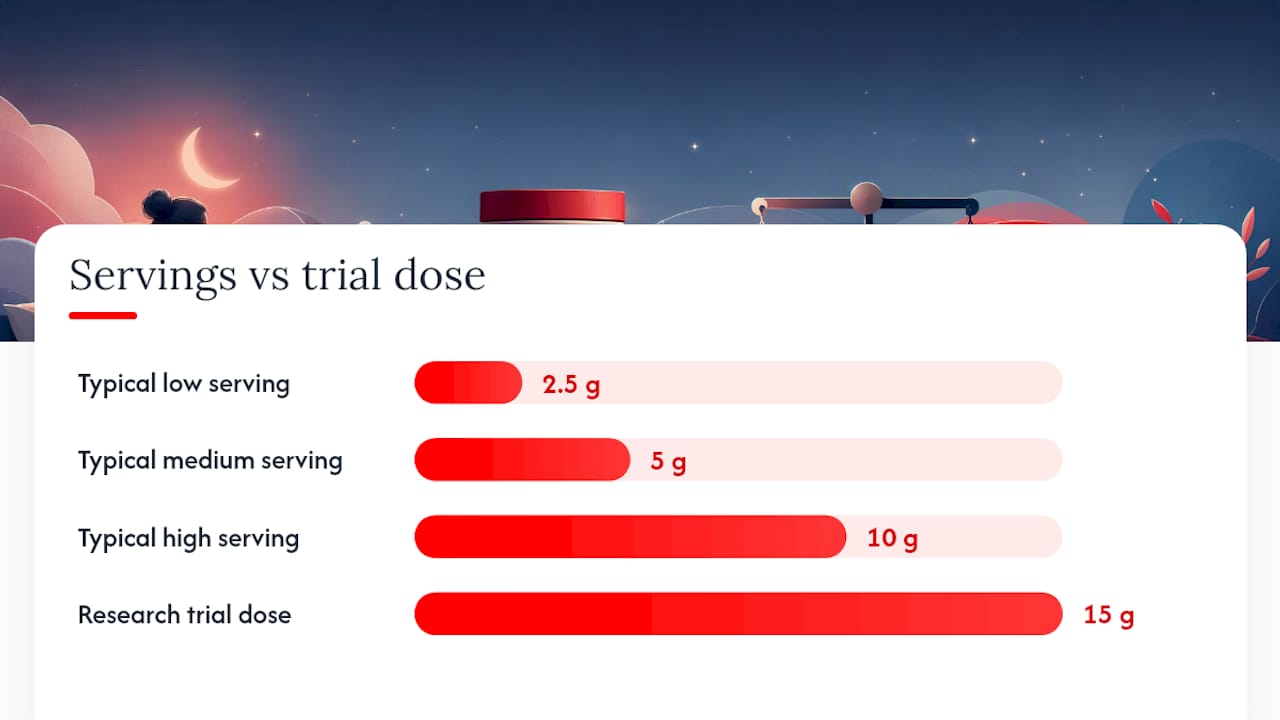
Here’s where label-reading gets practical: many commercial collagen servings sit well below that research dose, often in the 2.5 to 10 gram range per scoop or serving. If your product delivers 5 grams of collagen peptides and you’re hoping to match the trial’s glycine exposure, you’d likely need two servings, and even then the exact glycine content depends on the specific formulation.
A quick way to think through your own product:
- Check the serving size on the label first.
- Look for “collagen peptides” or “hydrolyzed collagen” rather than vague “collagen” labeling, since peptide form affects absorption.
- If the label lists a full amino acid breakdown, glycine typically makes up a meaningful share of total collagen content.
- If it doesn’t, you can estimate roughly by multiplying serving size by collagen’s typical glycine proportion, though this is an approximation, not a lab result.
Pro Tip: Take your dose consistently at the same time each night, roughly 30 to 60 minutes before you turn off the lights, rather than treating it as an occasional fix. The trial that showed measurable changes did so after seven consecutive nights, not a single dose, so give any product at least a week before deciding whether it’s doing anything for you.
Timing beats occasional use here. A collagen serving skipped three nights a week and doubled up on the fourth doesn’t replicate the conditions that produced the trial’s results.
Who Is Likely to Benefit, and When to Talk to a Doctor
The people most likely to see something close to the trial’s results look a lot like the trial’s participants: young, physically active men already dealing with some sleep complaints. If that’s you, the evidence, while still early, is at least drawn from people who resemble your situation.
If you’re older, less active, female, or sleeping reasonably well already, the evidence doesn’t disappear, but it does get thinner. Glycine is considered conditionally essential, meaning your body’s demand for it rises under physical stress or heavy training load. That’s a plausible reason athletes and highly active people might notice more benefit than someone with a sedentary routine and low baseline stress.
A few safety notes worth taking seriously:
- Collagen supplements are generally well tolerated, but check for known allergies to the source protein, whether marine, bovine, or otherwise.
- If you have kidney concerns, discuss any amino acid supplement with your doctor before starting, since protein metabolism runs through the kidneys.
- Collagen is not a sedative and won’t knock you out the way a sleep medication might. It’s a subtle, ancillary support at best, not a substitute for treating diagnosed insomnia or sleep apnea.
- If you’re on prescription sleep medication or have a diagnosed sleep disorder, loop in your healthcare provider before layering in a new supplement.
If your sleep problems are severe, persistent, or affecting your daily function, a supplement study built around minor awakenings in healthy young men isn’t the right benchmark for your situation. That’s a conversation for a clinician, not a label.
A Practical Checklist for Choosing an Evening Collagen Product
Shopping for a collagen product with sleep in mind is different from shopping for one focused purely on skin. Here’s what to actually look for:
- Serving size and glycine estimate. Aim for something closer to the 15 gram research dose if replicating the trial matters to you, or plan on doubling smaller servings.
- Hydrolyzed or peptide labeling. “Collagen peptides” or “hydrolyzed collagen” on the label indicates the protein has been broken down for easier absorption, which is the form used in the clinical research.
- No caffeine. This sounds obvious, but some multi-ingredient wellness blends sneak in stimulants that work directly against an evening routine.
- Low added sugar. A sugar spike before bed isn’t ideal for anyone trying to wind down, regardless of what else is in the formula.
- Complementary calming ingredients, if you want them. Some products pair collagen with ingredients like L-theanine or magnesium, though this is a personal preference rather than a research requirement.
- Transparent sourcing and testing. Look for brands that name their collagen source and disclose third-party testing rather than hiding behind vague “proprietary blend” language.
If the label doesn’t break down amino acids individually, you can still get a ballpark glycine estimate by multiplying the total collagen peptide amount by its typical glycine share, though this is an estimate, not a certified figure. A quick primer on what to look for in collagen powder covers the broader label-reading basics if you want more detail on peptide sourcing.
Pro Tip: Store your collagen powder or liquid in a cool, dry place away from direct sunlight, and reseal it tightly after each use. Humidity and heat can degrade peptide quality over time, which matters if you’re taking it consistently for weeks or months.
How Fromwithin’s Products Line Up With the Evidence
Fromwithin’s Collagen line is built around patented Wellnex® peptides, which the brand designed to absorb directly into the bloodstream rather than relying on standard digestion alone. That absorption focus matters given how much of the research conversation centers on whether glycine actually reaches the bloodstream in a usable form.
Two products line up naturally with the checklist above. The Collagen Peptides Glow Booster uses hydrolyzed collagen peptides, the same form studied in the sleep trial, and Fromwithin names its ingredients clearly rather than hiding behind blend labeling. The Sleep Better – Liquid Calm & Deep Sleep Support takes a different but complementary route: it’s formulated without melatonin or hormonal ingredients, aimed at supporting natural relaxation for people who want an evening routine that doesn’t depend on prescription sleep aids.
Neither product claims to replicate the exact 15 gram trial dose, and independent sleep-specific clinical data for such formulations is generally not published. Some brands offer ingredient transparency and a manufacturing process built in certified facilities, which addresses two items on the checklist directly: knowing what’s in the product, and trusting how it was made. If you’re evaluating any collagen product against the research in this article, ingredient transparency and peptide form are the two things worth checking first.
Building a Sleep Routine Around Collagen: An Editorial Take
Collagen won’t fix a broken sleep routine. Think of it as a small assist layered on top of the basics that actually move the needle: a consistent bedtime, a cool bedroom, screens off well before lights out, and some kind of wind-down ritual that signals to your brain that the day is over.
If you want to test collagen honestly, take it at the same time each night, roughly an hour before bed, and give it at least a week before judging results. Track something concrete, like how many times you wake up or how sharp you feel the next morning, rather than relying on a vague sense of “sleeping better.” Expect a modest, variable effect, not a dramatic one. And if sleep problems are severe or persistent, a supplement study on healthy young men isn’t a substitute for talking to a doctor.
— From
Try an Evidence-Aligned Evening Routine From Fromwithin
Most sleep supplements on the market lean on melatonin or sedating herbs, which can leave you groggy or build tolerance over time. Fromwithin’s approach is different: the Sleep Better – Liquid Calm & Deep Sleep Support liquid skips melatonin and hormones entirely, aiming to support your body’s own wind-down process instead of overriding it, and the Collagen Peptides Glow Booster uses the same hydrolyzed peptide form studied for its glycine content.

Both products list their ingredients clearly on the product collection page, so you can check serving sizes and formulation details for yourself before deciding whether they fit your evening routine. If you’re specifically curious about the peptide technology behind the collagen line, the collagen page walks through how Wellnex® peptides are designed to absorb into your bloodstream. And if you’re dealing with a diagnosed sleep disorder rather than occasional restlessness, talk to a healthcare provider before adding any new supplement to your routine. Ready to see how these fit your nights? Browse the full lineup and check ingredient lists directly on the Fromwithin product collection.
Sources
- Mechanistic literature on glycine’s effects on sleep (NMDA/SCN and thermoregulation)
- Glycine bioavailability and sleep-related outcomes following oral glycine and collagen supplementation — scoping review
FAQ
Can Taking Collagen Help You Sleep?
It may help reduce nighttime awakenings for some people, largely due to its glycine content, based on a small randomized crossover trial. It’s not a proven cure for insomnia, and the strongest evidence so far comes from a narrow study population.
What Are the First Signs That Collagen Is Working for Sleep?
In the clinical trial, changes showed up within seven nights as fewer overnight awakenings and sharper next-morning cognitive performance on a Stroop test. Total sleep time and how fast people fell asleep didn’t change, so don’t expect those to shift.
Is It Good to Take Collagen Before Bed?
Trial participants took 15 grams of collagen peptides about one hour before bed, and that timing lines up with when glycine’s calming and temperature-lowering effects would plausibly kick in. Taking it consistently at that same time each night mirrors the conditions that produced measurable results.
Does Collagen Make You Sleepy?
Collagen isn’t a sedative, and it won’t make you drowsy the way a sleep medication would. Its potential benefit is more about reducing fragmented waking through glycine’s effect on inhibitory brain signaling, not knocking you out.
