

on September 06, 2026

Yes, oral collagen can measurably soften wrinkles and improve skin elasticity, but the effect is real and modest, not dramatic. Randomized trials using 1,000 to 2,500 mg per day of hydrolyzed collagen peptides show visible changes in hydration and wrinkle depth within 6 to 12 weeks. The Mayo Clinic still puts sun protection first, and that ordering matters.
TL;DR:
- Collagen supplements with a verified peptide content and doses around 1,650 to 2,500 mg daily can produce modest improvements in wrinkle depth and skin hydration within 6 to 12 weeks.
- The effects vary significantly depending on formulation, peptide profile, and dosage, with stronger evidence supporting hydrolyzed peptides containing Pro-Hyp or Gly-Pro dipeptides.
- Long-term data beyond 12 weeks are limited, and results tend to persist after stopping due to actual dermal improvements rather than temporary hydration.
- Products with unverified ingredients or concentrations below trial-supported levels are unlikely to deliver meaningful outcomes.
- Collagen is safe for most but should be used cautiously by individuals with allergies, autoimmune conditions, or those on medication, and always in consultation with a healthcare professional.
Table of Contents
- What Does the Clinical Evidence Say About Collagen for Wrinkles?
- How Collagen Peptides Work on Your Skin
- How Long Before You See Results From Collagen?
- Is Collagen Safe? Side Effects and Interactions to Know
- Collagen vs. Retinoids vs. Fillers: What Actually Fits Your Goals?
- How to Choose a Collagen Supplement That Matches the Evidence
- Where From Within Fits Into This Evidence
- A Publisher’s Honest Take on Collagen for Skin
- Try Collagen the Way the Evidence Actually Supports
- Sources
What Does the Clinical Evidence Say About Collagen for Wrinkles?
Here’s the honest version, not the marketing version: several well-designed trials show collagen peptides genuinely change how skin looks and feels, but the magnitude varies a lot depending on the dose, the peptide type, and how long people stuck with it.
One trial gave women over 30 a daily 2.5 gram dose of hydrolyzed collagen and tracked wrinkle volume and skin moisture over six weeks. Numbers like that explain why collagen crossed over from bodybuilding shelves into skincare routines. But one study is one study, not proof for every product on the market.
A more recent double-blind trial tested a low-molecular-weight collagen peptide at 1,650 mg per day, enriched with the active dipeptide glycine-proline. After 8 weeks, the 70 participants showed measurable gains across wrinkle depth, elasticity, hydration, and dermal density, with the benefits still holding two weeks after they stopped taking it. No adverse events were reported, which matters when you’re evaluating something you’ll swallow daily for months.
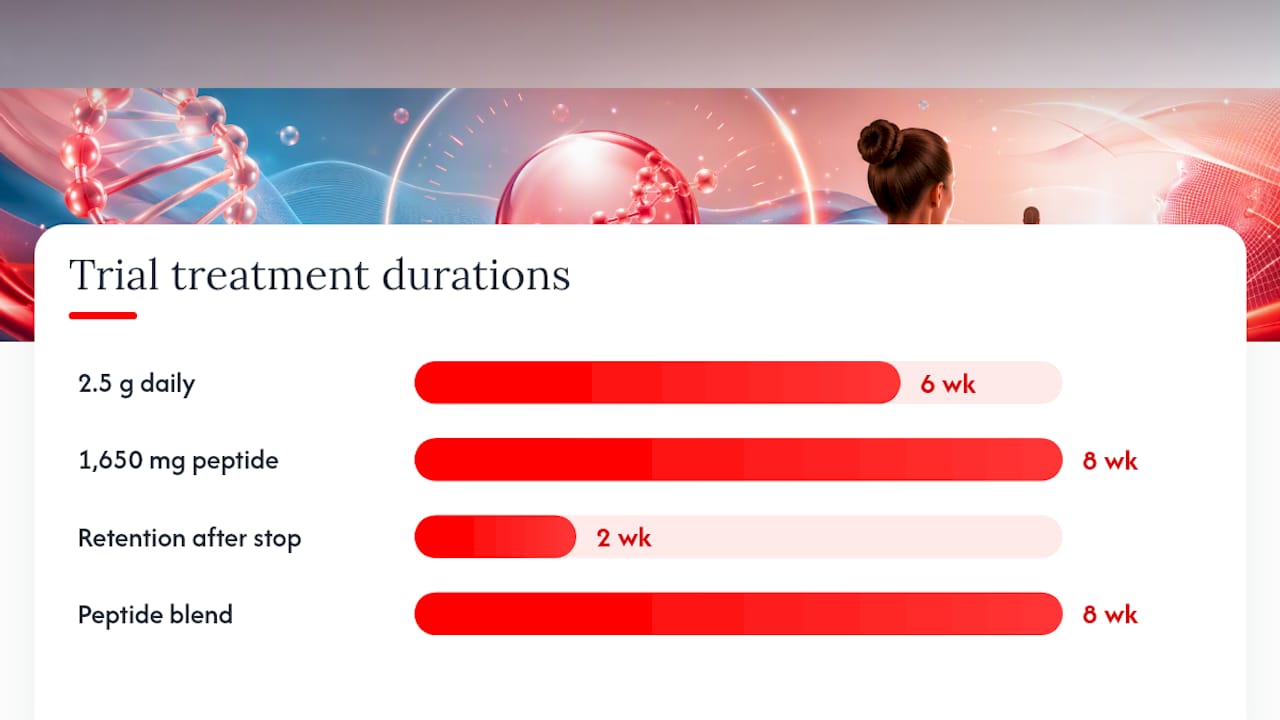
A separate study looked at a specific bioactive peptide blend and found a noticeable reduction in eye wrinkle volume against placebo after 8 weeks, alongside increases in procollagen type I and elastin. That’s a mechanistic clue as much as a cosmetic result: your skin wasn’t just hydrated, it was actively rebuilding structural protein.
Zoom out to the systematic reviews and meta-analyses that pool these individual trials, and the picture gets more careful. Reviewers consistently find statistically significant improvements in hydration and elasticity, but they flag real heterogeneity: different peptide sources, different doses, different measurement tools, and short follow-up windows. Some products bundle in vitamin C, hyaluronic acid, or antioxidants, which muddies whether the collagen itself, or the whole formula, deserves the credit.
What the evidence actually supports:
- Measurable improvements in wrinkle depth and skin hydration with daily dosing over 6 to 12 weeks
- Effect sizes that vary widely by study, ranging from modest to substantial depending on formulation
- Better data for peptide-specific products than for generic “collagen protein” claims
- Limited long-term data beyond 12 weeks in most published trials
- Some industry funding in trials, which calls for reading methodology sections, not just abstracts
The trial that stands out: A daily 2.5 g dose of hydrolyzed collagen produced a 46% reduction in wrinkle volume and a 34% increase in hydration after just 6 weeks in women over 30, one of the clearer effect sizes reported in the collagen literature.
The bottom line on certainty: this isn’t a fringe theory anymore. It’s a category with genuine randomized controlled trial support. But it’s also not a guarantee that any bottle labeled “collagen” on a shelf will replicate those specific results.
How Collagen Peptides Work on Your Skin
Think of your skin’s collagen network like the internal scaffolding that keeps a mattress from sagging. Over time, especially after your mid-20s, that scaffolding degrades faster than your body rebuilds it. Sun exposure, aging, and inflammation all ramp up enzymes called matrix metalloproteinases, or MMPs, which chew through existing collagen.
Here’s where oral collagen peptides get interesting. When you swallow hydrolyzed collagen, your digestive system breaks it into smaller fragments, including specific dipeptides and tripeptides like Pro-Hyp and Gly-Pro-Hyp. These small peptides survive digestion well enough to show up in your bloodstream, and lab research suggests they can stimulate fibroblasts, the cells in your dermis responsible for producing new collagen and hyaluronic acid. Some research also points to reduced MMP activity, meaning less breakdown alongside more production.
This is why peptide profile matters so much more than the word “collagen” on a label. Harvard Health specifically advises checking for concentrations of these bioactive dipeptides rather than just trusting total collagen grams, since insider research consistently points to Pro-Hyp and Gly-Pro-Hyp as the peptides with the strongest fibroblast-stimulating activity detected in plasma after ingestion.
Source matters too. Fish-derived (marine) collagen peptides tend to run at a lower molecular weight, which some researchers believe helps absorption, while bovine collagen is the more traditional source and shows up in plenty of the trials with strong results. Neither source has a definitive win in head-to-head human trials, so the peptide profile matters more than whether the label says fish or cow.
What to watch for on a label:
- Low-molecular-weight (LMW) hydrolyzed peptides, not whole collagen protein
- Specific mention of Pro-Hyp or Gly-Pro dipeptide content
- A disclosed source (marine or bovine) with traceability
- A dose that matches trial-tested ranges, not a vague “collagen blend”
Pro Tip: Flip the label over before you buy. If it just says “collagen” with no peptide breakdown or dose, you’re guessing. Products that name their active dipeptides are the ones with something to prove, and usually something to show for it.
Many products on store shelves contain collagen in name only, with concentrations far below what any published trial actually tested. That gap between labeled and clinically meaningful is where most of the disappointment with collagen supplements comes from.
How Long Before You See Results From Collagen?
Patience matters here, but so does consistency. Trials that show results all shared one thing: participants took collagen daily, without skipping, for weeks at a stretch. Here’s the general timeline based on published research:
- Weeks 1 to 5: Little to no visible change yet. Some people report subtly softer or less tight-feeling skin, but this is anecdotal, not what the trials measured.
- Week 6: The earliest point where a well-designed trial captured a measurable difference. One study found a 46% reduction in wrinkle volume at this stage with a 2.5 g daily dose.
- Week 8: Multiple trials, including the 1,650 mg/day low-molecular-weight peptide study, showed significant gains in wrinkle depth, elasticity, hydration, and dermal density at this point.
- Week 12: Other research using a 1,000 mg/day dose found meaningful improvements in hydration and wrinkling by this mark, suggesting lower doses need more time.
- After stopping: Some trials recorded benefits persisting for weeks post-supplementation, likely because your skin’s own collagen production got a genuine boost rather than just a temporary hydration bump.
Track your own results the way researchers do: consistent lighting, same angle, same time of day, photos every two weeks. Your memory of “how my skin looked a month ago” is unreliable. A camera roll is not.
Is Collagen Safe? Side Effects and Interactions to Know
Across the trials, collagen peptides come out looking pretty clean from a safety standpoint. The low-molecular-weight peptide study reported no significant adverse events over its 8-week span, and that pattern holds across most of the published research. Mild digestive upset, like bloating or a heavy feeling, is the most commonly reported complaint, and it’s not common.
That said, “well tolerated in a trial” and “risk-free for everyone” are not the same sentence. A few things worth knowing before you start:
- Allergen risk: Collagen is sourced from fish, shellfish, or bovine tissue. If you have a known allergy to any of those, check the source line on the label carefully, not just the front of the package.
- Quality and contaminants: Supplements aren’t regulated with the same rigor as pharmaceuticals in most markets. Third-party testing for heavy metals and purity is a meaningful signal a brand takes quality seriously.
- Pregnancy and autoimmune conditions: Data specific to these groups is limited. If you’re pregnant, breastfeeding, or managing an autoimmune condition, loop in your doctor before adding a new daily supplement.
- Medication interactions: Evidence here is thin, but some clinicians flag a theoretical interaction between amino acid-based supplements and certain medications, including some SSRIs. If you’re on a prescription regimen of any kind, ask your prescriber rather than guessing.
For more on side effects specifically, this breakdown of collagen tolerability covers the common complaints in more detail. If you’re managing multiple prescriptions or a complex health condition, a five-minute conversation with your doctor costs you nothing and closes a real gap in the research.
Collagen vs. Retinoids vs. Fillers: What Actually Fits Your Goals?
These three approaches aren’t competing for the same job, even though they all get filed under “anti-aging.” Understanding the mechanism behind each one tells you which fits your actual goal.
Oral collagen works from the inside, feeding your dermis the raw materials and peptide signals to gradually rebuild its own structure. It’s systemic and slow, showing results over 6 to 12 weeks, and effects seem to build on themselves rather than vanish the moment you stop.
Topical retinoids work faster and more locally. They accelerate skin cell turnover and boost collagen production directly at the surface, and Mayo Clinic considers retinoids and sun protection the most evidence-backed first-line tools for visible wrinkle reduction, with oral collagen positioned as a supporting player rather than a replacement.
Injectable fillers are a different category entirely. They add immediate physical volume under a wrinkle or fold, with results visible the same day, but they don’t rebuild your skin’s own collagen network, and they wear off over months.
How to think about which one fits:
- Fine lines and early hydration loss respond well to oral collagen and consistent sun protection
- Deeper, established wrinkles usually need a topical retinoid or dermatologist-directed treatment
- Volume loss (hollow cheeks, deep folds) is a filler problem, not a supplement problem
- If you want something today, only a procedure delivers that; supplements are a weeks-long commitment
Combining approaches, hydrolyzed collagen for the long game and a topical retinoid or hyaluronic acid strategy for surface hydration and cell turnover, is common practice, and there’s no evidence they work against each other.
How to Choose a Collagen Supplement That Matches the Evidence
Shopping for collagen without a framework is how people end up with a jar that does nothing. Use this checklist before you buy anything:
- Check the peptide profile, not just the word “collagen.” Look for disclosed dipeptide or tripeptide content (Pro-Hyp, Gly-Pro) rather than a vague protein claim.
- Match the dose to trial ranges. Products dosed well below 1,000 mg per day have little published support behind them.
- Scan for confounding additives. A handful of extra vitamins is fine; a long list of unnamed “proprietary blends” is a red flag.
- Look for third-party testing. This is the single clearest signal a brand is willing to be checked, not just trusted.
- Confirm the source and allergen info. Marine or bovine should be stated plainly, not buried in fine print.
- Pick a format you’ll actually stick with. Ready-to-drink formats remove the guesswork of powder measuring; capsules are easy to travel with; powders are usually the most cost-efficient per gram.
Pro Tip: Give any collagen supplement a real 6 to 12 week trial before judging it. That’s the window the actual trials used, and quitting at week three tells you nothing except that you were impatient.
Budget-wise, a subscription model can make sense here precisely because consistency is what the evidence rewards.
Where From Within Fits Into This Evidence
Fromwithin’s Collagen Peptides Glow Booster is built around the same checklist this article just walked through: a defined peptide dose per serving, disclosed ingredients, and the brand’s patented Wellnex® peptide technology, which the company states is formulated for direct bloodstream absorption. You can verify the specific dose and formulation details on the product page and read more of the clinical reasoning behind the approach on the brand’s collagen journal post. As with any supplement, proportional claims matter more than bold ones, so weigh published trial data alongside brand-published material before deciding it’s right for you.
A Publisher’s Honest Take on Collagen for Skin
Collagen for wrinkles isn’t hype, and it isn’t magic either. It’s a modest, cumulative intervention that works best alongside sun protection and realistic expectations, not instead of them. If you’re on prescription medication or managing a complex health condition, talk to your doctor before adding a daily supplement. We’d rather you go in informed than disappointed.
— From
Try Collagen the Way the Evidence Actually Supports
Most collagen products on shelves skip the part that matters most: a disclosed, trial-relevant peptide dose you can actually verify. Fromwithin built its Collagen Peptides Glow Booster around that gap, publishing the peptide technology behind Wellnex® rather than hiding it inside a vague “proprietary blend.”

If you’re ready to run your own 6 to 12 week trial the way the research suggests, start on the collagen product page to check current formulation details, dosing per serving, and available sizes. And if winding down at night is its own struggle, Fromwithin’s sleep aid rounds out the same evening routine without leaning on melatonin or prescription dependence. Either way, the next step is simple: pick a starting point, commit to the full trial window, and track your own before-and-after photos rather than guessing from memory.
This article is general information, not a substitute for advice from a qualified doctor. Consult a qualified healthcare professional about your own circumstances before acting on anything here.
Sources
- PubMed: Clinical trial showing measurable wrinkle and hydration improvements with collagen peptides
- Skin anti-aging and moisturizing effects of low-molecular-weight collagen peptide supplementation (PubMed, 2025)
- Collagen supplements for aging and wrinkles: review (PMC/NIH)
- Mayo Clinic: Does collagen really help fight wrinkles and aging? (Q&A)
