

on August 26, 2026

Collagen supplements are generally safe for healthy adults, and most people who react at all get mild, short-lived digestive symptoms. Clinical trials commonly use doses of 2.5 to 15 grams a day, and adverse events at those levels are uncommon. Here’s what shows up most, and what to do if it happens to you.
The short list of what to expect:
- Bloating, gas, or a heavy, full feeling
- Mild heartburn or diarrhea, usually early on
- Rare allergic reactions tied to the collagen’s animal source
- Very rare, more serious skin reactions worth calling a doctor about right away
If you notice swelling in your face or throat, trouble breathing, or skin that’s blistering, stop the supplement and get medical help immediately. And if you’re pregnant, nursing, or taking medication that could interact, check with your primary care provider or dermatologist before you start.
Key Takeaways
Collagen supplements carry a low overall risk profile for healthy adults, with mild digestive symptoms as the most likely side effect and severe reactions remaining rare.
| Point | Details |
|---|---|
| Safety profile is favorable | Trials using 2.5 to 15 g/day generally report few adverse events in healthy adults. |
| GI symptoms are most common | Bloating, gas, and mild heartburn usually ease within the first few weeks. |
| Allergies trace back to source | Fish, bovine, or porcine collagen can trigger reactions in people allergic to that source. |
| Check the whole label | Additives like high-dose biotin, not collagen, often cause the side effect you’re blaming it for. |
| Fromwithin prioritizes transparency | Wellnex® peptides and clear ingredient labeling support the label-reading and third-party testing steps outlined above. |
Table of Contents
- What Collagen Supplements Actually Are
- What Are the Most Common Collagen Side Effects?
- Who Should Think Twice Before Trying Collagen
- How to Choose and Use Collagen With Less Risk
- When a Side Effect Means It’s Time to See a Doctor
- Why Ingredient Transparency Is the Real Safety Signal
- What the Research Actually Tells Us About Collagen Risk
- Ready to Try Collagen the Transparent Way?
- Sources
What Collagen Supplements Actually Are
Most collagen supplements you’ll find are hydrolyzed collagen, sometimes called collagen peptides. That means the collagen protein has been broken down into smaller chains that your body can absorb more easily than the collagen in, say, a steak. You’ll see it as a flavorless powder mixed into coffee, a ready-to-drink shot, or capsules.
Where that collagen comes from matters more than most labels let on:
- Bovine (cow-derived): the most common source, generally well tolerated
- Porcine (pig-derived): common in some markets, a concern for those avoiding pork for religious or allergy reasons
- Marine (fish-derived): popular for its smaller peptide size, but a real risk if you have a fish allergy
Not all peptides are created equal, either. Research from Harvard Health points to specific peptide types, prolylhydroxyproline and hydroxyprolylglycine, as the ones most associated with visible skin benefit in trials. Generic collagen powder without a defined peptide profile is a different product, even if the label says “collagen” on both.
What Are the Most Common Collagen Side Effects?
The vast majority of complaints fall into one bucket: digestion. Bloating, gas, a feeling of fullness, mild heartburn, and occasional diarrhea are the side effects people report most, and they tend to show up in the first week or two as your gut adjusts to the extra protein load. For most people, these ease up on their own or disappear entirely once you find the right dose.
Allergic reactions are the second category, and they trace directly back to source. If collagen comes from fish and you’re allergic to fish, or from beef or pork and you have a known sensitivity to those proteins, you can react to collagen the same way you’d react to eating the source meat or seafood. Symptoms range from hives and itching to, in rare cases, a more serious reaction that needs emergency treatment. Case reports describing marine and bovine collagen reactions back this up, which is exactly why reading the fine print on sourcing matters as much as reading the dose.

Severe skin reactions, the kind documented in isolated case studies and occasionally compared to conditions like Stevens-Johnson syndrome, are reported so rarely that they sit at the far edge of the risk curve. They’re worth knowing about, not worth losing sleep over.
A few other things show up in the research less often but deserve a mention:
- Headache or lightheadedness in a small number of users, usually resolving on its own
- Lab test interference from high-dose biotin, a common add-in ingredient that can throw off thyroid and cardiac test results
- Interaction risk with medications like blood thinners, particularly when a product bundles in other active ingredients beyond plain collagen
Across the trials reviewed by major health institutions, adverse events tied to collagen peptides at studied doses are consistently reported as few and mild. Serious reactions exist in the literature, but as isolated case reports, not a common pattern.
Pro Tip: If you notice a new symptom after starting collagen, check the full ingredient list before you blame the collagen itself. A lot of “collagen side effects” are actually reactions to the vitamin C, biotin, or herbal extract sitting right next to it on the label.
Who Should Think Twice Before Trying Collagen
Collagen isn’t right for every body, every situation, or every stage of life. A few groups should slow down and talk to a clinician first, rather than just adding a scoop to their morning routine:
- Pregnant or nursing individuals, since safety data in this group is limited and under-studied
- Anyone with a known fish, bovine, or porcine allergy, given collagen’s animal origin
- People with gout or a medical need to limit protein intake, since collagen is a concentrated protein source
- Anyone on medication that could interact with common additives, especially high-dose biotin or herbal blends layered into the formula
If you fall into one of these groups, that doesn’t automatically mean collagen is off the table. It means the conversation happens with your doctor first, not after you’ve already started.
How to Choose and Use Collagen With Less Risk
You can lower your odds of a bad reaction before you ever take your first dose, mostly by reading labels the way a skeptic would.
- Check the source species first. Look for bovine, marine, or porcine on the label, and rule out anything that matches a known allergy.
- Scan the full ingredient list, not just the collagen line. Additives like herbal extracts or mega-dose vitamins are frequent culprits behind side effects blamed on collagen itself.
- Favor third-party tested products. Certifications like NSF and USP verify that what’s on the label matches what’s in the jar, and that it’s free of contaminants like heavy metals, an important check since supplements aren’t as tightly regulated as medications.
- Start low and go slow. Begin at the lower end of the studied range and give your gut two to four weeks to adjust before increasing toward higher trial doses.
- Ask for the certificate of analysis (COA). A brand willing to show batch-level testing is telling you something about how seriously they take quality.
Our guide on finding the right collagen supplement walks through label-reading in more depth if you want a deeper dive before you buy.
Pro Tip: Keep a simple symptom log for your first two weeks: what you took, when, and how you felt. It’s the fastest way to tell whether a symptom is collagen, an additive, or something unrelated entirely.
When a Side Effect Means It’s Time to See a Doctor
Most collagen side effects settle down on their own, but a few signs mean you shouldn’t wait it out.
Call emergency services immediately if you notice:
- Difficulty breathing or swallowing
- Swelling in the face, lips, or throat
- Skin that’s blistering, peeling, or spreading rapidly
Book a visit with your primary care provider or dermatologist for:
- Digestive symptoms that persist past a few weeks
- A new or spreading rash that isn’t improving
- Unexpected lab results, especially thyroid or cardiac markers, if you’re also taking biotin
Bring the product label, your dosing timeline, a full list of current medications, and photos of any skin reaction. That handful of details turns a vague “something felt off” appointment into one your clinician can actually act on.
Why Ingredient Transparency Is the Real Safety Signal
Everything in this article points back to one theme: the side effects that matter most are usually driven by what’s around the collagen, not the collagen itself. That’s the thinking behind how Fromwithin builds its formulas.
- Wellnex® peptides are formulated for direct bloodstream absorption, aimed at consistent efficacy rather than a large, unabsorbed dose
- Full ingredient transparency, so you can see exactly what’s paired with the collagen before you buy
- Customer feedback pointing to visible improvements in skin appearance without the guessing game of a vague “proprietary blend”
Ingredient transparency isn’t a marketing checkbox. It’s the difference between knowing what caused a reaction and spending weeks blaming the wrong ingredient.
That same transparency principle is exactly what the third-party testing guidance above recommends: know your source, know your additives, know what you’re actually taking.
What the Research Actually Tells Us About Collagen Risk
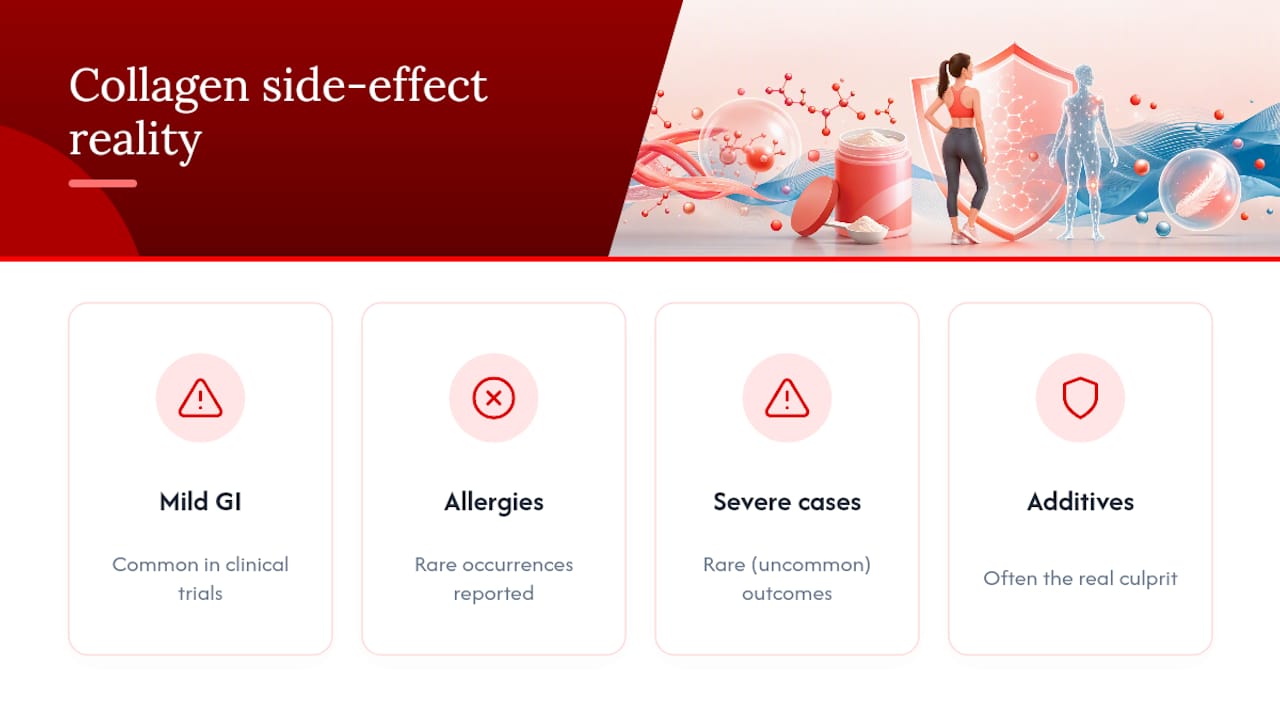
The conventional wisdom treats collagen like it’s either a miracle powder or a supplement roulette wheel, and neither framing holds up against the evidence. What the trials and clinical guidance actually show is narrower and less dramatic: mild GI upset is common, everything else is rare, and most of what gets blamed on “collagen” is really an additive riding along in the same scoop.
Where conventional advice falls short is treating all collagen products as interchangeable. A powder with a defined peptide profile and third-party testing behaves differently than an unverified blend padded with mega-dose vitamins. That distinction gets buried in most consumer coverage.
If you take one thing from this, prioritize the label over the marketing claim. Know your source species, know your additives, and start low. That’s a more reliable safety strategy than any single statistic about adverse event rates.
— From
Ready to Try Collagen the Transparent Way?
If the biggest risk with collagen is not knowing what’s actually in the jar, the fix is picking a product built around telling you. Fromwithin’s collagen line uses patented Wellnex® peptides designed for direct bloodstream absorption, with a full ingredient list you can check against everything covered above, no mystery additives, no proprietary-blend guesswork.

For busy professionals who want visible skin results without decoding a label like a chemist, the Collagen Peptides Glow Booster is a straightforward place to start at the lower end of a studied dose. Pair it with better sleep, since skin repair happens overnight, and Fromwithin’s non-melatonin sleep aid is built for the same transparency standard. Check the collagen page today, read the ingredient panel for yourself, and decide if it’s the right fit for your routine.
This article is general information, not a substitute for advice from a qualified doctor. Consult a qualified healthcare professional about your own circumstances before acting on anything here.
Sources
- Considering collagen drinks and supplements? — Harvard Health Blog
- Should you take collagen supplements? — UCLA Health
- Collagen Supplements: Benefits and Side Effects — Cleveland Clinic
- Collagen: Benefits, Side Effects, and Caution — Healthline
