

on July 31, 2026

Tonight, do this: set your phone to Do Not Disturb, place it in another room, and spend 10 minutes doing box breathing and a legs-up-the-wall stretch. That’s your whole routine. Consistent routines as short as 5–10 minutes can meaningfully reduce the effects of chronic work stress, according to CDC guidance. The APA and Cleveland Clinic both recommend controlled breathing and gentle movement as foundational stress-relief tools, and the Sleep Foundation notes that a pre-sleep buffer of 30–60 minutes improves sleep quality and mood regulation. You don’t need an hour. You need a signal that the workday is over, not a lengthy routine.
Start right now: Put your phone across the room. That single act removes the biggest barrier between your brain and rest.
Table of Contents
- What’s the best evening relaxation routine for busy professionals?
- How do the four core pillars actually work?
- How do you make this routine actually stick?
- How do clinically researched supplements fit into your evening routine?
- Your one-page evening checklist and two sample routines
- Key Takeaways
- Why simple routines beat long checklists
- Fromwithin supports your skin and sleep from the inside out
- Useful sources and further reading
What’s the best evening relaxation routine for busy professionals?
The answer depends on how many minutes you actually have. Here’s a time-budgeted breakdown you can use tonight.

| Time Budget | Top Priority | Key Technique | What to Skip |
|---|---|---|---|
| 5 minutes | Screen-down | Box breathing (4 rounds) | Everything else |
| 10 minutes | Wind-down + screen-down | Box breathing + legs-up-the-wall | Journaling, skincare |
| 20 minutes | Wind-down + body + mind | Breathing, stretch, brain dump | Long reading |
| 30 minutes | Full routine | All four pillars (see below) | Nothing |
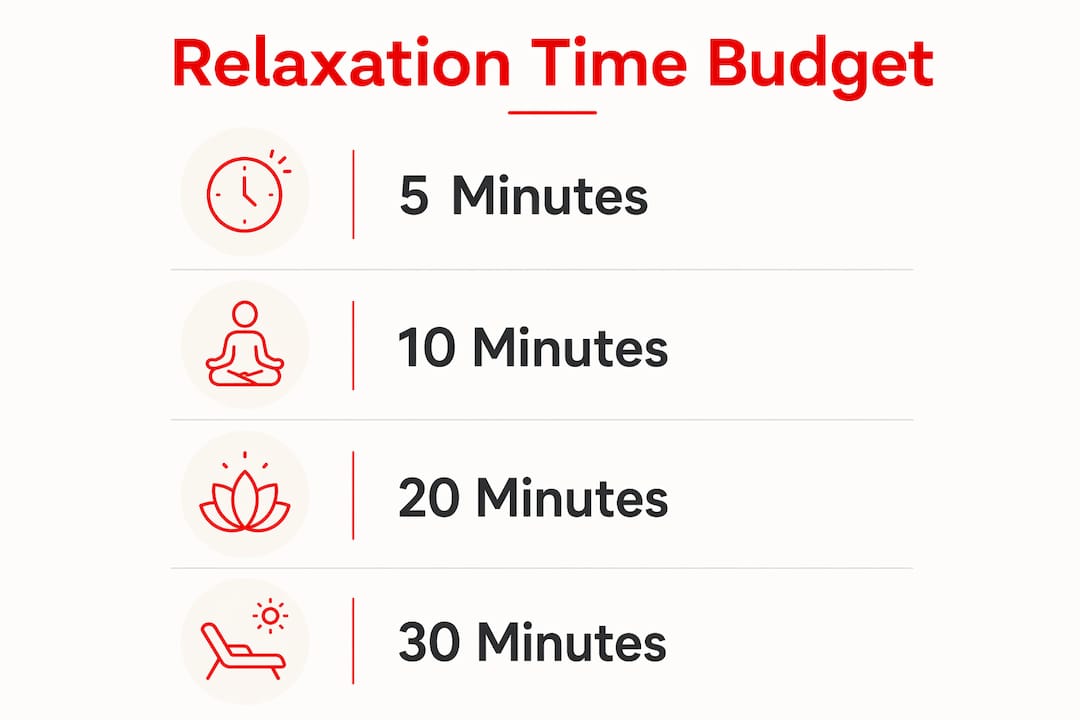
Pro Tip: Pick the time budget that fits your worst nights, not your best. A 5-minute routine you actually do beats a 30-minute one you skip.
The 5-minute reset
- Phone in another room, lights dimmed.
- Four rounds of box breathing: inhale 4 counts, hold 4, exhale 4, hold 4.
- Done. Seriously.
The 10-minute couch-start
- Phone away, dim one lamp.
- Four rounds of box breathing.
- Legs-up-the-wall for 5–10 minutes. No yoga experience needed.
- Quick brain dump: write three things on your mind onto paper.
The 20-minute wind-down
- Phone away, dim lights, change clothes (3 minutes).
- Box breathing, 4 rounds (2 minutes).
- Gentle stretching: hip opener, forward fold, side stretch (5 minutes).
- Brain dump or tomorrow’s top three priorities (5 minutes).
- Take your sleep supplement now if using one (30–60 minutes before bed).
The 30-minute full routine
- Transition ritual: change clothes, light a scent you only use at night (3 minutes).
- Box breathing or brief mindfulness (5 minutes).
- Warm shower or legs-up-the-wall (10 minutes).
- Skincare with gentle self-massage (5 minutes).
- Brain dump and tomorrow’s priorities (5 minutes).
- Supplement timing: collagen and sleep aid taken 30 minutes before lights out.
How do the four core pillars actually work?
Every effective nighttime routine for relaxation is built from four categories. One from each is the goal.
Wind-down signals the brain that the day is over. This is the physiological shift from sympathetic (“fight-or-flight”) to parasympathetic (“rest-and-digest”) nervous system dominance. Dimming lights around 9 PM is the single highest-return habit here because melatonin production is sensitive to indoor light levels.
Screen-down is less about blue light and more about content. Anything stimulating seen in the last hour before sleep tends to surface as wakefulness. Placing your phone in another room at a set cutoff time is a high-impact, low-effort habit.
Body care releases the physical tension that accumulates through a day of sitting and stress. Here’s how to do the two most effective techniques:
- Box breathing: Inhale slowly for 4 counts, hold for 4, exhale for 4, hold for 4. Repeat 4–6 rounds. This lowers cortisol and heart rate when practiced consistently, per APA guidance. You can find a quick guided version with anti-stress breathing exercises if you want a structured walkthrough.
- Legs-up-the-wall: Lie on your back, swing your legs up against the wall, arms relaxed at your sides. Hold for 5–10 minutes. This posture reliably shifts the autonomic nervous system toward parasympathetic dominance, even for people who can’t meditate.
Mind care offloads tomorrow so your brain stops rehearsing it. A brain dump (write everything on your mind onto paper) or a short list of tomorrow’s top three priorities tells your brain the plan is captured. Open loops are a major driver of the can’t-switch-off experience.
“The goal of an evening routine is to reduce friction between work and sleep, not to check off a long list. Practical boundaries like ‘no emails after X’ reduce work leakage and improve effectiveness far more than adding new tasks.” — APA
Pro Tip: Use a scent you only ever use at night, whether that’s a candle, a body wash, or a pillow spray. With repetition, your nervous system learns that scent means it’s safe to wind down. It’s a Pavlovian cue that costs nothing.
How do you make this routine actually stick?
The biggest reason evening routines fail isn’t motivation. It’s friction. Here’s how to design yours so it runs on autopilot.
Habit-stacking is the most reliable method: attach a new micro-habit to something you already do every single evening. Close your laptop, that’s your cue to dim the lights. Walk in the door, that’s your cue to change clothes. The transition itself becomes the trigger.
- Anchor to existing transitions: arriving home, closing the laptop, finishing dinner. Don’t add a new time slot; hijack an existing one.
- Convert micro-moments: your post-dinner 10 minutes, your commute home, the time between dinner and TV. These are already there. Make them intentional.
- Set a hard email cutoff: choose a time (7 PM, 8 PM) and hold it every day. When your brain knows the day ends at 7 PM, it starts winding down before that time arrives. Without a cutoff, it stays on alert indefinitely.
- Write tomorrow’s priorities tonight: three items only. This closes the open loops your brain would otherwise rehearse all night.
Small, low-effort habits done consistently are more sustainable than elaborate routines. The goal isn’t a perfect evening. It’s a repeatable one.
Pro Tip: Pick one tiny ritual and anchor it to closing your laptop tonight. Just one. “Laptop closes, lights dim” is a complete habit stack.
How do clinically researched supplements fit into your evening routine?
Supplements work best when they’re timed correctly and chosen with ingredient transparency in mind. Here’s what to look for and when to take them.
What to look for on the label
- Named, clinically studied active ingredients (not proprietary blends with no disclosure)
- Clear dosing per serving
- Third-party testing or patented ingredient forms (e.g., Wellnex® peptides)
- No undisclosed fillers or allergens
- Explicit guidance on timing relative to sleep
Timing guidance
Sleep aids are most effective when taken 30–60 minutes before your target bedtime, within the pre-sleep buffer the Sleep Foundation recommends. Collagen peptides for skin support can be taken at the same time, making it easy to combine both into one step. For more on scheduling supplements around your work day, the beauty supplements work schedule guide covers the specifics.
Safety and interactions
- If you take prescription medications, check with your pharmacist before adding any sleep supplement.
- Melatonin-based aids can interact with blood thinners and immunosuppressants.
- Collagen peptides are generally well-tolerated; those with fish or shellfish allergies should verify the source.
- Pregnant or breastfeeding? Consult your clinician before starting any new supplement.
| Dimension | Fromwithin Collagen Peptides Glow Booster | Fromwithin Natural Sleep Aid |
|---|---|---|
| Clinical evidence | Patented Wellnex® peptides with published absorption data | Formulated for natural sleep support without prescription dependency |
| Active ingredients | Wellnex® collagen peptides, absorbed directly into the bloodstream | Natural calming ingredients; full label transparency |
| Timing and convenience | Take 30 minutes before bed; liquid shot format | Take 30–60 minutes before target bedtime |
| Safety | Well-tolerated; verify source if allergen-sensitive | Not habit-forming; consult clinician if on medications |
The science linking sleep quality to skin repair is worth understanding here. Better sleep supports the skin’s overnight repair cycle, so a sleep aid and a collagen supplement are genuinely complementary in the same routine.
Your one-page evening checklist and two sample routines
Evening checklist (copy or screenshot this)
- [ ] Phone to another room or on DND
- [ ] Lights dimmed
- [ ] Transition ritual done (clothes changed, scent, playlist)
- [ ] Box breathing or legs-up-the-wall
- [ ] Brain dump or tomorrow’s top three written
- [ ] Supplement(s) taken 30–60 minutes before bed
- [ ] Screens off at least 30 minutes before lights out
- [ ] Skincare done (if doing 20+ minute routine)
Sample routine A: zero-bandwidth, 10-minute couch-start
- Minute 0: Phone in another room, one lamp on.
- Minute 1–3: Box breathing, 4 rounds.
- Minute 3–10: Legs-up-the-wall on the floor or couch.
- Afterward: Write three things on your mind. Take sleep supplement now.
- Lights out 30–40 minutes later.
Sample routine B: full 30-minute wind-down
- Minute 0–3: Change clothes, light your evening scent, phone away.
- Minute 3–8: Box breathing or brief mindfulness.
- Minute 8–18: Warm shower or legs-up-the-wall.
- Minute 18–23: Skincare with self-massage; take Fromwithin Collagen Peptides Glow Booster and sleep aid now.
- Minute 23–30: Brain dump and tomorrow’s top three priorities.
- Lights out 30 minutes later.
For a printable version with sleep hygiene steps tailored to professionals, the evening wind-down checklist is a good companion.
Key Takeaways
A consistent 10-minute evening routine combining box breathing, a screen cutoff, and a brain dump is the most sustainable starting point for busy professionals managing stress and sleep.
| Point | Details |
|---|---|
| Start with 5–10 minutes | Even short routines reduce chronic work stress effects; 10 minutes is the practical benchmark. |
| Screen-down matters most | Placing your phone in another room at a set cutoff time is the highest-impact, lowest-effort sleep habit. |
| Use the four pillars | Wind-down, screen-down, body care, and mind care together produce a more complete shift into sleep than any single habit. |
| Time supplements correctly | Take sleep aids and collagen 30–60 minutes before your target bedtime for best results. |
| Fromwithin supplements | Fromwithin’s Wellnex® peptide collagen and natural sleep aid are designed to fit into the 30-minute pre-bed window. |
Why simple routines beat long checklists
Here’s my honest take: the professionals I see struggle most with evening routines aren’t lacking information. They’re treating self-care like another deliverable. The moment your wind-down becomes a 12-step checklist, it stops being rest and starts being work.
The evidence points to something simpler. A phone across the room, four rounds of box breathing, and a brain dump on paper. That’s it. Fromwithin’s approach is built on the same philosophy: ingredient transparency, clinically researched formulas (including the patented Wellnex® peptides absorbed directly into the bloodstream), and products that fit into a short routine rather than demanding one. The sleep aid and collagen are designed to work within the 30–60 minute pre-bed window, not outside it.
One note on evidence limits: the techniques here are supported by CDC, APA, Cleveland Clinic, and Sleep Foundation guidance, but individual responses vary. If you’re dealing with chronic insomnia, persistent anxiety, or are on medications, please consult your clinician or pharmacist before adding supplements.
Fromwithin supports your skin and sleep from the inside out

If you’ve read this far, you already know the routine. What you might still be missing is the inside-out support that makes it work better. Fromwithin’s natural sleep aid is formulated to help you fall asleep naturally, without prescription dependency, and fits cleanly into the 30-minute pre-bed window. The Collagen Peptides Glow Booster uses patented Wellnex® peptides that absorb directly into the bloodstream, supporting skin elasticity and the overnight repair cycle your skin depends on. Both products are built on full ingredient transparency so you know exactly what you’re taking and why. Ready to add the inside-out layer to your evening routine? Visit Fromwithin to learn more and find the right fit for your nights.
This article is for general informational purposes only and is not a substitute for professional medical advice. Consult your clinician or pharmacist before starting any new supplement, especially if you take medications or have an existing health condition.
Useful sources and further reading
- Managing Stress | CDC: CDC’s practical guidance on daily stress management, including breathing, movement, and routine-building.
- Coping with Stress at Work | APA: APA recommendations for controlled breathing, mindfulness, and boundary-setting as core stress-relief tools.
- Bedtime Routine for Adults | Sleep Foundation: Evidence-based guidance on the 30–60 minute pre-sleep buffer and sleep hygiene habits.
- How Blue Light Affects Sleep | Sleep Foundation: Explains why screen content and phone proximity matter more than blue light alone.
- Stress Management and Emotional Health | Cleveland Clinic: Cleveland Clinic’s foundational list of clinically supported relaxation techniques.
- Yoga to Better Manage Stress | Harvard Health: Research on posture-based resets and their effect on the autonomic nervous system.
For clinical questions about supplements or sleep disorders, speak with your primary care physician or a licensed pharmacist.
