

on August 27, 2026

Three things matter most tonight: start a 60 to 90 minute wind-down before bed, stabilize your blood sugar so you don’t wake up at 2 a.m. wired, and use extended-exhale breathing (4 seconds in, 8 seconds out) to nudge your nervous system toward rest. Do those three things and you’re addressing the biggest levers on nighttime cortisol that we know of.
Here’s the honest timeline: the breathing works in minutes. Your sleep architecture, the deep, restorative stages that actually repair your body, takes longer to shift. Most people notice real change over 1 to 8 weeks of consistent effort.
- Start your wind-down 60 to 90 minutes before bed, screens dimmed and work closed.
- Eat a small protein-and-fat snack if dinner was early or light.
- Practice 4:8 breathing for two to three minutes before lights out.
- Keep your bedroom cool, dark, and quiet.
Quick fact: Sleep restricted to 5.5 hours or less consistently raises evening cortisol in controlled studies, which is exactly why timing matters as much as what you do. If you want a deeper dive into supplement-backed support, Fromwithin has research on this built into its approach.
TL;DR:
- Consistently building a 60 to 90-minute wind-down routine, with dimmed lights and calming activities, significantly reduces nighttime cortisol levels.
- Stabilizing blood sugar with a protein-and-fat snack before bed helps prevent 2 to 4 a.m. cortisol spikes caused by low glucose.
- Extended-exhale breathing (4 seconds inhale, 8 seconds exhale) provides immediate parasympathetic activation and can be repeated during waking episodes.
- Supplements like ashwagandha, L-theanine, and magnesium take four to eight weeks of regular use to produce measurable improvements in sleep quality and cortisol regulation.
- Medical conditions such as sleep apnea, thyroid issues, or unmanaged anxiety may require professional evaluation beyond lifestyle and routine changes.
Table of Contents
- Why Nighttime Cortisol Matters for Sleep Quality
- What Causes Elevated Cortisol at Night?
- What Are the Best Ways to Lower Cortisol Before Bed?
- Which Supplements Actually Lower Evening Cortisol?
- When Should You Get Tested for Cortisol or Sleep Issues?
- How Does Diet Affect Nighttime Cortisol Beyond Blood Sugar?
- How Chronic Stress Affects Long-Term Cortisol Regulation
- Do Adaptogens Work Better at a Specific Time of Evening?
- Your 7-Step Nightly Routine to Lower Cortisol
- What From Within’s Research Says About Evening Cortisol Support
- The Overrated Fix and the One Habit That Actually Moves the Needle
- How Fromwithin Fits Into Your Evening Routine
- Key Takeaways
- Sources
Why Nighttime Cortisol Matters for Sleep Quality
Cortisol isn’t the villain people make it out to be. It’s supposed to rise sharply about 30 minutes after you wake up, then decline steadily through the day until it hits its lowest point, called the nadir, a few hours after you fall asleep. That evening dip is what makes deep sleep possible in the first place.
When cortisol stays elevated instead of dropping, it interferes directly with slow-wave sleep, the stage where your body does most of its physical repair and releases growth hormone. Skip enough of that, and you wake up groggy no matter how many hours you logged. There’s also a metabolic cost: chronically high evening cortisol pushes your body toward insulin resistance over time, which is part of why poor sleepers often struggle with blood sugar control the next day.
The timing mechanism behind all of this sits in your brain’s suprachiasmatic nucleus, the master clock that governs your daily hormone rhythm and takes its cues mainly from light exposure and behavior patterns.
Cortisol’s diurnal rhythm is coordinated by the suprachiasmatic nucleus and entrained by light-dark cycles and behavioral timing, which is exactly why consistent light exposure and sleep timing carry so much weight in regulating it.
Once you see cortisol as a rhythm to protect rather than a hormone to eliminate, the nightly strategies below make a lot more sense.
What Causes Elevated Cortisol at Night?
Most people have a mix of behavioral and metabolic habits quietly working against them, and a smaller group has something medical going on that deserves a proper look.
On the behavioral side, late-night screen exposure, a caffeine habit that stretches into the afternoon, alcohol before bed, unresolved stress, and intense exercise too close to bedtime all keep your nervous system activated when it should be winding down. Alcohol is a sneaky one. It feels sedating going down but tends to fragment sleep and spike cortisol in the second half of the night.
Metabolically, a heavy meal too close to bedtime or, just as often, too little food in the evening sets up overnight blood sugar swings. When glucose drops too low around 2 to 4 a.m., your body responds with an emergency release of cortisol and adrenaline, which is why so many people wake abruptly in that exact window.
Then there are the medical drivers worth ruling out:
- Sleep apnea, especially with loud snoring and daytime exhaustion.
- Thyroid dysfunction or adrenal disorders.
- Perimenopause and menopause, which reshape hormone patterns broadly.
- Chronic, unmanaged anxiety or panic-like awakenings.
If any of those sound familiar, lifestyle tweaks alone probably won’t be enough. That’s a conversation for your doctor, not a wellness routine.
What Are the Best Ways to Lower Cortisol Before Bed?
Here’s your priority order, from immediate to gradual, so you know what to do first and what to expect over time.
1. Build a real wind-down window (60 to 90 minutes). This isn’t optional padding, it’s the foundation. Close your laptop, dim overhead lights, and switch to something genuinely calming: reading, stretching, a warm shower. Evening wind-down routines that start 60 to 90 minutes before bed work because they give your parasympathetic system time to actually take over, rather than asking your body to switch from “on” to “asleep” in five minutes.
2. Use extended-exhale breathing as your fastest tool. Breathe in for 4 seconds, out for 8. Repeat for two to three minutes. The longer exhale directly stimulates your vagus nerve, and unlike most items on this list, it works immediately, anywhere, no equipment needed.

3. Stabilize blood sugar before you get into bed. If dinner was more than four hours before sleep or was light on protein, have a small snack: Greek yogurt, a handful of almonds, or a spoonful of nut butter. The goal is steady glucose through the night, not a sugar spike. This single habit resolves 2 to 4 a.m. wake-ups for a lot of people within 1 to 2 weeks of consistent use.
4. Get morning light, then dim evening light deliberately. Ten to fifteen minutes of bright light shortly after waking anchors your circadian rhythm for the whole day. In the evening, dim overhead lights and cut blue light from screens starting about two hours before bed. If natural morning light isn’t realistic for your schedule, a light-therapy lamp is a reasonable substitute.
5. Set a real caffeine and alcohol cutoff. Caffeine has a half-life of roughly 5 to 6 hours, so a 3 p.m. coffee is still partly active at 9 p.m. Cut caffeine by early afternoon, and treat alcohol as a sleep disruptor rather than a sleep aid, even though it feels relaxing in the moment.
6. Time your workouts earlier in the day. Intense exercise raises cortisol temporarily, which is normal and useful during the day, but doing it within two to three hours of bed can delay your evening cortisol drop. Move hard training earlier when you can, and save gentle movement like walking or stretching for the evening.
7. Give your brain a scheduled outlet for worry. Set aside 10 minutes earlier in the evening, not right before bed, to write down what’s nagging at you. Progressive muscle relaxation, tensing and releasing muscle groups from feet to face, works well as a follow-up if your mind is still racing.
Pro Tip: Stack your wind-down activities in the same order every night. The predictability itself becomes a cue that tells your brain “we’re winding down now,” which speeds up how quickly the whole routine starts working.
Which Supplements Actually Lower Evening Cortisol?
Three ingredients have real evidence behind them for evening use, and they work through different mechanisms, which is why they’re often combined rather than used alone.
Ashwagandha has the strongest research base of the three for reducing anxiety and supporting sleep quality. Meaningful shifts in evening relaxation typically show up after 4 to 8 weeks of consistent use, not overnight, so patience matters here more than with the breathing techniques above.
L-theanine, an amino acid found naturally in tea, promotes relaxation by supporting GABA activity in the brain, essentially turning down mental chatter without sedation. Combined with magnesium glycinate, which supports physiological calming and is well absorbed compared to other magnesium forms, it forms a solid non-hormonal evening stack.
- Ashwagandha: best for anxiety-driven cortisol elevation, 4 to 8 week timeline.
- L-theanine: best for racing thoughts at bedtime, works same-night for many people.
- Magnesium bisglycinate: best for physical tension and muscle relaxation.
- Phosphatidylserine: a practitioner-level option specifically used to blunt evening cortisol when lifestyle changes alone aren’t cutting it, generally used under clinical guidance.
Quick fact: Clinician-observed timelines suggest measurable sleep and metabolic improvements often appear within 4 to 8 weeks when supplement support is combined with the routine changes above, rather than used in isolation.
A safety note that applies to everyone: if you’re pregnant, nursing, or taking prescription medication, particularly for thyroid conditions, blood pressure, or mood, check with your doctor before adding any of these. In Singapore, look for products with transparent ingredient sourcing and third-party quality checks, since supplement regulation varies by category.
When Should You Get Tested for Cortisol or Sleep Issues?
Lifestyle changes solve most nighttime cortisol problems, but not all of them. Get evaluated if you notice any of these patterns showing up repeatedly rather than occasionally:
- Frequent panic-like awakenings that feel physically alarming, not just restless.
- Unexplained weight changes or irregular menstrual cycles alongside poor sleep.
- Loud snoring paired with significant daytime sleepiness, a classic sleep apnea signal.
If you’re checking this out, ask your doctor about a multi-point salivary cortisol curve or DUTCH testing, since a single morning blood draw usually misses evening cortisol problems entirely. Overnight oximetry or a polysomnography study can rule out sleep apnea, and basic thyroid labs (TSH) are worth requesting if fatigue and sleep issues are both present. Start with your primary care doctor or a sleep clinic. Expect diagnostic clarity within a few weeks, with a follow-up plan shortly after.
How Does Diet Affect Nighttime Cortisol Beyond Blood Sugar?
Blood sugar stability is the headline, but what and when you eat matters in other ways too. Meals heavy in refined carbohydrates close to bedtime can cause a rapid glucose spike followed by an overcorrection, the same crash-and-alarm pattern that triggers cortisol release in the middle of the night, just from a different starting point than skipping dinner altogether.
Protein timing matters more than most people realize. A dinner too light on protein leaves you without the amino acids needed to stabilize blood sugar overnight, while adequate protein at dinner, paired with slower-digesting fats, keeps glucose steadier for longer. That’s part of why a snack combining protein and fat, not just carbs, works better for preventing 2 to 4 a.m. wake-ups.
Meal timing itself is a circadian cue, not just a metabolic one. Eating on a wildly inconsistent schedule, skipping dinner some nights and eating late others, sends mixed signals to the same internal clock that governs your cortisol rhythm. Keeping dinner within a consistent one to two hour window most nights reinforces the same rhythm your wind-down routine is trying to build.
Excess alcohol deserves another mention here specifically as a dietary factor: it disrupts liver glucose regulation overnight, which compounds any existing blood sugar instability from your evening meal.
How Chronic Stress Affects Long-Term Cortisol Regulation
A single stressful day barely registers on your nighttime cortisol pattern. Months or years of unmanaged stress are a different story. Chronic activation of your stress response system gradually blunts the natural rhythm that’s supposed to separate a high-alert daytime cortisol peak from a low, restful nighttime dip.
Instead of a clean rhythm, chronically stressed people often develop a flattened curve: cortisol that’s too low in the morning to feel properly awake, and too high at night to wind down properly. This isn’t about your adrenal glands failing, a popular but oversimplified idea, so much as the signaling between your brain and your hormone system becoming less responsive over time.
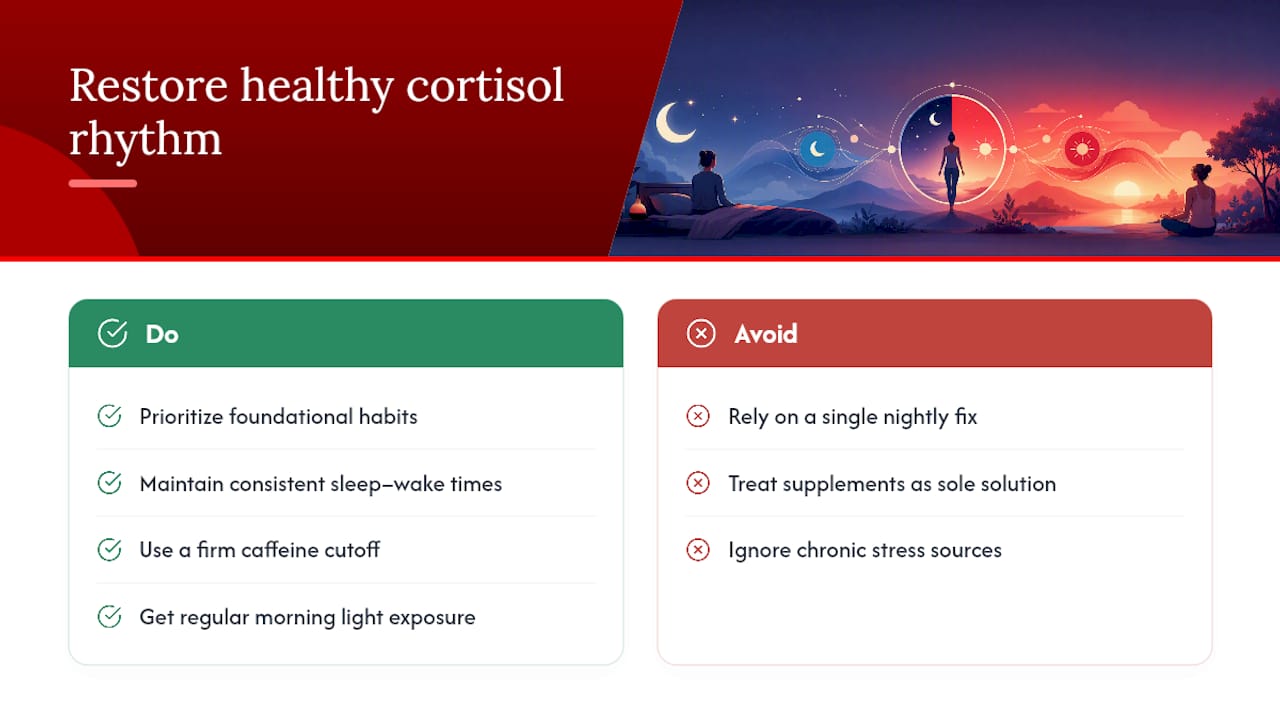
The practical implication is that people dealing with chronic stress usually need more than a single nightly fix. Foundational habits, consistent sleep and wake times, a firm caffeine cutoff, and regular morning light exposure, tend to be the most sustainable way to gradually restore a healthier rhythm, more so than any single technique used in isolation. Supplement support and breathing exercises help in the moment, but they work best layered on top of those basics rather than replacing them. If chronic stress feels like your main driver, addressing its sources, whether that’s workload, sleep debt, or unresolved anxiety, matters as much as anything on this list.
Do Adaptogens Work Better at a Specific Time of Evening?
Adaptogens like ashwagandha are often marketed generically, but timing genuinely changes how well they work for evening cortisol specifically. Taking ashwagandha with dinner or a couple of hours before bed, rather than in the morning, lines up its calming effect with the window when you actually need cortisol to be dropping.
That said, adaptogens aren’t a fast fix. Since meaningful shifts in relaxation typically appear over 4 to 8 weeks of consistent use, taking one dose before an important event won’t produce a noticeable calming effect the way L-theanine can same-night. Think of adaptogens as a slow recalibration of your baseline stress response, not a nightly sedative.
Consistency matters more than precise timing down to the minute. Taking ashwagandha at roughly the same time each evening, alongside dinner works well for most people, builds a routine your body can adapt to. Skipping days and doubling up later undercuts the gradual effect these compounds are known for. Pairing an adaptogen with same-night tools like extended-exhale breathing or a magnesium-based supplement covers both timelines: the adaptogen for the weeks-long trend, the breathing and magnesium for tonight’s actual sleep.
Your 7-Step Nightly Routine to Lower Cortisol
- 90 minutes before bed: stop work and caffeine entirely, dim overhead lights.
- 75 minutes before bed: have your snack if needed, Greek yogurt or a small handful of nuts.
- 60 minutes before bed: start your calming activity, reading, stretching, a shower.
- 20 minutes before bed: do a 10-minute worry-dump journal entry, just two prompts: “What’s unresolved from today?” and “What can wait until tomorrow?”
- 10 minutes before bed: dim your bedroom to near-dark, set the temperature between 65 and 68°F.
- Lights out: 4:8 breathing for two to three minutes, four counts in, eight counts out.
- If you wake at night: repeat the breathing rather than checking your phone or the time.
Shift workers and late schedules can shift this entire sequence to match sleep time rather than clock time, the sequence matters more than the specific hour.
Pro Tip: Don’t run the exact same routine every single night without flexibility. On high-stress days, extend the journaling step; on low-stress nights, you might only need the breathing. Treat this as a framework, not a rigid script.
What From Within’s Research Says About Evening Cortisol Support
Everything in this routine reflects what actually shows up in practice: metabolic stability and consistent timing beat any single supplement acting alone. Fromwithin’s approach centers on transparent, evidence-backed ingredients rather than proprietary blends that hide their dosing.
The pattern we see most often is straightforward. People who pair a real wind-down routine with targeted, non-hormonal support tend to notice steadier sleep within weeks, not months, and it tends to stick because the routine itself becomes the habit, not just the supplement.
The Overrated Fix and the One Habit That Actually Moves the Needle
The wellness industry loves selling supplements as the whole solution, and that’s backward. Ashwagandha, L-theanine, and magnesium are genuinely useful, but they work as accelerants on top of a routine, not replacements for one. Take the best adaptogen on the market and skip your wind-down window entirely, and you’re fighting your own physiology.
If I had to pick the single most underrated lever in this entire article, it’s blood sugar stability before bed. It gets far less attention than breathing exercises or supplements, yet it directly explains why so many people wake at 2 or 3 a.m. for no obvious reason. Fix that one habit, a slightly earlier dinner or a small protein-based snack, and a surprising number of “stress-related” sleep problems resolve without touching a single supplement bottle.
Prioritize in this order: timing and blood sugar first, breathing second, supplements third as reinforcement. Skip step one and the other two are working against a stacked deck.
— From
How Fromwithin Fits Into Your Evening Routine
If you’ve read this far, you already know that consistency beats any single trick, and that’s exactly where a well-formulated supplement earns its place: as reinforcement, not a shortcut. Fromwithin’s sleep aid is built without melatonin or hormonal ingredients, so it supports the same relaxation pathways discussed above (calming amino acids and magnesium) rather than forcing a hormonal reset that can leave you groggy the next morning.

The way it fits into the routine above is simple: take it during your wind-down window, roughly 60 to 90 minutes before bed, alongside your breathing practice, not as a replacement for it. Most people pair it with the evening wind-down checklist and notice the combined effect builds over the same 4 to 8 week window discussed earlier for supplement-based support. If you’re also managing skin recovery alongside sleep, since the two are more connected than most people realize, Fromwithin’s collagen line supports overnight repair from the same “consistency over time” angle.
As always, check with your doctor first if you’re pregnant, nursing, or on prescription medication. Ready to see how it fits your nights? Take a look at the sleep aid page and start with tonight’s routine.
Key Takeaways
Lowering cortisol at night works best when you combine immediate nervous-system tools with blood sugar stability and, over several weeks, evidence-backed supplements like ashwagandha and magnesium.
| Point | Details |
|---|---|
| Start your wind-down early | Begin 60 to 90 minutes before bed with dimmed lights and no work or screens. |
| Stabilize blood sugar | A small protein-and-fat snack can prevent the 2 to 4 a.m. cortisol spike tied to low glucose. |
| Use extended-exhale breathing | Breathe in for 4 seconds, out for 8, for immediate parasympathetic relief at bedtime. |
| Give supplements time | Ashwagandha and similar adaptogens typically take 4 to 8 weeks to show measurable benefit. |
| Consider Fromwithin’s sleep aid | A non-melatonin, non-hormonal option designed to fit into the same nightly wind-down routine. |
This article is general information, not a substitute for advice from a qualified doctor. Consult a qualified healthcare professional about your own circumstances before acting on anything here.
Sources
- Office of Dietary Supplements (NIH) — Ashwagandha fact sheet
- PMC — Review on sleep restriction and cortisol dynamics
- NCBI Bookshelf — Circadian rhythms and cortisol
