

on August 16, 2026

You can quiet a racing mind tonight using three steps: try a short breathing or cognitive-shuffle routine, write your worries down in a quick “park it” journal entry, and if you’re still awake after 20 minutes, get out of bed for a low-light reset. That’s the whole plan. Here’s how to follow it right now.
Your 3-step plan for tonight:
- Breathe first. Try 4-7-8 breathing: inhale for 4 counts, hold for 7, exhale slowly for 8. Do four rounds. This activates your parasympathetic nervous system and lowers your heart rate within minutes.
- Park your thoughts. Grab a pen and paper (not your phone) and spend 5 minutes writing down whatever is looping in your head. Add one small next-step beside each worry. Close the notebook. That’s it.
- Get up if needed. If you’re still wide awake after 20 minutes, move to a dim room, do something calm and boring, and return to bed only when you feel sleepy.
Start with step 1 right now. The rest will follow.
Key Takeaways
Calming racing thoughts at night comes down to one consistent truth: the techniques that work give your brain something neutral to do instead of ruminating, and the habits that prevent recurrence give your nervous system a reliable path to rest.
| Point | Details |
|---|---|
| Try a bedside technique first | 4-7-8 breathing or cognitive shuffling can lower arousal within 10 minutes tonight. |
| Use a 30-minute buffer zone | Dim lights, gentle movement, and pen-and-paper journaling before bed reduce nighttime reactivity. |
| Schedule your worry time | A 15–20 minute evening worry session parks intrusive thoughts before they reach your pillow. |
| Build one daytime habit | A consistent wake time and morning light exposure do more for sleep than most nighttime fixes. |
| Fromwithin sleep aid | A non-melatonin, non-hormonal supplement that supports natural relaxation as an adjunct to behavioral strategies. |
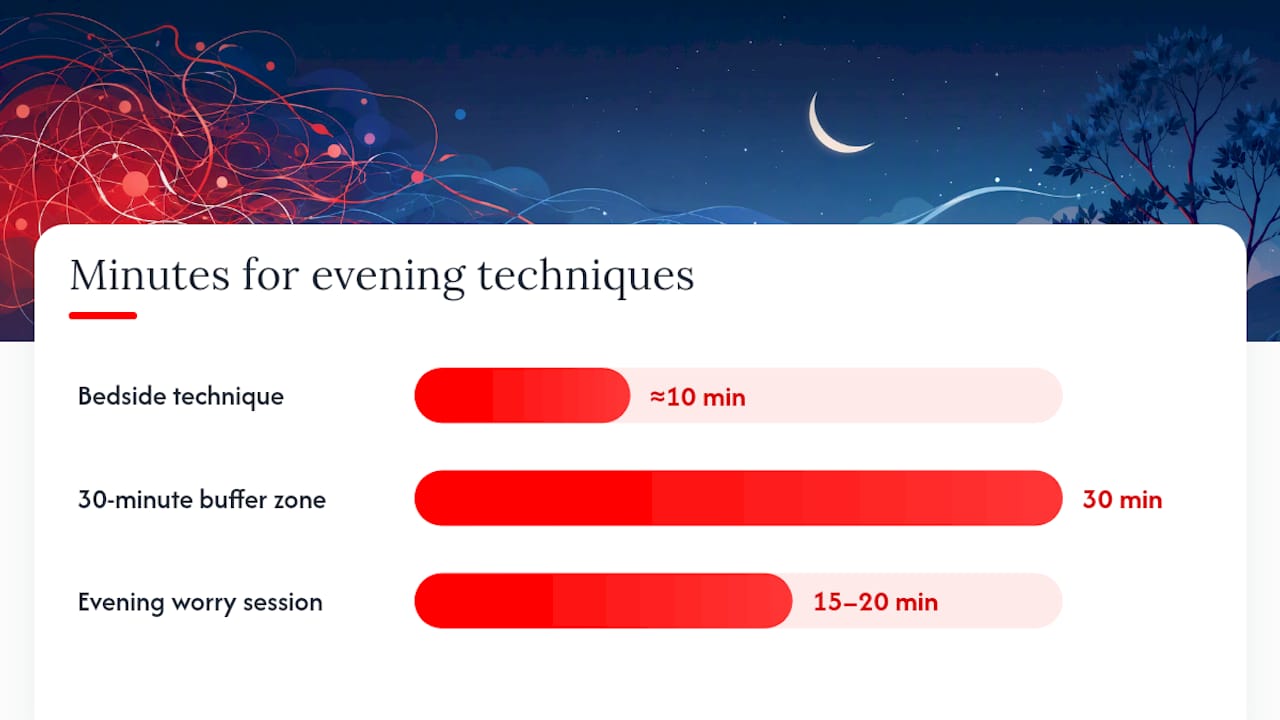
Table of Contents
- Why do you have racing thoughts at night?
- Practical bedside techniques to calm racing thoughts tonight
- Building a wind-down buffer zone that actually works
- Daily habits that reduce how often racing thoughts show up at night
- How to use journaling and scheduled worry time to move worries out of bed
- Cognitive techniques and when to see a clinician
- A non-melatonin option for nights when you need extra support
- Sources
Why do you have racing thoughts at night?
Before daytime distractions disappear, your brain has plenty of noise to keep it occupied. Once the lights go out, that noise stops, and your brain’s default mode kicks in, running through unfinished thoughts, worries, and plans without anything to interrupt it. This is a physiological response, not a personal failure. According to a UCLA clinician’s perspective, nighttime anxiety often worsens precisely because the mental buffer of daily activity is gone.
Sleep anxiety can also create a self-reinforcing loop: you worry about not sleeping, which makes you more alert, which makes sleep harder. The Cleveland Clinic notes that this cycle is common and very treatable with behavioral approaches. Knowing that helps. You’re not broken; your brain just needs a redirect.
Practical bedside techniques to calm racing thoughts tonight
These work best when you pick one and commit to it for at least 10 minutes before switching. Jumping between methods too quickly prevents any of them from taking hold.
4-7-8 breathing
Inhale through your nose for 4 counts, hold for 7, exhale through your mouth for 8. The long exhale is what does the work. It signals your nervous system to downshift. Use this when you feel physically tense or your heart is beating faster than usual.
Progressive muscle relaxation (PMR)
Start at your feet. Tense each muscle group firmly for 5 seconds, then release completely. Move slowly up through your calves, thighs, stomach, hands, arms, shoulders, and face. Clinical research supports PMR for lowering physical tension and improving sleep onset, especially in anxious sleepers. The Sleep Foundation also recommends body-scan meditations alongside PMR as practical tools for quieting an active mind.

Cognitive shuffling
Pick a neutral, emotionally flat word, like “feather” or “market.” Visualize the first random image that word brings to mind, then let your mind drift to the next unrelated image, and the next. Don’t build a story. The goal is mild, wandering engagement that keeps rumination from restarting. Time reports that cognitive shuffling works better than monotonous counting because it preserves just enough mental engagement to block narrative thought loops.

Grounding with a simple list
Mentally name five things you can hear, four things you could touch, three things you could see in the dark. This pulls attention away from future-focused worry and anchors it in the present moment. Use this when your thoughts are spiraling around a specific problem.
Pro Tip: Keep your phone face-down and out of arm’s reach. Even a glance at a bright screen resets your melatonin cycle and gives your brain a reason to stay alert. A dim lamp or no light at all is the right environment for every technique above.
If one method isn’t working after 10–12 minutes, switch to another. There’s no prize for suffering through the wrong one.
Building a wind-down buffer zone that actually works
A buffer period before bed acts as a neurological signal, shifting your nervous system from goal-directed mode into rest mode. Without it, you’re essentially asking your brain to go from full speed to zero in seconds. That’s why so many people lie down and immediately start replaying the day.
Here’s a sample 45-minute wind-down that works:
- 8:15 PM: Dim all lights in your home. Bright overhead lights tell your brain it’s still daytime.
- 8:20 PM: Do 10 minutes of gentle movement, like slow stretching or a short walk, nothing that raises your heart rate.
- 8:30 PM: Write in a physical notebook for 5–10 minutes. Dump worries, list tomorrow’s tasks, or just free-write. Close it when done.
- 8:45 PM: Listen to something calm: a podcast at low volume, ambient sound, or soft music. No news, no social media.
- 9:00 PM: Lights out. Room cool, dark, and quiet.
Bedroom rules worth keeping:
- No screens in bed, ever. Bed is for sleep only.
- Keep the room between 65–68°F (18–20°C) if possible; cooler temperatures support sleep onset.
- Wake at the same time every morning, even on weekends. A consistent wake time is one of the most reliable ways to regulate your circadian rhythm and reduce evening anxiety over time.
For a full checklist you can print and follow, the evening wind-down routine guide at Fromwithin walks through each step in detail.
Pro Tip: Anchor your wind-down to something you already do, like brushing your teeth. Use that moment as the trigger to dim lights and put your phone away. Habit stacking makes the routine stick faster than willpower alone. Try it for three nights before deciding if it works.
Daily habits that reduce how often racing thoughts show up at night
What you do during the day shapes how calm your mind is at bedtime. Think of it like a sleep balloon: every hour of wakefulness and activity adds air to the balloon, building sleep pressure. Skip the habits that fill it, and you arrive at bedtime with a half-empty balloon and a wide-awake brain.
- Get morning light within 30 minutes of waking. Natural light anchors your circadian clock and makes it easier to feel sleepy at the right time.
- Exercise, but time it right. Moderate exercise reduces anxiety and builds sleep pressure. Aim to finish vigorous workouts at least 3–4 hours before bed; late-night high-intensity sessions can delay sleep onset.
- Cut caffeine by early afternoon. Caffeine’s half-life is roughly 5–6 hours, meaning a 3 PM coffee can still be active at 9 PM. Move your cutoff to 1–2 PM if nighttime wakefulness is a pattern.
- Avoid long late naps. A nap after 3 PM or longer than 20–30 minutes deflates the sleep balloon and makes it harder to feel genuinely tired at bedtime.
- Keep a fixed wake time. This one habit does more for sleep quality than almost any other single change.
Pro Tip: Pick just one of these habits to add this week. Trying to overhaul everything at once usually means nothing sticks. Start with the morning light habit; it’s the easiest and has a ripple effect on the rest.
For a routine built around these principles, the evening relaxation routine for busy professionals at Fromwithin offers a practical starting point.
How to use journaling and scheduled worry time to move worries out of bed
Scheduled worry time is a technique with roots in cognitive behavioral therapy. The idea is simple: you give your worries a designated slot earlier in the day, so your brain learns it doesn’t need to process them at midnight.
How to set it up:
- Choose a 15–20 minute window in the early evening, not right before bed.
- Sit with a pen and paper. Write down every worry, fear, or unfinished thought that’s been circling.
- For each item, write one small next step, even if it’s just “decide by Thursday” or “ask Sarah tomorrow.”
- When the timer goes off, close the notebook. If a worry surfaces at bedtime, remind yourself: “I’ve already scheduled time for that.”
Penn State research suggests that designating a daily worry period reduces nighttime rumination by giving intrusive thoughts a legitimate outlet earlier in the day.
Do’s and don’ts:
- Do use pen and paper. Psychology Today notes that physical writing avoids blue-light exposure and reduces the risk of drifting into phone scrolling.
- Don’t use your phone for this exercise at night.
- Do set a strict time limit. Open-ended worry sessions backfire.
- Don’t try to solve everything. The goal is to acknowledge and park, not resolve.
Test this for one week. Many people notice a difference in nighttime rumination after a few days.
Cognitive techniques and when to see a clinician
CBT-I and cognitive defusion
CBT-I (Cognitive Behavioral Therapy for Insomnia) is the evidence-based first-line treatment for chronic insomnia. It typically takes 4–8 sessions and works by retraining your association between bed and wakefulness, restricting time in bed to build sleep pressure, and restructuring the thoughts that keep you alert. It goes well beyond basic sleep hygiene.
A simpler cognitive move you can try tonight comes from Acceptance and Commitment Therapy (ACT): instead of fighting a thought, label it. Say to yourself, “I notice I’m having the thought that I’ll fail tomorrow’s meeting.” That small shift creates distance between you and the thought. Harvard Health recommends labeling thoughts and giving yourself permission to experience them without resistance, which reduces the escalation that turns one worry into a spiral.
When to seek professional help
See a clinician if:
- Racing thoughts happen most nights and have lasted more than 3–4 weeks.
- You’re experiencing panic attacks, intrusive thoughts, or compulsive mental loops.
- You suspect ADHD, OCD, or an anxiety disorder may be contributing.
- Sleep deprivation is affecting your work, relationships, or safety.
- You’re having thoughts of self-harm. In that case, reach out immediately to a crisis line or emergency services.
Self-help strategies typically show noticeable improvement within 2–3 weeks of consistent practice. If they don’t, that’s a clear signal to move to structured CBT-I with a therapist.
What the research says about why these techniques work
The techniques in this article aren’t guesswork. Here’s the short version of why they hold up:
- Buffer zones work because the nervous system needs a gradual transition out of alert, goal-directed mode. A Cleveland Clinic piece on racing thoughts describes this transition as a necessary neurological cue, not a luxury.
- CBT-I is first-line because it addresses the behavioral and cognitive patterns that maintain insomnia, not just the symptoms.
- PMR and breathing have clinical trial support for reducing physiological arousal, which is often what keeps the mind running even when you’re exhausted.
- Cognitive shuffling works because it gives the brain mild, neutral engagement that blocks narrative rumination without being stimulating enough to prevent sleep.
- Worry time reduces nighttime intrusion by giving anxious thoughts a legitimate earlier outlet, which the brain gradually learns to use instead of midnight.
For a deeper look at the science behind relaxation and sleep, the Fromwithin article on why relaxation aids sleep quality covers the physiological mechanisms clearly.
What I’d tell a friend who can’t sleep tonight
Racing thoughts at night are one of the most common sleep complaints there is. You’re not uniquely anxious or broken. Your brain is doing exactly what brains do when the day’s noise disappears: it fills the silence with everything it hasn’t finished processing yet.
The mistake most people make is trying to force sleep. Sleep isn’t a performance. It’s a process. The more pressure you put on yourself to fall asleep, the more alert you become. So instead of measuring success by whether you’re asleep by 11 PM, measure it by whether you followed the process: the breathing, the journal, the buffer zone. Do that for one week and notice what shifts.
Pro Tip: If you catch yourself checking the clock and calculating how many hours of sleep you have left, turn the clock away. Clock-watching is one of the fastest ways to turn mild wakefulness into full-blown sleep anxiety.
A non-melatonin option for nights when you need extra support
Behavioral techniques are the foundation, and for many people they’re enough. But if you’ve built the habits and still find your body struggling to wind down, a supplement designed to support natural relaxation without hormones or melatonin may be worth considering.

Fromwithin’s non-melatonin sleep aid uses transparent, clinically researched ingredients to support relaxation without creating dependency or disrupting your natural hormone cycle. It’s designed as an adjunct to a behavioral plan, not a replacement for one. If you’re already doing the wind-down routine and the worry-time journaling, adding a non-hormonal supplement can help your body catch up to where your mind is trying to go.
A note before you start: always check with your doctor or pharmacist before adding any supplement, especially if you’re taking medications or managing a health condition. Supplements work best as part of a broader sleep plan, not as a standalone fix.
Ready to support your sleep from the inside out? Explore the Fromwithin sleep aid and see if it fits your routine.
Sources
- Sleep Anxiety: What It Is, Causes, Symptoms & Treatment (Cleveland Clinic)
- Relaxation exercises to help fall asleep (Sleep Foundation)
- Slowing down racing thoughts (Harvard Health Blog)
- 4 ways to calm your sleep anxiety (NPR)
This article is for general informational purposes only and is not a substitute for professional medical advice. If racing thoughts are frequent, severe, or accompanied by other symptoms, please consult a qualified healthcare provider.
