

on August 30, 2026

Short-term melatonin use is generally safe for most adults, but it commonly causes mild side effects and can interact with medicines. The usual suspects are headache, dizziness, nausea, and daytime drowsiness, and they’re rarely dangerous on their own. Where things get more serious is drug interactions and certain health conditions, so if you take prescription medication or have an underlying illness, talk to a clinician before you start.
TL;DR:
- Taking melatonin at higher doses or later in the evening increases the risk of next-day drowsiness and headaches, especially in slower metabolizers.
- Melatonin may interact dangerously with blood thinners, anticonvulsants, immunosuppressants, diabetes medications, and certain blood pressure drugs.
- Serious side effects such as allergic reactions, neurological symptoms, or unexplained bleeding require immediate medical attention.
- Long-term safety data is limited, particularly for children, pregnant women, and older adults, making regular medical review advisable.
- Ensure product quality by choosing batch-tested supplements and avoid high doses or unverified brands to reduce adverse effects and ensure proper dosing.
Table of Contents
- What Are the Most Common Melatonin Side Effects?
- When Melatonin Side Effects Turn Serious
- Which Medications Interact With Melatonin?
- Getting the Dose and Timing Right
- Is Melatonin Safe for Long-Term Use?
- Melatonin Side Effects in Children, Pregnancy, and Older Adults
- How to Stop Taking Melatonin Safely
- The Biology Behind Melatonin’s Side Effects
- Does Melatonin Affect Mood, Anxiety, or Depression?
- Synthetic vs. Natural Melatonin: Does the Source Change the Risk?
- Fromwithin’s Take on Melatonin and Safer Sleep Support
- A Non-Hormonal Option Worth Knowing About
- Sources
What Are the Most Common Melatonin Side Effects?
Most people who try melatonin notice something mild within an hour or two of taking it, and it usually fades by morning. Daytime sleepiness is the complaint you’ll hear about most, especially when someone takes too much or takes it too late. Headache, dizziness, and nausea show up next on the list, and some people report unusually vivid or strange dreams.
These effects tend to cluster around the first few nights of use, while your body adjusts to the timing signal. Clinical reviews consistently list headache, dizziness, nausea, and daytime drowsiness as the most frequently reported issues, alongside irritability and mild stomach upset.
A few adjustments usually solve the problem:
- Lower the dose. More melatonin doesn’t mean better sleep. It often just means a groggier morning.
- Shift the timing earlier, closer to your natural wind-down window rather than right before lights out.
- Skip alcohol or other sedating substances the same night. They stack the drowsiness.
- Don’t drive or operate machinery if you still feel foggy the next morning.
When Melatonin Side Effects Turn Serious
Rare doesn’t mean impossible, and knowing the difference between “annoying” and “get help now” matters. Serious reactions are uncommon, but they demand fast action when they happen.
- Watch for allergic reactions. Swelling of the face or throat, hives, or trouble breathing after taking melatonin needs emergency care immediately.
- Take neurological symptoms seriously. Severe confusion, fainting, or sudden vision changes are not typical melatonin effects and should prompt an urgent medical evaluation.
- Flag unusual bleeding or bruising. Blood in urine, unexplained bruises, or bleeding that won’t stop can signal an interaction with a blood-thinning medication, and it’s not something to wait out.
- Act fast if any of the above happen. Call emergency services, bring the product packaging with you, and tell every provider you see that you’ve been taking melatonin.
The NHS lists these red-flag symptoms explicitly and recommends reporting unexpected reactions through your country’s medicine safety scheme, not just shrugging them off.
Which Medications Interact With Melatonin?
This is the section worth reading twice if you’re on any regular prescription. Melatonin isn’t as “harmless” as its supplement-aisle reputation suggests once you add other drugs into the mix. The Mayo Clinic notes several interaction categories that carry real clinical consequences:
- Anticoagulants and antiplatelets (like warfarin): melatonin may increase bleeding risk.
- Anticonvulsants: some evidence suggests altered seizure control in people with epilepsy.
- Immunosuppressants: melatonin’s effect on immune activity could interfere with therapy.
- Diabetes medications: it can affect blood sugar regulation and blunt drug efficacy.
- Certain blood pressure medications: combined effects may lower blood pressure more than intended.
There’s also a lesser-known enzyme issue. Melatonin is broken down by an enzyme called CYP1A2, and drugs that inhibit it, such as the antidepressant fluvoxamine, can raise melatonin levels substantially in your bloodstream.
Pro Tip: Bring the actual supplement bottle to your pharmacist, not just the name from memory. Melatonin dose and formulation vary so much between brands that “5 mg” on one label can behave differently than “5 mg” on another.
Getting the Dose and Timing Right
More is not better with melatonin. Most adults do best on doses under 5 mg, and some clinical guidance points to even lower starting doses before working up. It functions more like a circadian timing cue than a sedative, which is why the moment you take it matters as much as how much you take.
Immediate-release formulations peak quickly and clear faster, which suits people who just need help falling asleep. Controlled-release versions stay active longer, which can help with staying asleep but raises the odds of next-day grogginess if the dose or timing is off.
If mornings feel foggy:
- Move your dose earlier in the evening.
- Try a smaller amount before assuming melatonin “doesn’t work” for you.
- Cut out alcohol and other CNS depressants that same night.
- Buy from suppliers who batch-test their products, since content on the label has been shown to not always match what’s in the bottle.
Is Melatonin Safe for Long-Term Use?
Here’s the honest answer: nobody has great data on what happens after years of nightly melatonin use, because the long-term studies simply aren’t there yet. What exists so far is reassuring at low to moderate doses. Most trials report few major harms over weeks or months, not decades.
The gaps are specific. Long-term effects in children, safety across a full pregnancy, and continuous use beyond six months remain thin on evidence. That’s not a reason to panic if you’ve been taking it for a year, but it is a reason to treat it like any other ongoing supplement: something worth reviewing with a clinician periodically rather than something you set and forget indefinitely.
Melatonin Side Effects in Children, Pregnancy, and Older Adults
Some groups need a different risk calculation entirely.
Children and teens are the population public health officials worry about most, not because melatonin itself is unusually toxic, but because accidental ingestion calls have climbed sharply as gummy formulations became common in households. Long-term effects on puberty and development are not well studied, so pediatric use should follow a pediatrician’s specific guidance, not general adult dosing.

Pregnant and breastfeeding people face a genuine unknown. The NCCIH is direct about this: safety data during pregnancy and lactation is unclear, so melatonin should be avoided unless a clinician specifically recommends it.
Older adults often clear melatonin more slowly, which extends sedation into the next day and raises fall risk. Lower doses and closer monitoring make sense here, especially for anyone already on multiple medications.
How to Stop Taking Melatonin Safely
Melatonin doesn’t typically cause the kind of physical withdrawal you’d see with sedative prescription drugs, but stopping abruptly after long-term use can still mean a rough few nights of sleep while your body readjusts.
- Step down gradually if you’ve used it for months. Reduce the dose over a week or two rather than quitting cold.
- Rebuild sleep hygiene as you taper. Consistent bedtimes, dimmer light in the evening, and cutting late caffeine all support the transition.
- Consider cognitive behavioral therapy for insomnia (CBT-I). It’s one of the better-supported non-drug approaches for chronic sleep trouble.
- See a sleep specialist if insomnia persists past a few weeks without melatonin. Ongoing insomnia deserves a real diagnosis, not another supplement swap.
Our guide on how to quit melatonin safely walks through this tapering process in more detail.
The Biology Behind Melatonin’s Side Effects
Melatonin isn’t a sedative in the pharmacological sense that a sleeping pill is. It’s a hormone your pineal gland releases naturally as darkness falls, and its main job is telling your body’s internal clock that nighttime has arrived. When you take it as a supplement, you’re essentially sending that same signal artificially, and most side effects trace back to the timing and strength of that signal rather than any toxic mechanism.
Daytime drowsiness happens when the dose is still active in your system come morning, particularly with slower-clearing controlled-release formulations or in people whose metabolism processes it more slowly, including many older adults. Headache and dizziness likely relate to melatonin’s effect on blood vessels and its interaction with other neurotransmitter systems, though the exact pathway isn’t fully mapped out.
The CYP1A2 enzyme angle explains a lot of the individual variation people notice. Because melatonin is metabolized through this pathway, anyone taking a drug that slows CYP1A2 activity, such as certain antidepressants, ends up with substantially higher melatonin levels than the dose on the label would suggest. That’s part of why two people taking the “same” 3 mg dose can have wildly different experiences: one feels nothing, the other feels hungover the next day.
Gastrointestinal effects like nausea often come down to simple digestive sensitivity rather than a systemic issue, and they tend to resolve if you switch from an empty-stomach dose to taking it with a small snack.
Does Melatonin Affect Mood, Anxiety, or Depression?
This is where the evidence gets murkier than most melatonin marketing lets on. Melatonin and mood regulation share overlapping biological territory. Both involve the serotonin system, and disrupted sleep itself is a well-known driver of anxiety and depressive symptoms, which makes cause and effect hard to untangle.
Some people report feeling more irritable or emotionally flat on melatonin, particularly at higher doses or with long-acting formulations that leave a lingering grogginess through the morning. That grogginess alone can mimic or worsen low mood, especially for someone already managing depression, simply because feeling sluggish and unmotivated all morning colors how the rest of the day feels.
For people with anxiety, the relationship can run either direction. Better sleep often eases anxious symptoms, which is presumably why melatonin gets recommended so often. But a subset of users report feeling more anxious or having more vivid, unsettling dreams on melatonin, and vivid dreaming is one of the more consistently reported side effects across clinical reviews.
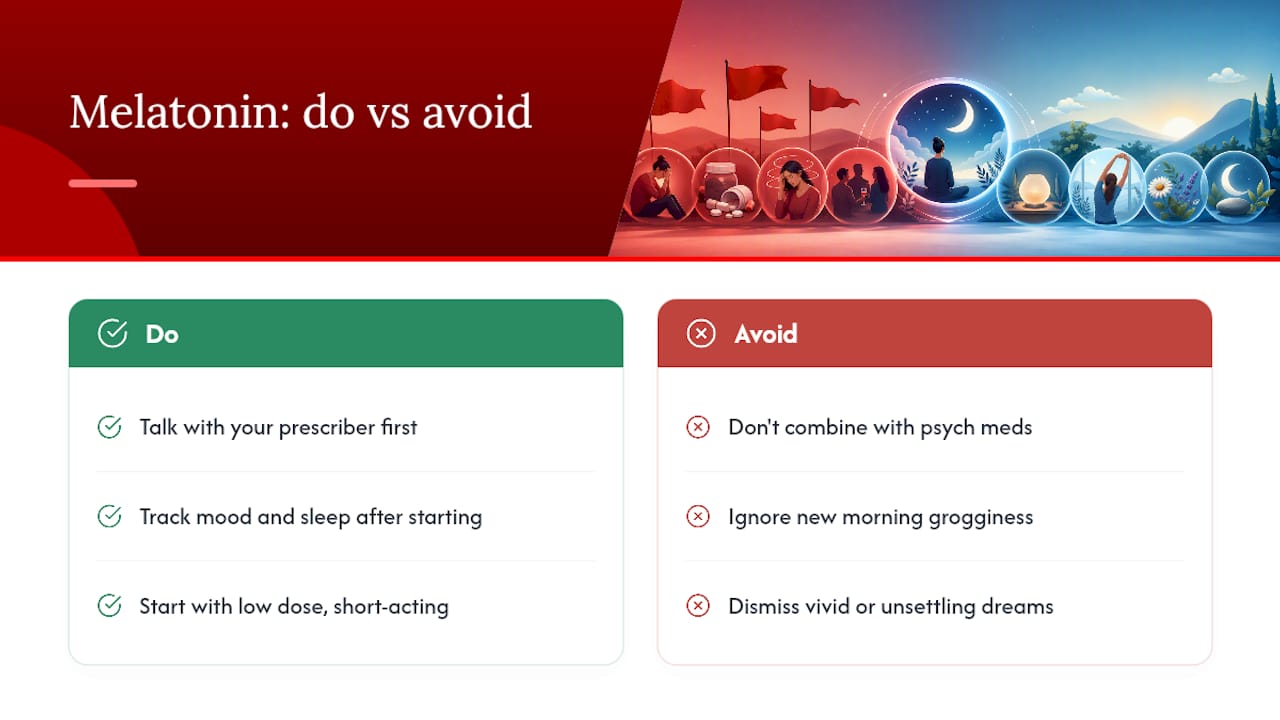
If you’re managing a diagnosed mental health condition, this isn’t a supplement to add on your own initiative. Antidepressants and other psychiatric medications frequently interact with melatonin through the CYP1A2 pathway mentioned earlier, and mood symptoms are exactly the kind of thing worth tracking closely with whoever manages your care. A short conversation with your prescriber before adding melatonin can save weeks of confusing about whether a symptom is your condition, your medication, or the new supplement.
Synthetic vs. Natural Melatonin: Does the Source Change the Risk?
Melatonin sold in Singapore and most other markets is synthetic, made in a lab to be chemically identical to what your pineal gland produces. “Natural” or “animal-derived” melatonin, extracted from sources like bovine pineal tissue, exists but has largely disappeared from the market over contamination concerns, since animal-sourced extracts carry a risk of viral or other biological contaminants that synthetic production avoids entirely.
So for practical purposes, the real variable isn’t synthetic versus natural. It’s formulation and manufacturing quality. Immediate-release synthetic melatonin clears your system faster, which generally means fewer next-day effects but a shorter window of sleep support. Controlled-release versions extend that window at the cost of more lingering grogginess if the dose runs too high for your body.
The bigger risk hiding in plain sight is quality control. A widely cited analysis of commercial supplements found significant mismatches between labeled and actual melatonin content, with some products containing far more melatonin than stated and others containing undeclared serotonin. That variability matters more for your side-effect experience than whether the source is described as synthetic or natural. Two products both labeled “3 mg” can deliver meaningfully different doses, which is exactly why batch-tested, verified suppliers are worth the extra scrutiny when you’re comparing options.
Fromwithin’s Take on Melatonin and Safer Sleep Support
Melatonin genuinely helps some people, and we’re not here to tell you otherwise. But we built Fromwithin around ingredient transparency because too many sleep products ask you to trust a label without earning it. If you’re rethinking melatonin, our piece on choosing the right sleep supplement walks through the tradeoffs honestly. And if you’ve decided melatonin isn’t for you long-term, talk to a clinician about your specific situation before making changes.
— From
A Non-Hormonal Option Worth Knowing About
If everything above has you second-guessing melatonin, particularly the interaction risks or the murky long-term data, you’re not alone, and you do have another route. Fromwithin’s sleep aid was built specifically for people who want to wind down at night without introducing a hormone into their system or gambling on unverified label claims.

It uses patented Wellnex® peptides, absorbed directly into the bloodstream, to support natural relaxation instead of overriding your circadian signaling the way melatonin does. That distinction matters if you’re managing medications, are pregnant or breastfeeding, or simply prefer a supplement where every ingredient is disclosed and dosed transparently. It’s a fit for busy professionals whose evening wind-down has become its own chore, not a replacement prescription. Sleep quality also shows up on your skin, and our piece on how sleep affects skin appearance explains that connection if you’re curious. Check out the sleep aid page to see the full ingredient list and decide if it fits your night.
This article is general information, not a substitute for advice from a qualified doctor. Consult a qualified healthcare professional about your own circumstances before acting on anything here.
Sources
- Melatonin - StatPearls (NCBI Bookshelf)
- Melatonin - Mayo Clinic
- Melatonin: What You Need To Know | NCCIH
