

on September 20, 2026

Passionflower can modestly improve your sleep, mostly by taking the edge off anxiety rather than knocking you out. Clinical trials show it helps some people fall into better-quality sleep and sleep a bit longer, especially when stress is what’s keeping you up in the first place. It’s not a sedative in the prescription-drug sense, and if you’re already taking anything that slows down your central nervous system, you’ll want to talk to your doctor before adding it in.
TL;DR:
- Passionflower may modestly improve sleep quality by reducing anxiety and increasing total sleep time, especially in stress-related insomnia.
- The most reliable results come from standardized extracts rather than loose tea, with doses around those used in clinical trials for consistent effects.
- Passionflower interacts with GABA receptors, calming the brain’s stress response, making it more effective for anxiety-driven sleep issues than mechanical sleep problems.
- Safety concerns are mild but include drowsiness and dizziness, with caution advised when combining it with other sedatives or before surgery; long-term effects remain unknown.
- Start with low doses, track sleep changes over one to two weeks, and prioritize standardized extracts for predictable results.
Table of Contents
- What Does the Research Say About Passionflower and Sleep?
- How Does Passionflower Help You Sleep?
- Tea, Tincture, or Extract: Which Form Should You Try?
- Is Passionflower Safe? Side Effects and Interactions to Know
- How Should You Try Passionflower for Better Sleep?
- Why Standardized Extracts Matter More Than the Herb Itself
- The Honest Take on Passionflower for Sleep
- A Research-Backed Way to Support Your Sleep
- Sources
- FAQ
What Does the Research Say About Passionflower and Sleep?
Here’s what I appreciate about passionflower: it actually has real, published clinical evidence behind it, unlike most herbs sold with a vague “may promote relaxation” label and nothing else. That said, the evidence is encouraging, not overwhelming, and you deserve to know exactly what it does and doesn’t show.
One of the earliest well-designed studies, a double-blind, placebo-controlled trial by Ngan and Conduit, had 41 healthy adults drink passionflower tea for one week. The result: significantly better subjective sleep-quality ratings compared to placebo, based on nightly sleep diaries. People just felt like they slept better.
More recent research has gone further, testing standardized extracts instead of loose tea:
- A 2024 clinical trial using a standardized Passiflora incarnata extract found statistically significant reductions in perceived stress and an increase in total sleep time over 30 days, with no adverse effects reported.
- A separate randomized, placebo-controlled trial using polysomnography in 84 adults with insomnia disorder found total sleep time increased by roughly 23 minutes versus almost no change in the placebo group.
Passionflower’s clearest effect isn’t putting you to sleep faster. It’s helping you stay asleep longer and rate your sleep as better quality. Sleep latency (how fast you doze off) shows mixed results across studies, and the National Center for Complementary and Integrative Health is upfront that the overall evidence base is still small, with short trial durations and inconsistent preparations between studies. Nobody has run a large, long-term trial that settles the question definitively.
How Does Passionflower Help You Sleep?
Passionflower’s calming effect appears to come from how it interacts with GABA, the brain’s main “slow down” neurotransmitter. GABA receptors are what most anti-anxiety medications and sedatives target, and passionflower seems to bind to some of those same receptor sites, gently boosting the brain’s natural braking system rather than forcing sedation the way a prescription hypnotic would.
That mechanism explains a lot about who benefits most:
- If your sleep trouble comes from a racing mind, work stress, or generalized anxiety, passionflower is working with your biology, not against it.
- If your sleep problem is purely mechanical (sleep apnea, restless legs, an irregular schedule), passionflower isn’t going to fix the underlying issue.
- Because it’s mild rather than a strong sedative, don’t expect it to work like a sleeping pill.
One caveat worth flagging: not all passionflower extracts are created equal. A pharmacology review of Passiflora incarnata points out that active compound levels vary meaningfully across preparations, which is exactly why standardized extracts (more on that below) tend to produce more consistent results in trials than random store-bought teas.
Tea, Tincture, or Extract: Which Form Should You Try?
The form you choose matters more than most people assume, because it changes both the dose you’re actually getting and how consistent that dose is night to night.
- Tea: This is the form used in the original 2011 trial, brewed as a simple cup before bed. It’s the most accessible option and the one closest to “traditional use,” but potency varies by brand, batch, and how long you steep it.
- Tincture: Fast-acting and easy to dose in drops, though concentration varies widely between manufacturers and it’s harder to match to a specific trial dose.
- Standardized extract (capsule or liquid): This is what the 2024 clinical trial used, and it’s the form most likely to deliver a dose similar to what was actually tested in humans.
Pro Tip: When you’re comparing products, look for the words “standardized extract” on the label, along with the specific compound it’s standardized to (often a flavonoid percentage). A pharmacology review of Passiflora incarnata notes that a vague “extract” claim without a named marker compound tells you almost nothing about what you’re really getting.
Tea works fine for casual, occasional use. If you want something closer to what was actually studied, a standardized extract is the more predictable bet.
Is Passionflower Safe? Side Effects and Interactions to Know
Passionflower has a solid safety track record in the trials that exist, but “solid” doesn’t mean risk-free, especially once you start mixing it with other things.
- Common side effects are mild but real. WebMD lists drowsiness, dizziness, and confusion as the most frequently reported issues, particularly at higher doses.
- Sedative interactions are the biggest concern. Because passionflower works on GABA pathways, combining it with benzodiazepines, other CNS depressants, or opioids can amplify sedation beyond what either substance would cause alone.
- Surgery requires extra caution. Memorial Sloan Kettering’s clinical summary recommends stopping herbal sedatives like passionflower before scheduled surgery, given the added-sedation risk during anesthesia.
- Pregnancy and breastfeeding safety isn’t established. There isn’t enough reliable safety data to recommend passionflower during pregnancy or while breastfeeding, so this is a clear “ask your doctor first” situation.
- Long-term use hasn’t been well studied. Most trials run days to weeks, not months or years, so what happens with continuous long-term use, including tolerance, remains genuinely unknown.
None of the trials to date, including the one showing a roughly 23-minute increase in total sleep time, reported serious adverse events. That’s reassuring for short-term use, but it isn’t the same as a long-term safety guarantee.
How Should You Try Passionflower for Better Sleep?
Treat this like a small personal experiment, not a leap of faith.
- Start low and stay consistent. Take your chosen form 30 to 60 minutes before bed, at the lowest labeled dose, for at least one to two weeks before judging whether it’s working.
- Track what actually changes. Keep a simple sleep diary, or use a short tool like the Pittsburgh Sleep Quality Index, noting how rested you feel and roughly how long you slept.
- Know what “working” looks like. Falling asleep noticeably faster, waking less during the night, or just feeling more rested in the morning all count. No change after two weeks is a real signal to stop and reassess.
- Pair it with the basics. A consistent wind-down routine and good sleep hygiene do more heavy lifting than any single herb ever will.
Pro Tip: If you notice grogginess the next morning, that’s usually a sign to lower your dose rather than push through it. Passionflower is meant to be gentle. If it doesn’t feel gentle, something’s off.
Why Standardized Extracts Matter More Than the Herb Itself
The single biggest lesson from the clinical research on passionflower isn’t about the plant. It’s about consistency. A cup of tea brewed from a random batch of dried leaves can vary enormously in potency, which is a big part of why sleep-latency results across studies are so mixed.
The 2024 clinical trial that found reduced stress and increased total sleep time used a standardized Passiflora incarnata extract, not loose tea, precisely because standardization lets researchers know exactly what dose participants received night after night. That same logic applies to you as a consumer: a clinically studied, standardized extract gives you a far better chance of reproducing what actually happened in the trial than an unstandardized herbal product does.
The practical decision rule is simple. Reach for tea when you want something low-key and occasional. Reach for a standardized supplement when you want dosing that’s actually predictable, night after night.
The Honest Take on Passionflower for Sleep
Passionflower gets marketed as a cure-all calming herb, and that oversells it. The research actually supports something narrower and, frankly, more useful: a mild anxiolytic that helps some people sleep better because it quiets the stress response keeping them awake in the first place. That’s a meaningfully different pitch than “natural sleeping pill,” and I think readers deserve that distinction instead of vague wellness-blog optimism.
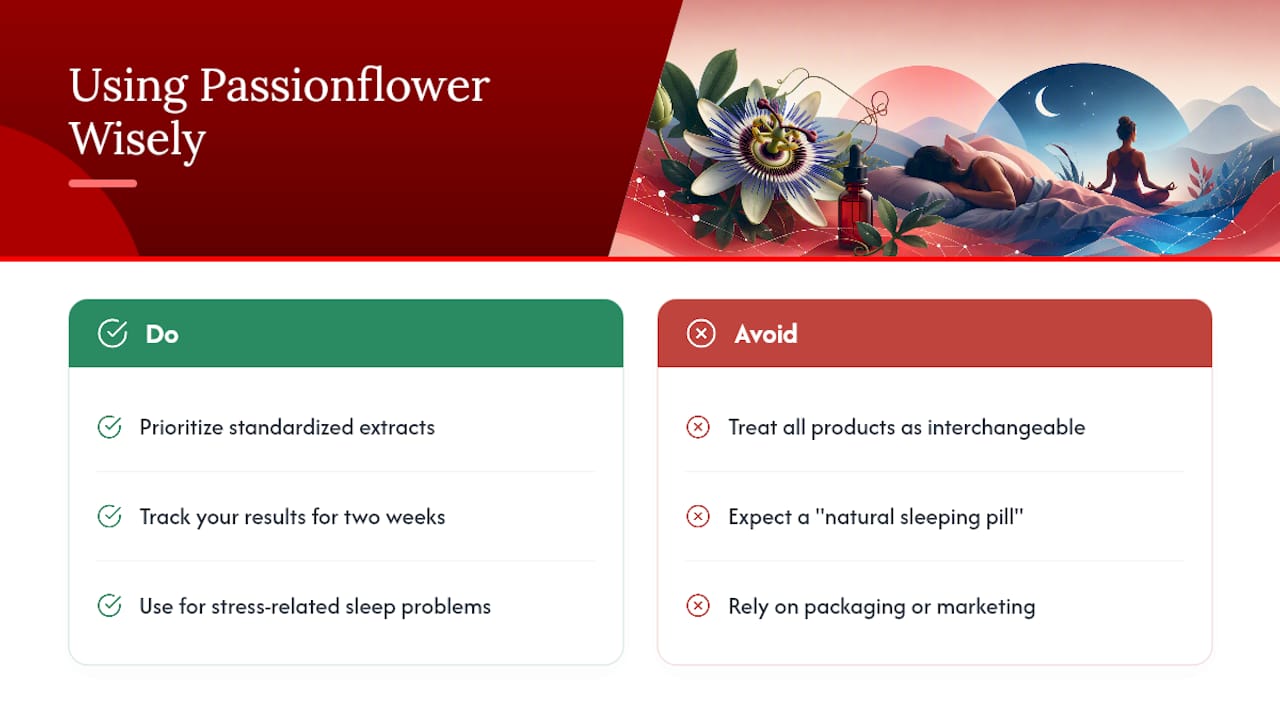
Where conventional advice falls short is treating all passionflower products as interchangeable. A grocery-store tea bag and a standardized clinical-grade extract are not the same intervention, even though they share a name on the label. If you’re the kind of person who wants results you can actually predict, prioritize the extract’s standardization over the marketing copy around it.
Start there, track your own results for two weeks, and let your own data, not the packaging, tell you whether it’s worth continuing.
— From
A Research-Backed Way to Support Your Sleep
If you’ve read this far, you already know that not all passionflower products deliver what the clinical trials actually tested. That’s the gap Sleep Better – Liquid Calm & Deep Sleep Support is built to close. It’s a non-melatonin, non-hormonal formula designed around clinically researched, clearly named ingredients, so you’re not left guessing whether your “calming tea” is anywhere near a studied dose.

The brand builds its products around patented peptides designed for absorption and emphasizes manufacturing in facilities that maintain quality control to ensure label accuracy. That’s the same standardization principle the passionflower research points to, applied to a formula meant for busy adults whose evenings don’t leave room for guesswork. If better sleep and clearer, more transparent ingredients sound like what you’ve been looking for, browse Sleep Better and see whether it fits your wind-down routine tonight.
Sources
- Clinical trial: standardized Passiflora incarnata extract (2024)
- Ngan A, Conduit R. Double-blind placebo-controlled study (2011)
- Polysomnography trial: Passionflower effects on objective sleep parameters
- NCCIH: Passionflower overview
- WebMD: Passionflower - Uses, Side Effects, and More
This article is general information, not a substitute for advice from a qualified doctor. Consult a qualified healthcare professional about your own circumstances before acting on anything here.
FAQ
Does Passionflower Help You Sleep at Night?
Yes, for many people it modestly improves sleep quality and can extend total sleep time, particularly when anxiety or stress is behind the poor sleep. It works better as a calming aid than as a fast-acting sleep-onset remedy, based on the clinical trials reviewed above.
Is Passionflower Safe to Take Daily?
Short-term daily use, up to a few weeks, appears safe in the trials conducted so far, with no serious adverse effects reported. Long-term daily use hasn’t been well studied, so check with a doctor before continuing it for months at a time, especially if you take other sedating medications.
What Is the Strongest Herb for Sleep?
There’s no single “strongest” herb backed by strong universal evidence. Valerian and melatonin are more commonly used for sleep-onset issues, while passionflower tends to work best for anxiety-driven wakefulness, so the right choice depends on what’s actually disrupting your sleep.
How Much Passionflower Should You Take for Sleep?
Trial doses varied: the tea study used one cup nightly for a week, while the 2024 extract trial used a standardized capsule dose taken over 30 days. Since potency differs by product, follow the label of whichever standardized extract or tea you choose and start at the lowest suggested amount.
