

on August 25, 2026

The fastest way to unwind after work is a three-part sequence: a 10 to 15 minute soft shutdown, a 10-minute transition ritual, and a 20-minute analog pocket with zero screens. Do these in order, and your brain gets the signal that the workday is genuinely over, not just paused.
More than half of employed adults say they struggle to relax after work, and passive screen time is often the reason. Scrolling feels like rest, but it rarely gives your nervous system the actual recovery it needs.
If you have energy left, go active: a 10-minute walk followed by light stretching burns off restlessness fast. If you’re running on empty, go calm: five minutes of slow breathing followed by a three-line journal entry (what happened, what’s unresolved, one word for how you feel) does the same job with less effort.
- Soft shutdown (10 to 15 min): close tabs, write tomorrow’s first task, put the laptop away.
- Transition ritual (10 min): walk, shower, or a specific playlist.
- Analog pocket (20 min): a book, a hobby, or a conversation with no phone nearby.
Key Takeaways
Unwinding after work works best as a three-step sequence: a 10 to 15 minute soft shutdown, a short transition ritual, and a screen-free analog pocket, matched to whether your day drained you mentally, physically, or socially.
| Point | Details |
|---|---|
| Soft shutdown first | Spend 10 to 15 minutes closing tabs, writing a tomorrow line, and setting a firm end time. |
| Match activity to need | Diagnose whether you’re mentally rehearsing tasks, restless, or under-connected before picking a routine. |
| Compress, don’t skip | On low-energy nights, use 2 to 3 minute micro-routines instead of abandoning the ritual entirely. |
| Watch hydration and caffeine | Rehydrate before your wind-down and cut caffeine well before evening to avoid feeling wired. |
| Fromwithin as adjunct | The brand’s non-hormonal sleep aid and Wellnex® collagen peptides support relaxation and skin recovery once behavior habits are in place. |
Table of Contents
- Why Unwinding After Work Matters More Than You Think
- What Are the Best Ways to Unwind After a Stressful Day?
- How to Run a Soft Shutdown Ritual in Under 15 Minutes
- What Does Your Evening Actually Need to Recover?
- Micro-Routines for Nights When You Have Nothing Left
- Making Your Wind-Down Routine Stick Without Extra Effort
- Can Supplements Help You Unwind After Work?
- What to Eat and Drink If You Want to Actually Relax
- Why Your Wind-Down Routine Keeps Falling Apart
- Sources
Why Unwinding After Work Matters More Than You Think
Skipping a transition doesn’t just feel unpleasant. It has a name: the Zeigarnik effect, the tendency for unfinished tasks to keep intruding on your thoughts until you give them some kind of closure. That half-written email or unresolved Slack thread doesn’t stay at your desk. It rides home with you and shows up again at 11 p.m. when you’re trying to fall asleep.
Related research found that 79% of employees report work-related stress on a monthly basis, which is a lot of unresolved mental residue accumulating night after night.
Closure rituals, even brief ones, reduce the rumination that keeps the workday looping in your head long after you’ve clocked out.
A deliberate transition ritual, something as simple as changing clothes or taking a short walk, interrupts that loop. The payoff shows up in concrete places: faster sleep onset, a calmer mood by dinner, and over time, a lower risk of burnout.
What Are the Best Ways to Unwind After a Stressful Day?
Not every relaxation technique restores the same thing. Pick based on what your day actually drained.
- Active reset (10 minutes). A brisk walk or a short mobility routine works because movement and brief outdoor exposure improve mood and stress regulation. Script: walk to the end of the block and back, then do 10 slow shoulder rolls and two calf stretches.
- Mindful reset (5 to 12 minutes). Start with five minutes of slow breathing, in for four counts, out for six. If you have more time, try a 12-minute body-scan meditation that walks you through releasing tension from your feet to your jaw.
- Cognitive offload (3 minutes). Write three lines: what’s unfinished, what’s worrying you, and one task for tomorrow. This kind of journaling reduces rumination and supports emotional processing, which is exactly what a racing mind needs before bed.
- Social or creative reset (10 to 15 minutes). A short call with a friend, ten minutes on a hobby, or a playlist you only play in the evening. Music tied to a specific time of day becomes a cue your brain learns to associate with winding down.
- Sensory anchor (2 minutes). A warm shower, a specific scent, or changing out of work clothes. These are small actions, but they’re reliable. Once your brain links a scent or a piece of clothing to “off duty,” it starts relaxing before you’ve consciously decided to.
Pro Tip: Pick one anchor from each category (one active, one mindful, one sensory) and rotate them by how your day actually felt, not by what sounds most productive.
How to Run a Soft Shutdown Ritual in Under 15 Minutes
Healthline recommends a 10 to 15 minute “soft shutdown” built around explicit closure, not just logging off. Here’s the sequence:
- Step 1: Close the loop. Close every open tab or bookmark them, then write one “tomorrow line,” a single sentence naming the first task you’ll tackle next.
- Step 2: Change the environment. Move your laptop out of sight, switch on a lamp instead of overhead lighting, or light a specific scent you only use in the evening.
- Step 3: Set a hard boundary. Put your work phone in a drawer, cover your laptop, and name a firm end time out loud.
Commuters can fold this into the ride home: the commute itself becomes the transition. Remote workers need a substitute. Healthline notes that a short “fake commute,” a walk around the block with no destination, helps remote workers draw the same line that a real commute draws automatically. Pair this checklist with a written evening wind-down routine if you want a version you can keep on your phone.
| Step | What It Prevents |
|---|---|
| Tomorrow line | Task rumination and 11 p.m. re-planning |
| Environment change | Work cues bleeding into home space |
| Fake commute | Boundary erosion for remote workers |
What Does Your Evening Actually Need to Recover?
Not every stressful day drains the same resource, and defaulting to the couch and your phone often misses what you actually need. Clinical psychologists point out that the most restorative activity replenishes the specific resource the day used up, rather than just distracting you from it.
Ask yourself one question before you pick an activity:
- Still mentally rehearsing tasks or conversations? You need cognitive closure. Do the three-line brain dump, then read fiction for 20 minutes.
- Drained but physically restless? You need movement. A walk or 10 minutes of stretching beats sitting still.
- Isolated or under-connected all day? You need social contact. A 10-minute call outperforms an hour of solo scrolling.
- Wired and can’t settle? You need sensory calm. Warm shower, dim lights, one playlist, in that order.
A useful two-week rebalance: alternate movement-heavy evenings on days packed with meetings, social evenings after heads-down solo work, and pure sensory/mindful evenings after anything emotionally taxing. Rotating deliberately, instead of reaching for whatever’s easiest, is what actually restores balance over time.
Micro-Routines for Nights When You Have Nothing Left
Some nights, even a 20-minute plan feels like too much. That’s fine. Compress it instead of skipping it.
- Two-minute breathing reset. Four counts in, six counts out, ten times. Do it on the couch, still in your coat.
- Three-line journal. What happened, what’s unresolved, one word for how you feel.
- Two-minute tidy. Clear one surface. A tidy corner reduces visual noise your brain reads as unfinished work.
- Warm rinse. A hot shower or even just washing your face resets your body temperature and signals “day’s done.”
- Change clothes. This single sensory cue does a surprising amount of work on its own.
On these nights, compressing into sensory and environmental changes beats forcing a full routine, consistency matters more than length. If you’re choosing between sleep and a social call, choose sleep unless the isolation itself is what’s wearing you down.
Making Your Wind-Down Routine Stick Without Extra Effort
The routines above only work if you actually do them on the nights you don’t feel like it. That comes down to habit design, not willpower.
- Pick two anchors, not ten. One transition ritual (change clothes) and one recovery activity (walk or journal) is enough to start.
- Attach them to something that already happens. Right after you close your laptop, right when you walk through the door.
- Add one small reward. Tea, a specific playlist, five minutes with a hobby you enjoy, something that makes the routine feel good, not like homework.
- Track it minimally. A checkmark on a calendar for “did the shutdown” is enough signal to keep going.
- Expect disruption. Travel, late shifts, and social plans will break the routine. Restart with just one anchor the next available night instead of trying to catch up all at once.
Pro Tip: If your schedule genuinely varies week to week, anchor the routine to your last work action of the day, not a clock time, so it travels with you.
Can Supplements Help You Unwind After Work?
Behavior change comes first. A consistent shutdown ritual and matched recovery activity do more for evening stress than any product on a shelf. But for people who’ve built the habits and still find their body won’t settle, a clinically researched supplement can be a reasonable adjunct, not a replacement.
Fromwithin builds its sleep aid around ingredient transparency rather than proprietary blends, and it skips melatonin and other hormonal ingredients, aiming to support relaxation without the grogginess some sleep aids leave behind. The brand’s collagen line uses patented Wellnex® peptides, engineered for direct bloodstream absorption, which the brand cites as central to visible improvements in skin elasticity.
A supplement can support the biology of winding down. It can’t do the closure work that a soft shutdown or a brain dump does. Those two things solve different problems.
- Clinically researched formulations with disclosed ingredient lists.
- Non-hormonal sleep support designed for busy adults, not shift-based dependence.
- Collagen peptides positioned for skin elasticity, not just marketed claims.
What to Eat and Drink If You Want to Actually Relax
What you eat and drink in the two hours after work has a real effect on whether your evening routine actually works. Heavy, greasy meals eaten fast tend to leave you sluggish rather than calm, which makes it harder to get through even a 10-minute walk or stretch session. A lighter dinner with protein and vegetables tends to sit better and doesn’t fight your body’s effort to downshift.
Hydration matters more than most people realize after a day at a desk. Mild dehydration shows up as fatigue and irritability, feelings that get mistaken for stress when the fix is a glass of water, not a longer wind-down routine. Aim to rehydrate before you start your soft shutdown, not during your analog pocket time when you’re trying to switch off.
Caffeine timing is worth a second look if evenings feel wired rather than tired. A 3 p.m. coffee can still be active in your system at 9 p.m., undercutting every relaxation technique that follows. Alcohol deserves the same scrutiny. It feels relaxing in the moment but tends to fragment sleep later, which cancels out whatever calm your evening routine built.
A warm, decaffeinated drink, herbal tea, warm milk, or plain hot water with lemon, can double as a sensory anchor. Pairing it with your transition ritual gives your evening one more reliable cue that the workday has ended.

Why Your Wind-Down Routine Keeps Falling Apart
The most common barrier isn’t lack of motivation. It’s bringing work devices into the exact space where you’re supposed to be unwinding. A phone on the couch arm means one “quick check” turns into twenty minutes of email, and the soft shutdown never actually finishes.
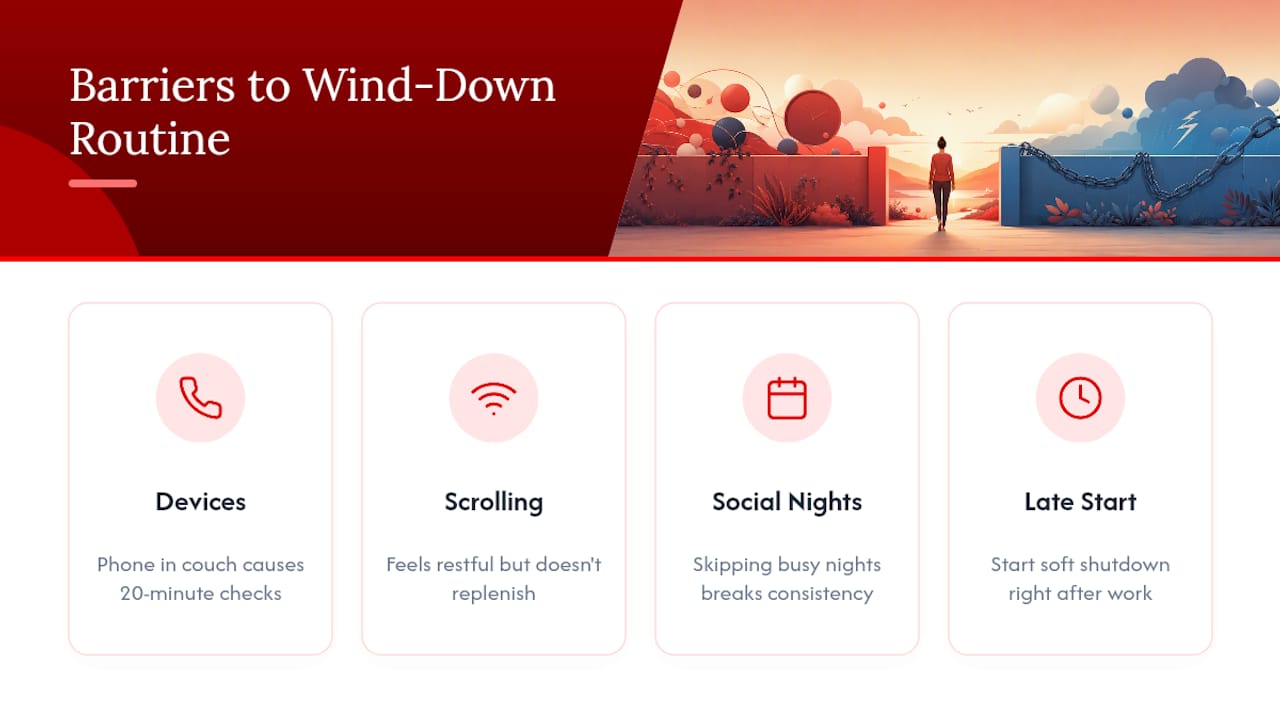
A second barrier is treating unwinding as passive. Scrolling feels restful because it requires no effort, but it doesn’t replenish the specific resource your day used up, which is why you can spend an hour on your phone and still feel just as tense as when you sat down.
Late nights and social obligations are a third barrier. If you skip the routine entirely on busy nights, you never build the consistency that makes it automatic. The fix isn’t forcing the full 20-minute version. Drop to the two-minute micro-routines instead of skipping altogether.
Finally, some people wait until they’re already overwhelmed to start winding down, by which point cortisol has been climbing for hours. Starting the soft shutdown the moment work ends, rather than after dinner or right before bed, gives the routine far more room to actually work.
A Note From Fromwithin on Why Evenings Deserve This Much Attention
We built Fromwithin because we kept hearing the same thing from busy professionals: the workday ends, but the tension doesn’t. That gap between clocking out and actually feeling calm is where most evening routines fail. If you want a version of this you can follow tonight, our evening relaxation routine for busy professionals breaks it down step by step.
— From
A Gentle Next Step If Your Body Still Won’t Settle
If you’ve built the soft shutdown, the transition ritual, and the analog pocket, and your body still fights sleep or your skin shows the wear of stress and poor rest, that’s exactly where a targeted supplement earns its place, as backup, not a shortcut.

Fromwithin’s sleep aid skips melatonin and hormonal ingredients entirely, built instead on transparent, disclosed ingredients meant to support relaxation without next-morning grogginess. For the skin toll that chronic stress and poor sleep leave behind, the collagen line uses patented Wellnex® peptides designed for direct bloodstream absorption, aimed at visible improvements in elasticity over time. Neither replaces the habits in this article. Both are built for the nights when habits alone aren’t quite enough. Start with the routine tonight, and check the sleep aid’s ingredient list if you’re still wired by 10 p.m. this week.
Sources
- Psychologists Explain Common Mistakes People Make Trying To Relax - Newsweek
- How to Decompress After Work: Evening Rituals That Help - Healthline
- A 12-minute body-scan meditation for letting go of stress and falling asleep - Mindful
