

on September 14, 2026

Valerian root shows no objective benefit for insomnia in the best available evidence, though some people report modestly falling asleep faster or feeling calmer at night. It’s generally well tolerated in typical doses, but it can interact with sedatives, alcohol, and certain medications, so anyone on other sleep aids or with liver disease should check with a clinician first. The sections below walk through what the research actually found, how to dose it safely, what to look for in a quality product, and which alternatives might work better for you.
TL;DR:
- Most quality research shows valerian provides no measurable objective improvement in sleep latency or total sleep time for insomnia.
- Subjective reports of feeling calmer or falling asleep faster are common but do not correlate with lab-based sleep measurements.
- Dosing varies widely, typically 300 mg to 600 mg before bed, with effects taking two to four weeks of nightly use to manifest.
- Valerian is generally safe at typical doses but can cause side effects like headache, stomach upset, vivid dreams, and grogginess, especially with higher doses.
- Its interactions with alcohol, sedatives, and liver conditions require consulting a healthcare professional before use.
Table of Contents
- What the Evidence Says About Valerian for Sleep
- Is Valerian Safe? Side Effects and Drug Interactions
- How Much Valerian Should You Take, and How Long Until It Works?
- Why Valerian Products Vary So Much (and How to Pick a Better One)
- A Safer Way to Try Valerian for Yourself
- Where Clinically Researched Supplements Fit Into the Picture
- Should You Actually Try Valerian?
- Fromwithin’s Approach to Evening Relaxation
- Sources
- FAQ
What the Evidence Says About Valerian for Sleep
The most rigorous evidence to date comes from a 2024 umbrella review that pooled findings from eight systematic reviews covering roughly 15,716 subjects. Its conclusion was blunt: there’s no objective evidence that valerian improves insomnia on measures like sleep latency or total sleep time measured in a lab. That’s a meaningful downgrade from valerian’s reputation as a gentle, reliable sleep herb, and it’s why the American Academy of Sleep Medicine’s 2017 guideline recommends against using it for chronic insomnia in adults.
Here’s where it gets more interesting, though. “No objective benefit” doesn’t mean “no effect on anyone.” Some individual trials, including a meta-analysis of valerian’s impact on subjective sleep quality, found that participants reported falling asleep a little faster or sleeping more soundly, even when polysomnography (the overnight brain-wave and breathing monitors used in sleep labs) showed no measurable change. That gap between how people feel and what machines record is one of the most consistent patterns in herbal sleep research.
Why the disconnect? A few structural problems keep showing up across the literature:
- Dose variability. Some trials used 300 mg, others 600 mg, with doses varying, making it hard to compare results apples to apples.
- Extract inconsistency. Valerian products differ widely in valerenic acid content, the compound believed to interact with sleep-related brain receptors, so “valerian” in one study isn’t chemically the same as “valerian” in another.
- Small sample sizes. Many individual trials enrolled only a few dozen participants, which makes it easy for a modest placebo response to look like a real effect.
- Mismatched endpoints. Some studies measured subjective sleep diaries, others measured objective sleep-lab data, and a few measured anxiety symptoms instead of sleep at all.
A 2024 umbrella review of 8 systematic reviews and roughly 15,716 subjects found no objective evidence that valerian benefits insomnia, even though subjective results varied from trial to trial.
The NIH Office of Dietary Supplements fact sheet echoes this, noting that while some trials reported modest subjective improvements, the overall body of evidence remains inconclusive because of these methodological gaps. And NCCIH’s own review lands in the same place: valerian is widely used for sleep and anxiety, but the science backing it hasn’t caught up with the tradition.
None of this means valerian is useless. It means the honest answer is “it might help some people modestly, and it clearly doesn’t help on the outcomes that matter most to sleep researchers.”
Is Valerian Safe? Side Effects and Drug Interactions
Valerian’s side-effect profile is generally mild, which is part of why it has stayed popular for centuries. The most commonly reported issues include headache, stomach upset, vivid or unusual dreams, and next-morning grogginess, particularly at higher doses. Rare case reports have flagged possible liver injury, almost always in situations where valerian was combined with other herbal ingredients rather than taken alone, so it’s worth being cautious with multi-herb “sleep blend” products.
The bigger safety concern isn’t valerian by itself. It’s what you take alongside it. Mayo Clinic’s overview warns specifically about combining valerian with:
- Alcohol
- Benzodiazepines (like diazepam or lorazepam)
- Narcotic pain medications
- Other central nervous system depressants
- St. John’s Wort
Stacking any of these with valerian can amplify sedation beyond what either substance would cause alone, which raises the risk of dangerous next-day impairment or breathing suppression in more severe cases.
A few groups should skip valerian entirely or only use it under direct medical supervision: pregnant and breastfeeding people, since safety data simply don’t exist for them; anyone with liver disease, given those rare injury reports; and children, where dosing hasn’t been established. If you’ve used valerian nightly for weeks or months, don’t stop cold. Practitioners note that abrupt discontinuation after prolonged use can, in rare cases, produce rebound symptoms, so tapering off gradually is the more prudent path.
Pro Tip: Before your first dose, check every medication and supplement you currently take against valerian, including anything for anxiety, pain, or allergies, and skip driving or operating machinery until you know how it affects you the next morning.
How Much Valerian Should You Take, and How Long Until It Works?
Most clinical trials used moderate doses typically taken before bed, with higher doses sometimes causing more morning sedation but without clear increased benefit.
If you prefer tea or dried root instead of capsules, the rough equivalent is 2 to 3 grams of dried valerian root steeped per cup, taken on the same before-bed schedule.
Timing matters as much as amount. Unlike a sleeping pill, valerian isn’t designed to knock you out fast. The ODS fact sheet and related trial data suggest that any benefit tends to build with consistent nightly use over two to four weeks, not after a single dose. If you try valerian once and feel nothing, that’s expected. Judging it after one night is like judging a gym membership after one workout.
A short practical list to keep in mind while you trial it:
- Start at the low end (300 mg) rather than jumping straight to 600 mg or higher.
- Take it at the same time each night so you can actually track whether it’s working.
- Give it two to four full weeks before deciding it isn’t for you.
- Watch for morning grogginess as a sign your dose might be too high.
Why Valerian Products Vary So Much (and How to Pick a Better One)
Part of the reason valerian’s research looks so inconsistent is that the supplement industry hasn’t solved the standardization problem. Valerenic acid, the active constituent researchers believe interacts with sleep-related brain chemistry, appears in wildly different concentrations from one brand to the next. Research and expert commentary consistently point to extract quality variability as one of the biggest reasons trial results don’t line up cleanly with each other.
Here’s how to shop smarter given that reality:
- Look for third-party testing. Seals from USP, NSF, or a ConsumerLab review indicate the product has been independently checked for what’s actually inside the bottle.
- Read the label for standardization. A product that states its valerenic acid percentage gives you more confidence than one that just says “valerian root extract.”
- Skip proprietary blends. If a label hides individual ingredient amounts behind a blend name, you have no way to know your actual dose.
- Be cautious with combination formulas. Products that mix valerian with melatonin, hops, or passionflower might work, but you won’t be able to tell which ingredient is doing the work, or whether one is causing an unwanted side effect.
Pro Tip: If you’re evaluating whether valerian is helping you, choose a single-ingredient, standardized product first. Once you know how your body responds to valerian alone, you can decide if a combination formula makes sense.
A Safer Way to Try Valerian for Yourself
Before reaching for any supplement, fix the basics first. A consistent sleep hygiene routine, cutting off caffeine by early afternoon, and a real wind-down period before bed solve more sleep problems than any herb on the shelf. If you’ve done that and still want to trial valerian, here’s a simple protocol:
- Choose a single-ingredient, standardized product with a clear dose on the label.
- Start at 300 mg, taken 30 minutes to two hours before your target bedtime.
- Keep a short sleep diary for two to four weeks, noting how long it takes you to fall asleep and how you feel the next morning.
- Adjust only after that window, not after one or two nights.
Watch for these stop signs along the way:
- Your sleep gets noticeably worse, not better.
- You feel groggy, foggy, or impaired well into the next day.
- You notice new symptoms like stomach pain, jaundice, or unusual fatigue.
If any of those show up, or if two to four weeks pass with no improvement, that’s your signal to stop and talk to a clinician rather than pushing the dose higher. Bring your current medication list, the exact product and dose you tried, and your sleep diary. Pairing a trial like this with an evening wind-down checklist gives the supplement its best shot at actually showing an effect, if one exists for you.
Where Clinically Researched Supplements Fit Into the Picture
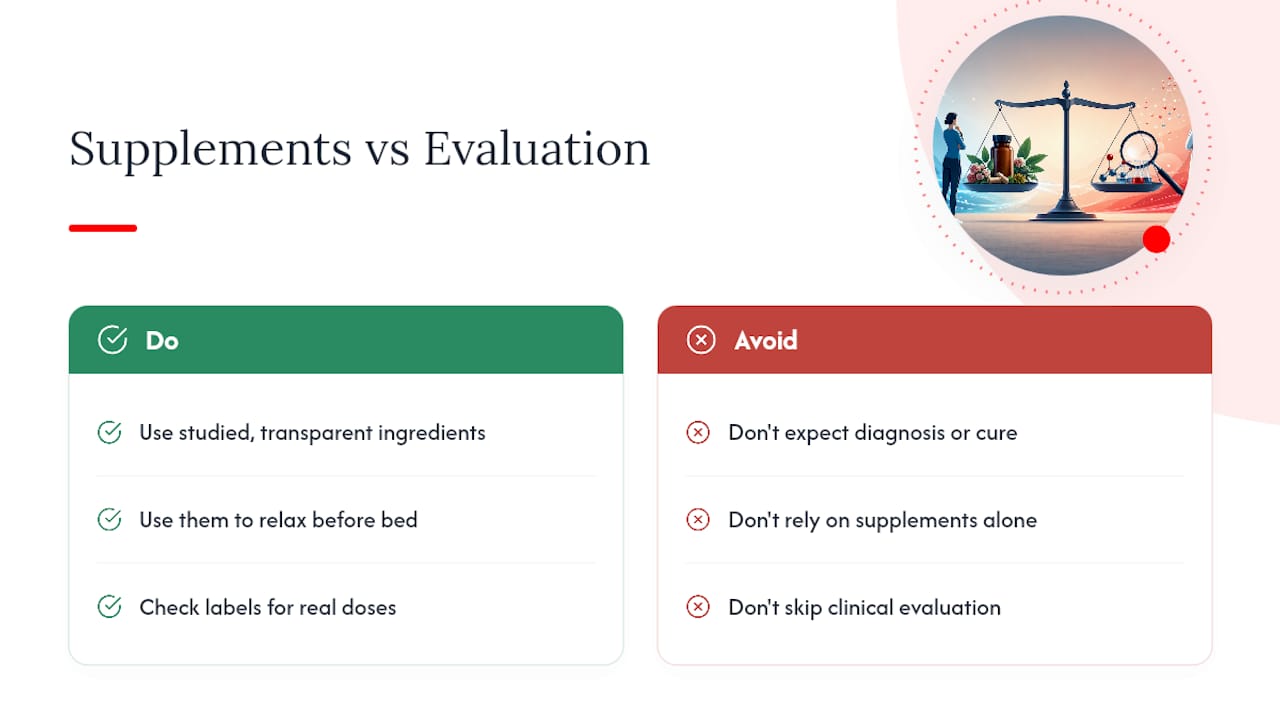
Wellness brands built around a simple belief emphasize that if a product touches your sleep or your body, you deserve to know exactly what’s in it and why. That’s the same standard we’d apply to any herb, including valerian. Clinically researched ingredients, tested at real doses with transparent labeling, can be a reasonable piece of an evening routine. They aren’t a replacement for figuring out why your sleep is off in the first place.
That distinction matters more than most supplement marketing admits. A product built on transparent, studied ingredients can support relaxation and help you wind down. It cannot diagnose or fix chronic insomnia, sleep apnea, or an anxiety disorder driving your sleeplessness. Anyone dealing with sleep trouble night after night, not occasionally, deserves an actual evaluation, not just a better bottle on the nightstand.
Should You Actually Try Valerian?
If you’re an occasional bad sleeper, someone who takes a while to wind down after a stressful day but sleeps fine most nights, a measured valerian trial after cleaning up sleep hygiene is a reasonable, low-risk experiment. Set your expectations honestly: some people notice a subjective difference, and the objective evidence backing that difference is thin.
If you’re dealing with chronic or severe insomnia, valerian isn’t the right first move. Cognitive behavioral therapy for insomnia and a proper clinical evaluation consistently outperform herbal options in the guidelines that matter, and a supplement shouldn’t be the thing standing between you and that conversation. Herbs can be part of a routine. They’re a poor substitute for finding out what’s actually keeping you up.
— From
Fromwithin’s Approach to Evening Relaxation
If you’ve read this far, you know valerian’s evidence is mixed and its safety profile requires some care. Fromwithin’s sleep aid takes a different route: no melatonin, no hormones, and a transparent list of clinically researched ingredients formulated to support relaxation as part of your evening wind-down, without the guesswork that comes with unstandardized herbal extracts.

Every ingredient and dose is listed on the label, reflecting transparency that is important to consider when choosing supplements. If you’re currently taking other sleep medications, sedatives, or have a liver condition, talk to your clinician before adding anything new to your routine, including this one. If you’re ready to see whether an evening routine built on transparent, non-hormonal ingredients fits your nights better than an unstandardized herb, check out the sleep aid and see how it’s formulated.
This article is general information, not a substitute for advice from a qualified doctor. Consult a qualified healthcare professional about your own circumstances before acting on anything here.
Sources
- Does valerian work for insomnia? An umbrella review of the evidence
- Clinical practice guideline for the pharmacological treatment of chronic insomnia in adults: an American Academy of Sleep Medicine guideline
- Valerian: Usefulness and Safety | NCCIH
- Valerian - Health Professional Fact Sheet
- Valerian: A safe and effective herbal sleep aid? | Mayo Clinic
FAQ
Is Valerian Better for You Than Melatonin?
Neither has strong evidence for objective sleep improvement, but they work differently: melatonin targets your circadian rhythm, while valerian is thought to act on calming brain receptors. Melatonin has more robust trial data for jet lag and shift work, while valerian’s evidence for insomnia remains inconsistent.
Is Valerian Safe to Take Every Night?
Valerian is generally well tolerated for short-term nightly use in typical doses, but long-term nightly safety data is limited, and abrupt discontinuation after extended use can occasionally cause rebound symptoms. Anyone using it nightly for more than a few weeks should check in with a clinician.
What Are the Negative Side Effects of Valerian Root?
The most common side effects are headache, stomach upset, vivid dreams, and next-morning grogginess, especially at higher doses. Rare reports link liver injury to valerian, mostly when combined with other herbal ingredients rather than taken alone.
What Is the Strongest Herb for Sleep?
No single herb has strong, consistent objective evidence for treating insomnia, including valerian, chamomile, and passionflower. Clinical guidelines favor evidence-based approaches like cognitive behavioral therapy for insomnia over any herbal remedy for people with persistent sleep problems.
