

on July 16, 2026

A patented peptide is a specifically engineered peptide or peptide complex protected by intellectual property law due to its unique structure, delivery mechanism, or synergistic composition. If you’ve been reading beauty labels and wondering what separates a patented peptide from any other ingredient, you’re asking exactly the right question. Peptides rank among the top five recognized beauty ingredients in 2026, and the “patented” distinction matters more than most labels suggest. Understanding patented peptides helps you make smarter choices about the supplements and skincare products you put into and onto your body.
What is a patented peptide, and how does it differ from regular peptides?
A peptide is a short chain of amino acids, fewer than 50 in total, that signals your cells to perform specific functions like producing collagen or repairing tissue. Proteins are simply longer versions of these chains. Your body naturally produces many peptides, and these are called native peptides. They do important work, but they come with a real limitation: they break down quickly before reaching their target.
A patented peptide goes further. It is a peptide that has been modified, stabilized, or combined with other ingredients in a way that is novel enough to earn legal protection. The modification might involve a new amino acid sequence, a proprietary delivery system, or a combination of peptides that work together in a way no single peptide can achieve alone. Synthetic analogues are engineered versions designed for improved stability and function compared to native peptides.

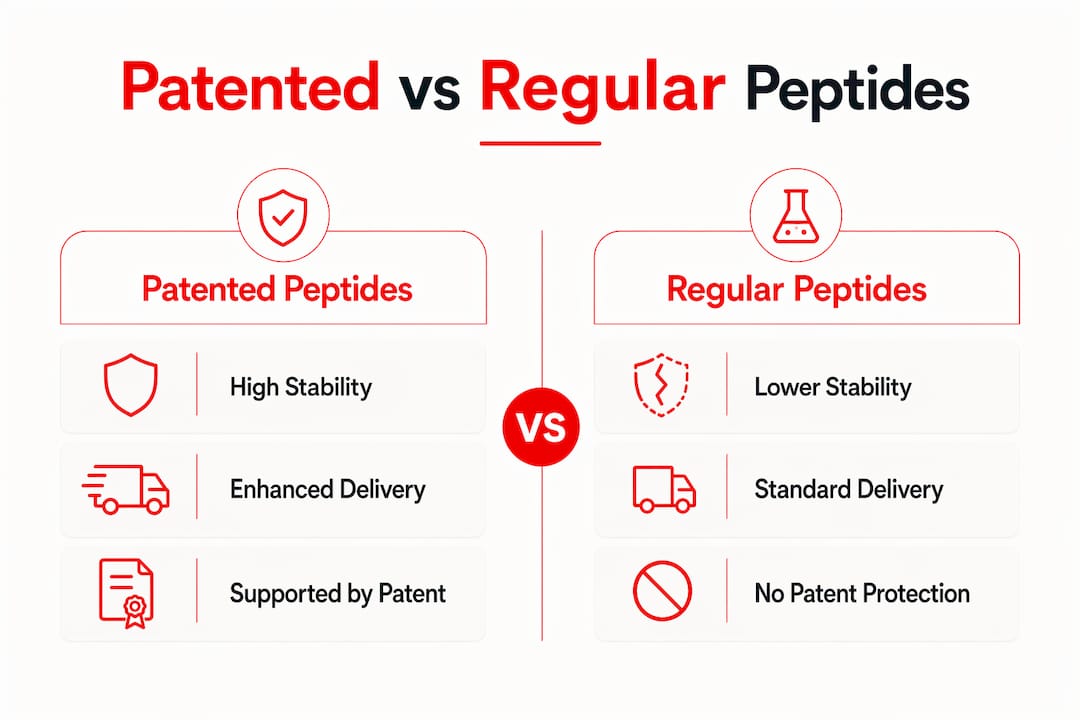
The key difference comes down to performance and protection. A native peptide is like a letter written in pencil. It delivers a message, but it smudges easily. A patented peptide is that same letter written in permanent ink, sealed in a protective envelope, and delivered directly to the right address. The patent exists because the innovation required to achieve that reliability is genuinely new.
Here is what typically sets patented peptides apart from standard options:
- Novel amino acid sequences that do not occur naturally and are engineered for a specific biological target
- Structural modifications that prevent the peptide from degrading before it reaches skin cells or the bloodstream
- Proprietary delivery systems such as cyclodextrin stabilization, which wraps the peptide in a protective molecular shell
- Dual or multi-peptide complexes that combine two or more peptides into a single formulation for synergistic effects
- Conjugation technologies that attach the peptide to a carrier molecule, improving penetration and bioavailability
Each of these innovations requires significant research investment. That investment is what the patent protects.
Why do patents matter in peptide science and consumer trust?
Patents in peptide science serve two purposes: they protect the inventor’s investment, and they signal to consumers that a formulation has cleared a high bar of novelty. To earn a patent, an invention must be both novel and non-obvious. That means a patented peptide is not just a slight tweak. It represents a genuinely new approach to solving a biological problem.
Consumer awareness of peptides in skin and haircare product launches has doubled from 2021 to 2026, showing how quickly this category has grown. That growth has also intensified competition, which makes patent protection more valuable than ever.
Here is how patents shape the peptide industry at every level:
- R&D incentive. Companies invest in peptide research because patents give them exclusive rights to profit from their discoveries for a set period. Without that protection, there is little financial reason to fund expensive clinical work.
- Consumer confidence. The “patented” label signals scientific validation, improved ingredient penetration, and credible efficacy claims. Shoppers associate it with rigor, not just marketing.
- Market exclusivity. A patented peptide cannot be copied during the patent term. That exclusivity keeps the formulation unique to the brand that developed it.
- Innovation pressure. When patents expire, competitors can produce biosimilars or analogues. This pressure, known as the peptide patent cliff, drives brands to keep developing new protected formulations.
- Regulatory credibility. Patent offices in the US and internationally require detailed technical disclosures. That documentation adds a layer of scientific accountability that unpatented ingredients do not have.
The peptide patent cliff threatens $200 billion in drug sales between 2024 and 2030. That pressure is pushing brands to develop more complex, proprietary peptide formulations rather than relying on older, off-patent sequences.
Pro Tip: When evaluating a beauty supplement, look for the specific patent number or the name of the patented ingredient on the label. A brand that lists “Wellnex® peptides” or cites a patent number is giving you something verifiable, not just a marketing claim.
What are the real benefits of patented peptides in beauty and wellness?
Patented peptides deliver benefits that standard peptide ingredients often cannot match, and the difference shows up in clinical results. The reason is simple: patented formulations are engineered to survive the journey from product to cell.
Here are the core benefits you can expect from well-formulated patented peptides:
- Collagen stimulation. Patented peptides signal fibroblasts, the cells responsible for collagen production, to work harder. This leads to firmer, more elastic skin over time.
- Barrier repair. Certain patented peptide complexes reinforce the skin’s outer layer, reducing water loss and improving resilience against environmental stress.
- Microbiome balance. Newer patented formulations target the skin’s microbiome, supporting a healthy bacterial environment that reduces inflammation and redness.
- Anti-aging effects. Patented peptides address multiple aging pathways at once, including oxidative stress, collagen degradation, and cellular regeneration.
- Hair repair. Patented peptide complexes bond with damaged hair keratin, improving strength, softness, and shine in ways that generic conditioning agents cannot replicate.
The table below shows how patented peptides compare to non-patented peptides across key performance categories:
| Category | Patented peptides | Non-patented peptides |
|---|---|---|
| Stability | High, protected by delivery technology | Variable, prone to degradation |
| Bioavailability | Optimized through structural modification | Standard, often reduced by digestion |
| Clinical evidence | Supported by patent documentation | Limited or general |
| Synergistic effects | Common in multi-peptide complexes | Rare without proprietary formulation |
| Consumer trust | Reinforced by patent label | Dependent on brand reputation alone |
A real-world example of this difference: in 2025, a US patent was granted for a dual-peptide stabilized complex combining L-Carnosine and GHK-Cu. The patented stability technology showed amplified improvements in skin elasticity and oxidative stress defense compared to either peptide used alone. That outcome is only possible because the patent protected a specific combination and delivery method that no single ingredient could achieve.
How do patented peptides work at the molecular level?
Patented peptides work by solving the biggest challenge in peptide science: getting an active molecule to its target intact. Native peptides degrade quickly when exposed to enzymes in the skin or digestive system. Patented delivery systems solve this by wrapping or modifying the peptide so it survives long enough to do its job.
Patents protect not only a peptide’s amino acid sequence but also its delivery platform. That means the innovation is not just in what the peptide is, but in how it gets where it needs to go. Cyclodextrin stabilization, for example, encases the peptide in a ring-shaped molecule that shields it from degradation until it reaches the target tissue.
Synthetic modifications in patented peptides enhance stability, binding affinity, and efficacy compared to native peptides. Better binding affinity means the peptide attaches more effectively to its receptor, triggering a stronger cellular response. That response might be collagen synthesis, reduced inflammation, or accelerated tissue repair.
Dual or multi-peptide complexes create synergistic effects by combining peptides that support skin firmness, oxidative stress defense, and regeneration beyond what single peptides can achieve. Think of it like a two-person team where each member covers the other’s weaknesses. The result is a clinical outcome that neither peptide could produce independently.
Pro Tip: Visible results from patented peptides typically require consistent daily use over four to twelve weeks. If a product promises overnight transformation, that is a marketing claim, not a peptide claim. Patience and consistency are what actually move the needle.
One honest note worth keeping in mind: large-scale human trials are still needed to confirm many anti-aging and wellness claims. The science is promising and growing fast, but the best-informed consumers hold both the excitement and the nuance at the same time.
Key Takeaways
Patented peptides outperform standard peptides because their structural modifications, delivery systems, and multi-peptide complexes are engineered and legally protected to deliver results that unmodified peptides cannot match.
| Point | Details |
|---|---|
| Patented peptide definition | A peptide protected by patent due to a novel structure, delivery system, or synergistic complex. |
| Why patents matter | Patents signal scientific rigor, protect R&D investment, and build consumer trust in efficacy claims. |
| Key benefits | Collagen stimulation, barrier repair, hair strengthening, and anti-aging effects supported by clinical documentation. |
| How they work | Structural modifications and delivery technologies help patented peptides survive degradation and reach their cellular targets. |
| What to look for | Seek products listing a specific patented ingredient name or patent number for verifiable, evidence-backed formulations. |
My honest take on patented peptides and what they mean for your routine
I’ve spent a lot of time reading ingredient labels and digging into the science behind beauty supplements, and here is what I’ve come to believe: the “patented” label is one of the few marketing terms that actually earns its place on a bottle.
Most beauty ingredients get added to products because they test well in a focus group or photograph nicely on a label. Patented peptides are different. They exist because a team of scientists spent years and significant resources figuring out how to make a peptide work better, more reliably, and more safely. The patent is the paper trail that proves it.
That said, I think the industry still has work to do on consumer education. Too many people see “patented” and assume it means “clinically proven in humans at scale.” It does not always mean that. What it does mean is that the formulation is novel, documented, and protected. That is a meaningful starting point, not a finish line.
My honest recommendation: look for brands that pair patented ingredients with transparency. A brand that names its patented peptide, explains what it does, and points you to the types of peptides for skin health behind the formulation is a brand worth trusting. One that just prints “patented complex” in small font and moves on is not giving you enough to work with.
The future of beauty supplements runs through patented peptide science. I genuinely believe that. But the consumers who benefit most will be the ones who ask good questions and choose brands that answer them honestly.
— From
Patented peptide supplements worth exploring at Fromwithin
Fromwithin builds its supplements around clinically researched, patented ingredients, and that commitment shows up most clearly in its collagen range.

Fromwithin’s collagen peptide supplements feature Wellnex® peptides, a patented peptide technology absorbed directly into the bloodstream for maximum efficacy. That means your body gets the active ingredient where it needs to go, not a degraded version of it. If you want to see what patented wellness ingredients look like in a real product, the collagen range is a clear example. Each formula is built for people who want visible results and the science to back them up.
FAQ
What is a patented peptide in simple terms?
A patented peptide is a peptide or peptide complex that has been legally protected because its structure, delivery system, or combination is genuinely new. The patent confirms the formulation is novel and backed by documented science.
How do patented peptides differ from regular peptides?
Regular peptides are often native or generic synthetic sequences with no proprietary modification. Patented peptides include structural changes or delivery technologies that improve stability, bioavailability, and clinical performance.
Are patented peptides safe to use in beauty supplements?
Patented peptides used in beauty supplements are generally considered safe when formulated by reputable brands. Large-scale human trials are still expanding, so choosing products from transparent brands with named, documented ingredients is the best practice.
What are the most common uses of patented peptides?
Patented peptides are most commonly used for collagen stimulation, skin elasticity improvement, barrier repair, anti-aging effects, and hair keratin bonding. Multi-peptide complexes also target oxidative stress and microbiome balance.
How long does it take to see results from patented peptides?
Visible results typically require consistent daily use over four to twelve weeks, depending on the formulation and the individual. Patented delivery systems improve the speed and reliability of results compared to non-patented alternatives.
