

on September 11, 2026

Clean label supplements meaning, in plain terms, comes down to this: a product whose ingredient list you can actually read, understand, and trust because the brand backs it up with proof. There’s no government stamp for it. It’s a promise, not a regulation, so it only means something when a brand can show its work through full ingredient disclosure, third-party testing, and clear documentation. Look for those three things before you believe the front of any bottle.
TL;DR:
- Look for supplements that provide full ingredient lists, exact dosages, and third-party testing documentation to verify safety and efficacy claims.
- Avoid products with proprietary blends and instead choose those that disclose every ingredient with specific source information.
- Check for third-party certifications like NSF or USP, and ask brands for Certificates of Analysis to confirm product quality and purity.
- Remember that “clean label” claims have no legal definition and often rely on marketing language that can be incomplete or misleading.
- Be aware that removing synthetic preservatives can impact shelf life and stability, so review formulation details and supporting stability testing.
Table of Contents
- What Does the Clean-Label Movement Mean for Supplements?
- What Ingredients Do Clean-Label Supplements Usually Avoid?
- How Do You Evaluate a Clean-Label Claim on a Supplement?
- Why Formulating a “Clean” Supplement Is Harder Than It Sounds
- Your Quick Checklist for Spotting a Real Clean-Label Supplement
- How We Think About Clean Label at Fromwithin
- Sources
What Does the Clean-Label Movement Mean for Supplements?
You’ve probably felt it yourself: flipping a bottle over, seeing a wall of chemical-sounding names, and quietly putting it back on the shelf. That instinct is exactly what’s driving the clean-label movement. You want ingredients you recognize, in amounts you can verify, without wading through a jargon jungle to figure out what you’re actually swallowing.
Here’s the catch, though. “Clean label” has no legal definition anywhere. It’s not enforced by the FDA, and there’s no universal checklist that a product has to clear to earn the phrase. As one industry breakdown puts it, clean label lacks a regulatory definition and its meaning shifts depending on who’s using it and what category of product you’re looking at. A supplement brand’s version of “clean” might look nothing like a snack company’s version.
That gap between what shoppers assume and what formulators mean creates real confusion. When you see these phrases on packaging, here’s what they typically signal, and what they don’t guarantee:
- “No artificial preservatives” usually means synthetic options like BHA or BHT were swapped for natural ones. It says nothing about dosage accuracy.
- “Natural” has no fixed legal threshold in supplements, so it’s more marketing than metric.
- “Free from fillers” often just means the formula skipped a specific class of bulking agent, not that every inactive ingredient was removed.
None of these phrases are lies exactly. They’re just incomplete, and that’s the whole reason ingredient transparency matters more than any single buzzword.
What Ingredients Do Clean-Label Supplements Usually Avoid?
Clean-label formulas tend to steer clear of a fairly predictable list. Synthetic dyes (the FD&C colorants), artificial flavorings, high-intensity artificial sweeteners, and preservatives like BHA, BHT, or potassium sorbate top that list, alongside excipients such as magnesium stearate and titanium dioxide, according to a breakdown from the Institute of Food Technologists. Some of that avoidance is genuine caution, while much is driven by consumer perception rather than risk data.
That’s where excipients get an unfair reputation. An excipient isn’t filler in the lazy sense. It’s a functional ingredient that keeps the product working:
- Binders hold a tablet together so it doesn’t crumble in the bottle.
- Flow agents (like magnesium stearate) keep powder from clumping during manufacturing.
- Coatings protect sensitive ingredients from moisture or stomach acid before they’re absorbed.
- Fillers maintain consistent capsule or tablet size when the active dose is too small to fill one on its own.
Here’s where it gets genuinely confusing for you as a shopper: some ingredients you’d swear are synthetic are actually the opposite. Tocopherol, for instance, is simply the label name for vitamin E, and the IFT notes that this kind of technical naming regularly gets flagged by consumers who assume it’s an additive. A name that sounds clinical isn’t automatically a red flag, and a name that sounds friendly isn’t automatically safe. That’s exactly why reading past the marketing language on the front matters more than trusting your gut reaction to a word.
How Do You Evaluate a Clean-Label Claim on a Supplement?
You don’t need a chemistry degree to vet a supplement label. You need a method, and here’s the one worth using every time:
- Check the Supplement Facts panel first. Confirm the active ingredients list exact doses, not vague ranges, and compare that dose to published research amounts when you can find them.
- Read Other Ingredients next. This is where excipients, binders, and coatings show up. If something’s unfamiliar, look it up before assuming the worst.
- Walk away from proprietary blends. If a label lists a blend name instead of individual ingredient amounts, you have no way to know if the active dose is meaningful or a token amount.
- Ask for a Certificate of Analysis (COA). A real COA verifies identity, potency, microbial safety, and heavy metal or contaminant limits. Reputable brands will produce one on request; brands that dodge the question are telling you something.
- Check for third-party seals, keeping their limits in mind. NSF and USP certifications confirm a product was tested against specific quality standards, while the Clean Label Project tests for hundreds of contaminants beyond what a standard label requires. None of these seals confirm the product actually works for you. They confirm it’s clean and consistent.
Pro Tip: Email the brand directly and ask two questions: “Can you send me the COA for this batch?” and “Where is this ingredient sourced from?” A brand with real third-party testing documentation will answer both without hesitation. Vague answers are your signal to keep looking.
Academic reviewers have made a similar point: clean label functions as a consumer shortcut, not a safety guarantee, which means you need more than one signal before you trust a product.
Why Formulating a “Clean” Supplement Is Harder Than It Sounds
Pulling a preservative or synthetic stabilizer out of a formula isn’t as simple as deleting a line from an ingredient list. Removing one functional additive can force changes to shelf life, texture, taste, and even how consistently a batch turns out from one production run to the next, according to formulation guidance from Lehmann Ingredients.
Formulators often reach for label-friendly substitutes instead, like plant-based extracts or multi-function fibers that can bind and stabilize at the same time. These swaps genuinely help. They also come with limits. A plant-derived preservative might not extend shelf life as reliably as a synthetic one, which means the product needs tighter storage conditions or a shorter expiration window.
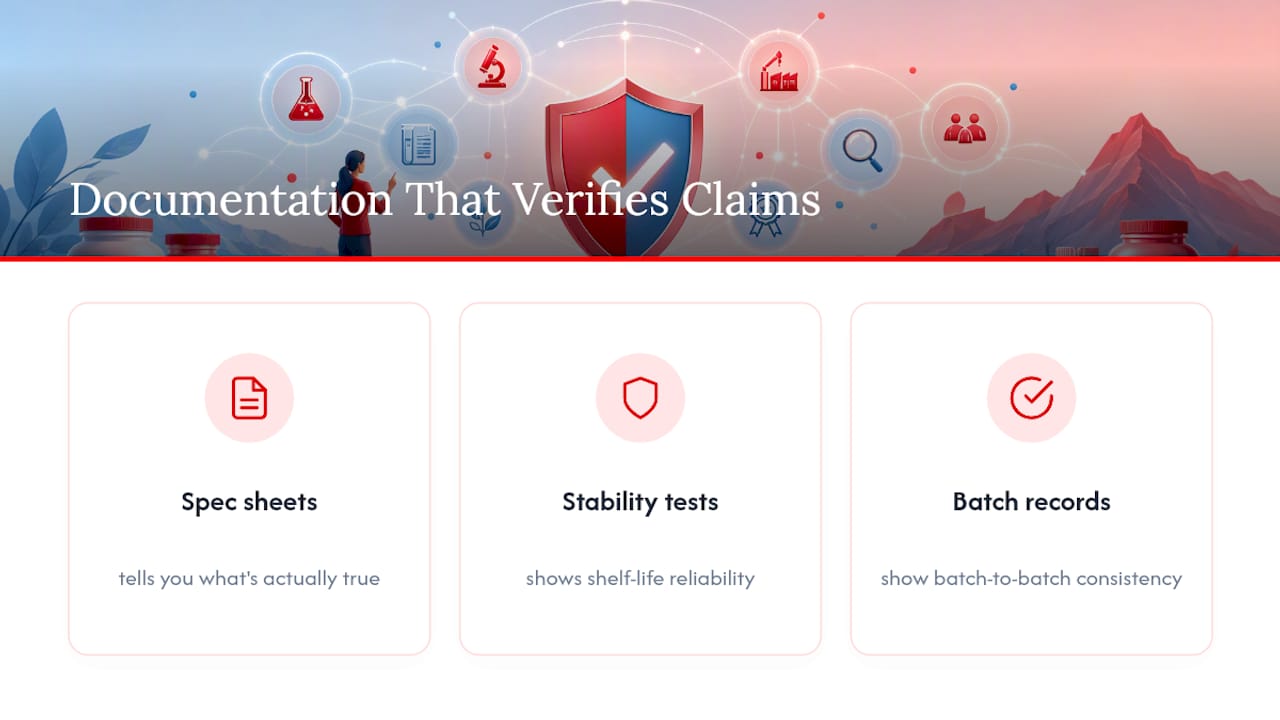
Here’s the practical takeaway: marketing copy tells you what a brand wants you to feel. Documentation, meaning specification sheets, validated stability testing, and batch records, tells you what’s actually true. If a brand can produce the paperwork, the clean-label claim holds weight. If all you get is a nice-sounding paragraph on the product page, treat it as a claim still waiting for proof.
Your Quick Checklist for Spotting a Real Clean-Label Supplement
Run any product through these eight checks before you decide it earns the label:
- Does it disclose every ingredient and its exact dose, with nothing hidden?
- Is there a proprietary blend anywhere on the label? If yes, that’s a mark against it.
- Can the brand produce a Certificate of Analysis when you ask?
- Are active ingredient sources named specifically, not just described generically?
- Does it carry a recognizable third-party seal, like NSF or USP?
- Are allergen and cross-contact statements clear and specific?
- Does the brand explain why it retained any given excipient?
- Is there visible supplier or sourcing transparency, not just a country of origin?
No single check should carry the whole decision. A clean-sounding front label with zero COA availability is a weaker signal than a longer ingredient list backed by real testing documentation. When a brand’s clean claim doesn’t hold up against several of these checks at once, that’s your cue to ask more questions or move on to a product that answers them without friction.
How We Think About Clean Label at Fromwithin
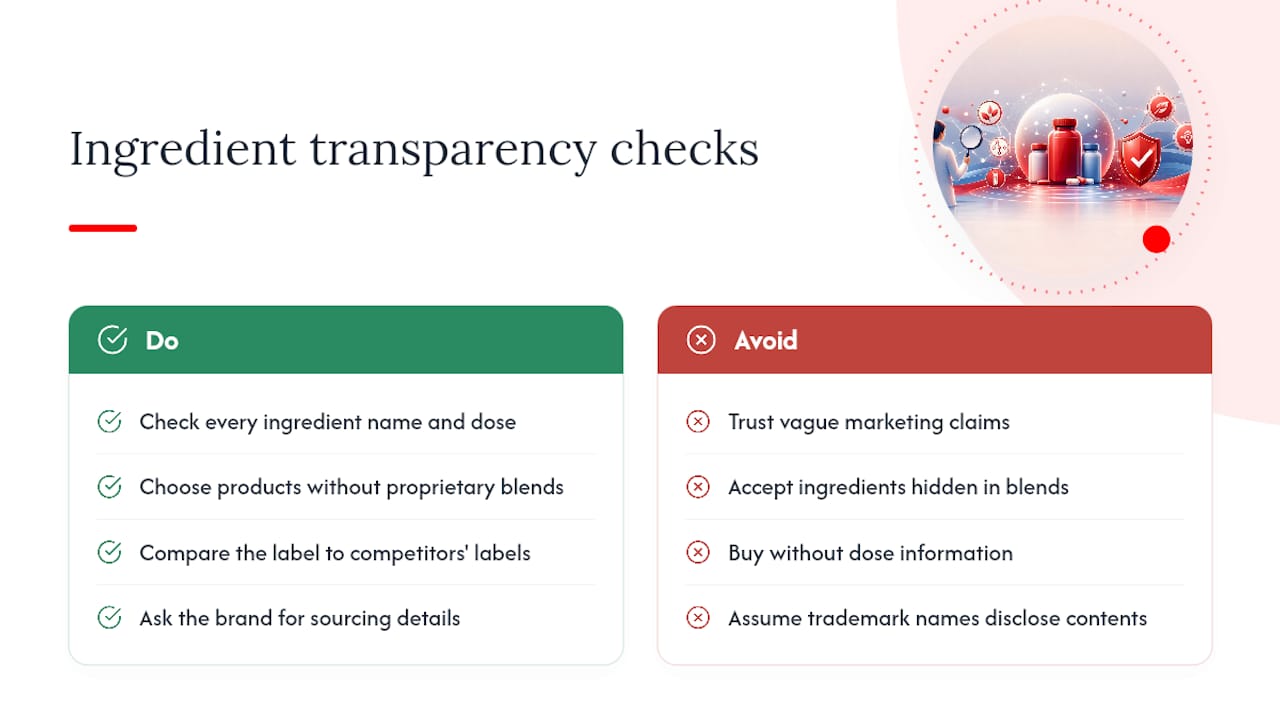
We built our own approach around the same standard we’re asking you to hold every brand to: show the proof, not just the claim. Our collagen and sleep aid formulas list every active ingredient and dose upfront, with no proprietary blends hiding behind a trademarked name. The Wellnex® peptides in our collagen line are disclosed by name and dose specifically so you’re not left guessing what you’re absorbing.
We’d rather you verify than take our word for it. That’s the whole point of ingredient transparency: it only counts when you can check it yourself, whether that means comparing our label against a competitor’s or asking us directly for sourcing details.
— From
Sources
- What is Clean Label · IFT Brain Food
- Clean labeling and the real-food movement (UGA Field Report)
- What is clean label · Lehmann Ingredients
- Seeing through the label: why ingredient transparency matters · Clean Label Project
- PMC review on consumer food choices and clean label
