

on September 10, 2026

Check the Supplement Facts panel first, then run the serving math (servings per container versus what’s actually in one dose), then look at ingredient form, then confirm a third-party seal like USP or NSF actually backs it up. Skip proprietary blends entirely. Get these four checks right and you’ll catch most of the label tricks that waste your money.
TL;DR:
- Always verify the serving size and number of servings per container to accurately assess the actual dose and value of a supplement.
- Check for “as [form]” notation to determine biosavailable ingredient forms, as they directly impact supplement effectiveness.
- Be cautious of proprietary blends that hide individual ingredient doses, and request third-party Certificates of Analysis for transparency.
- Read allergen and additive information carefully, especially if you have sensitivities or allergies, to avoid unwanted reactions.
- Confirm third-party seals like USP or NSF through their official databases to ensure product quality and ingredient accuracy.
Table of Contents
- How to Read Supplement Labels: Start With the Supplement Facts Panel
- Serving Size and Servings Per Container: Do the Math First
- Amount Per Serving and %Daily Value: What the Numbers Mean
- Ingredient Form and Bioavailability: The “As [Form]” Notation
- Proprietary Blends and Other Label Red Flags
- Other Ingredients and Allergen Warnings
- Third-Party Seals, COAs, and What Testing Actually Means
- The 60-Second Label Checklist
- Verifying Claims: Where the Evidence Actually Lives
- Expiration Dates and Storage Instructions
- How to Interpret Warnings and Contraindications on Supplement Labels
- Legal Disclaimers and Claims Allowed on Supplement Labels
- My Rules for Reading Any Supplement Label
- A Few Places to Verify What You Read
- Sources
How to Read Supplement Labels: Start With the Supplement Facts Panel
The Supplement Facts panel is the only part of the box or bottle that’s actually regulated. Everything else, the bold claims, the “clinically proven” banner, the glowing lifestyle photo, is marketing. The panel is where the real information lives.
It looks a lot like the Nutrition Facts label on a cereal box, but it’s built for supplements specifically. You’ll find serving size at the top, then a list of active ingredients with their amount per serving and, where one exists, the percent Daily Value.
A few quirks worth knowing before you scan one:
- Botanical ingredients often list the plant part used (root, leaf, extract), which matters because different plant parts carry different active compound profiles.
- You’ll frequently see “as [form]” next to a mineral or vitamin name. That notation tells you the actual chemical compound, not just the nutrient.
- Some ingredients show no %DV at all. That’s normal for compounds without an established Daily Value, not a red flag on its own.
Below the active ingredients sits the “Other Ingredients” list, which we’ll get to shortly. That’s where fillers, capsule material, and flavorings show up.
Serving Size and Servings Per Container: Do the Math First
Here’s where a lot of people get fooled. A bottle that boasts “1,000 mg of Ashwagandha” on the front might only deliver that dose if you take three capsules a day, not one. Reading the Supplement Facts label carefully means checking serving size before you get excited about any number on the front of the box.
- Find the serving unit. Is it one capsule, two tablets, a full scoop, or a certain number of milliliters?
- Check servings per container. A 60-capsule bottle with a 2-capsule serving size only lasts 30 days, not 60.
- Divide the total dose by the serving count if the label lists a combined amount, so you know what one actual dose gives you.
- Watch for split doses. Some products require two or three pills to hit the advertised amount, which affects both your daily pill count and your cost per dose.
Do this math before you compare prices between two products. A cheaper bottle with a bigger per-serving pill count isn’t always the better deal.
Amount Per Serving and %Daily Value: What the Numbers Mean
Amount per serving tells you the raw quantity of an ingredient, in milligrams (mg), micrograms (µg), or International Units (IU) depending on the nutrient. %Daily Value tells you how that amount compares to the government-established reference intake for the average adult. They’re two different pieces of information, and mixing them up leads to real confusion.
A few things to keep straight:
- A dagger symbol (†) next to an ingredient means no Daily Value has been established for it. That’s common with botanicals and specialty compounds, and it isn’t automatically a warning sign, though it does mean you’ll need to cross-check the dose yourself.
- Units matter more than most people realize. Vitamin D, for instance, is often listed in both IU and µg, and mixing up the two when comparing products leads to real dosing errors.
- Once you know the amount, compare it against the dose used in actual clinical research for that ingredient, or against the Tolerable Upper Intake Level (UL), where one exists. A number that looks impressive on the label can still be far below (or well above) what studies actually used.
Ingredient Form and Bioavailability: The “As [Form]” Notation
This is the single most underrated line on any supplement label. The milligram number tells you how much of a compound is in the capsule. The “as [form]” notation tells you how much of that compound your body can actually use.
Take magnesium. A label reading “Magnesium 300 mg (as magnesium oxide)” sounds generous, but oxide forms are often absorbed far less efficiently than citrate or glycinate forms. A product listing “Magnesium Bisglycinate 200 mg” at a lower total number can deliver more usable magnesium to your body than the flashier 300 mg oxide version.
The same logic applies to B12. Methylcobalamin is the active form your cells use directly, while cyanocobalamin requires an extra conversion step in the body. Neither is dangerous, but they’re not interchangeable when you’re evaluating what a supplement actually does for you.
- Minerals almost always show meaningful form differences (citrate, glycinate, oxide, chelate).
- Some vitamins matter too (methylcobalamin vs. cyanocobalamin for B12; methylfolate vs. folic acid for folate).
- If a label lists only “Zinc 15 mg” with no form disclosed, that’s a gap worth noticing, not necessarily a dealbreaker.
Pro Tip: When two products list the same nutrient, don’t compare the milligram numbers side by side until you’ve checked the form next to each one. The lower number with a better form often wins.
Proprietary Blends and Other Label Red Flags
A proprietary blend shows a total amount for multiple ingredients without specifying individual doses, which limits transparency. That’s a transparency problem, not a bonus feature, and it’s one of the clearest red flags on any supplement label.
Beyond blends, watch for:
- Disease-treatment language (“cures,” “reverses,” “treats”) on a product that isn’t a drug.
- “Clinical strength” or “pharmaceutical grade” claims with no dose or trial reference attached, since these terms carry no standardized meaning.
- Doses that sit well above the established Tolerable Upper Intake Level for that nutrient.
- No manufacturer name, address, or contact information anywhere on the label.
If you spot a proprietary blend on something you’re seriously considering, look for the same active ingredient sold elsewhere with full dose disclosure, or ask the manufacturer directly for a Certificate of Analysis before you buy.
Other Ingredients and Allergen Warnings
The “Other Ingredients” list covers everything that isn’t an active nutrient: capsule material, binders, flavorings, and coloring agents. Ingredients here are listed in descending order by weight, so the first few names carry the most volume in the product.
A short list of recognizable ingredients (rice flour, vegetable cellulose, silica) is generally a good sign. A long list heavy with artificial colors or preservatives like titanium dioxide is worth a second look, especially if you’re sensitive to additives.
Allergen statements typically sit right below this list or near the bottom of the panel, flagging common allergens like soy, dairy, tree nuts, or shellfish-derived ingredients (common in some glucosamine products). If a statement is ambiguous or missing and you have a known allergy, contact the manufacturer directly rather than guessing.
Third-Party Seals, COAs, and What Testing Actually Means
Not all seals mean the same thing, and mixing them up is easy. USP, NSF, ConsumerLab, and BSCG all test the finished product to confirm it contains what the label claims and screens for contaminants. GMP (Good Manufacturing Practice), by contrast, only certifies that a facility follows proper manufacturing processes. It says nothing about whether that specific bottle actually matches its label, since GMP is a process certification, not a finished-product one.
Since the FDA doesn’t approve dietary supplements before they hit shelves, independent verification carries real weight.
- Search the certifier’s public database (USP and NSF both maintain one) to confirm a product logo is genuine and current, since a printed seal not listed in that database may be expired or fake.
- Look for a QR code or batch number linking to a Certificate of Analysis (COA).
- If neither is available, email the manufacturer and ask for the batch’s lab report directly. A company confident in its product will send one.
The 60-Second Label Checklist
Here’s the order that catches the most problems in the least time, built around the sequence most label-literacy guides recommend:
- Serving math. Confirm servings per container and how many units make one serving.
- Active ingredient doses. Compare the amount per serving against a clinical dose or the UL.
- Ingredient form. Check for “as [form]” and favor bioavailable versions.
- Proprietary blends. If doses aren’t broken out individually, that’s a pass or a “look elsewhere.”
- Third-party seals. Verify any logo through the certifier’s database.
- Other ingredients and allergens. Scan for excessive additives or missing allergen disclosures.
- Manufacturer contact info. No address or contact listed anywhere is its own red flag.
Quick example: a label claims “2,000 mg Turmeric” but the serving size is four capsules and you only plan to take one. You’re actually getting 500 mg, with no disclosed curcumin percentage. That’s your cue to put it back and look for a product that lists standardized curcuminoid content per capsule.
Verifying Claims: Where the Evidence Actually Lives
A logo alone doesn’t prove much. A real Certificate of Analysis includes a batch number and lab results for identity, potency, and contaminants like heavy metals. That’s the document worth asking for, not just the seal on the bottle.
When you contact a manufacturer, ask two things: the batch number for the bottle you’re holding, and whether a lab report is available for that specific batch. Reputable companies answer both without hesitation.
For a deeper walk-through of what different testing seals actually verify, our own breakdown on third-party tested supplements covers the distinctions in more detail than any single label can.
Expiration Dates and Storage Instructions
Every supplement label carries an expiration date, usually printed on the bottom of the bottle or the crimp of a blister pack. That date reflects the manufacturer’s testing for potency and stability, not a hard safety cliff. A capsule a month past its date probably won’t hurt you, but its active ingredients, especially probiotics, fish oils, and certain vitamins, may have degraded well before that printed date if storage conditions weren’t ideal.
Storage instructions matter more than most people give them credit for. Probiotics often specify refrigeration because live cultures die off faster at room temperature. Fish oil and other omega-3 products call for a cool, dark location because heat and light speed up oxidation, which is what causes that fishy, rancid smell some capsules develop over time. Collagen powders and most vitamins are more forgiving, but “cool, dry place away from direct sunlight” is the standard instruction for a reason: humidity and heat both shorten shelf life.
A few practical habits:
- Store bottles away from bathroom cabinets, where steam and humidity accelerate breakdown.
- Keep the original container instead of transferring pills to a daily organizer for weeks at a time, since the desiccant packet inside the bottle helps manage moisture.
- If a capsule looks discolored, feels sticky, or smells off before the expiration date, don’t take it. Potency testing assumes proper storage, and improper storage voids that assumption.
Buying only what you’ll realistically use within a reasonable window beats stockpiling a year’s supply that degrades on a shelf.
How to Interpret Warnings and Contraindications on Supplement Labels
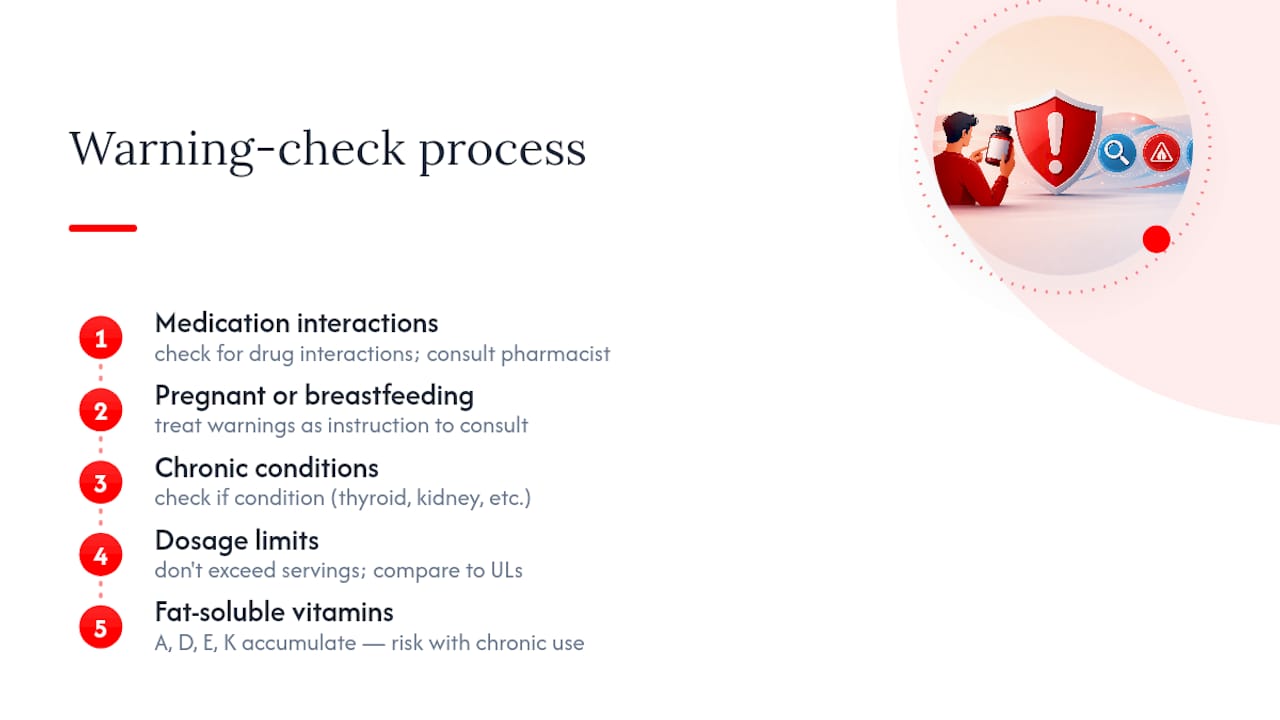
Warning statements on supplement labels exist because a compound interacts with a medication, a health condition, or a life stage in a way the manufacturer is legally required to flag. Reading past them because “it’s natural” is one of the more common mistakes health-conscious buyers make.
Common warning categories include interactions with blood thinners (common with vitamin K, fish oil, and ginkgo), contraindications for pregnant or nursing individuals, and cautions for people with thyroid conditions, kidney disease, or those taking prescription medications. St. John’s Wort, for example, carries well-documented interactions with a long list of medications, and its label reflects that.
A warning doesn’t automatically mean a product is unsafe for everyone. It means a specific group needs to check with a doctor or pharmacist before starting it. If you’re on any prescription medication, managing a chronic condition, or pregnant or breastfeeding, treat every warning statement as a direct instruction to consult a healthcare provider first, not a formality to skim past.
Pay attention to dosage-related cautions too. Labels that say “do not exceed [X] servings per day” exist because exceeding that threshold can push you toward or past the Tolerable Upper Intake Level for that nutrient. Fat-soluble vitamins like A, D, E, and K build up in the body over time, so chronic overuse carries different risks than a one-time excess. If a label’s warning section feels vague or nonexistent for an ingredient known to carry real interaction risks, that absence is worth noticing rather than assuming it means the product is universally safe.
Legal Disclaimers and Claims Allowed on Supplement Labels
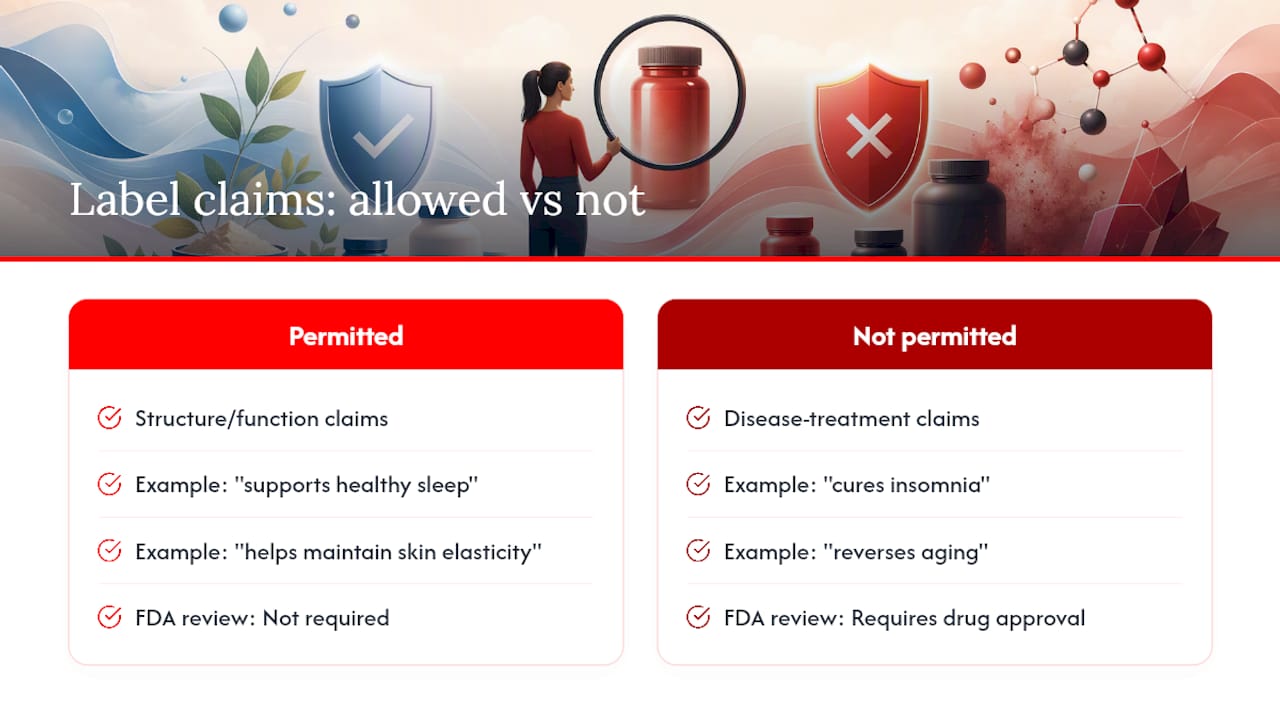
Nearly every supplement bottle carries some version of this line: “This statement has not been evaluated by the Food and Drug Administration. This product is not intended to diagnose, treat, cure, or prevent any disease.” That disclaimer exists because supplement manufacturers are legally permitted to make structure/function claims, statements about how an ingredient supports normal body function, but they cannot claim to treat or cure a medical condition without that claim being reviewed and approved as a drug.
That distinction explains a lot of the careful phrasing you’ll see on labels. A supplement can say it “supports healthy sleep” or “helps maintain skin elasticity,” but it cannot legally say it “cures insomnia” or “reverses aging.” If you see disease-treatment language on a supplement label, especially claims about curing, healing, or reversing a diagnosed condition, that’s a sign the product is overstepping what’s legally permitted, and it’s worth treating with real skepticism.
This regulatory gap is exactly why third-party testing and transparent labeling carry so much weight. The FDA doesn’t pre-approve these products, so the disclaimer you’re reading is a legal boundary, not a quality guarantee. A supplement can be perfectly compliant with disclaimer requirements while still using vague dosing, undisclosed forms, or proprietary blends elsewhere on the same label. Reading the disclaimer tells you what the company is legally allowed to claim. It tells you nothing about whether the product inside actually works, which is exactly why the rest of the label deserves your full attention.
My Rules for Reading Any Supplement Label
I’ve made this simple for myself: no disclosed dose, no purchase. I check the ingredient form before I check the price, because a bargain oxide form is often no bargain at all. And for anything with real risk attached, I want a COA, not just a logo, before it goes in my cart. If you want the fuller picture on what those seals actually test for, our breakdown on third-party testing is worth the five minutes.
— From
A Few Places to Verify What You Read
Check NCOA’s label guide for panel basics, NCBI’s formulation research for absorption science, and certifier databases (USP, NSF) to confirm any seal before you trust it.
This article is general information, not a substitute for advice from a qualified doctor. Consult a qualified healthcare professional about your own circumstances before acting on anything here.
Sources
- How to Read Supplement Labels: A Simple Guide — NCOA
- How to Read Supplement Labels — Healthline
- NCBI / PubMed Bookshelf — formulation and absorption evidence
- How to Read a Supplement Label Like a Scientist — SupplementScore
