

on September 21, 2026

Short early-afternoon naps (about 15 to 30 minutes) boost alertness and usually don’t harm nighttime sleep for most healthy adults. The Sleep Foundation recommends keeping naps under 30 minutes and finishing them before 3 p.m. Longer or later naps are a different story: a review of the “nap paradox” shows naps past 60 minutes, or taken close to bedtime, raise the odds of grogginess and fragmented nighttime sleep.
TL;DR:
- Napping for 15 to 20 minutes in the early afternoon maximizes alertness benefits without risking sleep inertia or disrupting nighttime sleep.
- Longer naps over 60 minutes or those taken late in the day increase the likelihood of grogginess and fragmented sleep at night.
- Individuals with sleep disorders or chronic sleep issues should exercise caution with frequent or long naps, as these may worsen their sleep problems.
- A well-timed nap can partially reverse some physiological effects of sleep deprivation, especially for shift workers, students, older adults, or those recovering from poor sleep.
- Maintaining consistent sleep routines and environment, and self-monitoring nap habits, helps optimize napping benefits without undermining nighttime sleep quality.
Table of Contents
- How Napping Affects Sleep Quality and Daily Function
- Why Do Naps Affect Nighttime Sleep the Way They Do?
- What’s the Best Nap Length and Timing for Better Sleep?
- When Napping Backfires: Risks and Who Should Be Careful
- What Does the Research Actually Say About Naps and Sleep?
- How Do You Nap Without Ruining Your Night Sleep?
- Planned, Emergency, and Habitual Naps Aren’t the Same Thing
- What Makes a Nap Environment Actually Work?
- Do Napping Needs Change With Age?
- Where Napping Fits Into Your Broader Sleep Hygiene
- From Within’s Take on Napping and Real Recovery
- A Complementary Way to Support Nighttime Sleep
- Sources
- FAQ
How Napping Affects Sleep Quality and Daily Function
A well-timed nap does real work for your brain and body, and the research backs that up in ways that go beyond “you’ll feel less tired.”
Vigilance and reaction time improve measurably after a short nap, even one as brief as 10 to 20 minutes. Memory consolidation gets a boost too. Your brain uses light sleep stages to file away what you learned that morning, which is part of why naps show up so often in advice for students cramming before exams. Mood benefits arrive alongside the cognitive ones: a short nap acts as a buffer against the irritability and impatience that build up after a rough night.
There’s a physiological story underneath this. Experimental work on the nap paradox found that short naps can reverse some of the biological fallout of sleep restriction, including changes in stress-related markers like salivary IL-6 and urinary norepinephrine. In plain terms, a nap can partially undo some of the wear and tear that a bad night puts on your body’s stress response.
Certain groups tend to see outsized benefits:
- Shift workers, whose schedules fight their circadian rhythm and who rarely get one unbroken sleep block.
- Students and knowledge workers, who lean on naps for memory encoding before a big test or deadline.
- Older adults, who often experience lighter, more fragmented nighttime sleep and use naps to close the gap.
- Anyone recovering from a single bad night, where an acute nap restores alertness faster than caffeine alone.
Pro Tip: If you only remember one number from this article, make it 20. A 20 minute nap hits the sweet spot for most people, long enough to feel the benefit, short enough to skip the grogginess.
None of this means napping is a universal fix. Someone with chronic insomnia or hyperarousal may not get the same payoff, a point worth holding onto as you read further.
Why Do Naps Affect Nighttime Sleep the Way They Do?
Two systems govern when and how well you sleep: homeostatic sleep pressure and your circadian rhythm. Napping interacts with both, and that interaction explains almost everything confusing about how naps affect sleep quality after dark.
Homeostatic sleep pressure builds the longer you stay awake, driven largely by a chemical called adenosine accumulating in your brain. By nighttime, that pressure is usually strong enough to pull you into deep sleep quickly. A nap taps that pressure early, releasing some of the built-up drive. A short nap barely dents it. A long nap in the afternoon can drain enough of that pressure that your body isn’t as ready for bed eight hours later, which is one mechanism behind the sleep fragmentation researchers keep finding in habitual long nappers.
Circadian timing matters just as much as duration. Most adults experience a natural dip in alertness in the early afternoon, often called the post-lunch dip, driven by your internal clock rather than how much you ate. Napping inside that window works with your biology instead of against it. Napping late in the day, closer to your circadian “wake maintenance zone” in the evening, fights your body’s natural push toward alertness and can leave you feeling worse when you wake up.
Sleep architecture is the third piece. In a short nap, your brain typically stays in light NREM sleep, stages 1 and 2, which is easy to wake from. Push past 30 to 45 minutes, and you risk sliding into slow-wave deep sleep, or even a brief REM period on longer naps. Waking from deep sleep is what produces sleep inertia: that thick, disoriented grogginess that can outlast the benefit of the nap itself. This is also why a 90-minute nap, which completes a full sleep cycle and typically ends in lighter sleep, can sometimes feel better on waking than a 45-minute nap that cuts deep sleep short.
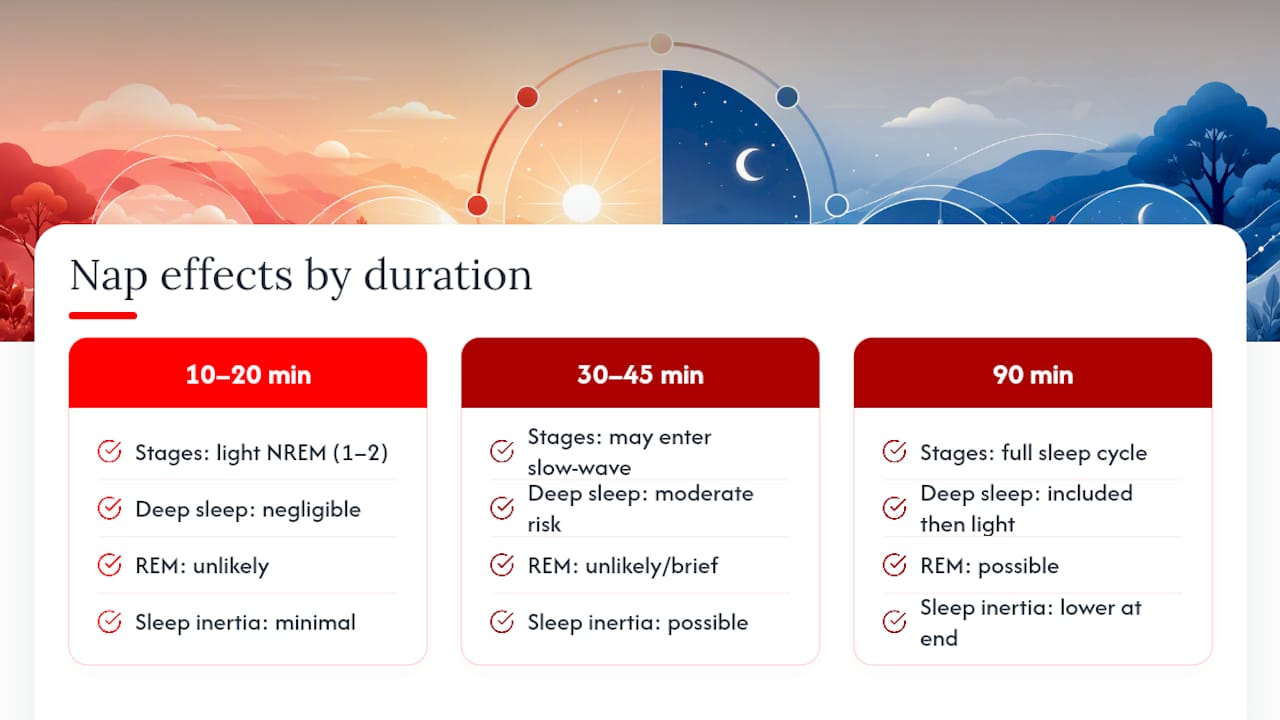
Individual variability plays a role too. Micro-longitudinal research shows the nap-to-night-sleep relationship runs in both directions for some people: poor sleep drives more napping, and more napping sometimes worsens the next night’s sleep, creating a loop that’s specific to the individual rather than universal.
What’s the Best Nap Length and Timing for Better Sleep?
Nap science sorts naps into a few useful categories, and choosing the right one for your situation matters more than most people assume.
The power nap, 15 to 20 minutes, is the workhorse recommendation from Cleveland Clinic and most sleep researchers. It restores alertness, sharpens reaction time, and almost never produces sleep inertia because you wake from light sleep. This is the nap to reach for on an ordinary day when you just need a reset.
The recovery nap, 20 to 60 minutes, suits genuine sleep debt: a night of five hours instead of seven, jet lag, or a stretch of poor sleep from stress. It delivers more restorative benefit but comes with a real trade off. The longer you push past 30 minutes, the higher your odds of waking mid deep-sleep and feeling worse before you feel better. Use recovery naps sparingly, not as a daily habit.
The full-cycle nap, around 90 minutes, completes an entire sleep cycle including REM. It has a place for athletes managing training loads or shift workers realigning a disrupted schedule, contexts that differ meaningfully from general daytime napping and often work best under a coach’s or clinician’s guidance. For most people with a standard 9 to 5 and a normal bedtime, a 90 minute nap is too long to fit safely into the day without risking nighttime sleep.
Timing carries as much weight as duration:
- Nap in the early afternoon, roughly between 1 and 3 p.m., to align with your circadian dip.
- Avoid napping within about eight hours of your usual bedtime.
- Set a hard cutoff around 3 p.m. if you go to bed around 10 or 11 p.m., per Sleep Foundation guidance.
- Keep naps to 20 to 30 minutes on most days, reserving anything longer for genuine sleep debt.
Pro Tip: Set a real alarm before you lie down, even for a “quick” nap. Nap intentions have a way of stretching once your body senses it’s finally allowed to rest.
When Napping Backfires: Risks and Who Should Be Careful
Sleep inertia is the most immediate downside, and it can hit hard. Waking from deep sleep during a long nap leaves you groggy, slow, and sometimes worse off than before you napped, an effect that can linger for 15 to 30 minutes or longer depending on how deep you were when the alarm went off.
The longer-term picture comes from observational research, and it deserves a careful read. Studies tracking habitual nappers have found associations between long naps, over an hour, and higher markers for obesity and elevated blood sugar. These are correlations, not proof that napping causes metabolic problems. People with poor underlying health or disrupted sleep often nap more as a consequence, not a cause, which makes reverse causality a real possibility researchers still haven’t fully untangled.
A more recent study on napping patterns in people with insomnia found that frequent napping, three or more times over an eight-day stretch, and late-afternoon naps were tied to significantly higher nighttime sleep fragmentation and longer sleep onset latency compared with non-nappers. That finding lines up with the homeostatic pressure mechanism described earlier: frequent napping chips away at nighttime sleep drive night after night.
Some people should treat napping with more caution than others:
- People with diagnosed insomnia, since hyperarousal can make naps ineffective or counterproductive, leaving them tired but unable to actually fall asleep during the day.
- Anyone who notices a sudden, unexplained jump in how much they need to nap, which can signal an underlying medical issue rather than routine tiredness.
- People with loud snoring, gasping, or witnessed pauses in breathing during sleep, which are red flags for sleep apnea and warrant a conversation with a doctor rather than a longer nap schedule.
- Frequent, habitual nappers who use naps to patch over consistently poor nighttime sleep, since this can become a self-perpetuating cycle that masks a problem instead of solving it.
If any of these apply to you, a nap adjustment alone probably won’t fix things. That’s a signal to talk to a clinician, not just to tweak your alarm clock.
What Does the Research Actually Say About Naps and Sleep?
The evidence on napping isn’t contradictory so much as context-dependent, and understanding why helps you interpret advice that otherwise seems to flip-flop.
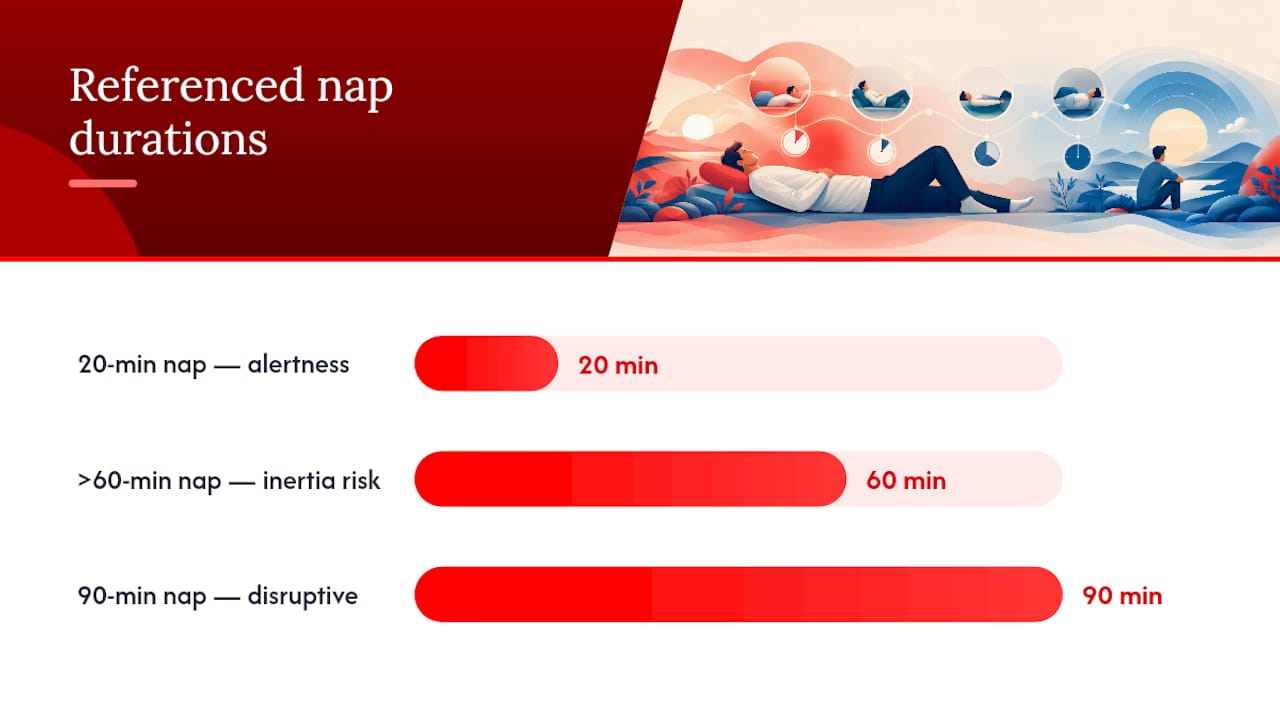
Experimental trials, the kind where researchers assign specific nap durations and measure outcomes directly, consistently show short naps improve vigilance, reaction time, and mood with minimal downside. These same trials show that naps stretching past an hour increase the odds of sleep inertia and, in some designs, measurable next-night sleep disruption. This is controlled, cause-and-effect evidence, and it’s fairly consistent across the literature.
Cohort and epidemiological studies tell a murkier story. These studies track large groups of people over time and look for patterns between habitual nap behavior and health outcomes like cardiometabolic risk. They’ve turned up real associations, longer and more frequent naps show up alongside higher rates of metabolic issues, but they can’t prove causation. Someone with early-stage sleep apnea, depression, or a chronic illness might nap more because they feel unwell, not the other way around. Reviewers of the nap paradox point out that this confounding is a real limitation, one that popular coverage of nap studies often glosses over.
| Evidence type | What it shows | Key limitation |
|---|---|---|
| Controlled nap-duration trials | Short naps improve alertness; naps over 60 minutes increase inertia risk | Small sample sizes, short observation windows |
| Cohort/epidemiological studies | Long or frequent naps associate with higher cardiometabolic risk markers | Cannot rule out reverse causality or confounding illness |
| Insomnia-specific studies | Frequent and late naps linked to more fragmented night sleep | Findings may not generalize to good sleepers |
Putting these threads together is what researchers call the nap paradox: the same behavior, napping, can be genuinely restorative or genuinely disruptive depending on duration, timing, frequency, and your existing sleep debt. A 20 minute nap at 1 p.m. for someone who slept six hours the night before is a very different intervention than a 90 minute nap at 5 p.m. for someone who naps daily out of habit. The paradox isn’t a contradiction in the science. It’s a sign that “napping” is too broad a category to give one universal verdict on.
How Do You Nap Without Ruining Your Night Sleep?
A nap routine works best when you treat it like a small experiment rather than a guess. Here’s a stepwise approach that lines up with the research above.
- Pick your window. Nap between 1 and 3 p.m., riding the natural circadian dip instead of fighting your body’s evening alertness push.
- Set a real alarm. Fifteen to 20 minutes for a standard power nap, up to 30 if you’re genuinely sleep-deprived. Let the alarm, not your body, decide when the nap ends.
- Control your environment. A dark, quiet, cool room helps you fall asleep faster and wake up cleaner, which matters more for naps than most people expect.
- Try the coffee-nap technique on high-demand days. Drink a small coffee right before a 20-minute nap. Caffeine takes about 20 minutes to kick in, so you wake up just as it starts working, layering the alertness boost of caffeine on top of the nap’s own benefit.
- Wake up and move. A few minutes of light activity, stretching, a short walk, natural light exposure, helps shake off any residual grogginess faster than sitting still.
- Watch your night sleep in response. If your naps are working, you should still fall asleep at your normal time without a long delay.
Pro Tip: Run a two-week self-test before deciding naps aren’t for you. Track bedtime, wake time, nap length, and how sleepy you feel each afternoon. Try one 20 to 30 minute early-afternoon nap most days, and compare how fast you fall asleep at night against your no-nap baseline.
If your sleep onset latency stretches out, or you start waking more during the night, that’s useful data, not a failure. It means your nap length, timing, or frequency needs adjusting. If problems persist despite changes, or you notice signs like loud snoring or excessive daytime sleepiness that won’t resolve, that’s the point to loop in a clinician rather than keep tweaking on your own.
Planned, Emergency, and Habitual Naps Aren’t the Same Thing
Not all naps serve the same purpose, and lumping them together is part of why nap advice can feel contradictory.
A planned nap is scheduled ahead of a known demand, before a night shift, a long drive, or a stretch of sleep restriction you can see coming. These tend to be the most beneficial because you can control timing and duration deliberately, keeping them short and early.
An emergency nap happens when sleepiness hits hard and unexpectedly, often during a monotonous task or a lull in the afternoon. These are harder to manage well since you’re reacting rather than planning, but even an unplanned 15-minute nap can meaningfully cut fatigue-related errors.
A habitual nap is one built into your daily routine regardless of how tired you actually are. This is where the nap paradox research gets most relevant. Habitual napping isn’t automatically harmful, plenty of cultures build it into the day without issue, but it’s worth periodically checking whether you’re napping because you need to or because it’s simply what you always do. If you’re a habitual napper and your nighttime sleep has gotten choppier lately, that’s a reasonable moment to test cutting back.
Recognizing which type of nap you’re taking helps you apply the right rules. A planned 20-minute nap before a demanding evening looks nothing like a daily 90-minute couch nap out of boredom, even though both fall under the same word.
What Makes a Nap Environment Actually Work?
The room you nap in matters almost as much as when you nap. A poor environment can turn a potentially useful 20-minute nap into 10 minutes of restless tossing followed by 10 minutes of unproductive lying still.
Light is the biggest lever. Even dim daylight can suppress melatonin release and keep you in lighter, less restorative sleep. Blackout curtains, an eye mask, or simply napping in a naturally shaded room helps you fall asleep faster and stay in a stable light sleep stage rather than drifting in and out.
Noise matters differently for naps than for nighttime sleep, since you’re aiming for a light, brief rest rather than deep unconsciousness. A consistent low hum, a fan, white noise, or earplugs, tends to work better than dead silence, which can make you hyperaware of every small sound during a short nap window.
Temperature affects nap quality the same way it affects nighttime sleep. A slightly cool room, somewhere around 65 to 68°F, helps your body’s core temperature drop, which supports faster sleep onset. A warm, stuffy room does the opposite, and it’s part of why office naps in bright, warm break rooms rarely feel restorative even when the timing is right.
Posture is worth a mention too. Reclining rather than lying fully flat can make it slightly easier to wake up quickly and avoid sinking into the deeper sleep stages that cause inertia, useful if you’re intentionally trying to keep a nap short.
Do Napping Needs Change With Age?
Nap needs shift substantially across the lifespan, and applying one set of rules to every age group misses real biological differences.
Children need naps as a core part of healthy development, not an optional extra. Toddlers often still need one to two hours of daytime sleep, and preschoolers gradually drop to a single afternoon nap before phasing naps out entirely by kindergarten age for most kids. Napping too late in a child’s day is a common cause of bedtime struggles, mirroring the adult “avoid late naps” rule but on a much lower threshold.
Working-age adults are the group most of this article speaks to directly. Naps are optional for most people in this range, useful for managing sleep debt, shift work, or an occasional rough night, but not biologically required the way they are for children.
Older adults often experience naturally lighter, more fragmented nighttime sleep due to age-related changes in sleep architecture, which makes daytime naps more common and, in moderation, more understandably useful. The same caution applies here as everywhere else: a short, early nap tends to help, while long or frequent naps can compound existing nighttime fragmentation rather than offset it. Older adults with excessive daytime sleepiness beyond normal fatigue should still mention it to a doctor, since it can flag conditions like sleep apnea that become more common with age.
Where Napping Fits Into Your Broader Sleep Hygiene
A nap is one lever in a much bigger system, and it works best when the rest of your sleep hygiene is already reasonably solid. Napping on top of a chaotic sleep schedule, wildly inconsistent bedtimes, heavy late caffeine, screens at midnight, tends to blunt whatever benefit the nap could offer.
Consistency is the piece that matters most. Going to bed and waking up at roughly the same time every day strengthens your circadian rhythm, which in turn makes your post-lunch dip more predictable and your ideal nap window easier to identify. If your bedtime shifts by two hours depending on the day, your best nap window shifts right along with it, and generic advice about “napping before 3 p.m.” stops being reliable for you specifically.
Naps also interact with the evening wind-down habits that set up good nighttime sleep in the first place. A well-timed short nap can actually support a wind-down routine by taking the edge off afternoon exhaustion, so you’re not walking into your evening already running on fumes and reaching for excess caffeine or a too-early bedtime that throws off your rhythm the next day. On the other hand, napping cannot substitute for the deep, restorative overnight sleep your body needs to fully repair, including the physical recovery your skin does overnight. Think of a nap as a support beam, useful, sometimes necessary, but not the foundation.
From Within’s Take on Napping and Real Recovery
Here’s where I land after going through this research: naps are a legitimate, evidence-backed tool, not a shortcut and not something to feel guilty about. A short, early nap is one of the lowest-risk interventions in all sleep science. It’s the chronic, long, late napping pattern that deserves a second look, especially if it’s quietly compensating for nighttime sleep that isn’t doing its job.
What the research keeps circling back to is personalization. The same 90-minute nap that helps a shift worker realign their schedule might leave a 9 to 5 professional groggy and off their nighttime rhythm for hours. That’s not a contradiction in the science, it’s a reminder that your sleep debt, your circadian rhythm, and your daily demands are specific to you.
At From Within, our focus has always been on supporting the body’s own systems rather than overriding them, which is exactly the philosophy that applies here. If you’re leaning on naps daily just to function, that’s worth investigating rather than accepting. Track your patterns for two weeks, be honest about what you find, and treat sleep support, whether that’s a nap, a wind-down routine, or a well-chosen supplement, as one piece of a system you’re building deliberately.
— From
A Complementary Way to Support Nighttime Sleep
If your nap routine is solid but your actual nighttime sleep still feels shallow or hard to fall into, that’s usually a sign to look at what happens in the hours before bed, not just the hours after lunch. Fromwithin’s Sleep Better – Liquid Calm & Deep Sleep Support is built without melatonin or hormones, designed to support natural relaxation for people whose evening wind-down needs more than willpower alone.

It’s formulated as an adjunct, something you layer into an evening routine alongside consistent bedtimes and a smart nap schedule, not a substitute for medical care if you’re dealing with a diagnosed sleep disorder. The same philosophy runs through Fromwithin’s Collagen Peptides Glow Booster, built on patented Wellnex peptides absorbed directly into the bloodstream, since better sleep and visible skin recovery tend to go hand in hand. Browse the full collagen and sleep support collection and pair a smarter nap habit with an evening routine that finally gives your body the overnight recovery naps alone can’t provide.
Sources
- Does Napping Impact Your Sleep at Night? — Sleep Foundation
- Exploring the nap paradox: are mid-day sleep bouts a friend or foe? — PMC
- 2026 study: associations between napping and sleep in insomnia patients — Springer
- To nap or not to nap? Science is still waking up to the question — ScienceNews
Study designs, populations, and definitions of “long” or “frequent” napping vary across this research. Talk with your doctor about your specific sleep patterns before making major changes.
FAQ
Does Napping Improve Sleep Quality?
A short nap, roughly 15 to 30 minutes taken in the early afternoon, generally improves alertness and mood without disrupting nighttime sleep for most healthy adults. Naps longer than an hour, or taken later in the day, are linked to more nighttime sleep fragmentation rather than improved quality.
Is a Two Hour Nap Better Than No Sleep?
A two hour nap will likely leave you with noticeable sleep inertia, since it’s long enough to include slow-wave deep sleep and possibly REM. It can still restore some function compared with total sleep deprivation, but it’s far from equivalent to a full night, and it raises the odds of a rough transition back into nighttime sleep.
Is a Two to Four Hour Nap the Same as Eight Hours of Sleep?
No. A two to four hour nap covers only a fraction of the sleep cycles your body needs and often ends mid-cycle, producing significant grogginess on waking. Eight hours of continuous sleep cycles through multiple full rounds of light, deep, and REM sleep in a way a daytime nap, however long, cannot replicate.
Is a One Hour Nap in the Afternoon Good?
A one hour nap sits right at the edge of the recovery-nap range recommended by Cleveland Clinic, useful occasionally for real sleep debt but risky as a daily habit. It’s long enough to reach deep sleep for some people, which can cause grogginess on waking and, if repeated often, contribute to fragmented nighttime sleep.
What if I Can’t Fall Asleep at Night Even Without Napping?
If cutting naps entirely doesn’t fix a persistent struggle to fall or stay asleep, that points toward an underlying issue beyond daytime habits, such as insomnia or hyperarousal. A non-melatonin sleep aid can support relaxation as part of a broader routine, but ongoing sleep problems are worth discussing with a clinician.
