

on September 24, 2026

Patented collagen peptides are hydrolyzed collagen materials, or the processes that make them, protected by a filed patent claim that specifies a reproducible peptide profile: a defined range of di- and tripeptides, a controlled molecular-weight distribution, and (often) a measured hydroxyproline content. That reproducibility is the whole point. Without it, you can’t run a clean clinical trial, defend a bioavailability claim, or promise a customer the same result batch after batch. This guide walks through the patents shaping the category, the production steps they protect, the technical markers that separate marketing language from measurable chemistry, and what Singapore’s regulator expects when you put any of this on a label.
TL;DR:
- Patented collagen peptides are protected by specific process, composition, or application claims, ensuring batch-to-batch consistency and measurable chemical markers.
- Most patents focus on yield optimization or low-molecular-weight profiles with organoleptic specifications, which influence production methods and product quality.
- Clinical benefits, such as skin hydration and wrinkle reduction, are linked to precise peptide profiles, molecular weight ranges, and di-/tripeptide content validated by strict testing.
- Regulatory compliance in Singapore requires substantiated claims tied to actual product evidence, with proof of safety, quality, and appropriate labeling based on detailed peptide profiling.
- Manufacturers and formulators should request peptide-profile certificates, conduct thorough quality checks, and match clinical data to the specific ingredient used to ensure regulatory and claimed efficacy.
Table of Contents
- What Sets Patented Collagen Peptides Apart From Generic Hydrolyzed Collagen
- The Patent Landscape: What Recent Filings Actually Protect
- How Manufacturing Steps Shape the Final Peptide Profile
- Which Technical Markers Actually Define a “Bioactive” Peptide Profile
- What the Clinical Trials Actually Show About Peptide Profile and Skin Outcomes
- Regulatory Obligations for Marketing Collagen Peptides in Singapore
- Turning Patent-Backed Ingredients Into a Compliant, Sellable Product
- How From Within Applies This Thinking to Product Development
- Where the Science Goes Next
- See What Patent-Backed Peptide Thinking Looks Like on the Shelf
- Primary Sources and Documents Worth Bookmarking
- Sources
- FAQ
What Sets Patented Collagen Peptides Apart From Generic Hydrolyzed Collagen
Generic hydrolyzed collagen is a commodity. Almost any manufacturer with an enzyme and a reactor can chop up bovine, porcine, or marine collagen into peptides of assorted sizes and call it “collagen peptides.” There’s no legal claim protecting the process, and no guarantee the peptide profile will be the same from one production run to the next, let alone from one supplier to another.
A patented material is different because someone has filed and been granted a claim covering either the process that makes it, the composition itself, or a specific application of it. That claim locks in a set of technical parameters, which is exactly what a formulator or clinical researcher needs before betting a study or a product line on the ingredient.
Patent claims in this space generally fall into three buckets:
- Process claims protect a specific manufacturing sequence, such as a defined order of enzymatic steps or a particular heat treatment, regardless of the raw material source.
- Composition claims protect the resulting material itself, defined by measurable attributes like average molecular weight or di-/tripeptide percentage, independent of how it was made.
- Application claims protect a specific use of a peptide composition, such as a beverage formulation with defined clarity and taste characteristics.
The practical consequence is that a patented ingredient comes with a paper trail. When a supplier can point to a granted claim, they can also usually produce a peptide-profile certificate for each batch, since the whole value of the patent depends on consistently hitting the parameters described in it. That’s the single most useful thing to request before buying: a certificate showing average molecular weight, percentage of material under 1 kDa or 2 kDa, and di-/tripeptide content, ideally verified by liquid chromatography-mass spectrometry or size-exclusion chromatography. Generic hydrolyzed collagen suppliers rarely offer this level of detail, because there’s no patent obligating them to hit a specific number.
The Patent Landscape: What Recent Filings Actually Protect
Filing activity around collagen peptide production has picked up noticeably. One patent landscape analysis tracking records through 2026 counted more than 200 filings tied to enzymatic hydrolysis for nutraceutical collagen peptides, with activity concentrated among a small number of large assignees. That concentration matters for anyone doing freedom-to-operate work: a handful of companies control most of the meaningful process and composition claims, which narrows the field considerably for new entrants trying to design around existing patents.
Three filings illustrate the range of what’s actually being claimed right now.
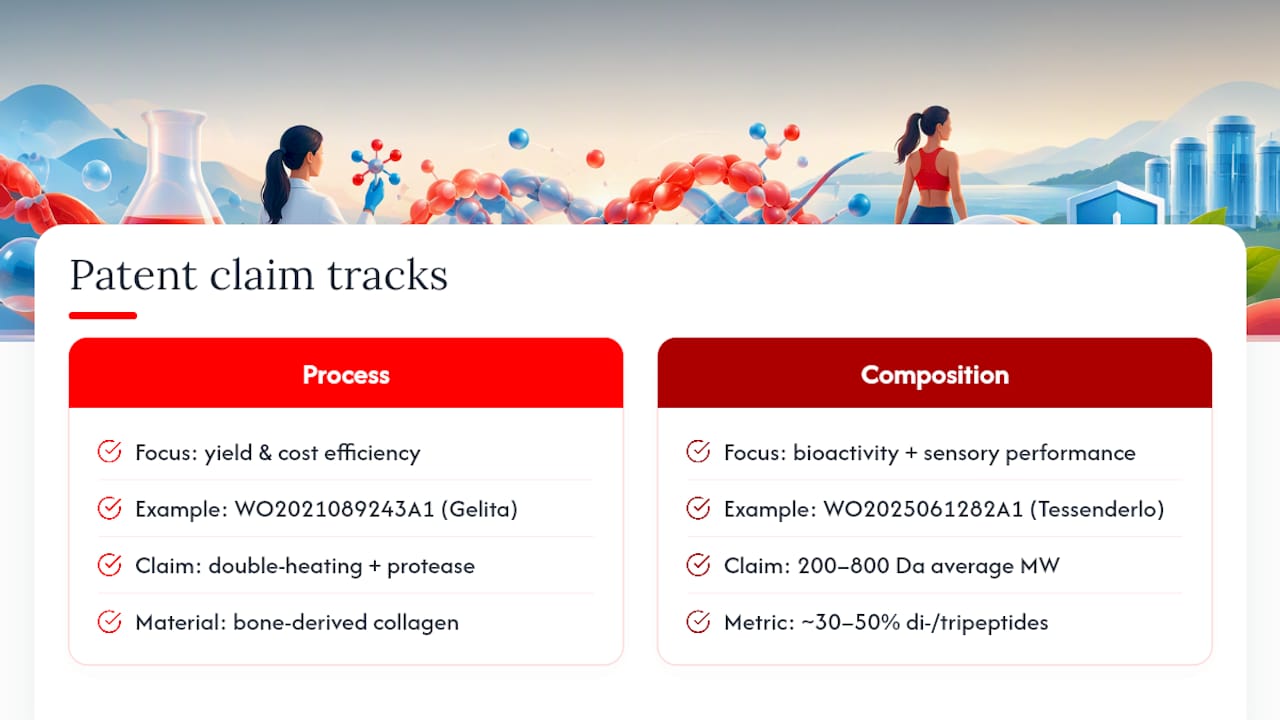
WO2021089243A1, assigned to Gelita, part of the Tessenderlo Group NV portfolio, describes a process for producing collagen peptides from bone raw material using a double-heating step combined with protease treatment. The claim is about yield efficiency and consistency in bone-derived collagen. Heating crushed bone twice, rather than once, before and around enzymatic treatment, increases the amount of usable peptide extracted per batch. For anyone sourcing bone-derived collagen peptides, this patent is a useful signal that yield optimization, not just peptide profile, is a live area of process innovation.
WO2025061282A1, held by Tessenderlo Group NV, claims a collagen peptide composition defined by a very low average molecular weight, with a preferred range of 200 to 800 Daltons, alongside high di-/tripeptide content of roughly 30 to 50 weight percent. What sets this filing apart is that it pairs the molecular-weight target with organoleptic thresholds, meaning transmittance and clarity specifications for aqueous solutions. That combination addresses a real commercial gap. Older low-molecular-weight compositions were often bioactive but cloudy, chalky, or bitter, which made them poor fits for clear beverages. This patent claims a way to hit both the bioactivity target and the beverage-clarity requirement at once.
US20230374112A1 covers a bioactive peptide composition claim focused on specific peptide sequences and their biological activity, rather than a manufacturing process. Composition-of-matter claims like this one tend to be the ones companies watch most closely during due diligence, since they can cover the material itself across multiple manufacturing routes.
For an R&D team, the takeaway isn’t just “here are three patents.” It’s that the landscape has split into two distinct innovation tracks: process patents chasing yield and cost efficiency (like WO2021089243A1), and composition patents chasing bioactivity plus sensory performance (like WO2025061282A1). Licensing decisions and supplier selection should track which track actually matters for your product. A powdered supplement cares more about process efficiency and profile consistency. A ready-to-drink beverage cares just as much about the organoleptic claims.
How Manufacturing Steps Shape the Final Peptide Profile
Every patented peptide starts as raw collagen, usually from bovine hide, porcine skin, or fish scales and skin, and goes through the same broad sequence: extraction, hydrolysis, purification, and drying. What patents actually protect is the specific parameters within each of these steps, because small changes there produce very different peptide profiles at the end.
- Raw-material preparation and extraction. Collagen is typically extracted using an acid or alkaline wash followed by controlled heat extraction to convert insoluble collagen into soluble gelatin. The wash conditions affect impurity levels and set the baseline molecular weight distribution before hydrolysis even begins.
- Controlled enzymatic hydrolysis. This is where most patent value concentrates. Manufacturers choose specific proteases, sometimes running them sequentially rather than in a single batch, and control reaction time, temperature, and pH tightly. Sequential enzyme treatment, using one protease to make broad cuts and a second to target specific bonds, tends to push more material into the di- and tripeptide range rather than leaving larger, less bioavailable fragments.
- Purification. Membrane filtration and, in some processes, chromatography separate the target peptide fractions from larger undigested proteins and unwanted salts. This step is where a composition claim like WO2025061282A1’s low-molecular-weight target actually gets enforced in production, since filtration cutoffs determine what makes it into the final blend.
- Drying. Spray drying or freeze drying preserves the low-molecular-weight fraction without further degrading or aggregating the peptides. Drying method choice matters more than it sounds. Excessive heat during drying can cause peptide aggregation, quietly shifting the molecular-weight distribution upward after all that careful hydrolysis work.
The double-heating approach in WO2021089243A1 is a good example of how a small process tweak, adding a second heat-extraction pass before hydrolysis, is enough to justify its own patent claim, because it measurably increases peptide yield from the same amount of raw bone material.
Pro Tip: Ask suppliers whether their hydrolysis process uses a single protease or a sequential multi-enzyme approach. Sequential treatment generally produces a narrower, more predictable molecular-weight distribution, which matters enormously if you’re trying to match a clinical study’s tested material rather than a loosely similar substitute.
Quality control checkpoints should track molecular-weight distribution after hydrolysis, before and after purification, and again after drying. Skipping the post-drying check is a common mistake. It’s the step most likely to quietly undo the profile control the enzymatic step just achieved.
Which Technical Markers Actually Define a “Bioactive” Peptide Profile
“Bioactive” gets used loosely in this category. Patents and clinical trials, by contrast, define it through specific, measurable parameters, and any researcher evaluating an ingredient should be asking for all of them, not just a single headline number.
- Di-/tripeptide content, expressed as a weight percentage of the total peptide mass, measures how much of the material is small enough to be absorbed largely intact rather than broken down further during digestion.
- Average molecular weight and cumulative distribution, typically reported as a percentage of material below 1 kDa or 2 kDa, describes the overall size profile rather than relying on a single average that can hide a wide spread.
- Hydroxyproline (Hyp) content is a marker specific to collagen-derived material, since hydroxyproline is rare outside collagen, and it correlates with the presence of the Gly-Pro-Hyp and Pro-Hyp sequences tied to biological activity.
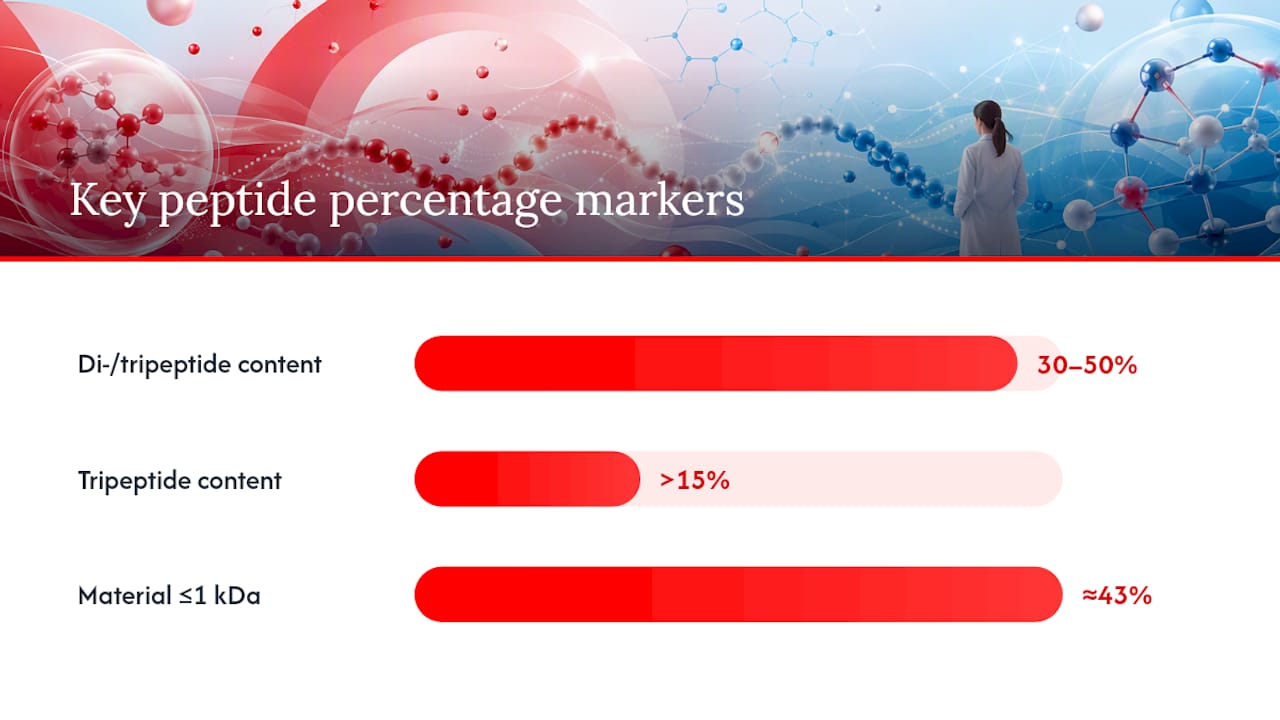
Patents in this space report specific target ranges rather than vague claims. WO2025061282A1 specifies a preferred average molecular weight of 200 to 800 Daltons alongside di-/tripeptide content around 30 to 50 weight percent, while the clinical trial testing LMWCP used a material with more than 15% tripeptides, including 3% Gly-Pro-Hyp specifically.
Measured markers, not marketing claims: the trial testing bioactive collagen peptides (BCP) at 5,000 mg per day reported a molecular-weight distribution where approximately 43% of the material sat at or below 1 kDa, a number that mapped directly onto the dermal density and hydration improvements the study measured over 12 weeks.
Validating these markers requires actual instrumentation, not a certificate of analysis with a single vague percentage. Liquid chromatography-mass spectrometry (LC-MS) identifies and quantifies specific peptide sequences. Size-exclusion chromatography (SEC) maps the full molecular-weight distribution rather than a single average. Standard Hyp assays confirm collagen-specific content versus non-collagen protein contamination. Any RCT working with a patented peptide material should report all three in its methods section, since a study using “collagen peptides” without a molecular-weight distribution attached is close to unreplicable.
Beverage-application patents add a second layer entirely: organoleptic metrics like transmittance and turbidity in aqueous solution, since a bioactive peptide that clouds a drink or leaves a bitter aftertaste won’t survive contact with an actual consumer, no matter how clean its molecular-weight profile looks on paper.
What the Clinical Trials Actually Show About Peptide Profile and Skin Outcomes
The strongest evidence in this category ties a specific tested material, at a specific dose, to specific measured outcomes, and the results genuinely differ depending on which profile was used.
Skin hydration improved measurably by weeks 6 and 12, with wrinkle depth and elasticity parameters improving significantly by the 12-week mark, and no adverse events tied to the test material.
A separate 12-week trial tested bioactive collagen peptides (BCP) at a higher dose, 5,000 mg per day, in a material with roughly 43% of its mass at or below 1 kDa and notably high hydroxyproline content. That study measured improvements in dermal density, hydration, and transepidermal water loss (TEWL), and unusually, the improvements largely held up through a four-week washout period after supplementation stopped.
A third trial used collagen peptide NS, containing Gly-Pro dipeptides specifically, at 1,650 mg per day for 12 weeks, and found improvements in hydration, elasticity, desquamation, and wrinkling that emerged at different timepoints across those separate endpoints rather than all at once.
Hydration tends to respond fastest, often showing measurable change within the first six weeks, while structural markers like elasticity and wrinkle depth generally take longer to shift, with most trials reporting significant changes closer to the eight- to twelve-week mark. That timeline difference isn’t a flaw in these studies. It reflects the actual biology of dermal remodeling, and it’s a reasonable expectation to set with anyone starting a clinically tested collagen regimen.
A few practical notes for anyone designing or interpreting a trial in this space:
- Dose ranges across successful trials vary substantially, from 1,000 mg to 5,000 mg per day, and the effective dose appears tied to the specific peptide profile rather than a universal number that applies across materials.
- The material actually tested in the RCT should be the material used in the finished product. Substituting a “similar” collagen peptide with a different molecular-weight distribution breaks the chain of evidence, even if both products are labeled “collagen peptides.”
- Sample sizes in this field run modest, typically 60 to 100 participants per trial, and profile heterogeneity between studies makes direct cross-trial comparison difficult without matched analytical reporting.
Absorption research helps explain why the profile-specific results make biological sense: specific dipeptides and tripeptides like Gly-Pro and Pro-Hyp have been detected intact in human blood within one to two hours of ingestion, and their presence correlates with fibroblast stimulation and increased dermal hyaluronic acid and collagen production. That’s the mechanistic thread connecting a patent’s molecular-weight claim to an actual clinical endpoint.
Regulatory Obligations for Marketing Collagen Peptides in Singapore
Singapore’s Health Sciences Authority does not pre-approve health supplements, including collagen peptide products, before they reach the market. That absence of pre-market review shifts the entire burden of proof onto the dealer, and it’s a distinction worth sitting with, because it means regulatory risk in this category is almost entirely self-managed rather than externally checked at the point of sale.
Under HSA’s health supplement framework, the company selling a product is responsible for its safety and must be able to substantiate any health claim with scientific evidence, specifically human studies or a documented scientific opinion, when HSA requests it. There is no grace period for scrambling to find evidence after a claim is already on the packaging.
- Confirm the claim type is permissible before writing it. Claims suggesting a product treats, prevents, or cures a disease are prohibited outright. Claims phrased around supporting or maintaining a normal function, such as “supports skin elasticity” or “helps maintain skin hydration,” fall within the acceptable structural/functional category.
- Match the evidence to the actual finished product. HSA guidance is explicit that generic literature on collagen peptides broadly is not sufficient to substantiate a claim about a specific formulation. The human study or scientific opinion needs to relate to the ingredient or finished product actually being sold, at a comparable dose and peptide profile.
- Check ingredient restrictions before formulating. Human-derived ingredients are not permitted in health supplements, which rules out certain sourcing routes regardless of any patent claim covering the process.
- Maintain quality documentation on file. HSA expects manufacturers and importers to hold records demonstrating product quality and safety, ready to produce on request rather than assembled reactively.
- Review labeling language against both categories. A single label claim that mixes a permissible structural claim with language implying disease treatment puts the entire product at risk, so legal or regulatory review of exact wording matters more than it might seem.
For any team bringing a patented peptide ingredient into a Singapore-marketed product, the practical move is treating the peptide-profile certificate and the clinical substantiation file as one linked package, not two separate compliance exercises.
Turning Patent-Backed Ingredients Into a Compliant, Sellable Product
Getting a low-molecular-weight, high-bioactivity peptide profile right on paper is only half the job. The other half is making it into something people will actually finish drinking, and doing the supplier and evidence work that keeps your claims defensible.
Low-molecular-weight peptide fractions, the ones enriched in di- and tripeptides that patents like WO2025061282A1 target, tend to carry more bitterness and a chalkier mouthfeel than larger, less bioactive fragments. Formulators typically manage this through flavor-masking systems, acid/sweetener balancing, or delivery matrices designed around the specific peptide’s taste profile, which is precisely why organoleptic thresholds show up inside composition patents rather than being treated as a separate cosmetic concern.
- Request a peptide-profile certificate and recent batch-to-batch consistency data from any supplier before committing to a formulation.
- Run a freedom-to-operate check against active composition and process claims relevant to your specific manufacturing route, not just the raw ingredient.
- Decide early whether you’ll rely on published ingredient-level RCT data or need a finished-product trial, since claim strength in Singapore depends on how closely the evidence matches what’s actually in the bottle.
- Track molecular-weight distribution and di-/tripeptide percentage at every production scale-up, since a process that behaves consistently at pilot scale can drift once it moves to full commercial volume.
Pro Tip: If you’re relying on published clinical data rather than running your own trial, keep a written comparison of your ingredient’s peptide-profile certificate against the tested material’s published parameters. Regulators and skeptical customers alike will ask for exactly that comparison, and having it ready is far better than assembling it under pressure.
How From Within Applies This Thinking to Product Development
Patented peptide science only matters if it shows up honestly on the product page, not just in a patent filing somewhere. That’s the standard Fromwithin holds its own formulation work to. The brand’s patented Wellnex® peptides are engineered for direct bloodstream absorption, built on the same logic this article has walked through: a defined, reproducible peptide profile matters more than a vague “collagen” label.
Every ingredient in the product lineup is clearly named and clinically researched, manufactured in certified facilities so the peptide profile a customer reads about is the one actually inside the bottle. That’s the same standard this article has argued for throughout: request the certificate, match the evidence to the product, and treat vague sourcing claims with real skepticism. Readers evaluating any patented peptide ingredient, from Fromwithin or elsewhere, should expect nothing less than that level of ingredient transparency and documentation before trusting a skin-health claim.
Where the Science Goes Next
R&D in this space is converging on two priorities: pushing di-/tripeptide enrichment higher without sacrificing beverage clarity, and running trials matched precisely to the commercial material rather than to “collagen peptides” as a generic category. Expect more patents pairing molecular-weight targets with organoleptic specifications, since that combination solves the biggest commercial bottleneck low-molecular-weight peptides have faced.
For researchers and regulatory teams, the practical priority is standardizing how peptide-profile data gets reported, so a 200 to 800 Dalton composition patent and a clinical trial testing a different but overlapping profile can actually be compared side by side. Right now, too much of the field’s real progress gets lost in inconsistent reporting formats. Cross-study comparability isn’t a minor technical fix. It’s the thing standing between where this field is now and where its evidence base could actually be in five years.
— From
See What Patent-Backed Peptide Thinking Looks Like on the Shelf
Fromwithin’s approach gives you a concrete way to see this article’s principles applied rather than just described. The Collagen Peptides Glow Booster uses patented Wellnex® peptides built for direct bloodstream absorption, positioned around the same clinical transparency this guide has been pushing you to demand from any supplier: clearly named ingredients, manufacturing in certified facilities, and a peptide profile you can actually ask questions about.

If evening wind-down is your other pressure point, the Sleep Better – Liquid Calm & Deep Sleep Support formula takes the same transparent, evidence-first approach without melatonin or hormonal ingredients. Browse the full product catalog to compare ingredient pages side by side, and request the documentation you’d want from any patented peptide supplier, certificates included, before adding anything to your routine.
Primary Sources and Documents Worth Bookmarking
The claims in this article trace back to a specific set of patent filings, clinical trials, and regulatory guidance worth keeping on hand for further review.
- How Health Supplements Are Regulated by HSA
- Health Supplements: Claims (HSA)
- Oral Intake of Low-Molecular-Weight Collagen Peptide Improves Hydration, Elasticity, and Wrinkling
- The Sustained Effects of Bioactive Collagen Peptides on Skin Health
- Oral Intake of Collagen Peptide NS Improves Hydration, Elasticity, Desquamation, and Wrinkling
- WO2021089243A1 (Gelita) Patent Record
- WO2025061282A1 (Tessenderlo Group NV) Patent Record
- Collagen Peptide Production by Enzymatic Hydrolysis: Patent Landscape
This article is general information, not a substitute for advice from a qualified doctor. Consult a qualified healthcare professional about your own circumstances before acting on anything here.
Sources
- How health supplements are regulated by HSA
- Oral intake of low-molecular-weight collagen peptide improves hydration, elasticity, and wrinkling in human skin
- The sustained effects of bioactive collagen peptides on skin health
- WO2025061282A1 - Low average molecular weight collagen peptides composition
FAQ
What’s the downside of taking collagen peptides?
Most clinical trials report no adverse events tied to the test material itself, even at doses up to 5,000 mg per day in the BCP trial. The realistic downsides are mild digestive discomfort in sensitive individuals, cost relative to benefit if you choose an unproven generic material, and the risk of buying a product whose peptide profile doesn’t match what was actually tested in research.
Which brand is best for collagen peptides?
The honest answer depends on whether the brand can actually document its peptide profile, molecular-weight distribution, and sourcing, rather than relying on the word “collagen” alone. Fromwithin’s Collagen Peptides Glow Booster is built around patented Wellnex® peptides with clearly named, clinically researched ingredients manufactured in certified facilities, which is the transparency standard worth applying to any brand you’re evaluating.
Can I take a collagen supplement with citalopram?
There’s no established interaction between collagen peptides and citalopram or other SSRIs in the clinical literature reviewed here, since collagen peptide trials generally test the ingredient as a standalone nutritional supplement rather than alongside prescription antidepressants. That said, anyone on citalopram or another prescription medication should check with their prescribing doctor or pharmacist before adding any new supplement, since individual interaction risks aren’t something a general article can rule out.
What is the best collagen brand in Singapore?
Under HSA’s framework, there’s no government-approved “best” list, since supplements aren’t pre-approved before sale, which means the responsibility for choosing well falls on the buyer checking ingredient transparency and evidence directly. Look for a brand that names its exact peptide material, discloses molecular-weight and di-/tripeptide data, and can point to human clinical evidence for the specific formulation, standards Fromwithin’s collagen and sleep support lines are built around.
How long does it take to see results from collagen peptides?
Hydration tends to improve first, often within six weeks, while structural changes like elasticity and wrinkle depth typically take eight to twelve weeks to become measurable, based on the LMWCP trial timeline. Results depend heavily on matching the dose and peptide profile to what was actually studied, which is why generic collagen powders without documented profiles produce such inconsistent real-world outcomes.
